

Upgrading to a larger, more aggressive set of wheels and tires is one of the first modifications most truck owners make. But if you drive a 2003 to 2026 Chevrolet or GMC, getting your speedometer and vehicle computers to play nicely with that new rubber isn’t always simple.
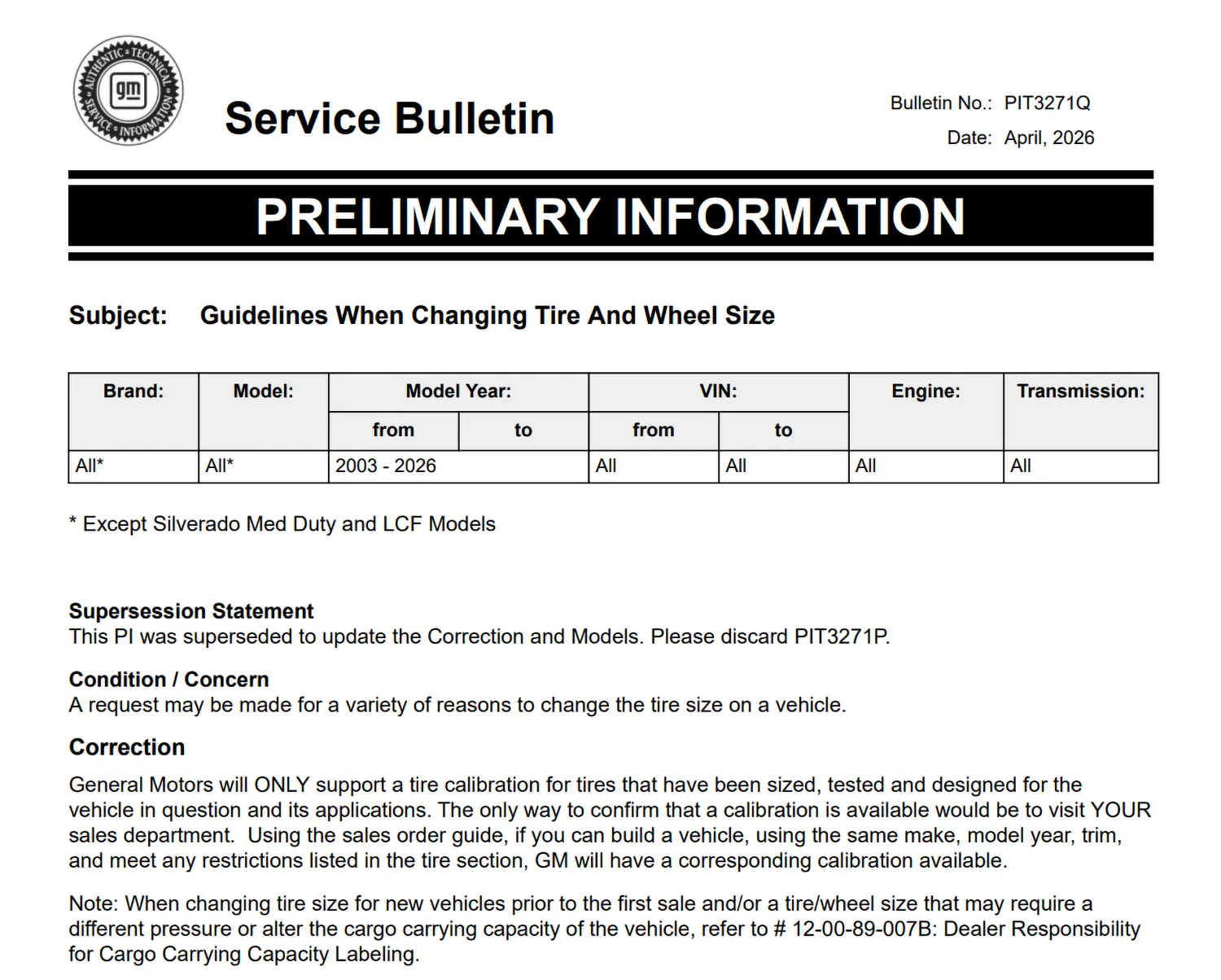
General Motors recently updated service bulletin PIT3271Q, which clarifies the automaker’s official stance on tire size changes. The bulletin outlines exactly when dealerships are allowed to recalibrate your truck for a new tire size, and their strict rules might throw a wrench into your build plans.
The Factory Build Rule
According to the bulletin, GM will only support a tire calibration for sizes that were specifically tested and designed for your exact vehicle application. Dealerships cannot simply plug in any tire dimension you want.
To determine if a factory calibration is available, the service department has to look at the GM sales order guide. If your specific make, model year, and trim level could have been built from the factory with the tire size you want to install, GM will have a corresponding software calibration available. If that tire size was not a factory option for your exact trim, you are out of luck.
For example, if you own a 2019 Chevrolet Silverado 1500 1WT Regular Cab that came with 255/70/R17 tires, and you buy a set of take-off 275/60/R20 wheels from a Silverado 1CX Double Cab, GM will not offer a calibration. Because the 1WT trim was only ever offered with 17-inch tires, the factory software simply does not exist for that swap. The exact same rules apply whether you drive a mid-size Colorado or a full-size GMC Sierra or GMC Sierra 1500.
Rooted in Engineering and Safety
While this strict policy can be frustrating for enthusiasts, it is rooted in solid engineering principles. Altering a vehicle’s tire size, weight, or load rating changes the fundamental physics of how that truck drives and reacts.
Tire swaps are not just about fender clearance. Changing the overall diameter or moving to a heavier E-rated mud-terrain tire directly impacts braking distances, suspension geometry, and the center of gravity. More importantly, modern trucks rely heavily on precision data for systems like Anti-lock Brakes (ABS) and StabiliTrak (Electronic Stability Control). If the computer does not know the exact size and rotational mass of the tires, those critical safety systems cannot react properly during an emergency maneuver. GM’s policy ensures they are not legally or mechanically liable for a truck operating outside of its tested safety parameters.
The Dealership Reality Check
Even if your planned wheel and tire swap perfectly aligns with the factory order guide, that does not guarantee your local service department will help you.
Dealerships are independently operated franchises. Many service managers are heavily risk-averse and may simply refuse to perform custom calibration work to avoid any potential liability. Furthermore, GM explicitly states that tire recalibration is an elective modification and is not covered under the manufacturer’s warranty. Finding a technician willing to take on the configuration work—and paying their hourly labor rate to do it—can often be an uphill battle.
Your Best Bet: Aftermarket Tuning Devices
If you want to run larger tires without fighting the dealership, your best bet is to bypass the factory limitations entirely.
The aftermarket is full of high-quality tuning devices and inline speedometer calibrators designed specifically for GM trucks. These devices allow you to manually input your exact new tire size, which instantly corrects your speedometer, adjusts your transmission shift points to match the new rotational mass, and keeps your ABS sensors happy. It is a faster, easier, and often more reliable way to ensure your truck drives exactly the way it should after a major tire upgrade.
Before you buy that new set of tires, head over to the GM-Trucks.com forums. If you drive a newer half-ton, our dedicated 2019-2026 Silverado 1500 & Sierra 1500 forum is packed with owners sharing exactly which aftermarket tuning devices and tire combinations work best.

Zane Merva is the Executive Editor of GM-Trucks.com and the President of the New England Motor Press Association (NEMPA). A veteran automotive journalist with over 26 years of experience, Zane is a designated ‘Car Talk’ Expert and has been a contributor to The Boston Globe. He possesses a unique evaluative perspective, having road-tested more than 2,000 vehicles across every major manufacturer. While he is a recognized authority on General Motors truck platforms—including the Silverado, Sierra, and Colorado—his expertise is grounded in decades of deep competitive analysis that few in the industry can match. His commentary has been featured by major OEMs and media outlets, including Hyundai and PR Newswire