
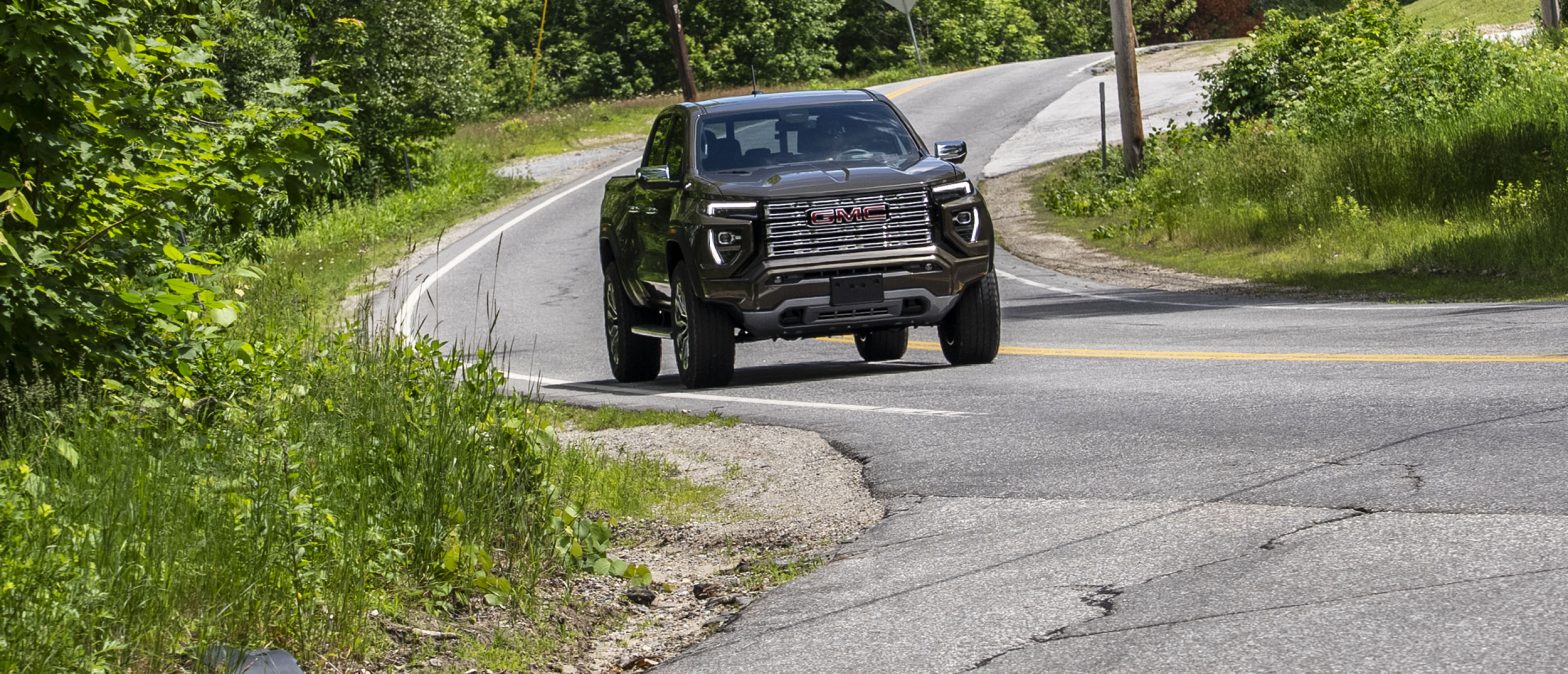
If you own a third-generation Chevrolet Colorado or GMC Canyon and have noticed your coolant levels dropping, you aren’t alone. After months of owners discussing the issue on forums and social media, General Motors has officially released a Technical Service Bulletin (TSB) addressing a known coolant leak affecting the 2023 through 2026 Chevrolet Colorado and GMC Canyon.
Having this issue? Join our official community discussion for this TSB here.
Bulletin PIT6494, released in March 2026, finally gives dealership technicians official guidance on how to identify and repair a frustrating leak at the upper radiator inlet hose.

The Problem: A Degraded Seal, Not a Busted Radiator
According to the bulletin, some owners might notice a visible coolant leak or a low coolant level at the overflow reservoir. You might also get a Malfunction Indicator Lamp (MIL) illuminated in your Driver Information Center.
If you scan your truck, you might find DTC P3075 (Engine Coolant Flow Too Low) stored in the Engine Control Module.
The good news? The issue isn’t a catastrophic radiator failure. The bulletin states that the condition is caused by a degraded seal inside the upper radiator hose quick-connect fitting. Technicians are instructed that seal wear can present with varying levels of residue or buildup, which is a sign of seal degradation, not a defective radiator.
The Fix: A Clean Swap
To fix the issue, technicians are instructed to drain the cooling system and remove the radiator inlet hose. GM stresses that technicians must clean the radiator spigot with a lint-free cloth to ensure the surface is completely smooth and free of contaminants before installing the new hose. Interestingly, the bulletin specifically warns technicians not to use any lubricants, grease, or detergents when installing the new hose.
According to the bulletin, this repair is covered under GM’s Powertrain warranty coverage.

The Real-World Catch: Parts Availability
While an official fix is great news, the community reaction highlights a major sticking point: getting your hands on the replacement parts.
Over in the 2023+ Chevy Colorado / GMC Canyon Owners Facebook group, the release of this TSB brought a mix of relief and frustration.
“Is this the first TSB for this issue?” asked Brent M., who experienced the leak on his 2023 model back in November. “That is wild that it took them this long.” Fortunately for Brent M., his dealer had the hose in stock and replaced it the same day under his bumper-to-bumper warranty.
Michael S., whose 2023 Z71 recently went in for the same issue, was relieved to finally have official documentation. “I am glad the TSB came out and has been posted. I printed it out and will give it to the service writer to describe my truck’s issues.”
However, not everyone is getting in and out of the service bay so easily. GM seems acutely aware of supply chain constraints for this specific part. The bulletin includes a special note instructing dealers to upgrade part orders to a “SPAC Case” immediately if they don’t have sufficient inventory of the radiator inlet hose.
That shortage is already hitting owners hard. Group member Ciarán Joseph C. reported being told it could be a “couple of weeks or even months” for the parts to arrive. Meanwhile, Shemick M. currently has his truck in the shop, noting that the “parts are on backorder.”
(Note: If you are out of warranty or want to tackle this yourself, group All-Star contributor Brian M. noted that the replacement hose, part number 86518091, has been spotted for sale on eBay).
If you are dealing with a mysterious coolant loss or a P3075 code on your 2023-2026 Colorado, Canyon, Colorado ZR2, or Canyon AT4X, it’s time to call your dealer and reference Bulletin PIT6494. Just be prepared: you might be waiting a little while for the replacement hose to arrive.
Join the Discussion
Are you dealing with the P3075 coolant leak or waiting on backordered parts? Head over to the 2023+ Colorado & Canyon 3rd Gen Forum on GM-Trucks.com to share your experience and connect with other owners!

Zane Merva is the Executive Editor of GM-Trucks.com and the President of the New England Motor Press Association (NEMPA). A veteran automotive journalist with over 26 years of experience, Zane is a designated ‘Car Talk’ Expert and has been a contributor to The Boston Globe. He possesses a unique evaluative perspective, having road-tested more than 2,000 vehicles across every major manufacturer. While he is a recognized authority on General Motors truck platforms—including the Silverado, Sierra, and Colorado—his expertise is grounded in decades of deep competitive analysis that few in the industry can match. His commentary has been featured by major OEMs and media outlets, including Hyundai and PR Newswire