


BG710
-
Posts
8 -
Joined
-
Last visited
BG710's Achievements

Enthusiast (2/11)
4
Reputation
-
ATTENTION anyone with oil pressure issues
BG710 replied to curtmerci's topic in 1999-2013 Silverado 1500 & Sierra 1500
I replaced the oil pressure sending unit on my 2001 Silverado 5.3 (no screens on the older GMT800s btw) not because I wasn't getting oil pressure readings, but because the readings I were getting were way too high. It would jump all over the high side of the gauge even spiking above 80. Seems to read much better with the new sensor. Truck does have rather high oil pressure though, much higher than my old 1999 with the 4.8. Not sure if it's normal or not but it's frequently over 60 whereas my 99 with the 4.8 would almost always sit right around the middle. I know it's not overfilled, and I've changed the oil twice since I bought it. Internal sludge maybe? Thing is, truck actually has a really good maintenance history. I seem to have a leak from my rear main seal so that's always fun. Still great pressure though! -
Another update. Following this repair I was still having issues. The AC would work great, but occasionally would stop working entirely or would get quite cold and have trouble maintaining temperature. Based on all my symptoms, I crafted a new theory. I don't actually think my system was low on refrigerant until I checked it when problems first occurred, I think it was at that point that the service port valve failed and leaked out all my refrigerant. The cooling fan clutch did need replacement, but it had still been working enough to keep the engine and AC cool when I bought it. Thus, based on the symptoms, I began to think the root of my initial issues was the AC cycling switch. I spoke to an AC specialist about it who told me that it's not so common for the switch itself to fail, but that the original pigtail connectors are prone to failure. Sure enough when I jiggled the connector a bit the compressor turned back on and I had cold air again. I decided to order both a replacement pigtail connector as well as a new cycling switch. While it is possible I could get away with just the pigtail, based on the one experience of having the compressor repeatedly cycle on and off, and the system having difficulty maintaining temperature even after fiddling with the old pigtail connector, I decided it was probably best to replace both since those two symptoms are not necessarily indicative of just a bad connection. The cycling switch is attached to a schrader valve so it can be removed and replaced without losing much refrigerant or PAG oil. AC is working great again now. I think I've got all the issues tracked down for now.
-
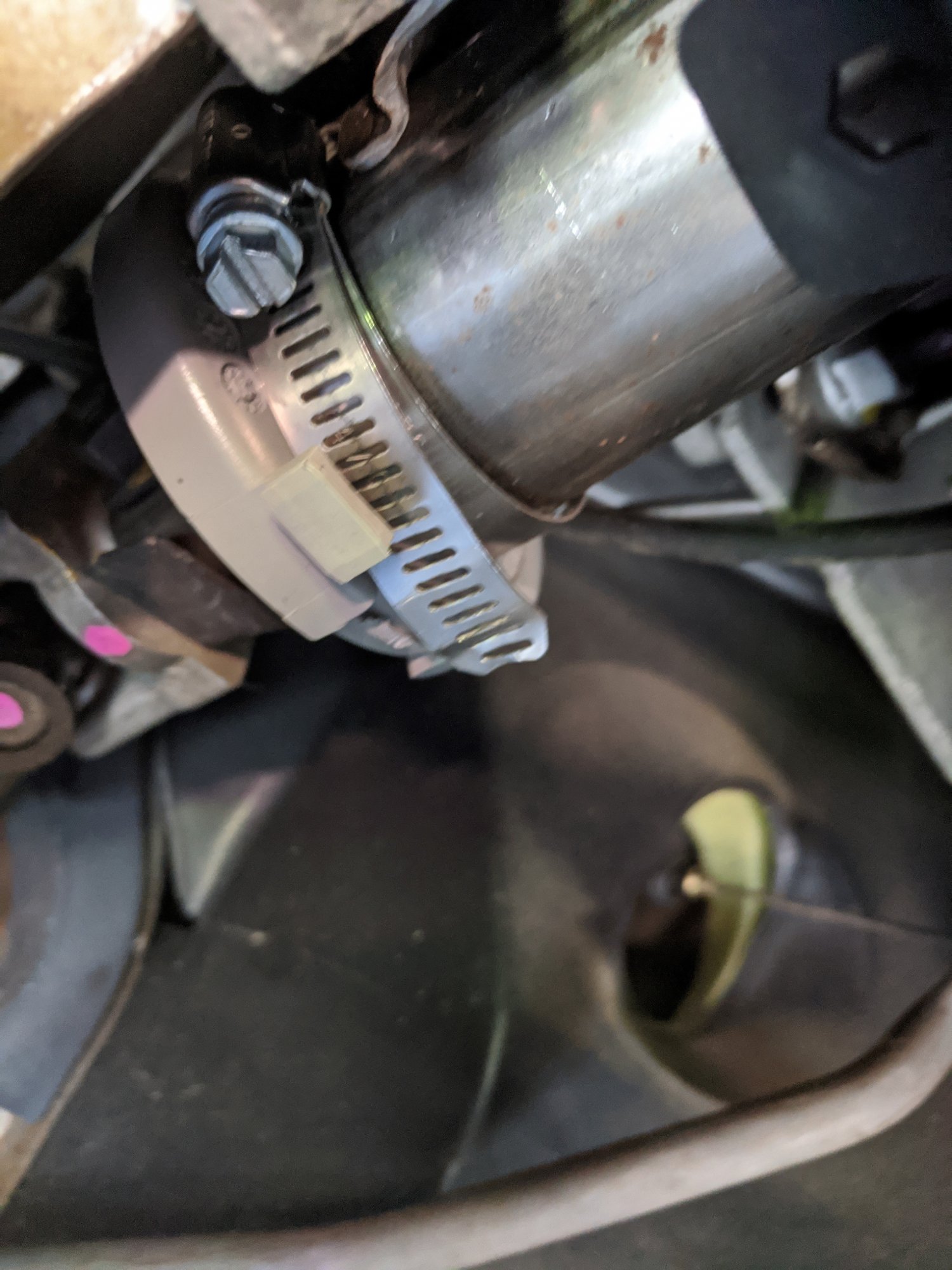
Many of those with a GMT800 may be familiar with the characteristic clunk that can develop when the intermediate steering shaft and/or steering bearing are worn out. It feels like your whole front end is going to fall off, but it's really the result of some rather minor play as the shaft rapidly shifts back and forth. If your steering bearing is worn you can reproduce the sound by simply grabbing the steering shaft in the engine bay and shaking it from side to side. Both parts have been redesigned by GM (twice in the case of the intermediate steering shaft). After experiencing it on my 2001 Silverado I've done a lot of research on the replacement parts and repairs, as well as spent quite a bit of time reading the experiences of others. My understanding of the issue is as follows. The OE intermediate steering shaft is prone to poor lubrication. At low speeds this can make the wheel difficult to turn and produces a creaking/squeaking noise. A worn intermediate steering shaft can produce rattle but Most report that while replacing the shaft with an updated model will alleviate the creaking and turning resistance, most of the time to alleviate clunking it requires replacing the steering bearing, however Some report that the new steering bearing will only temporarily alleviate the problem and the clunk returns in a few weeks, months, or years. I was about ready to order an updated intermediate steering shaft and steering bearing when I read an Amazon comment mentioning the issue returning and the fix being to apply a hose or exhaust clamp to the bearing. After Googling, I stumbled upon a thread from another forum. https://www.gmfullsize.com/threads/how-to-gm-steering-column-rattling-fix.290566/ I decided to give it a shot. And it works! It won't fix the creaking and resistance of the intermediate steering shaft since that is a lubrication issue, but the shaft no longer rattles and the steering bearing is now tight and can't be rotated by hand. Truck doesn't feel like it's going to fall apart going over bumps anymore. I'll still have to replace my intermediate steering shaft at some point, and while I'm at it I might as well replace the bearing as well, but I figured I'd share the information for anybody who might be struggling with this either pre or post bearing replacement. The hose clamp I used was cheapo and just what I had lying around. If you attempt this I'd probably recommend using a clamp with a hex nut on it for longevity and easy tightening + removal. Anyway, hope this could help somebody. Credit to those who have discovered this before. I've attached a photo of what it looks like after install.

-
Update: Turned out to be a combination of a couple things. 1) System was low on actual refrigerant, meaning the system was likely just compressing air which explained my high pressure readings. 2) Leak from one of the service ports. Both low and high side got replaced according to the shop. 3) Cooling fan clutch had not failed, but was on its way out. The fan would still turn on but which was what threw me off, but with a new clutch it definitely moves WAY more air. Explains why I wasn't getting as effective cooling around town or when stopped. Sounds like a jet at low speeds too. Definitely notice worse throttle response and power now, so I'm thinking about possibly doing an electric fan conversion in the future. That will probably wait a while though. Anyway, I'm happy to have nice cool AC again.
-
Purchased this truck maybe a month ago, when I bought it the AC worked pretty well. After a few weeks it gradually felt like the air was getting hotter, but still seemed cool enough once I got on the highway and up to speed. It did seem to take quite a while to get there though. Thinking it might be low on refrigerant, I hooked up a pressure gauge and saw that if anything, it was actually a bit overfilled. I decided to keep my eye on it. Today it started off semi-cool, then became hot within a 25 minute drive. I could also hear the compressor cycling on and off every few seconds. I put the AC on max on the way home, put a pressure gauge on, reading extremely high. When I disconnected the gauge the port hissed for a while afterwards. It's at this point I'm certain I have a problem. I've dealt with AC troubles on a GMT800 before. I had a 1999 Chevy Silverado where the compressor failed and sharted metal into the whole system, every place I went quoted me a full rebuild of the system for $1000-$1300. Ended up selling the truck before it ever got fixed. Metal contamination sucks. I'm hopeful this isn't the same situation. I have caught it much earlier than on my previous truck, so I'm optimistic. I have maintenance records for the truck going back to about 130k (currently sitting at about 203k), and while most parts of the truck were very well taken care of, I don't see any records regarding the AC system. I plan to take the truck to an AC specialist for a proper diagnosis, but I like to know what's going on with my own vehicle (do most maintenance and repairs myself. Hopeful somebody on here might have some insight. Looking around, there seem to be a few things that could be happening. 1) Compressor failure. According to Carfax it's one of the most common mechanical failures on this year and model of truck. May or may not be accompanied by metal contamination of the whole system. 2) Clog somewhere in the system, possibly repairable by a flush and recharge. 3) Fan failure. This doesn't seem to be my issue as the fan and clutch are operating fine, and wouldn't explain why there's hot air now even on the highway. 4) Thermostat failure. 5) Air may be in the system. 6) Blend door failure. I hear no clunking from the dash and air distribution was fine before, so I see this as a bit less likely. If anybody has other potential causes or has experienced this issue and resolved it, would appreciate hearing what the issue was. Thanks for reading. Like I said, plan to take it to a specialist, but want to be as informed as possible beforehand. (Worth noting that I have recently changed out the cabin air filter, so doubtful there's an issue there) Edit: Check replies for updates.

-
Forum Statistics
250.4k
Total Topics2.7m
Total Posts -
Member Statistics
342,837
Total Members8,960
Most Online
-
Who's Online 5 Members, 1 Anonymous, 1,108 Guests (See full list)