


ktuck
-
Posts
43 -
Joined
-
Last visited
Content Type
Profiles
Forums
Gallery
Events
Articles
RPO
Store
Blogs
Everything posted by ktuck
-
I believe that is correct, one bad injector and the HPFP. I made things difficult when I installed ebay injectors early on. That brought about the perpetual misfires which seemed to bounce around among the cylinders. During the pursuit of those misfires, a few more non-OEM parts (O2, MAF sensors and spark plugs), just made matters worse. After replacing the wires and moving coils and plugs around between cylinders, if I had simply sent the injectors out for testing, the solution would have revealed itself much quicker I believe. I do believe it odd that two different components failed at approximately the same time, but it can happen as I found out. My general lack of technical knowledge in interpreting fuel trim data and going the cheap route with non-OEM parts played the biggest role in why this ordeal extended out so long. I take some consolation in the fact that I have learned a great deal about OBD2 diagnostic procedures from this challenging experience.
-
Yes, I had seen this list of TSBs. I had followed the ones pertaining to the 5.3 and found none that were rubbing, chafing or pinched or open wires. Focusing on the P16E5 code, there are about 5 things listed as likely causes. I tried or eliminated each of them, including replacing the fuel rail pressure sensor(simply because it was cheaper!). Finally the only one I hadn't tried was the fuel pump. After installing the HPFP from my neighbor's Tahoe, everything was better. All codes gone, it's out of limp mode, MIL is out and most importantly the engine runs perfectly! After driving it for about 100 miles now, the misfire counter shows zero misfires on all 8 cylinders, 02 data looks good and fuel trims have balanced out quite a bit. After 114 days, I have my truck back! I want to thank you and others on this forum for your help in tracking down this most challenging drivability issue!
-
Here are a couple pics of the area around the fuel rail sensor and the HPFP. I have literally searched the harness and connectors with great detail...not only the wires and connectors that were disturbed when replacing the injectors but the rest of the harness as well. Everything looks pristine. My neighbor has an engine he took out of his Tahoe which is the same engine as mine. It ran perfect with no codes or anything, just had some bottom end noise. I am going to switch out the HPFP from his engine to try in mine. Nothing left to lose really and won't cost me anything but my time. Ohms test on the bank 1 injector harness wires was good as was signal voltage. I don't know if I can test for limp mode with the just having the pump installed and all connectors secure, or if I will need to put the intake back on so I can run the engine. I will check it with the key on, engine off just to see. If no luck with this, I pretty much will be ready to give up and will likely take it to the Chevy dealer this coming week.

-
Thanks for providing me with the circuit testing procedures. That helps me out a good bit since I do not have a current subscription to any technical manuals. Would it be a safe assumption that I should first focus on the P16E5 code as it may be what's also triggering the 3 P0200 series codes? I have checked all fuses and no problems found there. I also have disconnected the battery a couple different times hoping for some kind of reset, but to no avail. I do not have a schematic to isolate which wire or pin is which so I can perform the circuit tests such as the high and low control circuit testing resistance and voltage to ground testing. How can I know which wire to test? Also, I assume I'll need to remove the intake to test the Q17 fuel injector harness connector? Since these codes have never appeared before on this vehicle, I am pretty well convinced it has showed up due to me touching or moving something. It would seem like a wire or connector somewhere is stripped, broken, stretched or disconnected. The challenge I have is finding it! This truck has really kicked my butt to the moon and back. This has become the most extended diagnosis I have ever been involved in and that is mostly my own doing I have to say. Thanks again for your advice and insights into my problems with this Silverado, I appreciate it very much!
-
Another thing I see on my scanner...it shows the fuel rail pressure sensors (both 1 and 2) reading 95057.74 psi. Is this perhaps a result of limp mode status? No way the injectors can handle that kind of pressure. Whatever it is, it has affected all of the left bank except cyl 1, that seems odd to me. The new OEM injector is in the 7 hole and all the other injectors were recently tested and passed by an outside facility.
-
I received my new OEM injector today and with high expectations, I installed it. Unfortunately, I cannot tell if the misfire problem is corrected because somehow, I have introduced yet a new problem I have not had before. Apparently, the truck is in limp mode or something. The DIC is stating "engine power is reduced." It is staying in open loop and the idle is quite rough, much worse than when I had the misfires going on. When I rev it above about 900 rpm, it smooths out very nice. Also. 4 new codes have appeared that I have never seen before: P0202, P0205, P0207, and P16E5. I have gone back and double checked everything, especially harness connectors on cylinders 3,5 and 7 and all looks okay. I don't know if the P16E5 relates to the first 3 codes or not. I haven't had chance to look them up yet, I just came in when it got dark. I did attempt to collect some scanner data. One thing I noticed on the scanner, was that cylinder 3, 5, and 7 injector control circuit status does not alternate between "Not Run" and "OK" as the other five cylinders do. Maybe that is a hint, I don't know. Perhaps some of you all have some insight on this for me. The only other factor I might mention, don't think it would matter really, but I had the battery disconnected the entire time I had the injectors sent out for testing and I was in WV. Probably around 12 or 13 days, I think. I generally believe when something like this appears that wasn't doing it before, it is linked to the current work/repair. For the life of me, I can't think of what it might be. I was basically removing the intake, fuel rails and injectors, nothing else. If this is limp mode, is there a way to take it out of limp mode or is it locked in until the condition is corrected?
-
I received my injectors back from Injector Experts in Risingsun Ohio. One injector failed their test, and they recommended replacement. They sent me a 3-page document on the all the various testing procedures they did for each injector. It was a most comprehensive test procedure I could tell. Keith Brewer runs the business and I highly recommend him. He spent a good deal of time with me on the phone explaining each test procedure they do, and the necessity of certain tests conducted on GDI injectors. He told me when I receive the injectors back in the mail, to call him and he would explain the results of the tests, especially the one that failed. For GDI injectors, the cost is $25 for each injector which I think is a fair price. The question I had to ask him was did he think the nature of the failed injector was such that it would be noticeable as a misfire under light to moderate load, and he said without a doubt. He said replacing it with a good injector will guarantee the engine will run much better regardless of any other existing issues. The 8 injectors I sent him, were all of the original injectors, I wasn't going to waste my time or his on testing the ebay knockoffs. I have a new OEM injector on order and hope to receive it by tomorrow or Monday. Fingers crossed.
-
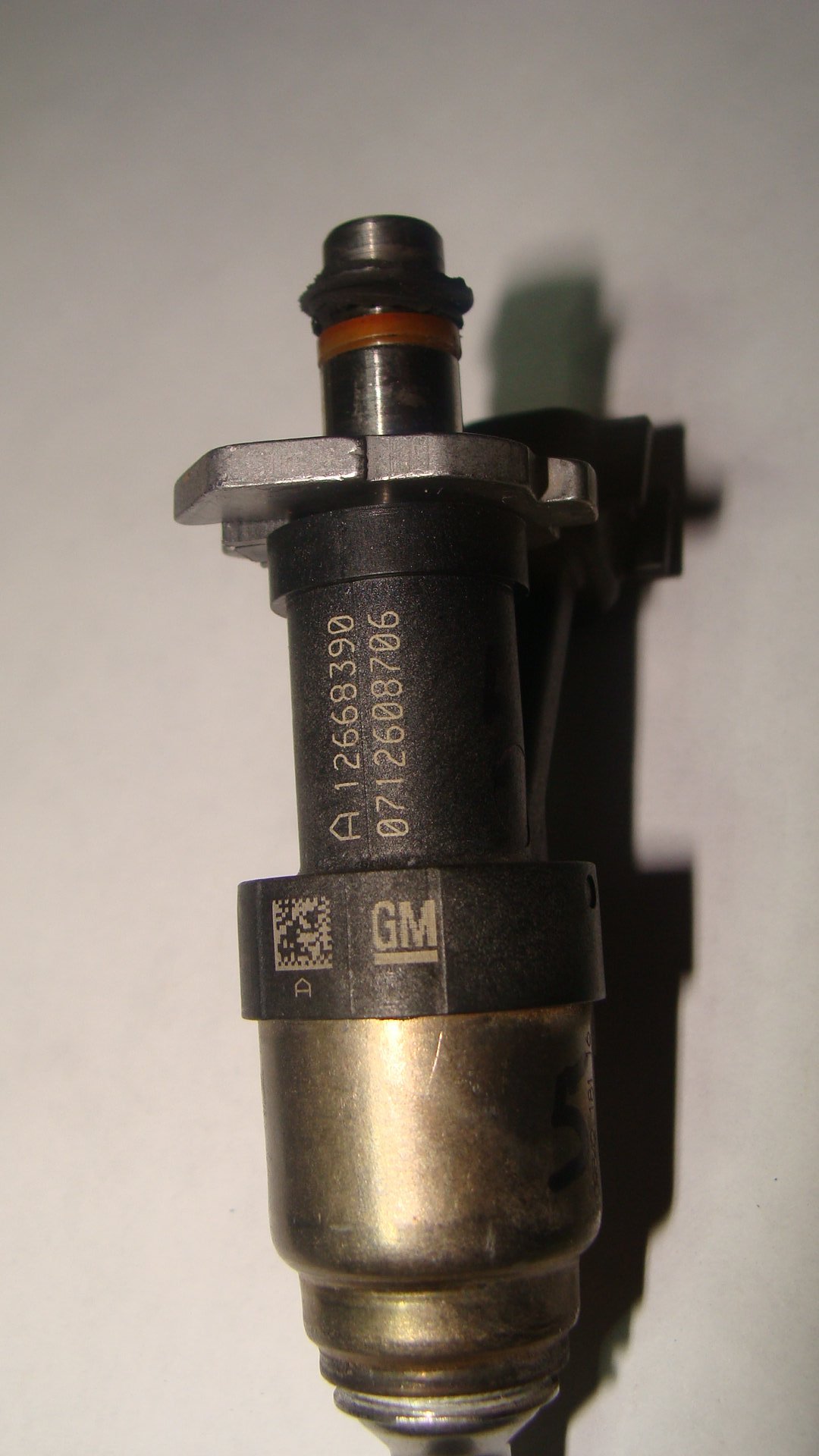
Yes, there certainly appears to be some inconsistencies with the fonts, numbers, etc, but I think the primary red flag on these injectors is the very low price compared to dealers and other jobbers. I think the old saying, "if it seems too good to be true, it probably isn't" applies here. Selling 8 "OEM" injectors at a cost just slightly higher than one normally costs, is not normal. But due to being on a tight, fixed income, I fell for it. Now I'm spending more than if I had just bought genuine GM parts to begin with. It is possible that introducing counterfeit parts (plugs, wires, sensors, and injectors) may be most if not all of my drivability problems. I anxiously await the results of the injector testing.
-
I went back and reviewed the fuel system diagnosis procedures and found that I was calculating the injector balance testing incorrectly. The procedure says to compare cylinders on each bank, not from one bank to the other. With that in mind, I went back and recalculated my most recent test and it showed three failing cylinders (1,2,3) compared to six the previously way I did it (1,4,5,6,7,8). It is interesting that 5 of those 6 did not fail when I conducted the testing properly. Only cylinder 1 failed both ways and more significantly, cylinder 2, as the primary misfire offender, did in fact fail this latter test. I couldn't help but notice that the average psi pressure drop was much lower on bank 1 (36.75) compared to bank 2 (56.75). Even with the somewhat improved negative fuel trim numbers, it still seems that the right bank is over fueling. I wonder if it could have something to do with the location of the fuel rail pressure sensor...I think it is on the left fuel rail if I recall correctly? At any rate, my neighbor has agreed to let me hook up my Autel scan tool to his 2015 Tahoe 5.3L to run some test data. I have often found that observing what normal looks like helps me isolate problems better. His Tahoe runs well and has no current codes or drivability issues. He has the same L83 engine with GDI injection. Meanwhile, I have sent my original injectors out for testing. I hope to have them back by next week sometime. I agree the OEM injectors will be my baseline. The ebay injectors are either counterfeit or not. I'm not going to worry about that now and just remove them from the equation altogether. All the other parts I have replaced so far are OEM and will do so with the injectors if the outside testing reveals any that fail. At this point, I personally am not sure the scan tool fuel injector test is reliable test procedure. My results so far have been inconclusive.
-
I drove it about 75 miles this evening. The misfiring remained steady on #2 and here and there on 1, 5, 6 and 7. I ran another injector balance test and all but #2 and #3 failed. Doesn't it seem odd that the cylinder that is steadily misfiring continues to pass injector balance tests? O2 sensor data looked normal but there was a noticeable improvement in LTFT on each bank. I noticed at idle, bank 1 LTFT was about 4 (first time it has been a positive reading since all this started) and bank 2 about -11. However, each time I accelerated to 2K, bank 1 went to -4 to -6 and bank 2 went to -18. The last time I ran the engine, LTFT trims were pretty steady at -23 on bank 1 and -34 on bank 2. So, both of these have improved by driving it even though the misfire and engine light is staying on steady. Maybe the computer has adjusted somewhat for the fuel trims issue. It did throw the P219A code again for some reason and activated the MIL along with P0300. the last time I had the intake off, I switched injectors around in various cylinders. I used 4 of the original injectors that came out of cylinders that were firing well and moved 4 of the best firing ebay injectors into the other 4 cylinders. Unfortunately, I did not write down which ones went in what cylinder, but I did mark each injector as to its origin so when I take it back apart, I will know which ones are which. I have this feeling the 4 ebay injectors may be in the cylinders that are showing the most misfires now (1, 2, 3, 5,). Here are the historical misfires as of tonight: 1 574 2 1828 3 530 4 16 5 86 6 339 7 143 8 20 If it isn't raining tomorrow, (yeah, I have to work on it outside in the driveway), I'll be pulling the injectors out again.
-
I think that may be a good idea, after all I haven't run it very long for the computer to process all the new data its receiving and adjust to it. I have nothing to lose at this point, and if the codes and misfiring remains, I am prepared to send my original factory injectors off for testing. I have found a place in Ohio I plan to send them to. If I am correct, these are GDI injectors? Correct me if I'm wrong because they indicate on their website there is a different process involved in testing GDI injectors from port fuel injectors. I'm kinda thinking my original injectors weren't bad to begin with. I was just taking a shot in the dark at that point, and it seems the issue intensified following that. The problem went from intermittent to full time.
-
Yeah, I hadn't notice that, but you are right. Also, if you look at the numeral "1", the factory injector has simply a straight line going down to the bottom, while the fake one has horizontal base at the bottom of the number. I too wonder how they can make money off counterfeiting these because surely it takes a certain amount of time and expense to make a duplicate that looks this close to the original, then they sell a set of 8 for just a tad more than one normally costs. Anyway, my great hope is that this ends up being the source of my misfire problems.
-
Yes, I must that due to the cost savings, I unknowingly fell for the $140 set of 8 "GM" injectors. Below I posted a pic of one of my original injectors and then one of the ebay specials. On the original factory injector, it is clear the font height of the letter A is above that of the part number that follows, on the ebay injector the height of the A is even with the height of the part number. Also, the number on the second line below, is the same on all of the ebay injectors (0615606065). Whereas on the original factory injectors, that number on the second line is different on each of them. I don't know if that means anything or not. You were the first person to enlighten me about fake aftermarket injectors and since I've had others tell me the same thing. At this point, I am considering sending all 8 of the original factory injectors off for testing, and then only replacing those that fail the test. As I recall, nothing improved when I installed the first set of "GM" injectors and it seems that the misfiring went from intermittent to constant all the time. Before that, I recall driving the truck for perhaps several days and maybe a few hundred miles between misfire flare ups. That hasn't been the case since, it is missing right from initial cold start up and does not go away even breifly.
-
Do any of you all know of a reputable, or have experience with a facility that tests fuel injectors that I can send mine off to? thanks
-
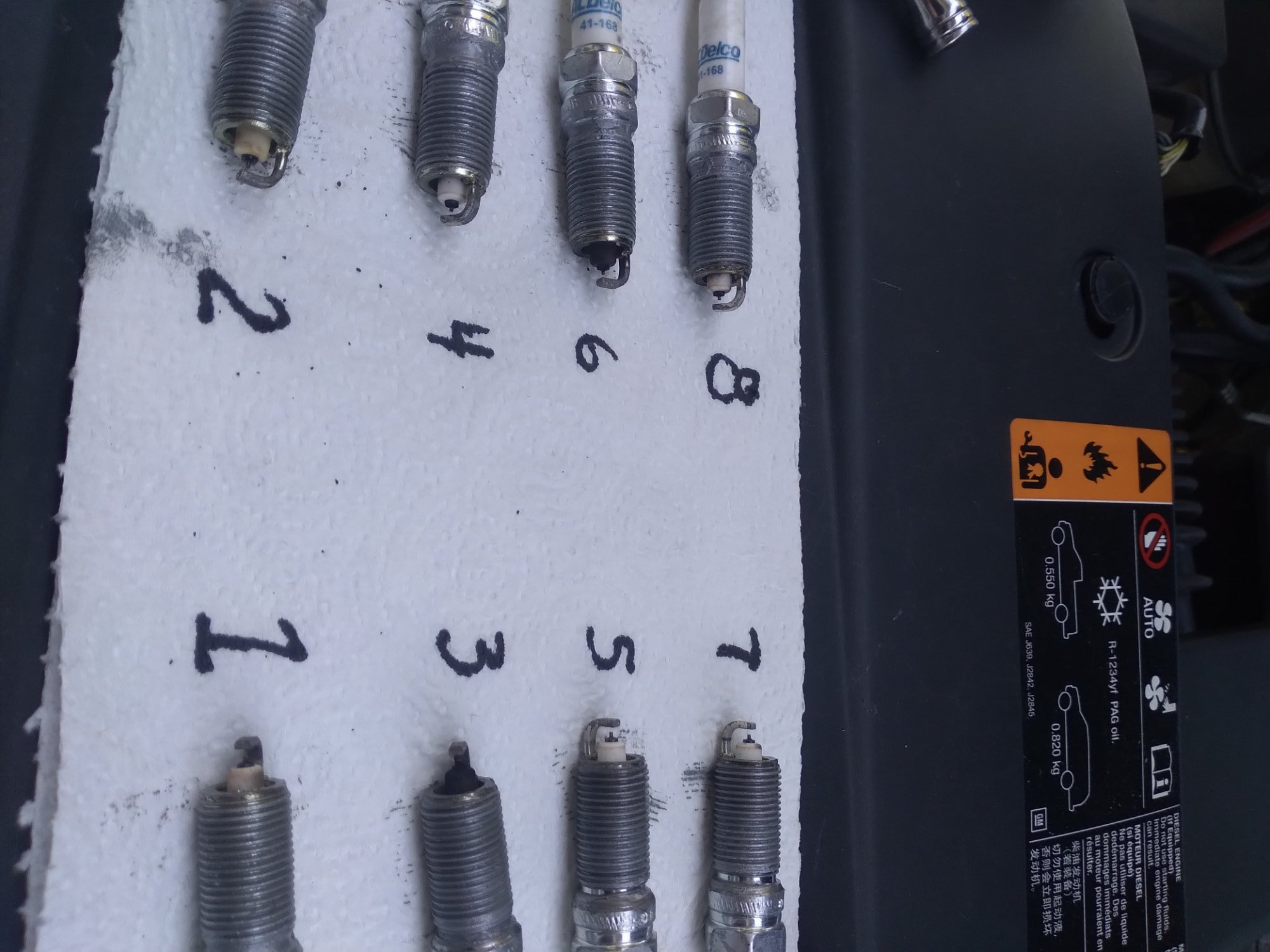
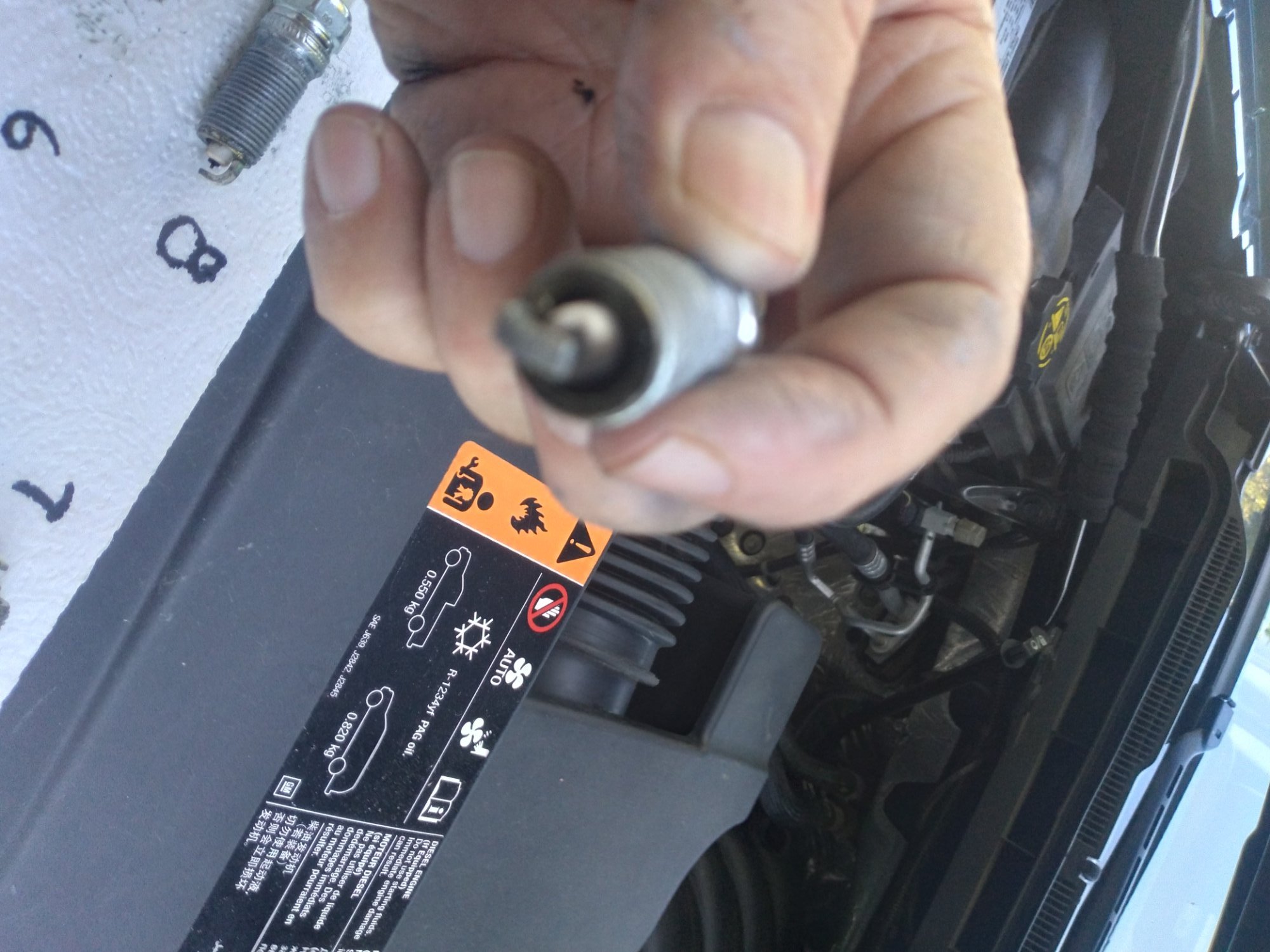
No, they haven't been tested. That is something I had asked about awhile back. Turns out there is no injector testing facility near me so I figure on finding a place I can mail them to for testing. Yes, that is absolutely my next step. Many folks have told me "GM" injectors that are sold on ebay or amazon can be counterfeit. That could be my whole problem in a nutshell. I am tired of spending the little bit of money I have on Silverado parts. I agree, surely out of 16 injectors, there can be 8 that are good. I'm thinking the original ones that had just over 100K miles may be better than any of them if the others are counterfeit. I have now run the truck over an hour since new factory plugs, wires and MAF sensor. I have provided a picture of all 8 and the black sootiness is gone except for cylinder 3 and partially cylinder 6. The picture of plug number 6 shows black on one side of the electrode and clean on the other. I don't know if that is indicative of some kind of particular problem or not, but without any doubt, the changes made have greatly reduced the black sooty plugs on most cylinders. O2 sensor data looks perfectly normal on both banks. However, the LTFT has not been reduced at all, -34% bank 2 and -21% bank 1. So much of what I have read about high negative long-term trims, points mostly to injectors so I am going to have to see that thru until I can confidently rule it in or out. I ran another injector balance test and this time just 3 cylinders failed (1, 2, and 7). The P0300 and P050D codes remain with a steady MIL. Cylinder 2 still the primary misfiring cylinder, but other cylinders (#1, #3, #6) are doing likewise. It seems the misfiring cylinders are kinda playing musical chairs. Depending on the day, it seems different cylinders are the culprits. Below is the latest historical count of misfires by cylinder: 1 574 2 1823 3 530 4 16 5 86 6 339 7 143 8 20
-
I also have a P050D code. The MIL has not been flashing. Three of the five cylinders failed both tests (4,5, and 6). The misfire counts show only #2 misfiring. A few misfires on #1, but usually no more than 1 or 20 for each 20 second cycle. None of the other cylinders show any misfires at all, including #5 which is strange. The plugs I pictured are what they looked like before changed out for a new set of GM plugs and wires and a new GM MAF sensor. So far, I have only run it for about 20 minutes or so. I plan to run it a little longer and pull the plugs again to do a comparison. Personally, I'm at the point I feel it has to either be an injector problem still or PCM going crazy on me. One thing I do recall, and I wish I had taken better notes of what all I've done to this truck, but the last time I had the intake off, I had steady misfires on #2 and #5. Suspicious of the second set of injectors (that were bought off ebay even though they were advertised as GM factory), I replaced the injectors on 2 and 5 with two of the original injectors that came from the truck when it was new. It is now interesting that neither of the plugs from those two cylinders show the black, sooty coating. Could that mean the original injectors, despite over a hundred thousand miles, perform better than the ones I bought on ebay?
-
I got to the Silverado today. Here are the changes I made and the results which include some reversals. I installed a fresh set of GM spark plugs on all eight cylinders. Also replaced all plug wires with a set of GM wires. I replaced the non-GM MAF sensor with a GM sensor. Finally, I switched the two new GM upstream O2 sensors. What I noticed was bank 2 O2 sensor was black and sooty, as were all the plugs on bank 2 except #2 (attached photo). The O2 sensor on bank 1 looked normal but # 3 was black and sooty, #5 looked a tad wet fouled but not really black, 1 and 7 looked normal, light tan electrodes. As a result, the truck now goes onto closed loop within just a few minutes of cold start up. It appears to remain in closed loop during idle periods and the duration of reviewing scanner data. Both O2 sensors are sending normal and similar readings to the ECM. The engine seems to be running smoother, however after about 10 minutes it throws the P0300 code again. Then something I cannot figure out. there has been a reversal of the misfiring cylinder. Last week the misfire had gone away on #2 and just #5 was misfiring. After these changes I made today, #5 is now firing normally and #2 is misfiring again. I cannot see where the new parts I installed could cause this reversal. LTFT remains negative and quite high. Within five minutes after cold start up, bank 2 went to -34% and bank 1 to -22%. STFT trims were mostly holding close to zero but always on the negative side. Throughout all of this, the spark plug color has gone from light, almost white (as I mention in my OP) to now most cylinders black and sooty. The cause for that reversal remains a mystery to me as well. One final test before I knocked off for the night, I repeated the injector balance test. Once again, 5 of the 8 failed. Oddly enough, among the three cylinders to pass, was the new misfiring culprit #2, along with #3 and #8. Any ideas about this situation are welcomed, thanks.
-
Thanks for the ideas, blazer. Makes sense to go back to the ignition side of #5. Neither the wires nor coils are OEM. I think this may be a case of not leaving a stone unturned. Strikes me odd that the black, sooty O2 sensor was on bank 2 but it set a P219A, not P219B. I've been thinking about why its running smoother now, but in open loop, as I understand things, the computer sends a pre-determined richer mixture and ignores the O2 sensors altogether. This fixed richer mixture may be why its running smoother, all except #5 which may well have its own problem otherwise. I wonder if it is configured in a way that if things get too screwed up fuel-wise, the computer can literally dictate open loop until correction is made? This afternoon, my wife and I are heading back down to our little cabin in WV for a week. I'll be back on the 18th to resume the battle! Meanwhile, I'll be studying up some more about this problem and likely I will go ahead and order new wires (OEM) and maybe another MAF sensor. The one that is in there is not OEM. This open loop deal didn't start until after I replaced the two upstream O2 sensors and the MAF.
-
I fiddled with it some more this evening. It seems to me that the next order of business is to determine why it is staying in open loop long after it has warmed up. It's kinda weird but I'm seeing a pattern of the two loops in reverse. When I first start it cold, it is in closed loop. After just a couple minutes it goes into open loop and stays there, just the opposite of how it should be. Is my PCM drunk or something?! Are there any other variables that control switching into closed loop than coolant temp and O2 sensors? This evening, for some unknown reason, it felt smoother than it's been. I went to misfires and #5 is the only one misfiring now. I think I saw one misfire on #7 and all the rest had zero over about a 15-minute period. The counter resets about every 10 seconds but during that short time, #5 registers around 180 misfires. I'm considering pulling the valve covers again, or at least bank 1 and taking a real close look at #5 and make sure there is no valvetrain issue there. I guess there could be two separate problems at the same time. Bank 2 has some weird fueling issue going on but now the misfire is solely on bank 1, strange indeed. Also, I remembered two other parts I've changed recently, the pvc valve and the evap purge valve. These two items were mentioned as a possible but unlikely reason for high negative fuel trim, so I thought with the miles the truck has, might be good to replace each of them at this point anyway. Obviously, neither had any positive effect on the trims. I'm considering switching the two new upstream O2 sensors from the bank they are on to the other one and see what happens. But mainly, I think I need to get this thing back in closed loop again.
-
I bought the truck exactly two years ago from the original owner who took very good care of it. It had 87K and ran perfect. Around 89K, I put a fresh set of AC plugs in it (12622441- same ones it had in it originally). It continued to run very well, and my mpg picked up a little. I have made many trips to WV. About 12,000 miles later, it developed a miss (no CEL). I replaced the drivers' side with yet another set of AC plugs. I took it for a test drive and the miss was gone so I did not bother with changing the passenger side plugs. This was early 2023. It ran well throughout the summer and in September, while driving back from WV, it developed a pretty strong miss and CEL came on and eventually started flashing. I stopped at an Autozone to have it scanned it had a P0301. I bought a standard brand ignition coil and replaced it in their parking lot, and it corrected the problem. Two or three months went by, and it started missing again and the engine light came on intermittently. It set a P0306. Once again, I replaced the coil, in fact I replaced all of them except #1 which had already been replaced. This is early 2024, the misfiring continued but was off and on. Sometimes I would drive for 2 or 3 hours, and it would run like a top. Gradually the missing got worse and more frequent. I tested my plug wires and there was some resistance inconsistency between them, so I put a new set on, this was Jan 2024 and around 110K miles. The truck ran good for a few days and the engine light started popping back on. This time it was the dreaded P0300 and also P0306 with it. I switched plugs, wires and coils around to cylinder 6 from cylinder 8 which is probably the most consistently firing cylinder of any of them. The problem stayed on #6. In February, the misfiring was getting so bad, I was hesitant to drive it very far, trips to WV were out. Another code started popping up was the P219A. Also, a code pertaining to the O2 sensor on bank 2. I don't remember the code number, but I ended up replacing the bank 2 upstream sensor with a Denso sensor. At that time, it took care of that code but the P0300 and P219A remained. I started noticing extremely high negative fuel trim numbers for bank 2 and a lesser extent, bank 1. For the most part, bank 1 at the time seemed to be doing a little better. The truck started missing on #2 and to a lesser extent #5. I had the truck at a specialty shop and later had a GM tech look at it. The specialty shop said I had collapsed lifters and a noise in the bottom end (a noise I still haven't heard). They gave me a $9000 quote for a Jasper replacement engine. The GM tech said he suspected injectors. I went that route and replaced all 8 with a set of GM 12668390 injectors. That was in the middle of March. The problem remained and I seemed to think the truck ran worse after the injectors were replaced. I thought I may have boogered something up so eventually I went back in and put another set of injectors in. Both times I did everything slowly and methodically. Nothing was messed up, the intake gaskets were exactly in the grooves, nothing leaking, nothing left loose, and I tested for vacuum leaks thoroughly-none found. That brings me to this week. as I have described, just yesterday, I installed new GM upstream O2 sensors on each bank and a new MAF sensor. I replaced the S & B CAI system and put everything back stock for the air induction system. Another part I replaced that I had forgot about is the fuel tank pressure sensor. Diagnostics led me to that, so I replaced it. It did not affect the misfiring issue, however. Now the truck has gone from an occasional misfire to steadily misfiring and basically being undrivable (flashing CEL). I have cleared the codes several times, generally when I have need to disconnect any sensor and then obviously when I had to intake and fuel rails off to replace the injectors. I ran the truck for about 20 minutes earlier today with the scan tool connected, and so far, you are correct, the P0097 has not reset. But something is going on with bank 2. Even though it is pretty much staying in open loop, bank 1 O2 sensors are fluctuating to some extent, but bank 2 is basically doing nothing and staying very high, only ranging from about .81 to .86 roughly. On the other hand, bank 1 sensors are reading super low in the area of .002 or .003. Occasionally, they'll jump up to .7 or higher and I cannot read any fuel trim numbers because I guess open loop status locks that out. Pretty much all the live data was within spec, at least all that I could see when in open loop and I've already mentioned about the O2 sensors. But just to give you an idea of the current misfire situation the following is a list of the historical misfires recorded this afternoon after running it about 20 minutes #1 185 #2 63 #3 27 #4 274 #5 7557 #6 162 #7 384 #8 2 Strikes me odd, that for all the apparent issues presumably with bank 2, it's total of misfires was 501 while bank 1 had 8153.
-
Two new issues I discovered this morning. The first possibly pertains to the P0097 code. I found that I had not tightened one of the two screws holding the new MAF sensor. The sensor was not completed flat against the intake tube and could be "rocked" a little. This no doubt was causing unmetered air to escape. I had not tightened the screw enough because I remember it felt like it was about to strip out and that was the last thing I needed. Anyway, this morning, I tightened the screw, it did not strip, and the sensor sits fully against the mounting as it should. The second thing points to some kind of issue with a rich mixture on bank 2. Bank 2 upstream sensor is reading high (around .78 to .85) and is not oscillating at all. Since the denso sensor I just removed had evidence of a black, sooty mixture, perhaps this issue has origin outside of the O2 sensor itself, like a bad ground or something? It is still staying in open loop. It went into closed loop shortly after start up, but soon went back to open. The IAT sensor 2 was already higher than sensor 1 shortly after start up (78 compared to 91). So perhaps that is the reason for open loop?
-
I did the injector balance test with an Autel scan tool. The injectors I installed were GM part # 12668390 which was the same GM number on the original injectors I took out of it. I purchased them from an individual on ebay who according to his feedback, had positive comments on his transactions. However, newdude indicated that part number is quite old and possibly I received some that were less than perfect. Right now, that is looking like a real possibility in my view given what all else has been done on this truck. The fuel pressure readings are staying in spec from what I've observed. I triggered a new code while I had the scan tool hooked to it last night, a P0097, intake air temperature sensor 2 circuit low. Oddly, the scan tool readings showed IAT sensor 1 around 113 when fully warmed up, but sensor 2 about 144. It set as a permanent code along with my other 3 permanent codes, P0300, P219A, and P050D. The P0171 and P0174 codes only showed up as pending during my testing which might have been what triggered them. The condition I have now is the fuel system is staying in open loop even though the truck has been fully warmed up and coolant temp around 190 or better. This has locked out my fuel trim numbers, and I don't believe the O2 sensors are functioning normally either. I was able to conduct another fuel injector balance test, but the results were affected by the open loop status and isn't a valid test I'm sure, especially since this time none of the injectors failed. I disconnected the battery for a couple hours today on hopes that would take care of the staying in open loop...it didn't. While running a test with the scanner, it briefly went into closed loop but less than a minute later went back to open loop and has stayed that way ever since. What is it going to take to get it out of open loop? At this point, I can't help but wonder if I could have a faulty ECM/PCM? Back in the day when I worked on computer command control feedback carburetor systems in the 80s, I recall among the possible codes that could be set were a few codes that actually pertained to the ECM itself. Of course, there were times when a computer got smoked in such a way it hadn't the capability to diagnose itself. I recall changing quite a few when I worked for a Chevy dealer. All one had to do was remove the chip from the old one and install in the new one and often that corrected the problem. However, from what I have read about the systems we have now, it appears ECM failures are not as common.
-
Okay, I'm gonna try to make this as brief as possible by just listing some observations and data values from the scan tool. I replaced both upstream O2 sensors with OEM sensors. The bank two upstream sensor(denso) I changed out around a month ago was coated in jet black soot. Bank one upstream sensor(the original one) looked normal by comparison. Original air box, air filter and air induction system reinstalled, CAI removed. A new MAF sensor installed. MAP sensor was reading within normal range (between 3.48 and 4.28) entire time of testing(over an hour). Five of the injectors failed the fuel injector balance test. All 4 cylinders on bank 2 failed and by a considerable amount. the only one to fail on bank 1 was #5 which for some reason is now the main misfiring cylinder by far (over 11,000 misfires, the next highest was just around 450). Surprising was that cylinder 2 is basically not misfiring at all and it was the worse one up until now. That shows the issue has moved from at least one cylinder and stopped misfiring altogether. Would this mean I do not have an internal issue with the valvetrain? To me, there is no reason for it to change after steadily misfiring for weeks now. Another change, the misfires on #5 increased exponentially upon increasing throttle position. At idle only #5 and occasionally #7 misfired. Upon acceleration, several other cylinders misfired as well, but none anywhere near the extent of #5. The LTFT trim numbers were around -30 for bank 2 and -16 for bank 1. I drove the truck for a short distance of about 4 miles. The traction control light came on as soon as I got out on the highway along with a flashing CEL. The CEL went off a time or two but mainly was flashing. I might have run the truck too long while reading the scan tool and it went into open loop and stayed there. It the set P0171 and P0174 lean codes and fuel trim numbers where halted...they all showed no reading, just blank. The average STFT for both banks was 25 and the average LTFT for both banks was 35. I guess that is an automatic reading when it goes in open loop. I am going to repeat the injector balance test tomorrow just make sure I get consistent results. I also am going to hook up my other scan tool and do comparisons of various readings. So, as I see it, the only thing definitive about my readings is that apparently, I still have an injector problem. Can I have my injectors tested? If so, how to I go about that? After all, this is the second set of GM injectors I've installed.
-
I need to correct my post from yesterday about the O2 sensors from Rockauto. I was wrong. The sensors I received were in fact GM sensors. I went to a local Chevy dealer to purchase the OEM sensors directly from them and learned that they too have Denso printed on the body of the sensor. The parts manager there got me straightened out on this. Denso is making O2 sensors for GM currently. The bank one sensor I removed yesterday has Denso printed on it and it is the O2 sensor that came with the vehicle when new. Denso does make a sensor of its own that they market for a much lower price and is not very user-friendly with GM ECMs. The OEM sensor will have the 8-digit GM part number at the top of the sensor housing and the word Denso directly below. The regular Denso sensor will not have the GM part number on it. So, bottom line, Rockauto sent me the correct sensors after all.
-
Thanks blazer, that makes sense to me. I will proceed with that when my new O2 sensors arrive. The truck is not runnable right now because I had to cut the wire harness pigtail on the bank one sensor so I could get a socket on it, could not break free with wrench. It was the only way I could remove the sensor, working on it from underneath on jackstands. Another concern I have is about fuel pressure. My high pressure seems to be running within spec, but the low pressure pump(i'm guessing the one in the fuel tank??) shows quite a variable reading. It generally shows around 55 psi, but at times swings as far south as 25 and other times well over 60. I do not know if that is a normal reaction due to engine load or other variables, but I agree this is shaping up a lot like it is some kind of fuel related problem.






-
Forum Statistics
250.6k
Total Topics2.7m
Total Posts -
Member Statistics
343,003
Total Members8,960
Most Online
-
Who's Online 10 Members, 0 Anonymous, 1,080 Guests (See full list)