


ktuck
-
Posts
43 -
Joined
-
Last visited
ktuck's Achievements

Enthusiast (2/11)
8
Reputation
-
I believe that is correct, one bad injector and the HPFP. I made things difficult when I installed ebay injectors early on. That brought about the perpetual misfires which seemed to bounce around among the cylinders. During the pursuit of those misfires, a few more non-OEM parts (O2, MAF sensors and spark plugs), just made matters worse. After replacing the wires and moving coils and plugs around between cylinders, if I had simply sent the injectors out for testing, the solution would have revealed itself much quicker I believe. I do believe it odd that two different components failed at approximately the same time, but it can happen as I found out. My general lack of technical knowledge in interpreting fuel trim data and going the cheap route with non-OEM parts played the biggest role in why this ordeal extended out so long. I take some consolation in the fact that I have learned a great deal about OBD2 diagnostic procedures from this challenging experience.
-
Yes, I had seen this list of TSBs. I had followed the ones pertaining to the 5.3 and found none that were rubbing, chafing or pinched or open wires. Focusing on the P16E5 code, there are about 5 things listed as likely causes. I tried or eliminated each of them, including replacing the fuel rail pressure sensor(simply because it was cheaper!). Finally the only one I hadn't tried was the fuel pump. After installing the HPFP from my neighbor's Tahoe, everything was better. All codes gone, it's out of limp mode, MIL is out and most importantly the engine runs perfectly! After driving it for about 100 miles now, the misfire counter shows zero misfires on all 8 cylinders, 02 data looks good and fuel trims have balanced out quite a bit. After 114 days, I have my truck back! I want to thank you and others on this forum for your help in tracking down this most challenging drivability issue!
-
Here are a couple pics of the area around the fuel rail sensor and the HPFP. I have literally searched the harness and connectors with great detail...not only the wires and connectors that were disturbed when replacing the injectors but the rest of the harness as well. Everything looks pristine. My neighbor has an engine he took out of his Tahoe which is the same engine as mine. It ran perfect with no codes or anything, just had some bottom end noise. I am going to switch out the HPFP from his engine to try in mine. Nothing left to lose really and won't cost me anything but my time. Ohms test on the bank 1 injector harness wires was good as was signal voltage. I don't know if I can test for limp mode with the just having the pump installed and all connectors secure, or if I will need to put the intake back on so I can run the engine. I will check it with the key on, engine off just to see. If no luck with this, I pretty much will be ready to give up and will likely take it to the Chevy dealer this coming week.

-
Thanks for providing me with the circuit testing procedures. That helps me out a good bit since I do not have a current subscription to any technical manuals. Would it be a safe assumption that I should first focus on the P16E5 code as it may be what's also triggering the 3 P0200 series codes? I have checked all fuses and no problems found there. I also have disconnected the battery a couple different times hoping for some kind of reset, but to no avail. I do not have a schematic to isolate which wire or pin is which so I can perform the circuit tests such as the high and low control circuit testing resistance and voltage to ground testing. How can I know which wire to test? Also, I assume I'll need to remove the intake to test the Q17 fuel injector harness connector? Since these codes have never appeared before on this vehicle, I am pretty well convinced it has showed up due to me touching or moving something. It would seem like a wire or connector somewhere is stripped, broken, stretched or disconnected. The challenge I have is finding it! This truck has really kicked my butt to the moon and back. This has become the most extended diagnosis I have ever been involved in and that is mostly my own doing I have to say. Thanks again for your advice and insights into my problems with this Silverado, I appreciate it very much!
-
Another thing I see on my scanner...it shows the fuel rail pressure sensors (both 1 and 2) reading 95057.74 psi. Is this perhaps a result of limp mode status? No way the injectors can handle that kind of pressure. Whatever it is, it has affected all of the left bank except cyl 1, that seems odd to me. The new OEM injector is in the 7 hole and all the other injectors were recently tested and passed by an outside facility.
-
I received my new OEM injector today and with high expectations, I installed it. Unfortunately, I cannot tell if the misfire problem is corrected because somehow, I have introduced yet a new problem I have not had before. Apparently, the truck is in limp mode or something. The DIC is stating "engine power is reduced." It is staying in open loop and the idle is quite rough, much worse than when I had the misfires going on. When I rev it above about 900 rpm, it smooths out very nice. Also. 4 new codes have appeared that I have never seen before: P0202, P0205, P0207, and P16E5. I have gone back and double checked everything, especially harness connectors on cylinders 3,5 and 7 and all looks okay. I don't know if the P16E5 relates to the first 3 codes or not. I haven't had chance to look them up yet, I just came in when it got dark. I did attempt to collect some scanner data. One thing I noticed on the scanner, was that cylinder 3, 5, and 7 injector control circuit status does not alternate between "Not Run" and "OK" as the other five cylinders do. Maybe that is a hint, I don't know. Perhaps some of you all have some insight on this for me. The only other factor I might mention, don't think it would matter really, but I had the battery disconnected the entire time I had the injectors sent out for testing and I was in WV. Probably around 12 or 13 days, I think. I generally believe when something like this appears that wasn't doing it before, it is linked to the current work/repair. For the life of me, I can't think of what it might be. I was basically removing the intake, fuel rails and injectors, nothing else. If this is limp mode, is there a way to take it out of limp mode or is it locked in until the condition is corrected?
-
I received my injectors back from Injector Experts in Risingsun Ohio. One injector failed their test, and they recommended replacement. They sent me a 3-page document on the all the various testing procedures they did for each injector. It was a most comprehensive test procedure I could tell. Keith Brewer runs the business and I highly recommend him. He spent a good deal of time with me on the phone explaining each test procedure they do, and the necessity of certain tests conducted on GDI injectors. He told me when I receive the injectors back in the mail, to call him and he would explain the results of the tests, especially the one that failed. For GDI injectors, the cost is $25 for each injector which I think is a fair price. The question I had to ask him was did he think the nature of the failed injector was such that it would be noticeable as a misfire under light to moderate load, and he said without a doubt. He said replacing it with a good injector will guarantee the engine will run much better regardless of any other existing issues. The 8 injectors I sent him, were all of the original injectors, I wasn't going to waste my time or his on testing the ebay knockoffs. I have a new OEM injector on order and hope to receive it by tomorrow or Monday. Fingers crossed.
-
Yes, there certainly appears to be some inconsistencies with the fonts, numbers, etc, but I think the primary red flag on these injectors is the very low price compared to dealers and other jobbers. I think the old saying, "if it seems too good to be true, it probably isn't" applies here. Selling 8 "OEM" injectors at a cost just slightly higher than one normally costs, is not normal. But due to being on a tight, fixed income, I fell for it. Now I'm spending more than if I had just bought genuine GM parts to begin with. It is possible that introducing counterfeit parts (plugs, wires, sensors, and injectors) may be most if not all of my drivability problems. I anxiously await the results of the injector testing.
-
I went back and reviewed the fuel system diagnosis procedures and found that I was calculating the injector balance testing incorrectly. The procedure says to compare cylinders on each bank, not from one bank to the other. With that in mind, I went back and recalculated my most recent test and it showed three failing cylinders (1,2,3) compared to six the previously way I did it (1,4,5,6,7,8). It is interesting that 5 of those 6 did not fail when I conducted the testing properly. Only cylinder 1 failed both ways and more significantly, cylinder 2, as the primary misfire offender, did in fact fail this latter test. I couldn't help but notice that the average psi pressure drop was much lower on bank 1 (36.75) compared to bank 2 (56.75). Even with the somewhat improved negative fuel trim numbers, it still seems that the right bank is over fueling. I wonder if it could have something to do with the location of the fuel rail pressure sensor...I think it is on the left fuel rail if I recall correctly? At any rate, my neighbor has agreed to let me hook up my Autel scan tool to his 2015 Tahoe 5.3L to run some test data. I have often found that observing what normal looks like helps me isolate problems better. His Tahoe runs well and has no current codes or drivability issues. He has the same L83 engine with GDI injection. Meanwhile, I have sent my original injectors out for testing. I hope to have them back by next week sometime. I agree the OEM injectors will be my baseline. The ebay injectors are either counterfeit or not. I'm not going to worry about that now and just remove them from the equation altogether. All the other parts I have replaced so far are OEM and will do so with the injectors if the outside testing reveals any that fail. At this point, I personally am not sure the scan tool fuel injector test is reliable test procedure. My results so far have been inconclusive.
-
I drove it about 75 miles this evening. The misfiring remained steady on #2 and here and there on 1, 5, 6 and 7. I ran another injector balance test and all but #2 and #3 failed. Doesn't it seem odd that the cylinder that is steadily misfiring continues to pass injector balance tests? O2 sensor data looked normal but there was a noticeable improvement in LTFT on each bank. I noticed at idle, bank 1 LTFT was about 4 (first time it has been a positive reading since all this started) and bank 2 about -11. However, each time I accelerated to 2K, bank 1 went to -4 to -6 and bank 2 went to -18. The last time I ran the engine, LTFT trims were pretty steady at -23 on bank 1 and -34 on bank 2. So, both of these have improved by driving it even though the misfire and engine light is staying on steady. Maybe the computer has adjusted somewhat for the fuel trims issue. It did throw the P219A code again for some reason and activated the MIL along with P0300. the last time I had the intake off, I switched injectors around in various cylinders. I used 4 of the original injectors that came out of cylinders that were firing well and moved 4 of the best firing ebay injectors into the other 4 cylinders. Unfortunately, I did not write down which ones went in what cylinder, but I did mark each injector as to its origin so when I take it back apart, I will know which ones are which. I have this feeling the 4 ebay injectors may be in the cylinders that are showing the most misfires now (1, 2, 3, 5,). Here are the historical misfires as of tonight: 1 574 2 1828 3 530 4 16 5 86 6 339 7 143 8 20 If it isn't raining tomorrow, (yeah, I have to work on it outside in the driveway), I'll be pulling the injectors out again.
-
I think that may be a good idea, after all I haven't run it very long for the computer to process all the new data its receiving and adjust to it. I have nothing to lose at this point, and if the codes and misfiring remains, I am prepared to send my original factory injectors off for testing. I have found a place in Ohio I plan to send them to. If I am correct, these are GDI injectors? Correct me if I'm wrong because they indicate on their website there is a different process involved in testing GDI injectors from port fuel injectors. I'm kinda thinking my original injectors weren't bad to begin with. I was just taking a shot in the dark at that point, and it seems the issue intensified following that. The problem went from intermittent to full time.
-
Yeah, I hadn't notice that, but you are right. Also, if you look at the numeral "1", the factory injector has simply a straight line going down to the bottom, while the fake one has horizontal base at the bottom of the number. I too wonder how they can make money off counterfeiting these because surely it takes a certain amount of time and expense to make a duplicate that looks this close to the original, then they sell a set of 8 for just a tad more than one normally costs. Anyway, my great hope is that this ends up being the source of my misfire problems.
-
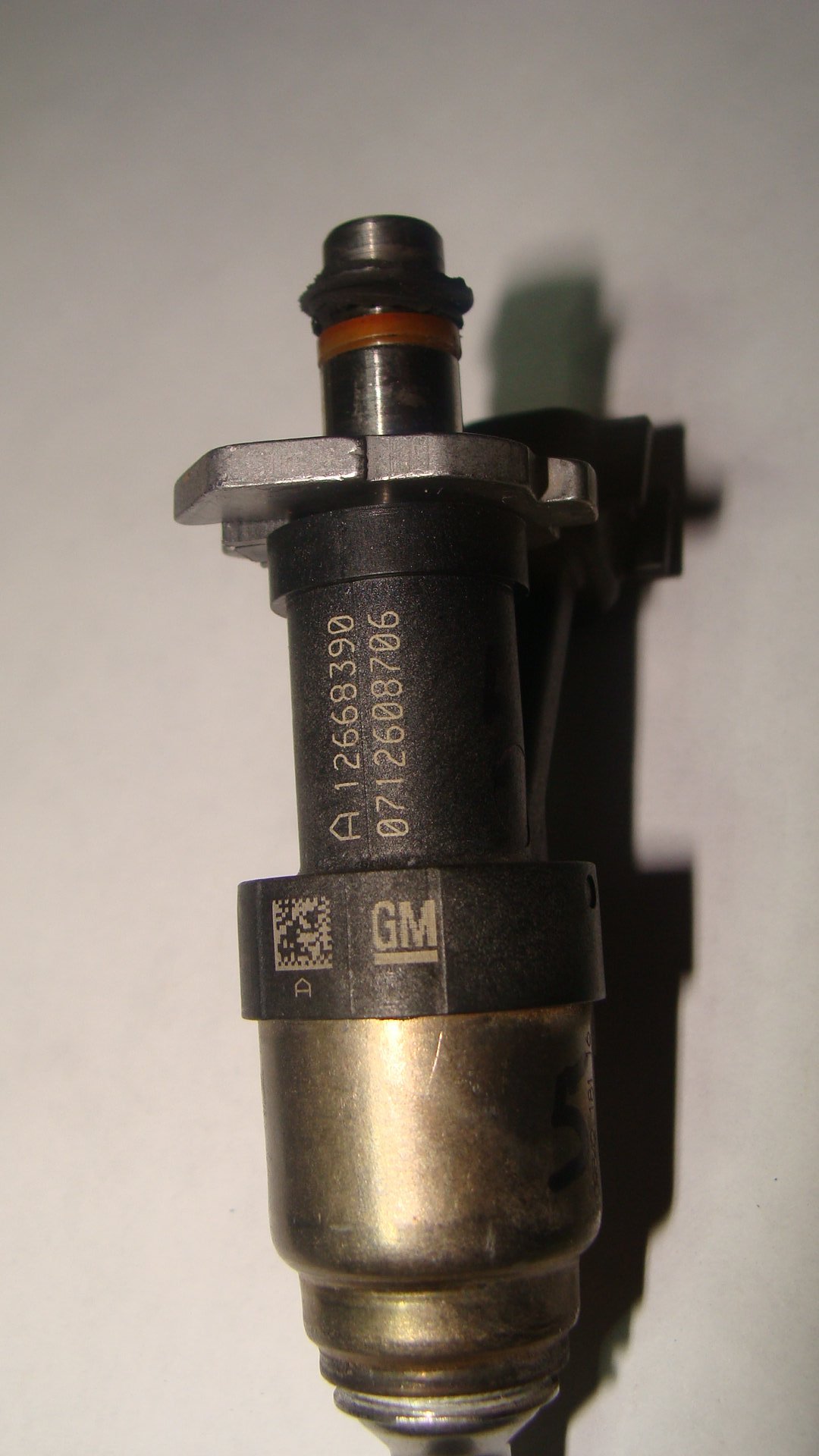
Yes, I must that due to the cost savings, I unknowingly fell for the $140 set of 8 "GM" injectors. Below I posted a pic of one of my original injectors and then one of the ebay specials. On the original factory injector, it is clear the font height of the letter A is above that of the part number that follows, on the ebay injector the height of the A is even with the height of the part number. Also, the number on the second line below, is the same on all of the ebay injectors (0615606065). Whereas on the original factory injectors, that number on the second line is different on each of them. I don't know if that means anything or not. You were the first person to enlighten me about fake aftermarket injectors and since I've had others tell me the same thing. At this point, I am considering sending all 8 of the original factory injectors off for testing, and then only replacing those that fail the test. As I recall, nothing improved when I installed the first set of "GM" injectors and it seems that the misfiring went from intermittent to constant all the time. Before that, I recall driving the truck for perhaps several days and maybe a few hundred miles between misfire flare ups. That hasn't been the case since, it is missing right from initial cold start up and does not go away even breifly.
-
Do any of you all know of a reputable, or have experience with a facility that tests fuel injectors that I can send mine off to? thanks
-
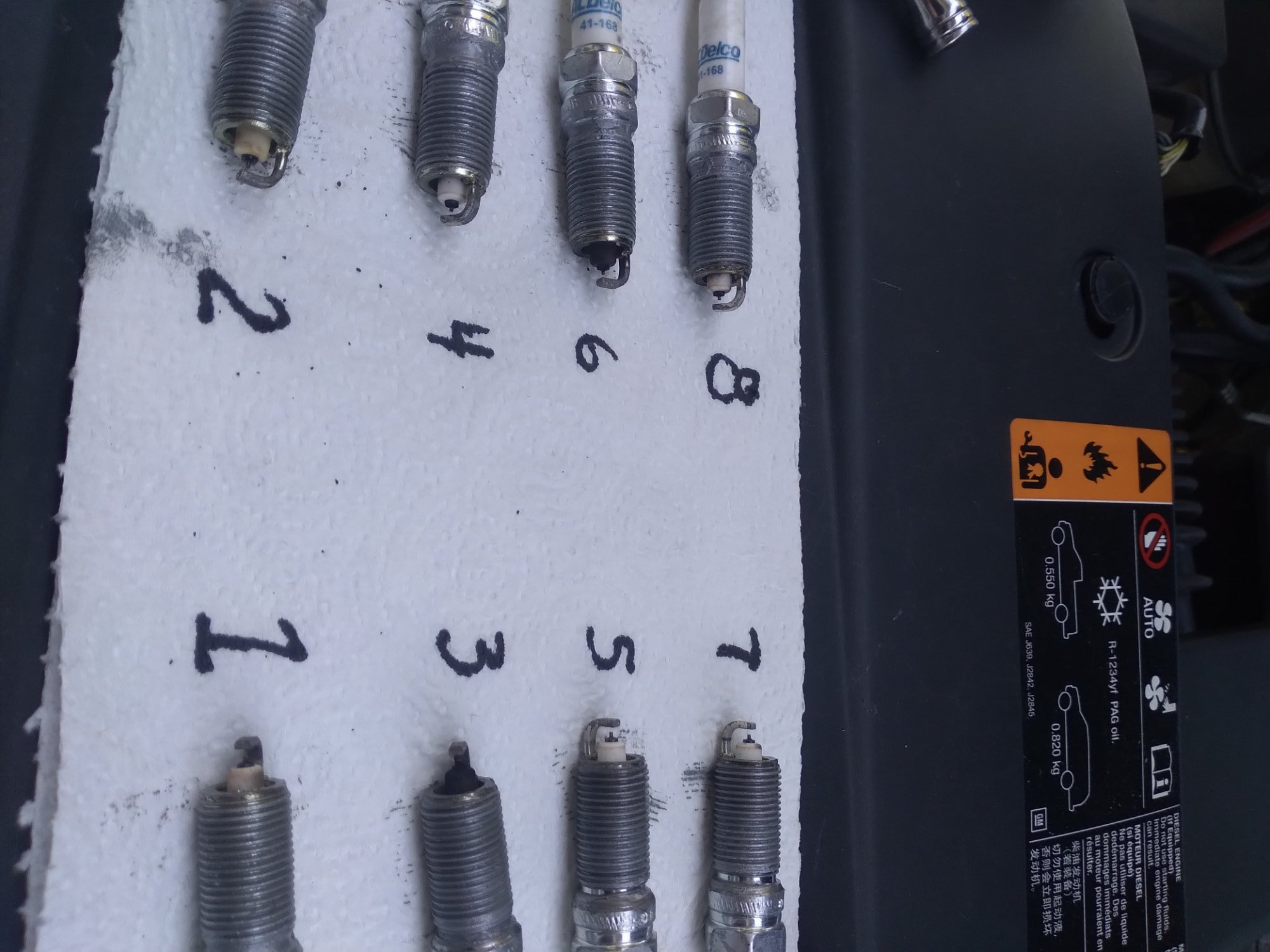
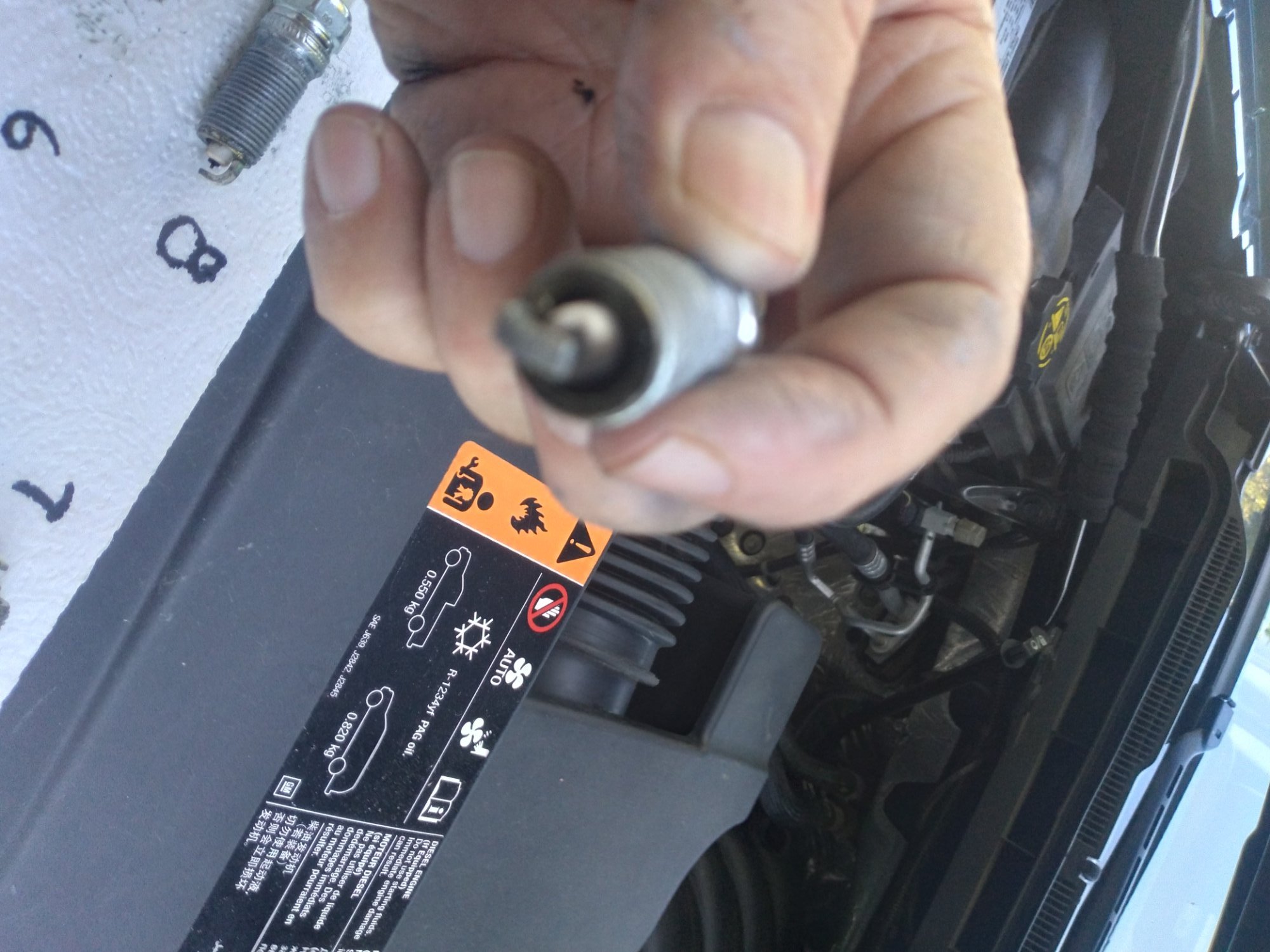
No, they haven't been tested. That is something I had asked about awhile back. Turns out there is no injector testing facility near me so I figure on finding a place I can mail them to for testing. Yes, that is absolutely my next step. Many folks have told me "GM" injectors that are sold on ebay or amazon can be counterfeit. That could be my whole problem in a nutshell. I am tired of spending the little bit of money I have on Silverado parts. I agree, surely out of 16 injectors, there can be 8 that are good. I'm thinking the original ones that had just over 100K miles may be better than any of them if the others are counterfeit. I have now run the truck over an hour since new factory plugs, wires and MAF sensor. I have provided a picture of all 8 and the black sootiness is gone except for cylinder 3 and partially cylinder 6. The picture of plug number 6 shows black on one side of the electrode and clean on the other. I don't know if that is indicative of some kind of particular problem or not, but without any doubt, the changes made have greatly reduced the black sooty plugs on most cylinders. O2 sensor data looks perfectly normal on both banks. However, the LTFT has not been reduced at all, -34% bank 2 and -21% bank 1. So much of what I have read about high negative long-term trims, points mostly to injectors so I am going to have to see that thru until I can confidently rule it in or out. I ran another injector balance test and this time just 3 cylinders failed (1, 2, and 7). The P0300 and P050D codes remain with a steady MIL. Cylinder 2 still the primary misfiring cylinder, but other cylinders (#1, #3, #6) are doing likewise. It seems the misfiring cylinders are kinda playing musical chairs. Depending on the day, it seems different cylinders are the culprits. Below is the latest historical count of misfires by cylinder: 1 574 2 1823 3 530 4 16 5 86 6 339 7 143 8 20





-
Forum Statistics
250.6k
Total Topics2.7m
Total Posts -
Member Statistics
343,003
Total Members8,960
Most Online
-
Who's Online 6 Members, 0 Anonymous, 947 Guests (See full list)