


waffler
-
Posts
6 -
Joined
-
Last visited
waffler's Achievements

Enthusiast (2/11)
0
Reputation
-
Yeah, I think the axle is too far back. Not something I'm going to be able to fix unfortunately. I haven't considered moving the battery and propane to the rear of it, but that's something to look into. I still have a warranty on it until ~May this year, so I'm going to wait to make any modifications to the super-thin rear bumper until then. But I'm thinking of getting something like this to replace it with so I can attach more than the spare tire to it. All 3 passes had the same load in the truck and were done at the same time (first with WDH, then no WDH, then no trailer). I am overloaded on payload (as mentioned above), but within GCWR and GAWR (barely). My truck's specs: Measurements: In order to get my truck's weight down, I had removed the fitted rubber mat I normally have in the bed (45 lbs), the tailgate (64 lbs), swing box with emergency tools (43 lbs), log chain (22 lbs), few other tools (9 lbs), and a few other things. I don't think I had put my truck's spare tire (60 lbs) in the trailer for those weights, and I'm not planning to screw with that. I really dislike having to move all that stuff.

-
Yep, 920 lbs tongue weight from the trailer's tongue on the rear axle of my truck without WDH. That was with food and stuck packed in the trailer for a trip last summer. Everything that weighed more than a couple pounds was stored in the rear of the trailer (either on bunks or in-between them and the restroom), and some in the fridge or rear dinette storage area which is located over the axles. You can see some more discussion about weighing my trailer over on this forestriver forum thread if you're interested. I pasted my 3-pass scale weights in there. I actually didn't measure any difference in front end wheel well height from the ground with my trailer hitched up and no WDH. The scales showed weight was removed though, so the WDH is needed to restore some of that. Yeah, this trailer is supposed to be "1/2 ton towable", but with a hitch weight so high, almost no half-ton is going to have any payload left for family with it connected. As we all know dealers and RV manufacturers aren't going to tell people to inspect their payload stickers. Coachman's website claims 596lbs dry hitch weight which is a bunch of bologna. They must have had no propane in the tanks, no mattress on the bed, no battery on the tongue, and maybe even no cabinets installed or something to hit that number. The trailer towed okay with my current truck even though I'm clearly exceeding the payload. I had to go slow up hills and on interstate, but that's a power+drag issue, not stability. I'm just not very comfortable taking my family on long trips in the future knowing I'm not even marginally close to the manufacturer's given limits. I agree a 3/4 ton truck seems like it should be overkill, but I don't have much payload to work with on 1/2 ton trucks. I think the a 6.2 LTZ 1500 with NHT will be enough that I'm not going to be exceeding it (until my kids are older and weigh more maybe), but there still isn't going to be much headroom for throwing things like bikes, firewood, generator, or what-have-you in the back for trips.
-
The 1950 figure I mentioned in the OP was an in-the-middle (of recommend 10% to 20%) tongue weight for a trailer that was around the max trailering capacity for that configuration. I used those numbers to illustrate the mismatch of increases in trailering capacity and reduction in payload over time for these trucks. My tongue weight isn't quite that much, lol. I've measure it at 920 pounds without WDH. With the WDH, I measure 720. Most folks don't recommend factoring the WDH returned weight into payload capacities, so I've been viewing my payload as 920 plus weight of passengers and other items which is about 705 currently (it will grow as my kids do). So a total of 1625. I'd like to be able to bring our bicycles with us on some trips, so add ~150 pounds to that for 1775. edit: forgot to mention trailer is an Apex Nano 208BHS. Anything that weighs more than a pound is packed in the back of it for the measurement above.
-
Thanks for sharing your specs ExYukon! That is close to what I would be looking for if I get a Silverado 6.2L. I also found the one in the attached pdf a couple days ago not too far from me that has 6.2 and NHT (this combination seems kind of rare) and the dealer told me the sticker says 1810 for payload. It has the LTZ Premium Package which adds the sunroof on top of your specs I think and it looks like must account for at least part of the 16 pounds difference there. I wonder how much weight the multi-flex tailgate adds compared to the standard one. At this point, I think I mainly just have the Silverado 1500 6.2 with NHT and a Ram 2500 Big Horn on the list. I'd really like to have a Silverado 2500 on the list too, but my garage is 250.5 in long and those trucks are 250in. Really wish GM wouldn't have increased its length so much in this latest generation. Unfortunately, the Ram 2500 pretty much requires getting the gas engine if you want HD type payload. Putting the Cummins in there gets the payload down close to 2000. Gas is closer to 3000. So I'm leaning mostly towards the Silverado because it can meet my minimum requirements and function well as a daily driver too (comfort, drivability, tire wear, mpg, etc.). Just no room to grow with it in the future. edit: forgot to add here the Ram 2500 with gas would also have less hp and torque per pound than my current truck (5.7L Ram 1500 with payload stick of a very wimpy 1132). roberts-robinson-1500-6.2-window-sticker.pdf
-
I knew I'd get a lot of "buy a 3/4 ton" or "buy a 1 ton" replies, but a little surprised there haven't been any "if it fits, it ships" replies too, lol. Lots of opinions on how to interpret the payload sticker. I don't really want to debate that issues because there are plenty of threads on the internet for that already. I'm looking for a new truck because I'm definitely exceeding the rated payload of my current truck and I'm not comfortable doing that long-term. We took a long trip last year with it pulling our travel trailer and it performed fine from a stability perspective. However, I do not like being several hundred pounds over it's absurdly low payload rating of 1138, even if I am still within the GAWR. I would like to be within the rated payload when fully loaded with the family, TT, bicycles, and normal things we'll want to bring with us. One long trip per year and 5 or so much shorter ones. I'm not terribly concern if I'm bumping up against that number occasionally, but I don't want to be exceeding it frequently. This will be my daily driver, so I do not really want overkill capabilities for towing when it will be such a small amount of the time I'm using it. In particular, HD trucks are also missing some features the 1500s have like adaptive cruise, new interior (both coming MY2024), and of course a smoother ride. Oh, and available for shorter size since I'm not 100% an HD will even fit in my garage; it'd extremely close fit if it does. Don't get me wrong, I'd love the overkill of 3K+ payload, but it seems like it would require sacrificing a lot of other things I'd be able to have with a 1500. Tradeoffs for sure. Anyway, I was a little surprised to see the trend in rated payload for the Silverado/Sierra 1500s and diminishing additional payload the NHT package offers and mostly wanted to see if there was any more info why that is. SAE J2807 has nothing to do with the rated payload stick on the B pillar of trucks. It is for determining the max trailering capacity (~GCWR).
-
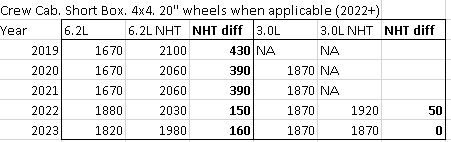
I've been looking at Silverado 1500 quite a bit recently as an option to replace my 2013 Ram 1500. I don't think it's likely to work out that I'll find what I'm looking for in Silverado 1500, but while looking at payload stickers for Silverados/Sierras on the internet and asking some local dealers to send me payload stickers from the B pillar of trucks I became of aware of decreasing payload in the newest generation (2019+) of these trucks. I put together the following comparison table from the "eBrochure" for each truck year that has the maximum payload (if you get lowest trim level and zero options): I'm looking for a crew cab. I used short box numbers here because they are slightly better than standard box, and I'm not 100% sure a standard box will fit in my garage. I'd really like to get the baby Duramax, and that's what I've been mainly looking at. I started comparing to the 6.2L because I noticed it seems to generally have a large payload (from the b pillar stickers). My title may be a little bit misleading since 2021->2022 actually saw an increase in the 6.2L payload...however, the payload with the max trailing package (NHT) actually went down even though the non-NHT payload went up. For the 3.0L Duramax, it's only been offered since 2022 and only added 50 pounds to the payload. MY 2023 it adds zero pounds to the payload! The description for the current model year in "Build & Price" on Chevrolet's website claims "Increased towing and GCWR" (amongst other details). So there is no direct claim of increase in payload, but all of these 1500 are going to max out payload before they hit the trailering "GCWR" limit. For example, a 3.0L MY2023 has a trailering capacity of 13,000 which is great. However, even at the minimum recommended 10% trailer weight on the tongue that takes up 1300 of the available 1870 pounds. That leaves 570 pounds until the maximum is reach. A couple of large guys in the cab will come close to maxing that out. A family of 5 will certainly break that. And that's with the minimum tongue weight for a trailer to use up the capacity. If a trailer is closer to the 20% tongue (as many are), that would be 2600 pounds of the available 1870. See a problem here? In the middle with 15% is 1950 of the available 1870. Why wouldn't GM look to increase the payload with such a package that increases "trailing capacity"? To be fair, NHT does increase the payload for the 6.2L across all five years...but it is down from an addition of 430 pounds in 2019 to 160 pounds in 2023. Is GM just adding more and more to these trucks each year since the redesign in 2019 and not caring about the additional weight of what they are adding to them? Is there information anyone has come across that explains any of the decisions GM is making regarding payload? TBH, looking for a new truck has been kind of discouraging. I'd like to find a truck that can pull my travel trailer and hold my family of 5. I've been looking for a minimum of 1700 to 1800 pounds as that should be enough to keep me below exceeding the payload rating. I also need power folding mirrors since I park inside every evening and I've had them for the past 9 years on my Ram. Silverado requires you to get the LTZ trim to get power folding mirrors which apparently adds quite a bit of weight. The Duramax also reduces the payload even though the main compelling feature it brings is the additional torque for towing. I get there is a conflict there between engine weight and payload, but it's unfortunate they cannot make other changes to keep the payload up or improve it for one of the main reasons some is going to get the Duramax. I'm not super excited about a 2500 because this vehicle is also my daily driver which I will use it for about 95% of the time and it's really kind of overkill for what I need. I'm rambling a bit about my frustrations with finding the right truck for my needs, but I'm really curious if there is any more info out there for those of us wondering why GM would be okay with these payload numbers continually going down, and the NHT package getting closer to the point (it's there already for the Duramax) of doing diddly for payload.


-
Forum Statistics
250.5k
Total Topics2.7m
Total Posts -
Member Statistics
342,972
Total Members8,960
Most Online
-
Who's Online 10 Members, 1 Anonymous, 1,574 Guests (See full list)