


asilverblazer
-
Posts
4,776 -
Joined
-
Last visited
-
Days Won
9
Recent Profile Visitors
10,073 profile views









asilverblazer's Achievements

Senior Enthusiast (11/11)
445
Reputation
-
At what point "between" were you refilling them? (1/2qt, 1/4qt) Did you ever overfill any? What did you do if you did? Further to my opinion, I don't want to keep or have a bunch of 1/2 quarts laying around in the garage. That kind of forces a wait until it's down to the 'full' quart low mark. And if I'm in spitting distance of an oil change anyways, I'm not dumping a new quart in to drain it back out a month later. That mindset is geared more to the darn near 10 qt capacity of the current fleet, being 10% low is a much different animal than 20%.
-
Another 6.2L engine failure!
asilverblazer replied to Stevens54's topic in Engines & Drivetrain (V8, Duramax, TurboMax)
What 'more' are you referring to? I'm not asking anything more than what the LS engine has been doing basically for nearly three decades. They aren't spinning significantly faster, I doubt the loads placed on those components has changed significantly. Even the oil weight has been the same since at least 2007, when 5w-20 was the spec for my Silverado. (The 2016 might be 0-20... don't fault the memory) I wonder if a manufacture would ever do a 'limited' lifetime power train warranty, that covers more or less a long block, block (rotating assembly, heads, cam, LIFTERS, timing set) plus transmission internals. I don't need an alternator, O2 sensor, radiator, etc. warranty, but if it requires a machin shop to fix... Oddly enough, Kia (I think) used to offer something ridiculous on the power train, GM used to have a 5 year 100k power train, and some dealers offer 'engines for life' here. Without delving into the fine print... -
Another 6.2L engine failure!
asilverblazer replied to Stevens54's topic in Engines & Drivetrain (V8, Duramax, TurboMax)
Your 2016 had the same crank bearing failure as a 2019-2024? -
I doubt the machines care whether Bob, Jesus or Mickey Mouse pushed the button.
-
Personally, if it's anywhere on the upper 3/4's of the marked area I'm not adding anything, to avoid the 'risk' of overfilling. If I am close to oil change time, and it's at the bottom of the marked area, I still might not add any. For this to be the case (which it never has) the engine would be consuming an amount of oil that I am no longer worried about the longevity of it.
-
Shopping for new truck and have question.
asilverblazer replied to Gary Doolin's topic in 6.6L Gas V8 (L8T)
-
You could hold yourself liable for something you did to yourself, for yourself.
-
Shopping for new truck and have question.
asilverblazer replied to Gary Doolin's topic in 6.6L Gas V8 (L8T)
I see you've stepped in my cynicism. -
Shopping for new truck and have question.
asilverblazer replied to Gary Doolin's topic in 6.6L Gas V8 (L8T)
Carfax is at best a joke and more appropriately called a scam. I've seen clean car fax cars that were wrecked and commanded a premium price because of the clean car fax, do a little digging and you find that it was likely repaired (botched) in someone's backyard and worth 1/2 what was paid. Flip side, we had a new Explorer Sport Trac way back in 2003, someone hit and messed up the rear door and running board. Not a bad crash - a fender bender in all rights except it was't the fender it was the door. I made sure that it was professionally repaired, with genuine Ford parts, no Bondo, perfect paint match etc. No one would have ever know it was hit - except for car fax. Instant 1500.00 to 2000.00 hit at time to get rid of it. A 'regular' appearance at the dealer oil change line means what exactly? What oil was put in it, how was it driven, environment, other maintenance, etc... Meanwhile, Grumpys truck, the worlds best maintained, (probably) comes with extensive documentation that never makes it past the next buyer. Absolutely nothing on Carfax... suddenly it's the worst maintained. Carfax is a cheap way for Big Data to sell a product to make lazy consumers feel better about their used car purchase. 'Buy Back Guarantee', good luck. Carfax = the automotive version of Experian, Transunion and Equifax - junk big data, that no one is responsible for and only useful for extracting money out of the weakest player in the game, the lone consumer. -
What is that going to fix? (Besides a bunch of breaking a bunch of manifold bolts...) Are they cracked? Touching them will likely cause more problems than a little rust.
-
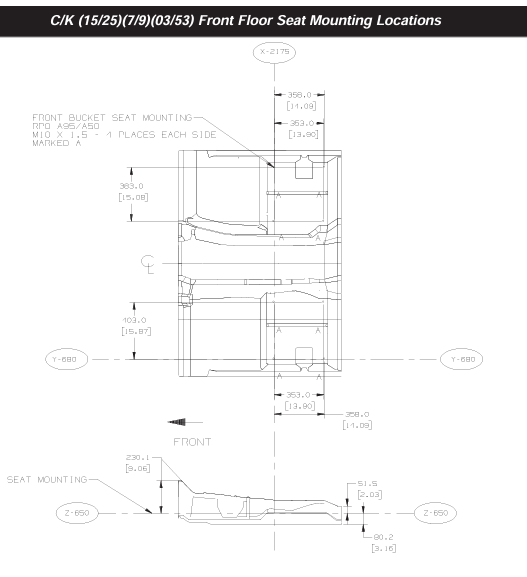
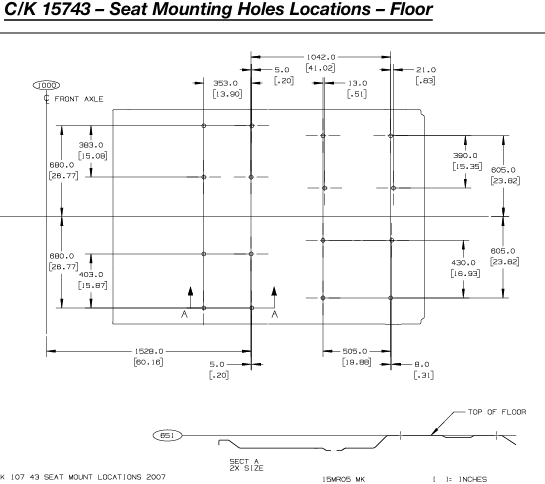
For a 2000 model - GMT 800 the pattern is: For a 2014: Fron seat mount spacing looks identical - enjoy.

-
That's not what I was talking about. I have not seen it specifically documented that bottom of the hatched area equates to "1 quart low". I've never measured or compared a dipstick reading at the bottom of the acceptable range, added 1 quart, took a new reading and it be exactly at the top of the range. My view of the manual is if it is BELOW the mark, add one quart at a time until the level is within the hatched area, 1 quart could put it 1/4, 1/3, 1/2 all the way there. I don't know, none of mine have been BELOW the mark to require adding any to find out. However, if over 400 miles it takes multiple quarts to keep it in the hatched area, yes, that is a problem. EDIT: None of my vehicles have ever been to the bottom of the range, every check shows them give or take somewhere on the top half of range. (I might even challenge my own memory and say at worst the top 3/4s.) Never to the bottom, much less below the "add" mark, so I've never added 1 quart to see how much it moves the level up the stick. Circling back to my point, the volume coming out is less than what everyone suggests my dipstick readings should be indicating. If from the top to bottom mark of the hatched area equates to 1 quart of oil, I would see the dipstick reading (on every vehicle I've touched in the last 30 years) be at the top of the mark when I fill with new oil and be at the bottom just prior to changing; based on what I am measuring in the drain pan. However, the dipstick readings are NOT showing that amount of drop. See above.
-
I take it as add one quart at a time until the level is within the hatched area. I'll be attempting to better determine on my current two trucks what 1 quart looks like on their dipsticks.
-
Grumpy Bears 2015 Silverado 2WD
asilverblazer replied to Grumpy Bear's topic in Member Build Threads
My expectation for any vehicle: 250k on the original engine and transmission. Following manufacturers recommended maintenance. (I know, another argument) After that, there's not much truck left around them. Weather: faded paint, dried out rubber and plastic, hazy headlights Urban/Rural warfare: Door dings, rock chips, brush scratches, windshield chips, fender benders Road wear: CV-shafts, ball joints, wheel bearings, bushings, water pumps, seals and gaskets Kids: Stained seats, carpets, melted crayons Oops: Got in with a screwdriver in my pocket, knocked something over in the garage on it, left the windows down in the rain... It's a long road (pun intended) to keep a vehicle nice enough to continue investing in after the 10 years/250k miles. -
Perhaps, especially as noted since this post in the days of smaller capacities. I haven't seen any data or official publication describing or acknowledging the same - especially in the last decade. I posted it already, but, yes, when level falls below (point of semantics, below, not, to) the marked area, add oil. Never add oil above the mark. Given that above the mark is just as dangerous as below the mark (per the manual, not exactly my opinion) to keep the level at the top of the mark, or full, could be just as risky as at the bottom of the mark.


-
Forum Statistics
250.3k
Total Topics2.7m
Total Posts -
Member Statistics
342,720
Total Members8,960
Most Online
-
Who's Online 1 Member, 0 Anonymous, 582 Guests (See full list)