


Tickerguy
-
Posts
26 -
Joined
-
Last visited
Tickerguy's Achievements

Enthusiast (2/11)
5
Reputation
-
Check the fuel trims. If you are lean (very HIGH trims) at idle, especially when cold, but with some throttle (or when running) they are lower or near/in the normal range on BOTH banks I'll bet your intake gaskets are leaking (badly.) This problem tends to be materially worse the colder it is outside, especially on a cold start. When it gets especially bad the engine will not run at idle when its cold out unless you give it a fair bit of throttle. BTW this is a "must-fix" because you are ingesting UNFILTERED AIR which means you're greatly accelerating engine wear. Do not ignore this; CLEAN intake air is LIFE, second only to clean oil under pressure. Pretty common problem and not all that hard to fix -- I recommend using the FelPro set, its of better quality than OE and no more expensive. I've had to change them on a couple of these engines; while you have the intake off check the knock sensors under the manifold and if there is ANY indication of water intrusion in there replace them both, the harness to them and the plugs -- and seal both with silicone. It BITES if you wind up having to remove the intake a second time to replace the knock sensors! Do use some care when taking the intake off as there is often quite a bit of debris in that area between the intake and the head and you don't want it going down an open intake port!
-
If its an 01/02 then the throttle body should be cable-driven -- the only potential issue is the IAC (idle air control) valve and whether the cables will connect (including the second one for cruise control.) If it connects up it should work, assuming the air intake piping from the air filter and MAF will connect as well of course. Roughly '03 (although SOME 03s, specifically I've seen it in the 1500 Vans) they went to electronic throttle body and DBW for the loud pedal -- and no IAC. Those obviously will not interchange.
-
2003 5.3L Express persistent high LTFTs at idle
Tickerguy replied to Tickerguy's topic in Chevrolet Express & GMC Savana
Yeah I checked those and the MAF as well; the IAT is in the MAF and both were reading ok, along with coolant temp. I'll look for the ambient sensor if I can find the PID for it; I know there is one somewhere as that also gates the A/C off when it gets too cold so below-freezing temps don't slug the compressor. -
2003 5.3L Express persistent high LTFTs at idle
Tickerguy replied to Tickerguy's topic in Chevrolet Express & GMC Savana
Solved -- leaking intake gaskets. The OE ones had ZERO relief off the plastic carriers when removed and there were clear tracks where they had been leaking at idle. Its a Jenga-style puzzle getting the intake out on these vans; it comes out the back via the doghouse once you figure out what has to be unclipped and otherwise gotten out of the way. Of particular amusement is the transmission dipstick tube which is actually two pieces vertically and that is not at all obvious -- but it is, and it does separate. Without that you have no way to gain clearance for it to come out. I used the FelPro replacements; it looks like a better solution. Now that I know what has to be moved and in what order I could probably get it out again in an hour or two. Not nearly as bad as I thought it might be -- it LOOKED impossible. -
If its like the '03 my kid has the fuel pump relay is in the main box which is under the brake master in the engine compartment. It is labeled on the top of the lid. The easy way to do this is probably to figure out which is the wire for the coil coming into that relay and interrupt it. No coil power, no relay pull and thus no fuel pump pressure, no start.
-
I'm usually pretty good at finding these things, but this one has me entirely-stumped. This is a cable throttle unit, not the newer electronic throttle body, so it has the IAC valve. The truck had a problem with the IAC wiring, which is pretty common on these and led to all manner of misbehavior with the requested idle not matching actual including both a stumble/stall and racing idle depending on what sort of mood it was in. That's fixed and the idle is now stable. The MAF was also questionable and not producing the sort of numbers it should under hard acceleration, so that got replaced too. MAP is good; shows 14.1 engine off, ~4psi at hot idle, normal and plausible while driving. Idle is stable at 550, plugs are new laser iridium as are wires as the plugs in there were generating a few misfires and, when removed were slightly out of spec on gap. Swapped one bank's O2 sensors, no change (so obviously the originals were good); they LOOKED ok but if they're slow I've seen this before. Nope, not this time. Go drive it and fuel trims are normal. When cold they're wildly high; LTFTs +25 on both banks. After it warms up they'll come down to about +15 at idle in park, which is still too high. STFTs behave normally. Come off idle a bit (e.g. 1200 RPMs in park) and they come down, but not to zero. O2 sensors sweep normally once the engine goes into closed-loop. This implies a vacuum leak, but I'm pretty darn sure there isn't one as the MAP is normal and MAF is mid-4s at hot idle, which is also normal -- and a vacuum leak will cause MAP to read high. No damage on any of the hoses to the manifold and detaching and plugging the ports manually does not resolve it (e.g. if there was an open somewhere into the crankcase thus the PCV was basically open all the time to atmosphere, etc.) No code for evap fault so its not the purge into the manifold. Fuel rail pressure is also good; 53psi at idle, right around 60 when the key is on before you start; the vacuum modulator for the fuel rail appears to be good and pressure is fine. I ain't buying a manifold gasket leak given that; if that was the cause I should see it in the MAP sensor and I don't. Misfires are also normal (zero other than one or two counts during start); there were a few recorded when I first started looking here and there and the wires looked original so I changed both plugs and wires (the wires disintegrated trying to remove them); plugs are the newer iridium ones as what was in there were the older-style platinum. There was no evidence of misfires or fouling on any of the 8; all looked good other than normal wear and slightly out of spec on gap implying there's not an injector problem; there is definitely not a cold or fouled cylinder involved, and besides, both banks are out of range so its not logical its a cylinder-specific issue nor a bad/plugged catalyst. In cold weather (below freezing) it goes far enough out of range on a cold start to trip bank lean codes (which the fuel trims say it is) but in warmer weather generates no codes. I'm rather stumped; any ideas on where to look next?
-
Welcome to the Hell my daughter had with her '03 Express. Same deal. It's especially great when it happens in the middle of traffic. Oddly enough it has only happened to both her and I at altitude; at sea level, never. Both her truck and mine are sporting new fuel pumps at this point and it has not yet recurred. I dropped the tank to get to both of them; it's especially fun on the Express as the idgits at GM used captive nuts on a crap bracket that inevitably strips when you try to take them out, so you get to drill the bolt and then buy new captives (which are, fortunately, readily available and cheap.) Oddly enough while Delphi redesigned the pump that goes in my '02 Suburban and should completely remedy the root of the issue the pump for the '03 Express was exactly the same was what came out of there. It was clearly original and the fittings are different between the two so there's no possibility of using the Suburban's in the Express. Oh, and for good measure on the van the tank design is such that you can easily wind up with a no-fuel situation with close to a quarter tank if you travel up an incline (you'll see once you drop it why; there's basically no sump which is Effing Stupid.) That's not a factor on the 'Burban. There IS a fuel pressure regulator at the rail; on some it has a vacuum connection (does on mine) and on others it does not. Your pressures look good but so did mine -- right up until it died, of course. I spent a LOT of time chasing potential electrical (e.g. swapping the fuel pump relay, etc) with no joy, but as far as I can tell it is actually fixed now (and I've been using it "in anger" since, including towing where the load is a LOT higher.)
-
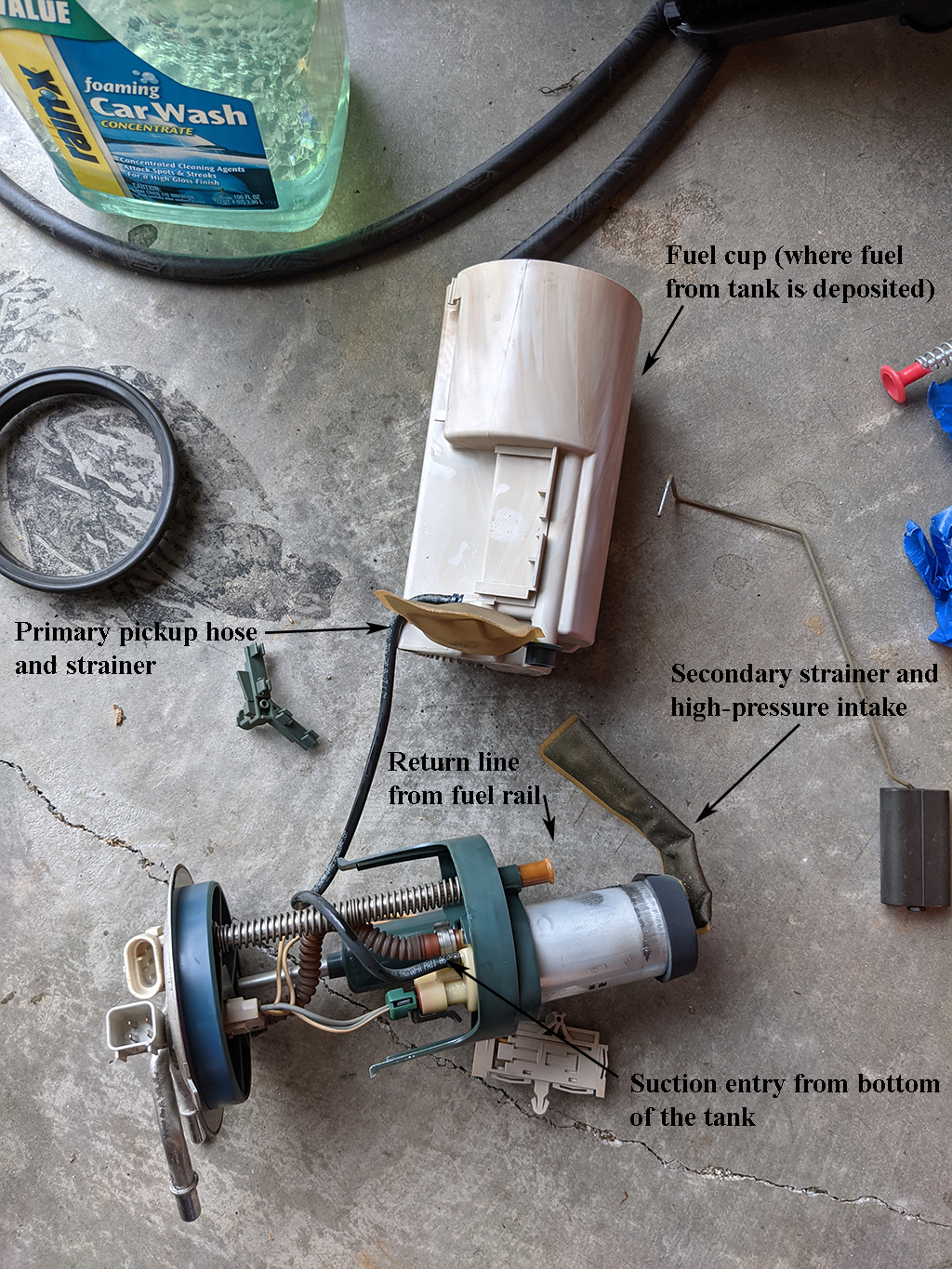
So the new pump is here and guess what -- the fine folks who make these things came to the same conclusion I did above some time in the last however many years. Anyone with a vehicle in this age range that has a return line and the original fuel pump, or one of unknown vintage, if you have this sort of problem (high-altitude, high-temperature issues with fuel delivery) I'll bet its related. The new pump I received today (Delphi) has *two* chambers in the cup. The first admits fuel as the other one did with a silicone flapper at the bottom. The return also dumps into there. The motor, however, is not in that chamber -- there is just a suction line all the way down at the bottom of that chamber in the cup. The *second* chamber pulls the fuel in that chamber through the suction line into the pump/motor chamber and ejects it out toward the rail. I presume as there is no visible connection for cooling flow there is a cooling flow bleed somewhere on the pump itself that bleeds a small amount of the ejected fuel into that chamber of the cup since I cannot imagine that chamber remains "dry" in operation. This accomplishes several things that materially improve the pump and, I bet, prevent the problem. 1. The pump *itself* no longer contributes to the heat level in the cup, since the bleed is now a continually-exchanged flow of fuel for cooling purposes rather than the motor simply being submerged in the cup and relying on engine draw for turnover. It also means the entire motor is submerged, which was not the case in the old design as the fuel level got lower in the tank The continual bleed means that heat is effectively carried to and dissipated in the entire load of fuel in the tank, instead of just a small part of it. That's a major improvement. 2. The suction side from the first part of the cup is obviously a positive-displacement stage. It has to be, otherwise the pump would never work at all (it would fail to prime) if the fuel level was lower than the hump in the hose, which it nearly-always is unless the tank is completely full. This in turn means that *IF* vapor gets into that hose the vapor will be immediately pulled through and expelled, likely preferentially through the cooling bleed at the motor since it is of much lower density than liquid fuel, and thus the collapse of fuel rail pressure is averted. The second stage (that pumps the fuel to the rail) cannot be positive displacement because if the pressure regulator at the engine were to fail closed the pump would dead-head, go locked-rotor and destroy itself almost immediately. Thus this has to be a two-stage design -- the previous one may well not be (I may well rip it completely apart to find out.) When I get the chance I'm going to see what's in my daughter's van -- I'll lay odds its the OEM fuel pump given what I've found here. I think we can call this one resolved.
-
Observation: These fuel pumps ("Cup style") all appear to return fuel to the cup and not the tank "at large." IMHO this is a generally-bad design because the fuel being returned (bypassed by the regulator) is going to be quite hot. In fact, in adverse conditions (e.g. very hot day outside, engine is working, etc.) that fuel could be VERY hot. Putting it back in the cup means it does not have the mass of the remaining fuel to dissipate the heat into, nor can it dissipate it through the tank wall; it will instead be immediately recirculated to the engine by the pump a second and subsequent time. I can see where a return back to the tank generally could be trouble too in that the fill rate into the cup might be insufficient and if it is then you'd get starvation. But without an external fuel cooler, which I know this truck does not have (my VW Jetta TDI does under the floor in the return line) this looks like it could be begging for serious trouble. Gasoline has an initial boiling point (at atmospheric pressure) around 95F where the lighter fractions boil off; I've seen 150F IATs in the mountains with this engine on Torque which is MUCH higher than I see around here even under heavy operating conditions, and obviously the fuel rail is right near the exhaust manifolds which are plenty hot when the engine is running. Altitude would potentiate this materially by depressing the boiling point; at 6,000' the boiling temperature is lower by about 6% so now we're right around 90F for that initial fractionalization. I have to wonder if the shutdowns are actually potentiated by fuel boil in the pump cup, which of course then winds up attempting to pump vapor and the rail pressure collapses even though the pump has power and is running. The shutdown resets the condition since the boiled fraction would either wind up in the charcoal cannister or condense and then the fuel level in the cup would be made up by cooler fuel in the tank itself, which is liquid. Key off/on, in short, would be enough time for the vapor in the pump to condense back to liquid and pumping is restored. This also explains why when the tank is VERY full it doesn't happen; the cup does not go all the way to the top, so if the tank is full enough you get exchange with the fuel in the tank at-large. If that's the case the only actual fix is an external fuel cooler since the cup design will always recycle the returned fuel and no new, cooler fuel will be admitted until the level drops, so you will always be able to provoke this under the right set of circumstances (altitude and heat.) The other fix I can come up with would be to drill a few holes at about 1/4 of the way up the fuel cup; in this fashion if the tank is more than 1/4 full or thereabouts you will get circulation of the extremely hot fuel back into the tank at-large. It won't prevent you from getting hosed if the fuel level is low, but otherwise it should. Direct-draw, non-return pumps will not run into this as there's no circulation back to the tank of potentially heated fuel from the rail.
-
Oh there's a drain plug in mine. It was non-removable. Once I got the pan off and could put REAL torque (and HEAT on it) I realized they likely loctite RED'd it in the hole. Ain't coming out, no way, no how, and was obviously done at the factory to force you to drop the pan, which is ok generally in that you want to change the filter anyway. Kid just had the 4L60E blowup happen to her; almost 200k miles, smoked the 3/4 clutch pack. Limped it to a place in second. Nice surprise when you're on the road and it blows up in your face; not much you can do about it though as I'd driven it recently and there was no hint of misbehavior first. Mine is still behaving ok but eventually I'm expecting to have to drop and replace it.
-
Biggest bit of stupidity (other than the parking brake design which has been stupid on GM truck products for decades, simply because it never gets hot and thus turns into a ball of rust) is the impossibility of dropping the transmission pan without removing the shift cable bracket first (or the exhaust, which is even worse!) That wouldn't be such a big deal EXCEPT the bolts are Torx and on the TOP of the gearbox, and on a 4x4 the front driveshaft is in the way, so you get to take that out first. Turns what should be a 30 minute job to do trans fluid and filter into a couple of hours. God help you if you strip those Torx bolts too; do that and you get to pull the transmission in order to get to them with a cutoff wheel on a dremel or similar. First time I did one of these I ASSUMED there was clearance to get the pan off -- and wound up taking a transmission fluid bath as a consequence.
-
Who's the jackwad at GM who thought that tiny little feed hose from the tank bottom would be sufficient to keep the cup full under all load and environmental conditions? Specifically the most pressure differential (and thus flow potential) you can ever have on the "suction" side of a pump is 14.7psi, and as you go up in altitude that decreases of course. Run out of fuel in the cup if you consume it faster than the lift side can refill it and the high-pressure side sucks air - you're done. The obvious debris all over the in-cup strainer -- but none polluting the tank-bottom one -- is almost-certainly what used to be internals of said lift pump. The inside of the tank is completely clean; no debris of any sort. There's what appears to be a silicone one-way valve on the bottom of the cup for it to fill as well; it's possible that second intake is only for cooling flow, but if it is then the disparity of debris in the two strainers still is a problem. It appears, from the pictures I've seen of the replacement on the way, that this bit of stupidity has been corrected as there is no second thin line anymore. One thing I get very, very annoyed with is obvious stupidity in design. This qualifies.

-
I'm going to tear it apart and figure out why it failed once I get a replacement and put the beast back together. This is certainly an interesting one and since its original, and the kid's may be as well, I'm wondering if we share a common flaw in terms of design that may have been addressed down the road but neither was ever changed out.
-
And the answer is.... with the pump sucking air two full 5 gallon cans siphoned out and a third that was 2/3rds empty (so call it 13 gallons so far) and there is still fuel in the tank! Sum-ting-wong with existing pump
-
Well well now we got an interesting and new set of facts. Dropped the tank. Should have been empty. When I got the jack under it and took the straps off, well, it was rather too heavy. I got it out and.... there's a crap-ton of fuel in it. But the pump was pumping... nothing. So..... hypothesis (which I will confirm when I get the pump out after going to get a siphon to remove the fuel) is that there's a crack somewhere in the pump that lets air in intermittently but, it's not all THAT intermittent because here I am at sea level, I ran the pump until I got no fuel jumpering it, and the tank is nowhere NEAR empty. We'll see exactly how much is in there when I get the siphon. And I need a piece of 5/8" ID fuel line as I had to cut the vent line; it would NOT come off the nipple on the tank and that's plastic, so getting really aggressive was asking to buy a tank which I definitely did not want to do. Surprisingly enough the area above and around the tank is in surprisingly good condition corrosion and such-wise. No problems at all, which for 20 year old truck..... who can argue with that? Pump is on the way. For those who don't know there's an anti-siphon (and ignition) screen on the inlet and vent lines. Stuff a hose down the filler attempting to siphon fuel and you'll get nothing.

-
Forum Statistics
250.6k
Total Topics2.7m
Total Posts -
Member Statistics
343,007
Total Members8,960
Most Online
-
Who's Online 2 Members, 0 Anonymous, 902 Guests (See full list)