

Wcuchad
-
Posts
18 -
Joined
-
Last visited
Content Type
Profiles
Forums
Gallery
Events
Articles
RPO
Store
Blogs
Everything posted by Wcuchad
-
issue Popping noise from under the bed area?
Wcuchad replied to Charlieo132's topic in Troubleshooting & Recalls
Found it. It is actually for older models but im sure it would pertain to newer as well. 2010 Chevrolet Silverado - 4WD | Cheyenne, Sierra, Silverado VIN C/K Service Manual | Document ID: 2732835 #06-03-09-004D: Squeak Noise from Rear of Vehicle (Lubricate Rear Leaf Springs) - (Nov 1, 2011) Subject: Squeak Noise from Rear of Vehicle (Lubricate Rear Leaf Springs) Models: 1999-2007 Chevrolet Silverado (Classic) 2007-2012 Chevrolet Colorado, Silverado 1999-2007 GMC Sierra (Classic) 2007-2012 GMC Canyon, Sierra 2007-2010 HUMMER H3, H3T This bulletin is being revised to add the 2012 model year. Please discard Corporate Bulletin Number 06-03-09-004C (Section 03 – Suspension). Condition Some customers may comment about a squeak noise coming from the rear of the vehicle. During normal operation, certain vehicles may exhibit a squeaking noise that may be traced to the rear leaf springs. While this noise is an operating characteristic of leaf springs, the frequency and severity of this noise will be affected by the roads that the vehicle is driven on. Cause This condition may be due to debris getting between the leaf springs. Correction To correct this condition, lubricate the rear leaf springs using the following procedure. Important: It has been found that the application of grease to the rear leaf springs does a better job of preventing the noise from reoccurring than replacement of the spring. 1. Raise the vehicle on a frame lift-type hoist. 2. Inspect the springs for damage. If none is found, proceed to the next step. 3. Pressure wash the rear leaf springs to remove as much dirt and grit as possible. 4. Dry the springs with compressed air. Note: Ensure any tool used to gently pry the tip inserts or spring leaves is protected to prevent damage to the spring leaves. 5. Apply a liberal amount of grease, P/N♦12345996 (in Canada, use P/N♦10953501), both underneath and on top of the front and rear tip inserts for the #2 and #3 leaves, as indicated below. A screwdriver can be used to gently pry up the tip insert; however, a rag around the screwdriver must be used to prevent damage to the spring. Use a flat-bladed tool, such as a gasket scraper to properly distribute the grease. 6. Lower the vehicle to the ground and test drive to verify the repair. Please inform the customer that this will offer relief, but is not a lifetime repair. Periodic cleanings and grease re-application may be necessary throughout the life of the vehicle. For 1500 Series (½ ton) models only: On vehicles built prior to October 2004, if the above procedure does not correct this noise, it could be caused by an incorrectly dimensioned splay clip (the band holding the ends of the leafs together) that interferes with the leaf springs. A 5♦mm (0.197♦in) wider splay clip was introduced in early 2005 model year to provide additional clearance. To correct this concern, replace the rear leaf spring assembly. There was no change to the part number. Parts Information Part Number Description Qty 12345996 (in Canada, use 10953501) Lubricant 1 <a href="http://gsi.xw.gm.com...65742">Warranty Information For vehicles repaired under warranty, use: Labor Operation Description Labor Time E9437* Lubricate Rear Leaf Springs-LD 0.5♦hr Lubricate Rear Leaf Springs-HD 0.9♦hr *This is a unique labor operation for bulletin use only. It will not be published in the Labor Time Guide. GM bulletins are intended for use by professional technicians, NOT a "do-it-yourselfer". They are written to inform these technicians of conditions that may occur on some vehicles, or to provide information that could assist in the proper service of a vehicle. Properly trained technicians have the equipment, tools, safety instructions, and know-how to do a job properly and safely. If a condition is described, DO NOT assume that the bulletin applies to your vehicle, or that your vehicle will have that condition. See your GM dealer for information on whether your vehicle may benefit from the information. WE SUPPORT VOLUNTARY TECHNICIAN CERTIFICATION Its the same bulletin that was out before,they just added the 2012 model-year. -
issue Popping noise from under the bed area?
Wcuchad replied to Charlieo132's topic in Troubleshooting & Recalls
I actually saw it on another thread (I tried to go back and copy the link but now i cant find it) I wish i had the bulletin number since i just got a call from the delaership stating they tigthened the rear shock mount and that magically fixed it. I then told him that that wasnt the fix since I have had both shocks replaced and have been dealing with the issue for 1yr 3 months. Im going to print this off and take it to them maybe they can pull the bulletin number. I will keep you posted. -
issue Popping noise from under the bed area?
Wcuchad replied to Charlieo132's topic in Troubleshooting & Recalls
I have my truck at the dealership as I write this. I too have had the noise had both rear shocks replaced and now that the weather has changed im positive it is the rear leaf springs. With that said has anybody had the below done and if so how long did it help or did it help at all? Condition Some customers may comment about a squeak noise coming from the rear of the vehicle. During normal operation, certain vehicles may exhibit a squeaking noise that may be traced to the rear leaf springs. While this noise is an operating characteristic of leaf springs, the frequency and severity of this noise will be affected by the roads that the vehicle is driven on. Cause This condition may be due to debris getting between the leaf springs. Correction To correct this condition, lubricate the rear leaf springs using the following procedure. Important: It has been found that the application of grease to the rear leaf springs does a better job of preventing the noise from reoccurring than replacement of the spring. Raise the vehicle on a frame lift-type hoist. Inspect the springs for damage. If none is found, proceed to the next step. Pressure wash the rear leaf springs to remove as much dirt and grit as possible. Dry the springs with compressed air. Apply a liberal amount of grease, P/N 12345996 (in Canada, use P/N 10953501), under the front and rear tip inserts for the #2 and #3 leaves, on top of the tip inserts, and in between the #1 and #2, and #2 and #3 leaves, as indicated below. A screwdriver can be used to gently pry up the tip insert; however, a rag around the screwdriver must be used to prevent damage to the spring. Use a flat-bladed tool, such as a gasket scraper to properly distribute the grease. Lower the vehicle to the ground and test drive to verify the repair. Please inform the customer that this will offer relief, it is by no means a lifetime repair. Periodic cleanings and grease re-application may be necessary throughout the life of the vehicle. -
-
-

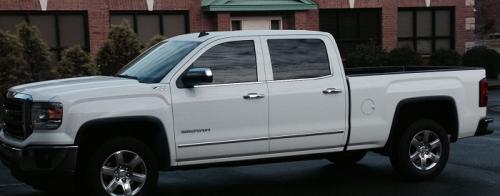
From the album: Truck
-

From the album: Truck
-
Forum Statistics
250.4k
Total Topics2.7m
Total Posts -
Member Statistics
342,850
Total Members8,960
Most Online
-
Who's Online 6 Members, 0 Anonymous, 675 Guests (See full list)