All Activity
- Today
-
.thumb.JPG.2c573de60d3a3a4407c7d92298db46dd.JPG)
Some Assembly is Required
Grumpy Bear replied to Grumpy Bear's topic in Maintenance, Oils/Fluids, Detailing & Rust Prevention
Common Sense Assembly Your driveline is forgiving of the occasional mistake. It will even often forgive the random serious blunder. But it will not forgive a continuous bad habit. What? Not everything needs to be a five thousand word essay. -
We drove about 15 minute east today to visit a friend and saw a steep increase in price in the same county. About 50 cents a gallon steepper.
-
Wow I'm in a pickle. (Broke down truck) and a story.
Grumpy Bear replied to Atlas's topic in The Off-Topic Bar
Sure about that? A degree wheel and a dial indicator would lower your degree of assurance in that statement. It why we have offset keys and dialable timing sprockets. Just say'n.... I've built a few and have never seen one "On the money". -
I will admit I haven't experimented much with pressure drops beyond the numbers I put in and part of that is that the numbers I used are fairly low and then found out it would trigger regardless at that 35 psi. Having said that I had tried before had changed the placard pressures and being that I have a 1 ton set to 80 on the placard for the rear I believe it triggered close to 60, the front I don't recall now for sure but thought maybe it could get close to 45 from that factory 60 placard pressure. So I never did figure out if it was a number of psi from placard pressure to the alarm or a percentage of the total placard number as some figured it was like a 25% drop from placard pressure would trigger it. So as to try and answer your question, I believe I set the placard pressure on the front to 47 or so and while I run the front tires at 40, they have dipped below that some if its colder and I haven't put "winter air" in yet and never once have had the front alarm go off. I would say that the answer your looking for is no, that if you set your placard pressure to 45, you have a certain amount of room to drop below that pressure before the alarm will go off. The pressures you decide to run in your truck, that ends up being what makes sense to you based on what your carrying in your truck or if towing, then have to bump them back up to something that will carry the load in the rear and the fronts typically left at the same pressure. It all comes down to that chart I put the link to and using an accurate roadside scale to be your guide, both unloaded and then loaded to know your minimum safe pressures. I just wish GM would allow a person to change the readings for the tire pressures to the English system of pounds as I have to look at that goofy metric reading that will never ever jive in my head and will go over and change it just to figure out what they are if need be and then change it back.
-

No Software Updates - Old Build
TrueBlue replied to DaleB's topic in Troubleshooting, Warranty & Recalls
That part I understand, that the dealer can do it. But I'm not understanding why updates that were available to the truck since it left the factory, or the dealership originally, would not still be available to it without dealer intervention. I'm thinking along the lines of recalls. They stay available until they are completed, regardless of whether they are in warranty or not, or in the hands of the original owner or not. Why not updates as well, especially since some of those can be safety related also? -
That's good to know, but I don't think I'll even be running them under 45 in the rear unless it's on the sand or something but will only be for a short distance anyways! I didn't read all the instructions in the booklet yet, but do you know let's say I set the rear psi on the placard to 45, will the warning light come on soon as it drops under 45 or is there a percentage it has to drop from the set value before the warning light is triggered?
-

Would this CV Shaft be bad?
newdude replied to anthony2558's topic in Troubleshooting, Warranty & Recalls
That's bad. Like, its probably destroying the stub axle the CV slides into. Do you have a proper lift installed with differential lowering brackets? Did you install AT4/Trail Boss factory CV axles? -

Would this CV Shaft be bad?
PunchT37 replied to anthony2558's topic in Troubleshooting, Warranty & Recalls
Hot? New Jersey? Today? I was working on my old 2000 Silverado 1500 today. Believe me, it was boiling hot today. As it has been. -
Gas on the hi-way followed Mobil's lead and went up a dime to $3.79, Sunoco was still $3.69 though. The truck stop went up twice today, first a dime then a nickel. Diesel $5.35 at Sunoco but $5.79 next door at Gulf
- Yesterday
-

No Software Updates - Old Build
DaleB replied to DaleB's topic in Troubleshooting, Warranty & Recalls
There are no available updates in my settings, but the dealer can still flash the latest. They told me it was risky to force flash updates because if anything went wrong with the update that I'd be on the hook for the repair costs. They recommended just leaving it as is. -
I put a set of the Eibach Pro Truck 2.0's on mine this past weekend. Lower bolts def was the trickiest part. Def leave the top bolts very loose, as in the nuts barely started. Have a jack under the LCA so you can move it up and down. One of mine I had to barely unclip one side of the spring nuts as to create the odd angle. With those spring nuts being fairly loose, and holes slotted, it can be done. Just have to keep at it. One note, I used a LONG extension with deep barrel socket on the inside nut on the passenger side, was able to reach it from the top. Swivel head ratcheting wrench on all the others. Couple of observations: sure seems like the rear lifted some, which I know sounds crazy since I kept the original leafs. I ran the front shock adjustments all the way up to the 137mm measurement. Unfortunately I didn't measure rear wheel arch height before. Front measure about 5/8" higher than before, but I'm sure it had settled some. Had 110,000 miles on the original Ranchos, I can't express how much better the ride is now.
-
Wow I'm in a pickle. (Broke down truck) and a story.
TrueBlue replied to Atlas's topic in The Off-Topic Bar
If it's not put to normal and right, it won't be from lack of trying on your part. Or because you didn't spend the money that needed to be spent. You're committed and thorough for sure. -
No Software Updates - Old Build
TrueBlue replied to DaleB's topic in Troubleshooting, Warranty & Recalls
Just out of curiosity, why would there be no available updates if in fact updates had previously been available but not installed? Does a vehicle have to be under warranty to receive such updates? -
Would this CV Shaft be bad?
anthony2558 replied to anthony2558's topic in Troubleshooting, Warranty & Recalls
Thanks. The wheel hub looks fine and no play when moving the tire. I tried to take the axel out but couldn't get it to budge off the front dif. It's to hot for this stuff, I need air conditioner in the garage. Lol -

No Software Updates - Old Build
Atlas replied to DaleB's topic in Troubleshooting, Warranty & Recalls
If there are updates/fixes you want, you could pay to have the updates applied by the dealer. -
Hi all - my current truck is a 2022.5 1500 High Country 3.0. I bought the truck used last year. After doing some digging, I noticed that my truck's software is stuck on the original build from 2022. I have no available software updates. I talked to my dealer about this and they recommended not trying to force an update since the 36,000 mile warranty is expired. This is a big bummer since there have been many major releases since that have fixed small issues and improved speed/usability. For reference, the current software build number is: full_gminfo37_gb-user 10 W158E-W164.4.2-QIH22B-563.3 158 release-keys Has anyone had a similar experience? Should I just forget about it and move on, or try a different dealer?
-
Sure. Buy it for me
-
Using zip ties but 2-3 they snap due to sharp edges. Just using a shoestring. Last longer.
-
DaleB joined the community
-
Wow I'm in a pickle. (Broke down truck) and a story.
Atlas replied to Atlas's topic in The Off-Topic Bar
I ordered the Snap On...waiting for it to come in later this week or early next week. New front cover, new crank seal and new balancer are on. Water pump, pulley, fan, hoses, and plastics reinstalled. I can move forward knowing all my timing marks are dead on and the front engine is hopefully sealed better than it was. Take 2 with the water pump...trying high temp thread sealer on the lower bolts. Rebuilt injector and new-new regulator is in, it looks like new. Top intake reassembled and all the bits are reconnected and snugged down. Thinking about knock sensors again, I located both of mine and, there's your problem, Francis... The driver's side one is broke, plastic is bashed in, part of the wire is bare, and it appears to have been damaged like that for a long time. I saw the wire but didn't think anything of it. The knock sensor might not be my pulled timing issue, but it sure looks suspect. It must still be conducting, otherwise I'd expect a CEL. But perhaps with its sacred crystal inside exposed, jilted and dirty, maybe it's sending mixed signals. So I'm waiting for one of those and a new pigtail to come in. Pass side sensor looks good, except for the spark plug wire resting on it (!). The plug wires are healthy so it shouldn't be causing an issue, but I separated them and added zip ties to nearby looms to keep everything well apart. So, I'm down to installing a knock sensor AND, oh, replacing the exhaust and cat. I actually think that's going to be fairly easy, it's all bolt-together, all new stuff from Walker is laid out on the shop floor ready to go. Hopefully have this thing on the road again for the weekend. My luck? It will still be leaking oil, coolant, pulled timing, intermittent CEL for running rich, or it probably won't run at all -- because that's how this project has gone. I've never worked on a vehicle so ...hurt? ...cursed? in my life. Everything has been effed with SO HARD, but I think...knock on wood...I've managed to undo all the backyard stuff and we're almost reset back to "just" an 80k mile, 30 year old Blazer. -
Would this CV Shaft be bad?
PunchT37 replied to anthony2558's topic in Troubleshooting, Warranty & Recalls
Yes. You need to check out that thing, and the hub further. -
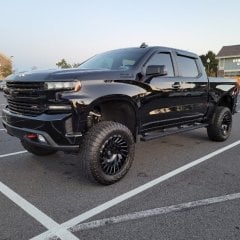
Would this be normal or a worn CV Shaft? 51K miles 3.5" lift? Boots are intact and no visible leaks showing. Attached is a the video I took. Thanks https://youtu.be/ZnW7PPRmjJY?feature=shared

-
2010 Avalanche 5.3 not running correctly after engine swap.
Jsdirt replied to contrabombarde's topic in Ask A GM Technician
If everything checks out at the MAF, then the MAF is BAD, new or not. You don't need a signal generator to troubleshoot this. PCM needs ALL powers and ALL grounds able to light a halogen headlight bulb - if it can light the bulb bright, then the wiring is good enough to run the PCM. Best thing you can do for yourself is spend some time here: scannerdanner.com - Check out all his YouTube videos on similar issues. If you decide to subscribe it's the best bang-for-buck ratio in the automotive world, hands-down. He's got TONS of free vids on YouTube, too. -
You got that Hengst D110??
-
 Yes, I used my multimeter to probe all of the wires at the MAF, both with the sensor connected, sensor disconnected, key on engine off, key on engine running, etc etc etc. I probed all of the wires again at the PCM, at the connectors, etc. All voltages are what they should be according to the service manual/wiring diagrams. All grounds are good, less than 20 millivolts from the battery negative under load. Both at the connector of the MAF, at the PCM connector etc. I know this throws a pretty big wrench into things, but this truck was acting up before the swap. I don't have very much information, if any on what was causing it, but if you cleared all of the dtcs it would do the same thing where it would crank, fire, then die. And it would do the same thing a dozen or so times, and eventually it would start and run, but the difference is that it would run and actually be drivable. Whereas now if you can drive it at all, it goes into reduced power mode almost immediately, and even then it's not running correctly. When you come to a stop at a light it stumbles down to for 500 RPM before catching itself and returning to the smooth idle. And if you go more than about 50% throttle then it immediately goes back to doing the misfire thing. Like I said, I know that throws a wrench into things, and unfortunately I was not able to pull any data or anything like that before I did this work, so I don't have much to go on. I'm trying to not fixate on one particular thing as the cause of the problem, but it seems like all avenues are pointing me towards the PCM. Like I said I have tested the wiring extensively (see above), and during cranking the sensor does produce seemingly legitimate values at least according to my multimeter, but as soon as the engine fires those values quickly descend into gibberish. I've tried it with multiple different known working sensors, I have done literally every test I can think of multiple times on the wiring (probing the signals, probing the pins with the sensors unplugged, probing the pins at the PCM, voltage drop, voltage drop under load, continuity, ohms, and double-checking everything against the wiring diagrams/ proper values in the service data.) Another thing that pushes me towards a possible PCM failure is, I have noticed in troubleshooting a little bit taking a break and coming back, that when I leave the truck to sit for a while and cool off, it starts and runs smoothly when I first start it up. However once it warms up. It starts having problems. For example, when I went out to the truck this morning after it had been sitting overnight, I was actually able to drive it down the block. And then once I got on the throttle a Little bit after going about a thousand ft, it started misfiring again. I pulled it back into the driveway, shut it down, and started it back up. It idled smoothly. As soon as I touched the throttle it did the misfire thing again. From then on as soon as I started it it would misfire. I shut the truck off and went to go get a coffee and do a bit more research. When I came back out I started the truck up and it immediately went into the smooth idle. After a couple of minutes of playing around with it, it would not idle smoothly anymore. Let it sit a couple of hours, rinse and repeat. This makes me think with temperature change something is going wrong inside the PCM. I have the PCM out of the 2007 donor vehicle and I'm thinking of getting a one-day subscription to the ACDelco programming service to try and program that and see if it helps. Like I said, I'm really trying to not fixate myself on one potential cause, but it seems everything is pointing me towards PCM failure. I would really like to try to confirm that, but unfortunately I don't have an oscilloscope or a signal generator to do the GM service procedure where you feed 5 khz into the signal pin.
 -
2010 Avalanche 5.3 not running correctly after engine swap.
Jsdirt replied to contrabombarde's topic in Ask A GM Technician
Ahh, sorry about that - I got some bad info. Newdude is correct. That's what I get for working 13 hours straight ... on my "vacation", lol. Should've checked the files I had instead of the internet. Anyway ... this is GREAT news, since this would've been an absolute friggin nightmare to get working. I don't think the lack of VVT is causing this - you've got another issue. Wiring, I'm betting. I'm telling you right now, your computer isn't bad. If it worked before the swap, it's working now. You need to do some more (better) diagnostics and figure out exactly what you're missing. Did you test every wire directly at the MAF? Have 5V reference? Ground? If you're reading ZERO g/s, your Hz isn't much use - it's going to be the wrong value anyway. The MAF is not working, and you need to find out WHY. I got this off the net, so VERIFY first: Pin A: Black (BLK) wire, Circuit 552, serves as the Sensor Return (Ground). Pin B: Tan (TAN) wire, Circuit 472, carries the Intake Air Temperature (IAT) signal. Pin C: Yellow (YEL) wire, Circuit 492, is the primary MAF Sensor Signal output to the PCM. Pin D: Pink (PNK) wire, Circuit 339 or 539, provides Ignition 1 Voltage (Power). Pin E: Tan/Black wire, Circuit 552 or similar, often associated with the Intake Air Temperature ground or signal return. Global-A list: https://postimg.cc/KKJnQC85