

.JPG.6537b7f00fa66f30aa51f5040da0fd95.JPG)
Grumpy Bear
-
Posts
12,858 -
Joined
-
Last visited
-
Days Won
465
Content Type
Profiles
Forums
Gallery
Events
Articles
RPO
Store
Blogs
Everything posted by Grumpy Bear
-
.thumb.JPG.2c573de60d3a3a4407c7d92298db46dd.JPG)
HighMileage oils or stay with Dexos 1 ?
Grumpy Bear replied to Jworks's topic in 1999-2013 Silverado 1500 & Sierra 1500
HM oils and cleaning. Well, soft deposits yes, perhaps. Like you say esters are present in in theory that should be a plus. But, is there enough? The marker is the "Aniline Point" and it has to be pretty low to solve out baked on deposits. The softer sludge, yea, they do that and that is the claim. Valvoline R&P is the only HM oil I know of (Jury is out on Mobil 1's product) whose chemistry is uniquely able to remove the hard stuff and not be so aggressive as to swell seals to uselessness. Oxidation levels in virgin oils blends is a good indicator of ester level and higher is generally a lower Aniline number and at one time we could predict without the $400 aniline test it's effectiveness. AN's, alkylated naphthalene doesn't show up in the oxidation test but does show in the aniline test and has become sort of a cheaper go to but most oils only add enough to solve the additive package. Not nearly enough to clean the harder carbon materials. To your second question about does it matter. Yes is the short answer. Deposits are insulative. Those under the piston crown for example add octane requirement for knock free running. We don't' normally notice in todays motors due to Knock sensor driven ignition R-e-t-a-r-d. At least until the full slate of available values is consumed. Newer motors also often use oil jets to cool the piston to achieve tunes that would otherwise not be possible. Deposits on either side subtract from that. Deposits in fine screens used in VVT/VVL or DFM/AFM services live and die on cleanliness and screens are front and center. Vacuum pumps as well like brake booster in the K2's. 90% of todays oils are Group II+/III blends. A few more at PAO/AN/Group II's. A few boutique oils not Walmart shelf materials have enough solvency to prevent but not remove the hard stuff. R & P the current exception. Even HPL's EC30/40 used as directed (20% max) will get the soft stuff and some varnish out but not the hard stuff. That orange varnish isn't baked on oil. Those are fuel varnishes left when the fuel diluted in the oil drops out when the oil cools. Like sugar does in a saturated mix of sugar and water that is put into the frig. That is ring sticking material and a glue the binds hard carbon sometimes. Name brand shelf oils are intended to provide a useful service life at the least cost and highest benefit to the OEM who is trying very hard to keep you in $500 a month payment programs where the real money is made. Did I miss anything you asked or left unsatisfied? -
$3.90 to $4.50 depending on the brand and location of the station. 87 regular.
-
Guys that read Dizzy's thread know that eons ago after multiple manifold pulls to clear the CCV orifice I converted it to a PCV system with an orifice below it via the valve cover. The blow-by (sticky rings) was so bad it was impossible to keep clean and accumulated water in the oil in the winter when the moisture would freeze in the fresh air side. The PCV functioning mainly as a check valve. I carefully sized the orifice to reproduce the factory values for crankcase pressure at idle. Well...took a slug of oil to get my attention but the ring seal improvement meant the system was over drafting sucking oil up and out the breather. (V8 guys with orifice systems are nodding their heads). So today I choked it down...allot....to replicate the "just enough to hold a piece of paper on the fresh air side at idle". May still be to much but I'm working with shims at the moment. When I get it sorted I'll make a proper plate and plug. Perhaps using carburetor jets to tune it. So I guess this means it isn't my imagination. Dizzy is a pig guys so don't go expecting huge moves in equipment (your equipment) that is in much better shape. A needle valve....lord that just came to me....
-
Okay boys and girls I put a bottle of this in Dizzy the oil burning guineapig after a tank between the coil and plug service of the #3 hole and near the end of the first R&P 5W30 attempt. As a note I did a two R&P oil changes back in October of 2025 with little effect. Granted they were 1K mile a shot oil changes so.... Then followed by fourteen 1K mile changes of Mobil 1 Euro 5W30 FS. Also ineffective. Anyone who has followed the adventures of Dizzy may remember that to put the oil on the full mark of the published nominal 5 quart change I withhold about a cup of oil. That over the last 50K miles the P0420 light has been a frequent flyer, sometimes three or four a day. And that even on 93 octane fuel she registers some KR even in moderate conditions on favorable days on slight inclines. Lastly when giving her a kick in the pants, something done about once a week, she looks like a diesel with the pump turned up. After one bottle and over the last 500 miles of a 3K mile OCI, of the first oil change I dropped the nastiest looking oil ever in her history. That's saying something as you will recall I have used AutoRx, HP EC30/40 and a few other harsh solvents in her before including the GM top soak twice. This was syrup. Black stinky, inky syrup but the filter wasn't all that bad. On the second fill I had to use the entire 5 quarts to reach the full mark. That was unexpected! The ignition KR is completely gone! Even at 99% engine load. MAP is much lower. Level road is now 9.8 instead of 12.5. Fuel economy is remarkably higher and for the first time since her earliest days she will spin to 6500, more than a thousand higher with out laying down dead. Yes, the coil and plug had something to do with that but remember the first 2500 miles after that repair on the first change it was same ole same ole Dizzy. Seems we have top rings that are somewhat functional again. P0420 code only comes on now if run in town for more than an hour of stop and go. On the open road it goes weeks without a incident. Perhaps it is cleaning the cat on the pass through? Fuel Trims have improved as well. Nothing not to like. To early to say about oil economy but the changes to date in the operational aspect is remarkable. I can't think of a worse case than Dizzy.... It's already paid for itself in a few tanks of fuel with the mpg improvement. @OnTheReel, I'd say if the Jeep didn't respond perhaps there wasn't an issue to respond to. I've run the Red Line SI-1, AMSOIL fuel cleaner, GUMOUT and Techron all in this SUV without any such results. Color me impressed. I'll be running out my supplies of the list mentioned and moving on to the Valvoline R&P Fuel System Cleaner.
-
Wife has enough metal in her she hides from the scrapper.
-
HighMileage oils or stay with Dexos 1 ?
Grumpy Bear replied to Jworks's topic in 1999-2013 Silverado 1500 & Sierra 1500
Oh please, tell me who I am and what I know. (This is going to get interesting) Please, continue. Floor is yours. -
Hormuz has them confused around here. Some stations down twenty cent and other up that amount.
-
HighMileage oils or stay with Dexos 1 ?
Grumpy Bear replied to Jworks's topic in 1999-2013 Silverado 1500 & Sierra 1500
If you have to move from your regular oil to an HM oil then your regular oil didn't get it done. If you have to clean out your motor with such products as R&P or AutoRx then your regular oil didn't get it done. Period, Full Stop, drop the Mic!! -
HighMileage oils or stay with Dexos 1 ?
Grumpy Bear replied to Jworks's topic in 1999-2013 Silverado 1500 & Sierra 1500
Partial correct answer but not the whole story. -
Question @diyer2 on this line if you please. Are you saying the shudder is the system turning on and off at the frequency of the shudder? Guess I'm asking if you are saying you have seen it do this with the bi-direction scan tool in graph mode? If so have you been able to discern the 'trigger'. Something is telling to cycle rapidly. My truck just started doing this recently. 197K on the clock. My response has been M5 anything under 55 mph. I treat it like a lugging stick shift. Gear down and let it spin a bit. Engauge M5, then tow mode and then M6 lets the trans stay in 5th but the AFM is active. Smooth like Skippy. My thought was that as a machine ages the friction gets lower and as the system is load based, the lower friction would allow it to turn on at ever lower rpm until it reaches the lugging point. And yes I am ignorant of any minimum rpm requirement for the system. If you know that would be useful information. As you know I run a Scan-Gauge II which allows me to watch the On/Off of the signal to the VLOM. While in the shudder mode I'm not seeing is cycle at that frequency or at all for that matter outside the triggers @newdude posted a few years back. Now is it possible that the refresh rate isn't fast enough to catch it? Maybe. It is why I asked my first question about graphing and trigging parameter. As we have observed from members here the failure point is all over the map miles wise as you note yourself in your opening post. That by itself begs a few questions like fellows that comment on these lifters failing even after the system has been disabled. Long after. https://www.enginelabs.com/news/tech-tips-replacing-ls-active-fuel-management-lifters-with-melling/ The Gen5 lifters operate the same as the LS versions. In fact they are the same lifter. https://www.enginelabs.com/tech-stories/sorting-out-gen-v-lt-lifter-failure-with-a-simple-valvetrain-fix/
-
196,680 Mile Service 8/23/2026 Balance and rotate tires after removing rocks and a screw that didn't make it past the top tread thickness. 4,888 mile interval. I don't use anything but tape weight and one of them had spit its out coming up 3.25 oz out. Also have one rim with a bit of runout. Potholes I expect. Looking for a replacement then I'll have this one straightened and painted and star a wheel restoration. Anyway, it spins no worse than any other. Took a perfect balance and drives fine. I'm not getting lazy; just pragmatic. Road trip tomorrow.
-
Well that book won't sell many copies. Taking ones right foot off the loud pedal never gets applause. Funny really, It isn't that people don't know what to do...they just don't want to do it. But they will complain about it. About bad craftsmanship, about the cost of fuel, about the cost of part and repairs and mainly they complain that the solution while still possible isn't one they are willing to do. I observe this daily. 'Gas cost to much!", they wail, while they mat it passing at 80+ mpg and scoot down the road like gas cost a dime a gallon. Then complain about the few that will lift and save both fuel and iron like they are owed and own the road. Good thing they haven't an ounce of influence on my equipment. The rest I just laugh at. Stupid is as stupid does, right Forest?
-
Today I filled up with 4.899 gallons of fuel at a cost of $4.899 a gallon. $24 bucks. 290 miles. 59.2 mpg. After my 4% COSTCO discount just under eight cents a mile.
-
2027 Which 2027 engine will you choose?
Grumpy Bear replied to Zane's topic in Gen VI Small Block V8 (5.7L & 6.6L)
All the OEM's have taken so many pickles out of the jar they are selling empty jars and we are still buying them. What's to discuss? Your handle and your beliefs seem a mismatch Kidding. There are many failure modes and a few of them do show up early or not at all. Hardness for example. Others like cyclic stress failures, (valve springs not in coil bind but breaking anyway) are baked into the OEM cake. Those take a preset number of cycles which will be reached by different operators (miles). Load stresses are allot like cyclic stress but in the hands of a guy like me may never be exceeded while a guy who bought to use as advertised may get it to tap out on the first tow or haul or excursion into the offroad. There is a whole universe in between. Until the death of the Buick 3800 and Ford 300 I-6 I used to believe that if you got it to 10K without a materials or lubrication related failure then how long it lasted was up to you and not the product. Today....not so much. They are building down to an ever reduced expectation driven by building down and there just isn't anything to be excited about. -
What did you do to your "other" car (aka musclecar) today
Grumpy Bear replied to RyanbabZ71's topic in The Off-Topic Bar
@Jsdirt saw a South Dakota plate in town yesterday with your name on it. JSTDIRT -
I did the new thermostat after doing a 'flip' for a year. Runs as cool one way as the other in the summer but in the winter there is a bit of a floor. Yellow with the new 70 C thermostat. My data over the life of the unit to date. Still need more cooler. Anyway that floor helped both winter fuel economy and shift quality in the winter. I found it a good balance.

-
Evan Williams Bottled in Bond So pouring the last of a bottle of Evan Williams Black label last night I set off the the state store for a refill only to be denied the by an empty shelf. Rats. What the did have was a bottle of Evan Williams Bottled in Bond. 100 proof. Hum, a few bucks more but a known distiller. Lets have a swing at it. ( I have before ) Cracked it open and pour a serving over ice. Hum.... more heat, yes. More alcohol naturally. But the barreling not the proof brings the taste and this one came up short. Oh is was familiar but the heat ran the barrel over like a Peterbilt runs over a squirrel. Could use a heavier toasting of the oak me thinks or perhaps a longer barreling. Who knows. But what I can say is ice or a water back isn't the answer. What kills one kills them both. Sad. It is a pleasant drink....if you have little to compare it to.
-
Bridgestone vs Goodyear tires?
Grumpy Bear replied to Philipgonzales3's topic in 2019-2026 Silverado 1500 & Sierra 1500
I've had exactly one set of Bridgestone. Lasted five year and 125,000 miles and had I known better 15oK would have been a cake walk. I would have bought a like set had they not tripled in price since the first set. I removed them at said mileage with 5/32" remaining in dead even wear all four. They were fuel efficient, quite, comfortable and predictable. Early on I got a very good alignment checked at least once a year, sometimes twice; kept the tires properly inflated, balanced and rotated. And I've found that many a tire issue can be avoided with great maintenance practices. Lot's of tire dealers will do rotation and balance (simple) for free for as long as you own the tire they sold you so no excuse not to. Bead prep, alloy integrity and stem health have a huge impact on inflation stability. There are more mountings done poorly that perfectly. Finding a good tire guy is gold and as important as finding a tire you like. That 3X price increase now two sets of "other tires' later is starting look like a bargain. Bad maintenance kills more tires than bad tires. -
Wow I'm in a pickle. (Broke down truck) and a story.
Grumpy Bear replied to Atlas's topic in The Off-Topic Bar
Atlas, you kill me As aggravating as a project like this can be you have been unable to hide your fascination with learning and using that angst against this beast like a Ninjitsu Master. It amuses you, admit it now. BTW, love your writing style. -
About that: Once upon a time in a land far far away lived a car company that was shy about taking your money and wanted to be sure that they gave you more that you asked for so that you'd come back. No really, not a fairytale. But after the field got thinned out enough to limit the competition it seemed good enough to give you only what you asked for. Fair enough I say but in such a market you have to give something the others are not or they go to the one who does. Gimmicks or glitz. Oh, fins and chrome. Yea, shinny crow like cars. Yum. Field narrows a bit more and 'brand loyalty' becomes a thing and the minute it does they start thinking to themselves, "Could we make more money if we gave them less than they expect and they will hang in there for brand and comfort with the known?" They gave it a try and da*n, it worked!! Well, what if we teach them, groom them into believing that less is "Normal" and cut some more corners. Will that work? Oh heck yea! I wonder, can we give then WAY less than they expect and make them mad enough to spit nails and STILL get them to pay up? Sure, if we get everyone else to do the same so that the choice is less or nothing at all. How would be do that? Platform sharing. What a concept, right? Steal like there is no tomorrow and it's legal too! Truth is no one is going to give up driving, not for very long. The Gen Z crowd is fine with it and will be as long as someone not Gen Z will haul them around. At some point we all die. Economic voting only works if you cast a NO vote now and again and enough of them to get dumb and dumber to wise up. Well, that's how I was taught anyway. And it should have worked. Would have worked. But the Bail out!! Look, you have another choice if you take that bag off your head. If they dumb it down to some predetermined expectation of how John Q Public will use it then, that is, under design it to failure, then you use it to a lower stress mode. D'ho! A 1950 Royal Enfield Bullet 500 will go anywhere a Suzuki Hayabusa will and for just as long. But you will have to treat it for what it is and not for what you wish it was.
-
What did you do to your "other" car (aka musclecar) today
Grumpy Bear replied to RyanbabZ71's topic in The Off-Topic Bar
Yes. Absolutely. That doesn't mean I don't like and enjoy a variety of machines. I went for a time with no other vehicle than a 1976 Triumph TR7-V Tiger. Loved that bike and rode it 365 in any and all weather. I did not feel deprived of anything. -
https://en.wikipedia.org/wiki/Overengineering Excerpt from the above link: (BTW the above is a 90 second read) [Quote] A story about very precise engineering is given in the 1858 story The Deacon's Masterpiece or, the Wonderful "One-hoss Shay": A Logical Story by Oliver Wendell Holmes Sr., which tells of a carriage (one-horse shay) Because it had been engineered so that no single piece failed first – no piece was over-engineered relative to the others, and they thus all collapsed at the same time. A similar quote by Ferdinand Porsche claimed "the perfect race car crosses the finish line in first place and immediately falls into pieces."[5] [End Quote} By Engineering's own definition then; the AFM and Torque Converters, 4-5-6 clutch assembly of the 6L80E, and a dozen other common chronic parts and systems failures are "UNDER ENGINEERED". And by their own definition done so with INTENT. Ya can't have it both ways OEM's.
-
What did you do to your "other" car (aka musclecar) today
Grumpy Bear replied to RyanbabZ71's topic in The Off-Topic Bar
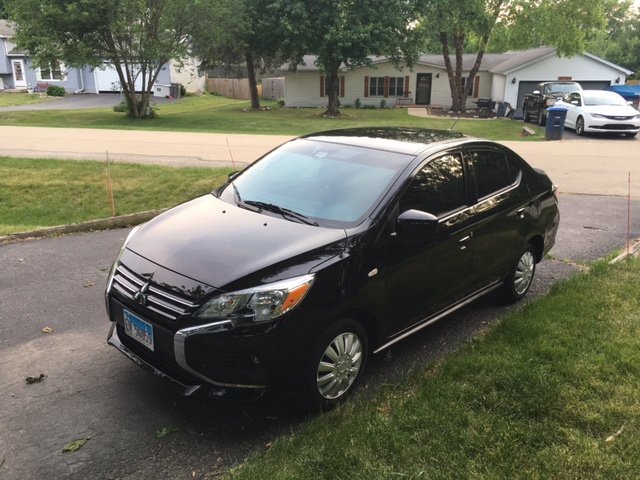
Raven About 2 more weeks and this Mirage will be two years old and already packing 54K miles. The CVT has settled in and is outperforming my expectations. The engine in quite, smoot for a three pot and very economical to fuel. Life time result to date is a stunning 52.44 mpg with a median tank of 52.74 mpg. Given the number of miles I drive and the cost of fuel lately this buy has turned out to be quite the winner in this stable. She is also quite the teacher. Nice thing about a car that gets this type of milage is that you see the results of minor changes with the change instead of having to average a months worth of gas tickets to filter out the tank to tank scatter. Those lesson apply to everything in the fleet and everything I've done to the pack works with this one as well. EPA numbers for this car: This example is running 42% over the government values!!!! I am really enjoying this car. Can't even hear the laughing of those that thought this a 'dumb/disappointing buy".
-
Some Assembly is Required
Grumpy Bear replied to Grumpy Bear's topic in Maintenance, Oils/Fluids, Detailing & Rust Prevention
Just did an oil change on Dizzy. It's first batch of R&P 5W30 and a shot of the new Valvoline Fuel system cleaner. It was the inkiest, stinkiest batch of oil I've pulled out of that motor. -
Some Assembly is Required
Grumpy Bear replied to Grumpy Bear's topic in Maintenance, Oils/Fluids, Detailing & Rust Prevention
You will share, right?





-
Forum Statistics
250.6k
Total Topics2.7m
Total Posts -
Member Statistics
342,992
Total Members8,960
Most Online
-
Who's Online 3 Members, 0 Anonymous, 352 Guests (See full list)