


lucas287
-
Posts
325 -
Joined
-
Last visited
-
Days Won
2
Content Type
Profiles
Forums
Gallery
Events
Articles
RPO
Store
Blogs
Everything posted by lucas287
-
$500 REDUCED - Bilstein 6112 - Tahoe or Yukon
lucas287 replied to lucas287's topic in Classifieds (Buy/Sell/Trade)
BUMP -
WILL BE DRIVING FROM DC TO LITTLE ROCK, AR IN TWO WEEKS! Which means I can meet you or drop off, if reasonable. Assembled and never used! Decided to go a different route. I'm on a TDY in the Northern VA (south of DC). https://www.bilsteinlifts.com/shop/chevy-gmc/tahoe-yukon/bilstein-6112-0-1-6-front-lift-coilovers-2015-2018-chevy-tahoe-4wd/ $500 and they're yours. Not willing to ship just yet - these suckers are heavy.

-
2018 Sierra with tuned 6.2 and 8 speed transmission
lucas287 replied to CamaroSS6.2's topic in Modifications & Accessories
Yep, It’s worth it. I’ve been tuning my 8 speed for over a year and have a great shifting trans now! With that said, there’s a lot on the engine side of tuning that affects how the trans shifts too. For example, dialing in fueling (VVE/MAF) and driver demand can make a big difference. On the trans side, you can change so many things that don’t really make a big difference that I just left a lot of it alone. I basically make the normal table shift times as quick as tow/haul for each gear, bump line pressure a bit in the higher torque ranges, and create a table for the shift torque adder (timing reduction during shifts). Aside from that, I use Bluecat to populate part throttle shift MPH and the torque converter lockup strategy, which makes the biggest difference of all. so, yeah, a long winded way of saying hell yeah it’s worth it -
Tune for 2015 5.3L 2015 Silverado
lucas287 replied to Nobody-117's topic in Modifications & Accessories
i was just referencing changing things on the fly with the tow haul button yes, a handheld can absolutely flash the tcm too! Not hating, just don’t want someone to think they’re getting anything other than different tcm settings! (Which happens in stock form anyways when you click the tow haul button haha) -
Tune for 2015 5.3L 2015 Silverado
lucas287 replied to Nobody-117's topic in Modifications & Accessories
Just fyi for anyone that reads this…all this is doing is changing settings in the TCM. Our truck-based OS isn’t capable of altering anything else when you push the tow/haul button. I’ve tried lots of stuff like this (changing driver demand, AFM settings, etc.) with HP tuners and haven’t gotten anywhere. If that can’t do it, a handheld tuner can’t even either. -
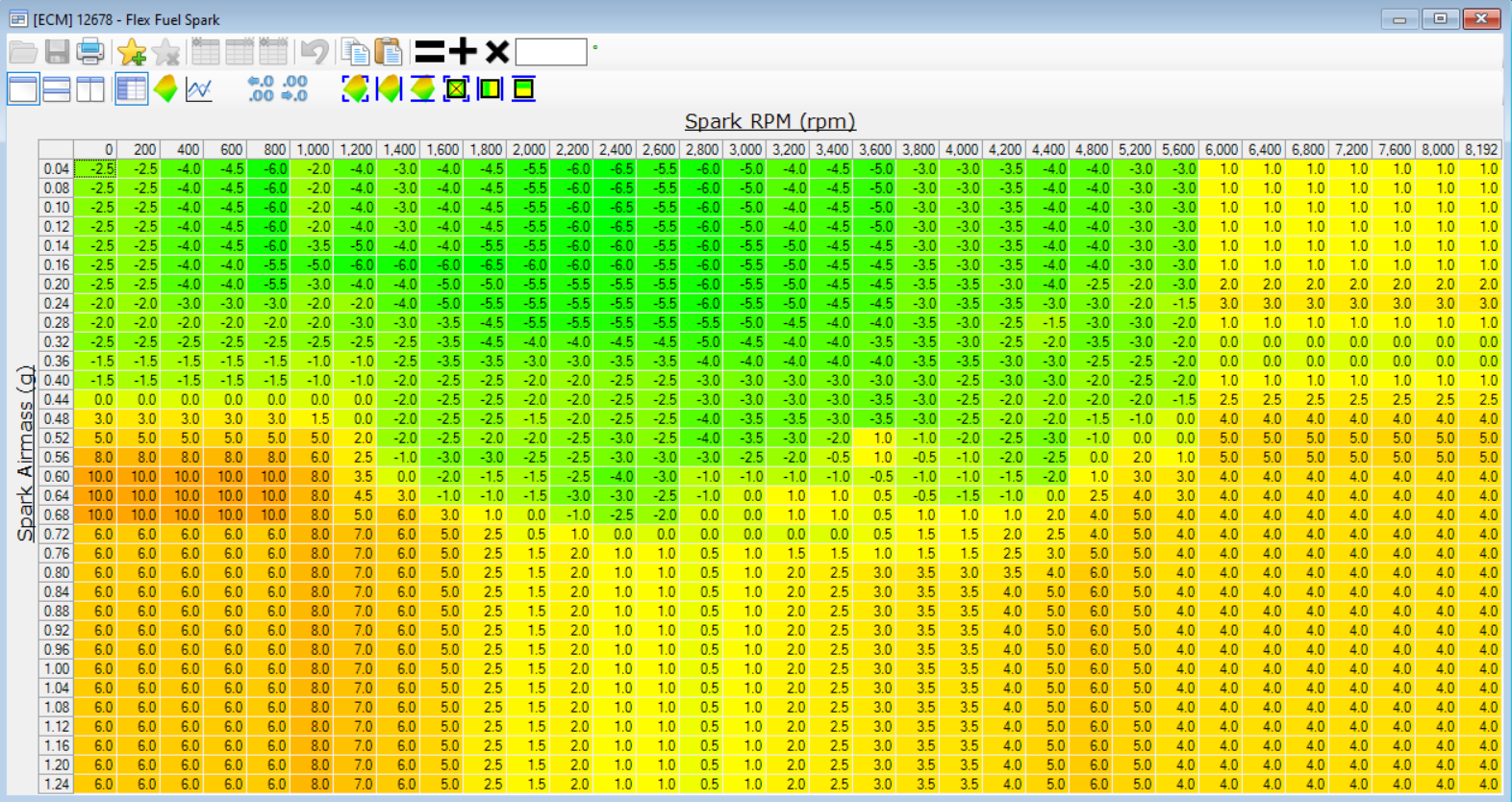
Nope. The flex fuel table only adds (or subtracts) from the current "learned" amount of timing it's running. While I don't fully understand how "knock learn down" function works the values prepopulated in HPTuners looks like it would take a hot minute.
-
For all intents and purposes - yes. The alcohol sensor will immediately report composition changes exceeding 2% to the ECM. Then, there's a delay based on volume (.28 liters for my truck). Basically, it wants to use all the fuel from the sensor to the rail first BEFORE making changes.
-
It's really quite simple - @Grumpy Bear doesn't get deep enough into the load range to notice the difference that the extra ignition advance adds. Here's a paste of a stock Flex Fuel timing table. This adds (or subtracts) based on another multiplier which references alcohol content. Something else worth mentioning is knock learn factor. Allow me to explain. If you've been running 87 then your ECM will have certainly "learned" to run less ignition timing because it detects knock at higher loads at various RPMs. Basically, if the ECM detects greater than 3* (on my L86) of knock then it will interpolate between the high and low octane spark table to find a value that doesn't knock. If you randomly fill up with premium then it will slowly realize that there isn't any knock present and start learning back to the high octane table. Why do I bring that up? If you run ethanol for several consecutive tanks you are allowing the ECM to bring back ALL the ignition timing that it's been removing (assuming 87 octane) PLUS it will be adding more timing in the higher load ranges. This extra timing should make a big difference in the way it feels in top gear lugging around.
-
@Justheman80when's the last time you were at 100% throttle at 2700-3000 RPM? The only time that happens is when you're quickly sweeping past that range when you floor it at a stoplight from a dig. In any other real-world scenario, I'm not seeing where that could happen. Dyno graphs can be a bit misleading for those looking at gains in driveability. People see gains down low and think that translates to part throttle transient gains, but in reality, they are two very different things. I'd buy a Soler Ported throttle body before touching the manifold. He specifically (and scientifically) increased flow in the low throttle input areas (5-30% throttle). He even says that a dyno wouldn't reveal much about what his porting does. Taking it a step further - I'd use his throttle controller too. I can mimic what a throttle controller does with tweaking the Driver Demand tables in HPTuners and you can make the bottom end feel VERY torquey (which just means it's opening the throttle more) down low. You would need to run 91+ octane though as it will attempt to advance ignition timing to the max to make that demanded torque.
-
Sorry I didn't see this sooner. I can't specifically help you but I researched this pretty heavily and ultimately decided on Viking instead (atomic fabs kit). I concluded that it's probably a great kit. It's made by Elka, up in Canada. Everything I researched it should be good workmanship and ride quality. I just wanted full adjustability and control over valving, that's why I went a different direction.
-
2015 driveline vibration
lucas287 replied to 177mph's topic in 2014-2018 Silverado 1500 & Sierra 1500
You very well might need the new updated "blue bottle" ATF. However, I think a lot of folks are experiencing axle wrap and general vibrations from unequal operating angles. Just my two cents. I've been down this road myself and blamed it on the 8 speed or the TC. After the dealer flushed with new fluid I thought it was all better but it was just placebo. That's when I started going down the path of operating angles. With a one-piece driveshaft the angle of the t-case/transmission output shaft needs to be equal (and opposite) to the pinon angle. Once I got that nailed (with shims) I installed some traction bars and voila - no vibes. These direct-injection engines punch above their weight class down low in the torque department. The L83 is more akin to the coveted LQ4 and the L86 makes big-block torque. You can't control that torque with the crappy leaf design GM uses. -
Nail on the head here. My truck (e85 tuned L86) is worthless from a dig in 2WD. Not to mention that it would axle wrap and hop like a buckin' bronco. The exact reason I put traction bars on my truck maybe one day GM will employ a 5 link or even IRS. By then I'll probably be driving an electric truck though.
-
@garrett0151Any updates on this? Was this really the fix, or did it come right back? Thanks!
-
Didn’t fully finish my thoughts there. So you have the ability to reduce the ****** to 0 for any given rpm/airmass, but that’s it. You cannot advance beyond its parked position. Hope that helps!
-
I’m not sure how the 5.3 is set up but I believe the 6.2 is advanced 8 degrees until the ECM says to ****** (I think this forum bleeps that word out lol). WOT it starts to reduce that advance at 3000 RPM and by 5000 RPM it’s retarding 8 degrees so it’s straight up. All of that is great. I have no issues with it. However, in the low load ranges .16-.56 g/cyl airmass is can ****** up to 23 degrees. Basically to introduce the EGR effect of cooling the chamber and reducing pumping losses. And yes SOI is in HPT, what I use. It’s under the spark tab I believe!
-
Klunk from front end when (sometimes) turning?
lucas287 replied to Euston's topic in 2014-2018 Silverado 1500 & Sierra 1500
NBS trucks had steering shaft clunk issues so it's possible. But I don't think that's your problem. Put a floor jack under your LCA (under the lower strut bolts or thereabouts) and raise it up until you've got about an inch clearance between the tire and the floor. Insert crow bar and pry while looking for play at your lower ball joints. Mine were shot (stock ride height) at 90k miles. And I mean SHOT - like 4-5 mm's of play. -
100% doable with 87 octane. My wife's CX-9 has the 2.5 Skyactiv Turbo and it runs great on 87. Madza itself even claims that use of 91+ will give you 10% more HP but the torque down low stays the same. Just a matter of how much resources can be put into the project. I think it's paramount to have full control over the intake and exhaust valves - independent of each other. That would be the best way to keep the chamber cool and prevent detonation. And that's never going to happen with our engines. As I'm sure you're aware, you can adjust SOI (start of injection). It's a map that looks very similar to the timing tables where you tell it exactly when you want it to spray (in degrees relative to BDC, I believe). That would probably help a lot. In fact, the stock SOI tables are kind of a mess. I can get nearly the same fuel mileage as stock by disabling part throttle VVT and retarding (delaying) SOI a good bit. The result is a super responsive throttle and great torque production. Lastly, I apologize if it's been mentioned - but alcohol-based fuels are superior for boost. Their cooling properties alone are a game changer. I can run my 93 tune on E30 (e85 blended with 87 octane) with zero knock at all.
-
New Rubber - Falken Wildpeak H/T02
lucas287 replied to dtholmanmax's topic in 2019-2026 Silverado 1500 & Sierra 1500
Now that you've had a lot of seat time. What are your overall thoughts? Ride compliance? (feeling on small bumps) and highway smoothness? I hate when you end up fighting tires to get a good balance. -
Throttle body from Soler Performance
lucas287 replied to bartstan's topic in 2014-2018 Silverado 1500 & Sierra 1500
Hmm - this is intriguing. Would you say the additional aggressiveness at part throttle would cause unwanted issues? Like lack of velocity or something? Seems to me that it would be a no-brainer for someone who has full access to HP Tuners to just use the LT4 variant and get all the part throttle airflow they can get. Especially since I'm only interested in drivability improvements. Now, since an engine is merely an air pump, having that additional airflow will have diminishing returns based on other factors such as valve events, exhaust flow/scavenging, and other intake restrictions. IE: it will only flow so much. -
Here's my 2 cents. The load index and max psi varies from tire to tire, so there isn't a "perfect" number as many other members have illustrated. Go with what feels right to you! My truck has approx 58/42 weight split. There's absolutely no reason the run the rear tires at the same PSI as the front, except if you're towing or hauling a lot. Watch your tire wear, and on the front pay attention to wear beyond the shoulder of the tread (aka rolling onto the sidewall). If it's doing that and your alignment is good - it needs more PSI. For example, if you have a really square tread tire, like a Continental Terrain Contact - you could probably run 30 PSI and never roll onto the sidewall. I have Pirelli Scorpion Verde Plus 2 - which is the complete opposite and very rounded - I like running a tad more (33-34) because I don't like how it rolls onto the sidewall. The rear - PSSH - lower it until your TPMS gets mad and bump it 1 PSI from there. For reference, my rears are at 26 PSI and I wish I could do 23/24. Heck, I had a ECSB NBS Silverado that I ran 20-22 PSI. The chalk test has gained popularity lately, but a well-trained eye can see the same thing without chalk. And because I anticipate people saying: "that's a dangerously low amount of tire pressure - yada yada - I've driven a solid 100,000 miles between these two trucks at the stated rear pressures (including lots of ranch roads) and have never had issues.
-
https://www.spring-things.com/ I used these along with a couple small tubes of energy suspension poly lube and it's so quiet now. Annoyed the crap out of me too haha
-
If you ever pop a valve cover - the '16 updates include blue valve springs. That could give you some peace.
-
I wonder If I have that RPO code too. I'll check it out. I've heard from many VERY knowledgeable people that the 8L90 is a straight-up stud mechanically. I mean a beast. When GM built the C7 Z06 they changed almost everything in the engine to handle the boost but didn't changed a single thing in the 8L90. That's sweet right there.
-
Considering the 14 and 15 models have persistent valve spring issues (upgraded in 2016) I'm pleasantly surprised that you've been trouble free.
-
Awesome feedback for a guy about to hit 100k on his L86 STRONGLY emphasize this engine over the L83 5.3 if at all possible. They're hard to find - but seriously worth it. It's actually quite bizarre how well this engine performs and get's pretty much identical fuel mileage as a 5.3.



-
Forum Statistics
250.5k
Total Topics2.7m
Total Posts -
Member Statistics
342,936
Total Members8,960
Most Online
-
Who's Online 0 Members, 0 Anonymous, 453 Guests (See full list)
- There are no registered users currently online