


Another JR
-
Posts
1,105 -
Joined
-
Last visited
-
Days Won
9
Content Type
Profiles
Forums
Gallery
Events
Articles
RPO
Store
Blogs
Everything posted by Another JR
-
Break-In Procedures Per Manual.....???
Another JR replied to SoCal Angler's topic in 2020-2026 Silverado HD & Sierra HD
I was thinking more about design issues other than serious blowby that cause deposits due to condensation. Bad ring design, improper assembly, or badly worn rings that cause a lot of blowby can cause sludge, but does an engine of an otherwise good design that uses some oil due to poor break in practices tend to have major sludge issues? I don’t have direct experience with this to know, and I appreciate being edumacated. -
Break-In Procedures Per Manual.....???
Another JR replied to SoCal Angler's topic in 2020-2026 Silverado HD & Sierra HD
The importance of break in procedures to ensure a good long term ring seal without destroying the honed cylinder surface, and the breaking in of the axle ring and pinion without causing damage that causes tooth surface spalling in the long run are one thing. The tendency of an engine design to collect sludge for various reasons is an entirely different issue. -
Downgrading from LED taillights to Bulb pnp??
Another JR replied to nitrorocket1's topic in Modifications & Accessories
Any idea why the LEDs aren’t lasting? -
Break-In Procedures Per Manual.....???
Another JR replied to SoCal Angler's topic in 2020-2026 Silverado HD & Sierra HD
Hi Grumpy Bear. I was just reading what you had put in your post: “When GM designed the first SBC the rods were built to take 110% of designed load at 6K rpm for one million cycles. It was considered infinite life. But what does it mean?” In the next paragraph you then described the test load as 110% of yield, which seemed like a misinterpretation to me. Sorry if I read it wrong. -
I decided I probably shouldn’t advertise that tactic but you caught it before I deleted it! Oh well. Our law and the associated affidavit form does not require the registered owner to identify who was driving. I came across this when a house guest got a red light ticket in our car and insisted on paying it. I tried to look up how one transfers ticket responsibility and found the section about submitting the affidavit and the ticket going away. We’ve legitimately gotten out of that ticket plus two others based on it not being the registered owner driving. (My wife tends to slow roll or stop past the stop line on free rights on a red.) My wife and I for other reasons (who closed the deal buying the vehicle) have our registrations in each others’ names. Our insurance company doesn’t care as long as the cars are in one of our names.
-
Deleted
-
The tabs for my 2021 3500HD, which has an 11,500 GVWR, were around $100 at the most recent renewal last April. No RTA tax is listed in the itemized list of fees. Most of it is gross weight fee. I live in Renton. I just went to buy a new 4runner and found they get you twice now for the RTA tax on purchasing a new vehicle of that size. About $650 “RTA tax” listed right under the state sales tax, PLUS the license fees are over $1200, about $600 of which is, wait for it, RTA tax. I questioned whether they were double billing it but we looked up the state law and they get you twice. If I didn’t love paying taxes I might be a bit annoyed by this!
-
Break-In Procedures Per Manual.....???
Another JR replied to SoCal Angler's topic in 2020-2026 Silverado HD & Sierra HD
Not 10% past their yield load - 10% past their design load. At least that’s what it says. They still would have been below the fatigue limit (endurance limit) at the critical location if they designed it right because that would be one of the constraints that set the design. I assume that was what they were intending to demonstrate. -
I don’t have anything to offer about how well the bed rug fits. Did you get the factory spray-in bedliner? For general bed and load protection, as opposed to a liner inside a topper, I’d suggest also considering the OEM rubber mat just for the bottom instead of a bed rug. It’s 3/8 thick, tough as a tire, and fits well. I bought mine through my dealer for $155 (8 foot bed). That was cheaper than the on line places when shipping was added.
-
GMC 2500 and 3500 bumper badges
Another JR replied to Sam Avaiusini's topic in 2020-2026 Silverado HD & Sierra HD
If someone on our block did this and any of us found out the teasing would be merciless. -
I’m definitely with you in liking my 6 speed “trouble-free transmission.”
-
When I said holes might be misaligned I meant the holes in your truck’s receiver, the sleeve if you are using one, and the ball mount. If any of those weren’t drilled straight, one hole on the truck receiver could be taking more load in some high load condition. I didn’t mean the wdh bars were misaligned in some way. If you loaded the chains similarly, any difference in bar loads probably isn’t the issue.
-
I would keep an eye on it and see if it is stable now. Also, I’d suggest talking to an experienced hitch person if you have one nearby. They may be able to tell you, “yeah, that happens because …” However, if he tells you it’s because your truck isn’t a 2024 10 speed gasser with the fancy display, he’s probably pulling your leg and is a forum reader.
-
Sorry, I didn’t see the pic when I first viewed this. I think my phone was still loading it. That hole definitely looks like it’s getting worked. Looks like wear at both 10 and 12 o’clock. Unfortunately the picture as I see it on the forum is a little blurry. I assume you are being careful to load your wdh bars symmetrically. The question is why one side and not the other. Could be the original holes were not perfectly aligned and the left one is getting most of the load.
-
I too was thinking it might have to do with loads from a wdh. So you have looked at it with the pin out and are definitely seeing elongation? Are you seeing actual wear in one area (as opposed to maybe it was a bad hole from the factory)? The good thing is that metal is probably ideal for a weld and re-drill repair if it becomes necessary. Plus, I heard the holes on the new 2024s are rounder.
-
Are you looking at it with the pin and hitch in place and the trailer connected (seeing a gap at 10 o’clock) or are you looking at an empty slightly egg-shaped hole? And when I say empty hole I mean like that hole you have in your heart for a new 2024 10 speed gasser with the fancy touch screen!
-
Disable Amber Cab Lights
Another JR replied to JTRACKER's topic in 2020-2026 Silverado HD & Sierra HD
Deleted -
2021 Air Conditioner issues
Another JR replied to SteveG63's topic in Troubleshooting, Warranty & Recalls
Maybe it’s a programmed or sensor-driven de-icing cycle? -
2020 2500Hd feels like it is surging when towing a hill
Another JR replied to Addison Reeder IV's topic in 6.6L Gas V8 (L8T)
I wonder what it is about the most recent post from downsj that triggers the bot to offer GM help when all the other posts were ignored. -
No offense taken whatsoever, GB! I thought you made an important point that oil formulations change over the years.
-
Acknowledged. I’m just posting my experience for what it’s worth. I think my 3-4k mile oil change intervals are just as important as oil type.
-
I’ve been running Castol Edge (formerly Castrol Syntec) “full synthetic” 5w-30 for 30 years in my GM trucks and Volt with no problems. Even on my 150k mile K2500 5.7 and and 150k mile 2004 Yukon 5.3 I do not have to add oil between oil changes. I don’t know how Castrol compares in lab tests to the competitors, but it has worked fine for me with 3-4k oil change I intervals. I do not tow a heavy trailer, though.
-
Towing AFTER First 500 miles...Oil Change?
Another JR replied to SoCal Angler's topic in 6.6L Gas V8 (L8T)
I’m always an advocate of, at a minimum, following the break in advice in an owners manual. That said, if your trailer only weighs 2500 lbs and has a frontal area less than the truck, I would not be worried about either of those recommendations if you for some reason can’t follow them. Just take it easy while accelerating and while pulling your boat out of the water at the boat ramp. The engine oil recommendation is to ensure you have clean oil and get rid of break in particulates before you run at high cylinder pressures. You probably would be just fine not changing it but I’d do it if I could. My oil was changed at 300 miles due to my discovery of a dented filter. My truck at 10k does not appear to use oil between oil changes (less than a pint in 4k). Did that early oil change help make it be one of the engines that doesn’t use two quarts between changes? Maybe. I suspect it had more to do with my receiving the truck with 2 miles on it (no test drives by others) and my being easy on it for the first 1000 miles. The recommendation about initial towing weight and easy accelerations is primarily to avoid damage to the ring and pinion gear teeth in the differential and avoid excessive differential oil temperature. At 500 miles the gear contact areas are still forming and the contact areas are small. Trying to transmit too much power through those small contact areas can cause oil film breakdown and damage to the teeth, and it generates a lot of heat which also can deteriorate the oil and cause oil film breakdown. Ideally you don’t want to tow a heavy trailer before the ring and pinion gears have developed mature contact areas. 2500 lbs is not going to be a problem, though, after 500 miles of initial break in. There are guys who will say “I bought my new truck, drove it home, hooked up my 15k 5er and floored it up and down the Ike for the next 6 months, and my diff didn’t explode. What are you, a wimp?” But if you want a nice quiet rear axle at 150k miles, try to follow the break in advice. -
2023 GMC Sierra 3500HD 6.6L Gas/6 Speed - Trans Temps?
Another JR replied to SoCal Angler's topic in 6.6L Gas V8 (L8T)
His 2022 would have the new valve. The changeover in production was April 2021. -
2023 GMC Sierra 3500HD 6.6L Gas/6 Speed - Trans Temps?
Another JR replied to SoCal Angler's topic in 6.6L Gas V8 (L8T)
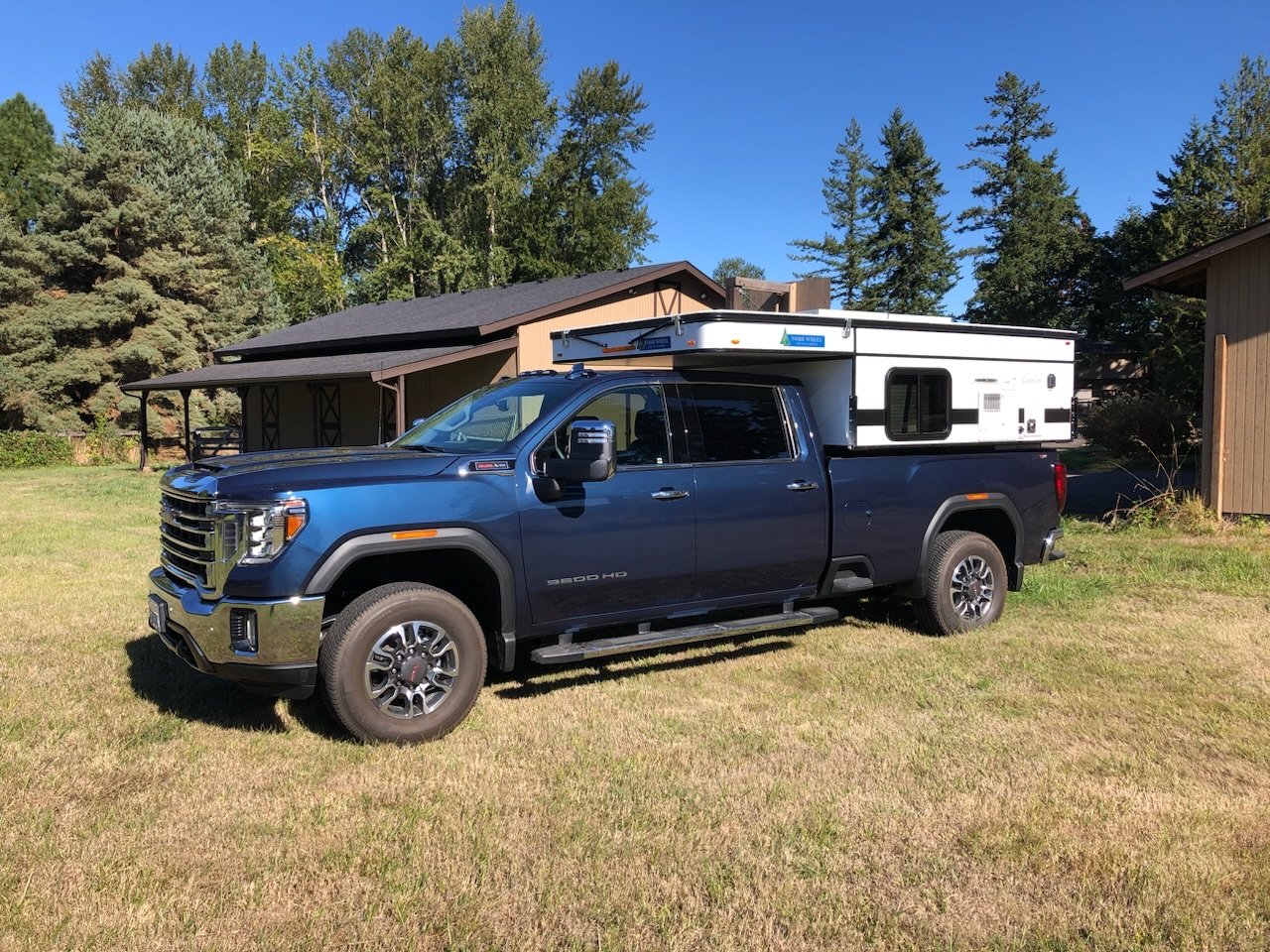
I went in circles with the dealer and with GM customer support and they refused. I pointed to that wording but they (GM) said there still needs to be a customer complaint about the way the transmission is operating. The transmission was working fine, and I wasn’t going to lie to them. I just wanted the updated design. I plan to install the GM part with the 70 marking. I have a Four Wheel Camper Grandby (8 foot bed) front dinette model with most of the options. I did my own lithium solar and dc to dc charger installations to save money and get exactly what i wanted for my power system. It weighs about 1800 lbs fully loaded up for camping - 1700 on rear axle and 100 on front axle. So I’m at about 50% of the payload rating. I have no suspension mods except I took out the unneeded 5600 lb front camper springs i originally ordered and put in the base 5200 lb springs for my model. I wanted the 3500 payload because it allows me to tow a decent sized fishing boat with the camper on.


-
Forum Statistics
250.5k
Total Topics2.7m
Total Posts -
Member Statistics
342,917
Total Members8,960
Most Online
-
Who's Online 4 Members, 0 Anonymous, 1,609 Guests (See full list)