


Another JR
-
Posts
1,105 -
Joined
-
Last visited
-
Days Won
9
Content Type
Profiles
Forums
Gallery
Events
Articles
RPO
Store
Blogs
Everything posted by Another JR
-
That was my experience too prior to this recent event. I think the difference was I was going fast and the slowdown in front of me was very sudden. The thing did its job very well. I’m just trying to understand whether the AEB fired right before I hit the brake.
-
There is a delay between the FCA warning and the application of brakes. I’ve had maybe a dozen FCA warnings, but this was the first one where the brakes did something in addition to what my foot was commanding. I suspect the delay is longer when the the closure rate is lower. In this case it seems like there was maybe a full second delay, but not much more.
-
Yes it was my 2021 3500hd SLT with convenience and safety packages (forgot what the packages were called). It definitely has those features. They were on the sticker and covered in the manual. The manual says “if you have FCA you also have AEB and IBA.” You can turn them off in the settings, but I have them turned on. One of the two braking features definitely activated, but it’s not clear to me which one.
-
Just bought a cheap boroscope today.
Another JR replied to Jettech1's topic in Modifications & Accessories
Kaiser is now for non-high-risk people saying either do colonoscopy or the lab test. -
I was on the freeway in fairly heavy rain and the traffic ahead of me suddenly slowed rapidly. I was on it and never came closer than 30 feet from the car ahead of me, but I had the forward collision alert triggered (which I’ve experienced several times before) and, for the first time, at least one of the braking system assist features also triggered. I’m not sure which one, though. It almost seemed like the truck was already starting to brake as I hit the pedal, but I’m not sure. It definitely was applying more brake than my pedal input. It braked more heavily than I would have in that particular event, but it did its job and kept me from getting near the car in front of me. It sounded sort of like the noise ABS makes, but more of a steady noise rather than the stuttering sound ABS makes. I was impressed with how well and how smoothly it worked, but I’m curious whether AEB actuated versus just IBA. Anybody able to describe how to tell the difference when the braking is not obviously well before you hit the brake pedal?
-
Something disgusting happened to my HD today.
Another JR replied to Pryme's topic in 2020-2026 Silverado HD & Sierra HD
New truck time? -
My gas truck has never done this. Maybe a tank vent line is plugged or kinked somewhere?
-
Forgot to quote so you’d get a notification.
-
I measured mine. Top of badge is 1.2 inches below the edge of the black plastic bed rail cover. The rear edge of the badge is 2.0 inches forward of a vertical line drawn up from the most forward part of the tail light plastic.
-
Multipro Tailgate Working Backwards.
Another JR replied to Wellarmedlamb's topic in Troubleshooting, Warranty & Recalls
My tailgate is in a crate because I have a camper installed, and my memory was incorrect. The owner’s manual confirms what you wrote, that the upper button on the tailgate is for the inner tailgate. I’ll edit my previous message. -
Multipro Tailgate Working Backwards.
Another JR replied to Wellarmedlamb's topic in Troubleshooting, Warranty & Recalls
I would think “You clearly built it wrong,” would trump calendar and miles, unless you or a previous owner modified that area. If the dealer won’t help try contacting the GM ombudsman, and copy your state attorney general’s office. “Warranty of merchantability” is the phrase you want to use repeatedly. -
Z71 package and Towing
Another JR replied to Steve Hougham's topic in 2020-2026 Silverado HD & Sierra HD
Deleted -
Multipro Tailgate Working Backwards.
Another JR replied to Wellarmedlamb's topic in Troubleshooting, Warranty & Recalls
Under warranty? Take it to a dealer. It sounds like the wire harness or a connector has reversed wires for the main and inner tailgate releases. GM should fix that clear manufacturing error even if it’s beyond warranty. Are the switches on the tailgate itself reversed? (Upper switch should be inner tailgate.) -
Z71 package and Towing
Another JR replied to Steve Hougham's topic in 2020-2026 Silverado HD & Sierra HD
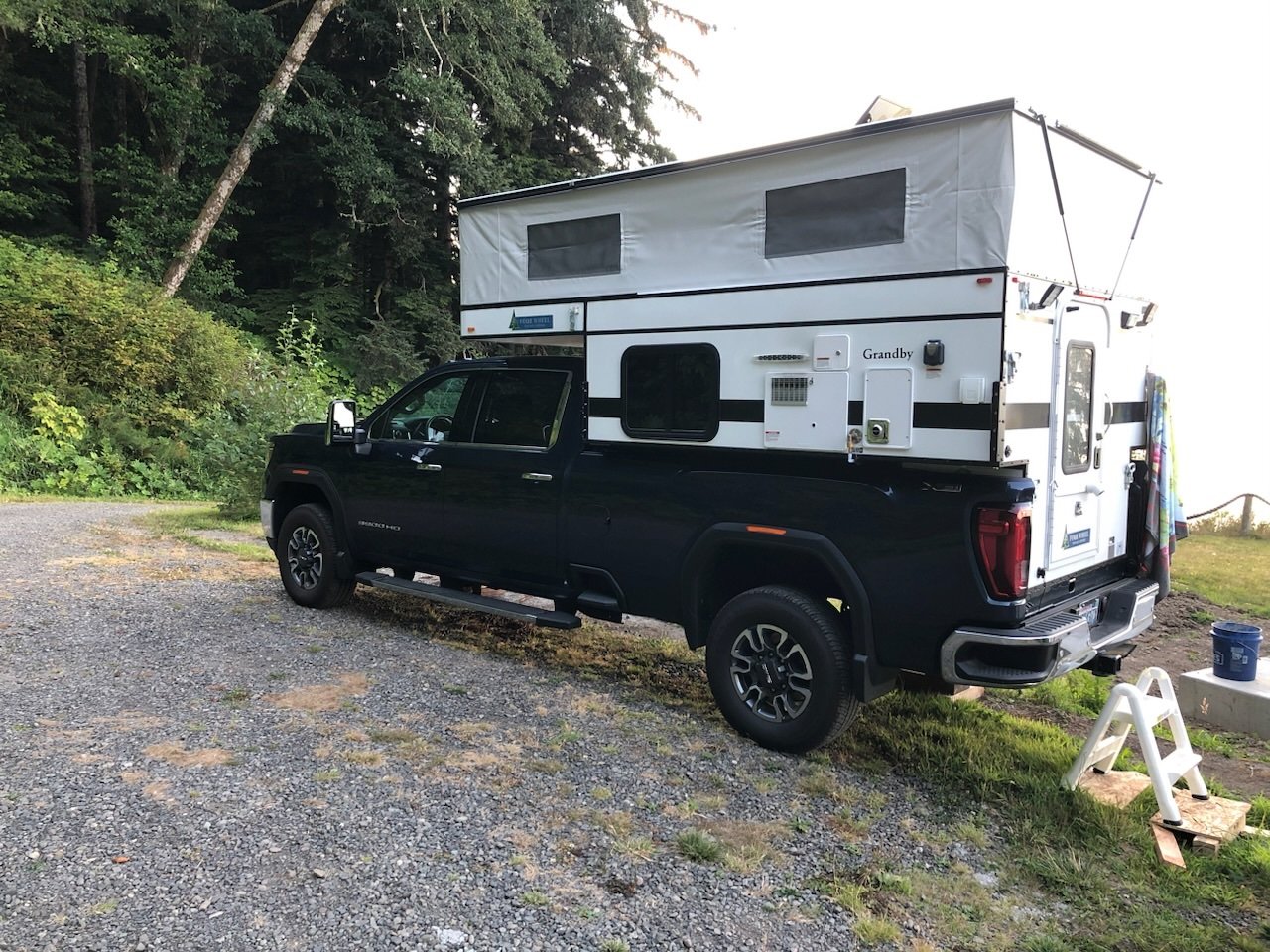
I would recommend you only buy the camper springs or snowplow package if you determine you really need it due to loading of the front axle. I ordered the camper springs on my truck (400 lbs heavier FGAWR of 5600 lbs) because i was planning to install a lightweight truck camper, and wanted the flexibility to potentially get a heavier one later. After weighing the truck with and without my pop up camper I found the camper only put 100 lbs on the front axle. I also soon decided I would not ever get a bigger truck camper. With the camper springs and no significant added load on the front axle, the front suspension response was noticeably stiffer than the rear even with the truck empty. I addition to being generally annoying, it made the front pitch up going over dips at highway speed. I spent the $600 for the standard 5200 lb springs for my model (cclb gas) and installed them myself, and it rides better and has well matched front and rear suspension response. -
I must be weird; Long Bed SRW
Another JR replied to IDBrett's topic in 2020-2026 Silverado HD & Sierra HD
If you ever want to do a truck camper long bed is nice.
-
2024 2500/3500HD Midnight Edition High Country
Another JR replied to SidTheKidd's topic in 2020-2026 Silverado HD & Sierra HD
The build web site wheel pictures should be accurate. -
Multipro Tailgate Use With Forklift?
Another JR replied to Haoleguy's topic in 2020-2026 Silverado HD & Sierra HD
The multipro is nice for entry because the bed floor is so high. When you get the point where you are really struggling to climb up, it would be a big help. I’m 59, and I find I don’t bother to use it much - yet at least. For me, I find the steps built into the bumper corners and into the forward sides of the bed to be more useful because they are always available. -
Multipro Tailgate Use With Forklift?
Another JR replied to Haoleguy's topic in 2020-2026 Silverado HD & Sierra HD
On past trucks when I have picked up loads on pallets, I have taken the tailgate off. Unless the load is actually on a pallet and the loader has long forks, the driver always wants to set the load down partially in and slide the forks out to relift the load and place it all the way in. That can damage the tailgate. If the OP has to leave the tailgate on, a standard tailgate likely will tolerate the abuse better, and is at least a little cheaper to replace. -
I was trying to keep my answer simplified regarding SAE J2807. It really looks at cooling in a severe climb, minimum speed in a severe climb, handling and understeer due to front end unweighting, acceleration at GCWR, braking at GCWR, and some other things. Compliance with all of the requirements is shown with certain requirements placed on the trailer configuration for the tests, one of which is that the tongue load is 10% of the total trailer weight. So they have to use that value in the vehicle limits because it’s the value they used in showing compliance with the standard. What you don’t know is whether any of the characteristics caused by high tongue weight, like handling and understeer, set the trailer weight limits. I agree with you that on these 3500 trucks that’s unlikely. Cooling or minimum speed in the prescribed climb almost undoubtedly set the GCWR for the 3500 configurations, and probably also the 2500s. (My daughter’s longtime boyfriend has done these tests as a manufacturer engineer, and he’s said you’d be surprised how hot the rear differential gets, and that this climb significantly sets the design of the rear axle and differential.) Here is SAE J2807 if you want to read it yourself. https://fifthwheelst.com/documents/tow-test-standards-2016-02.pdf
-
A policeman by the side of the road will refer to the sticker if he’s getting into that. In court, it all is relevant and will be examined. “A man’s got to know his (vehicle) limitations.” In the end, all the app is doing (if it’s programmed correctly) is helping you stay within all of the limits. With a gooseneck, I suspect GCWR will almost alway be the controlling limit on these trucks. If you are already aware of and following all the limits - GVWR, GCWR, payload, axle ratings, tire ratings, trailer weight ratings, tongue rating, and hitch rating (what did I miss), you know what you are doing and will be legal. If you have an accident and are 3k above your actual most limiting rating, and all you can do is point at the hitch rating to defend yourself, you may be found liable.
-
The sticker has an upper half showing the actual rating limits for the actual vehicle, and a lower half with a separate heading. The lower half shows the SAE J2807 based structural limits of the hitch receiver and frame. They sort of say it there by general reference to the SAE standard, but it’s not clear enough what they are providing in that lower half.
-
No mystery here - they are just up against the GCWR.
-
Is it possible for TPMS to be reversed?
Another JR replied to Terry OBrien's topic in Troubleshooting, Warranty & Recalls
Discount tire will do this for you in their tire pressure check line. It takes less than 5 minutes if the technician knows what they are doing. Have your owners manual handy because they won’t necessarily know how to put your truck in learn mode. -
Here is an interesting Banks video where they replace a stock differential cover with a same-shape clear cover allowing you to see how the oil flows, and then they compare it to a flat cover. They discuss why overfilling is detrimental. Note that their 90 minute test representing towing at 200 hp up a constant 6% grade where the fluid overheats with a stock cover equates to a nonstop climb of about 28,000 feet, and their 60 minute test equate to 19,000 feet. Such a climb in real life is not even possible, let alone realistic. The car companies have a particular climb they do to evaluate rear axle cooling, so it’s not like they’ve neglected seriously considering differential heat in their design. So they built a cover that rejects heat better and you can buy it for $500, but I don’t think it’s needed for the vast majority of our trucks. On the other hand, Banks makes a very good flow-based case for why you should not buy their competitors’ flat covers just because they have fins.
-
It’s subjective, but I tend to agree with the 4-5k max for my half ton and older light 3/4 ton trucks. While the newer 1/2 ton trucks have good pulling power, the suspensions and tires are still much more flexible (including laterally) and the truck weight is lower. I by far prefer to tow loads above 4 k with my 3500. One of the primary subjective differences for me aside from feeling more in control is I feel like I’m beating the heck out of the transmissions on my 1/2 ton and old 3/4 ton when towing 5000 - 6000 lbs (I live in the hilly PNW), whereas my 2021 3500 seems to just mechanically say “thanks for giving me something to do” when I pull 6-8k.


-
Forum Statistics
250.5k
Total Topics2.7m
Total Posts -
Member Statistics
342,916
Total Members8,960
Most Online
-
Who's Online 4 Members, 0 Anonymous, 1,536 Guests (See full list)