


Another JR
-
Posts
1,103 -
Joined
-
Last visited
-
Days Won
9
Content Type
Profiles
Forums
Gallery
Events
Articles
RPO
Store
Blogs
Everything posted by Another JR
-
I have no direct experience, but previous threads have talked about the square punch being needed to do the job as intended by GM on the 20220+ trucks.
-
I reinstall it when I have my camper off long enough to bother putting the tailgate back on. They are a bit pricey, aren’t they? I think if you go underneath and look up forward of the stake pocket you may have hand access to the backside of that third hole. I think on the trucks with the handle a nutplate is installed - probably spot welded in. It’s definitely more substantial than just threaded sheet metal. You may be able to epoxy a nutplate in there yourself if you can get your fingers up there.
-
The question would be whether all the trucks have the three bolt holes in the bed wall provided for mounting the handle. Maybe Sonders knows?
-
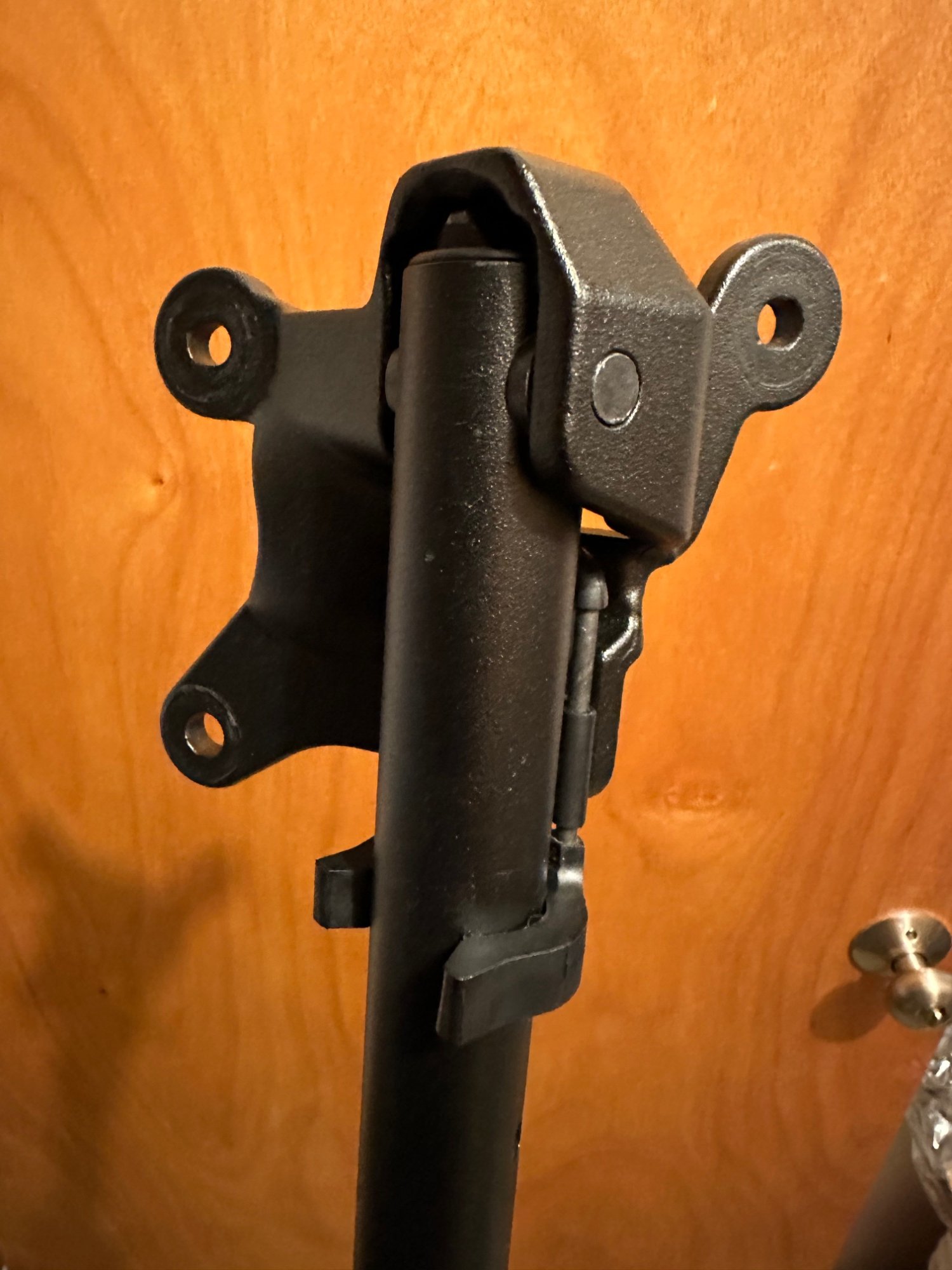
Yes. The bracket has two welded studs and you need the two matching flange nuts. Then there is a third bolt (not nut) that you need that goes into a threaded hole in the bed. My camper is installed right now so I can’t take a picture of the hole. Here is a picture of my removed handle showing the third hole on the right.

-
The owners manual refers to it as an “assist handle.” https://www.gmpartsbin.com/p/HANDLE-inside-Alignment-cam-Release-Tailgate/105863948/85116689.html This is the bracket that goes in the stake pocket you need to mount the handle. There are also two nuts and a bolt to buy. https://www.gmpartsdirect.com/oem-parts/gm-handle-bracket-84338560?c=Zz1ib2R5JnM9dGFpbC1nYXRlJmw9MTMmbj1TZWFyY2ggUmVzdWx0cyZhPWdtYyZvPXNpZXJyYS0zNTAwLWhkJnk9MjAyMSZ0PXNsdCZlPTYtNmwtdjgtZ2Fz
-
Here’s the GM towing guide in case it’s any help. It has lots of towing spec info. https://www.gmc.com/content/dam/gmc/na/us/english/index/about/trailering-towing/02-pdfs/03-pdfs/GMTB21CT100_2021_GMC_Trailering Guide_DIGITAL.pdf
-
It’s because the limiting factor in the case of the gooseneck is the 24,000 GCWR. The 3500 weighs a little more, so it comes off the trailer weight.
-
I’m only familiar with some of the wdh and antisway systems out there, so I don’t know exactly what you are describing. Maybe a photo or product name? I’m just curious to learn more. Thanks.
-
Deleted
-
Remember the manual covers DRW trucks, which is why it mentions up to 20,000 lbs. For an SRW 3500, the maximum conventional trailer weight is 14,500, and max tongue weight is 1,450. In my opinion there is no need to use a weight distributing hitch on a 3500hd SRW at all. The hitch tongue weight limit is 1450 for an SRW, and the payload of the truck is typically about 4000 lbs. For a 10,000 lbs trailer as an example: Without a wdh, with 1000 lbs on the hitch about 4 feet behind the rear axle, you are putting about 1200 lbs on the rear axle and taking about 200 lbs off the front axle, are fairly close to an ideal 50/50 front/rear weight distribution, and haven’t even “leveled” the truck yet even if you carry another 600 lbs in the bed. A big benefit of not using a wdh is you are less likely to overload and fail your trailer frame going over dips, driveways, or sudden transitions to a steep incline. Every pound you pull on the WDH chains is reacted by the ball, and significant additional bending load is added on the trailer A-frame at the front of the trailer due to the torque from the wdh. That is where you will sometimes see frames bend or break.
-
I don’t remember, but I remember seeing the procedure in the owner’s manual.
-
An aftermarket company making a mod that improves the visibility and actually works would have a brisk business I suspect. These mirrors are my biggest complaint about my 3500hd. Luckily I don’t have to fold them very often, but i hate the way they block my view at intersections and entering roads from a driveway. I sure wish I could have bought the non-towing 2500 mirrors on my 3500. I may look at a conversion if it’s close to plug and play.
-
I was trying to be funny. I thought my comment was absurd enough that it didn’t need a /s, which was probably a bad assumption on my part. I am familiar with the ways a front hitch can be helpful. Thanks for the polite explanation, though.
-
Seriously though, could you briefly describe what was involved in doing that front receiver installation? Small bolt on, big cross member bolt on, or welding job? Thanks.
-
If you want to tow backwards down the highway with only one gear, I guess that’s between you and the highway police, but the rest of us are busy having a serious debate about whether 6 gears or 10 gears is better. Please don’t complicate that debate.
-
2023 3500HD Multiflex tailgate complaint
Another JR replied to BigEd65's topic in Troubleshooting, Warranty & Recalls
Tow & stow has a specific model for multiflex tailgate. Also, note that the inner tailgate disable procedure only works on 2022 and later trucks. -
Fyi, curb weight on the sticker includes a full fuel tank.
-
Do you tow different trailers with different hitch heights? If not, I favor a simple forged steel fixed height hitch bar of appropriate height for my trailer, and preferably one that doesn’t interfere with the inner tailgate, but that’s height dependent. This type is simple, strong, and has no bad stress concentration areas where they better get the design and weld quality just right.
-
Concerns with 6 speed transmission vs 10 speed transmission?
Another JR replied to Gabe Bunn's topic in 6.6L Gas V8 (L8T)
Longevity of the gear sets and bearings, and at least some aspects of torque converter behavior, may be related to the amount of horsepower or torque through the transmission, but control system related issues - which seem to be involved in quite a few of the threads in the troubleshooting and diesel forums, may not be related to torque or power at all. I’m not suggesting any conclusions - I’m just suggesting how the available information should be considered. -
No, I do not like those wheels.
-
I would like to start a NEW catch can post for all to follow.
Another JR replied to Jettech1's topic in 6.6L Gas V8 (L8T)
That’s a patent description for some proposed bearing compartment detail feature on a Pratt & Whitney Canada engine (not a large turbofan), and it is not going to help anybody here understand the basic differences between a turbine engine dry sump oil system and a wet sump automotive piston engine oil system that might be relevant to the discussion of crankcase ventilation systems and of catch cans. Perhaps post a more basic overall description of a turbofan oil system? -
I would like to start a NEW catch can post for all to follow.
Another JR replied to Jettech1's topic in 6.6L Gas V8 (L8T)
I think when he wrote scupper he may have meant the oil scavenge system. -
I would like to start a NEW catch can post for all to follow.
Another JR replied to Jettech1's topic in 6.6L Gas V8 (L8T)
Aside from the debate over what you are “catching,” catch cans, especially metal ones, function as condensers. So what you catch wouldn’t necessarily have entered the intake system as liquid. -
2023 GMC 2500HD Not Starting
Another JR replied to yoman's topic in Troubleshooting, Warranty & Recalls
I don’t have any help to offer, but others may be able to help if you tell us the engine type -diesel or gas? -
I would like to start a NEW catch can post for all to follow.
Another JR replied to Jettech1's topic in 6.6L Gas V8 (L8T)
Deleted


-
Forum Statistics
250.5k
Total Topics2.7m
Total Posts -
Member Statistics
342,915
Total Members8,960
Most Online
-
Who's Online 3 Members, 0 Anonymous, 1,241 Guests (See full list)