


Another JR
-
Posts
1,103 -
Joined
-
Last visited
-
Days Won
9
Content Type
Profiles
Forums
Gallery
Events
Articles
RPO
Store
Blogs
Everything posted by Another JR
-
Me three. I wanted reliability on the road and longevity over everything else.
-
Recommendation for TPMS Relearn Tool?
Another JR replied to Another JR's topic in Modifications & Accessories
Thanks for the quick reply. I called my local Discount Tire and they said just come through their air check line and they will do it. Took less than 5 minutes. I may just stick with that approach. -
Hi All, I just rotated my tires and was looking on line at inexpensive relearn tools. They all seem to have a lot of reviews saying they didn’t work. Does anyone have a recommendation for a reliable relearn tool to use after a rotation? I don’t need other programming capabilities as far as I know. I’ll get it done by the dealer or local tire shop this time but I’m thinking I’d like to have the tool. Thanks.
-
Alternator power to trailer
Another JR replied to Rick Schleicher's topic in Troubleshooting, Warranty & Recalls
The behavior you are seeing is the result of the voltage loss between the alternator and the trailer battery and the output characteristics of your vehicle’s “smart alternator” system. These two in combination with the trailer loads result in insufficient voltage at your trailer battery for charging except when your alternator is putting out high voltage to recharge the truck battery for a period after engine start. Ideally, what you would want to do to to solve this is 1) run larger positive and negative wires from the truck battery fuse block and a large ground stud in the engine compartment, respectively, to the trailer battery compartment, and 2) install a DC to DC converter/charger in the trailer battery compartment or very near to to it. A popular and versatile 30 amp DC to DC converter/charger is the Victron Orion Smart 12/12-30. Renogy makes a 40 amp converter but the ability to tailor the battery charging is more limited than the Victron. 6 awg wires from the truck are sufficient for the Victron because of its more sophisticated engine running detection logic. You probably would need at least 4 awg with the Renogy. One good thing about installing such a charger is you will be all set for a lithium battery conversion in the future, at least with respect to charging from the truck. I have one of those Victron chargers in my truck camper along with a solar setup. It works very well and can be monitored and controlled from a smart phone. -
Agreed, although I was more concerned about internal bypassing of the filter media with that particular dent.
-
Deleted
-
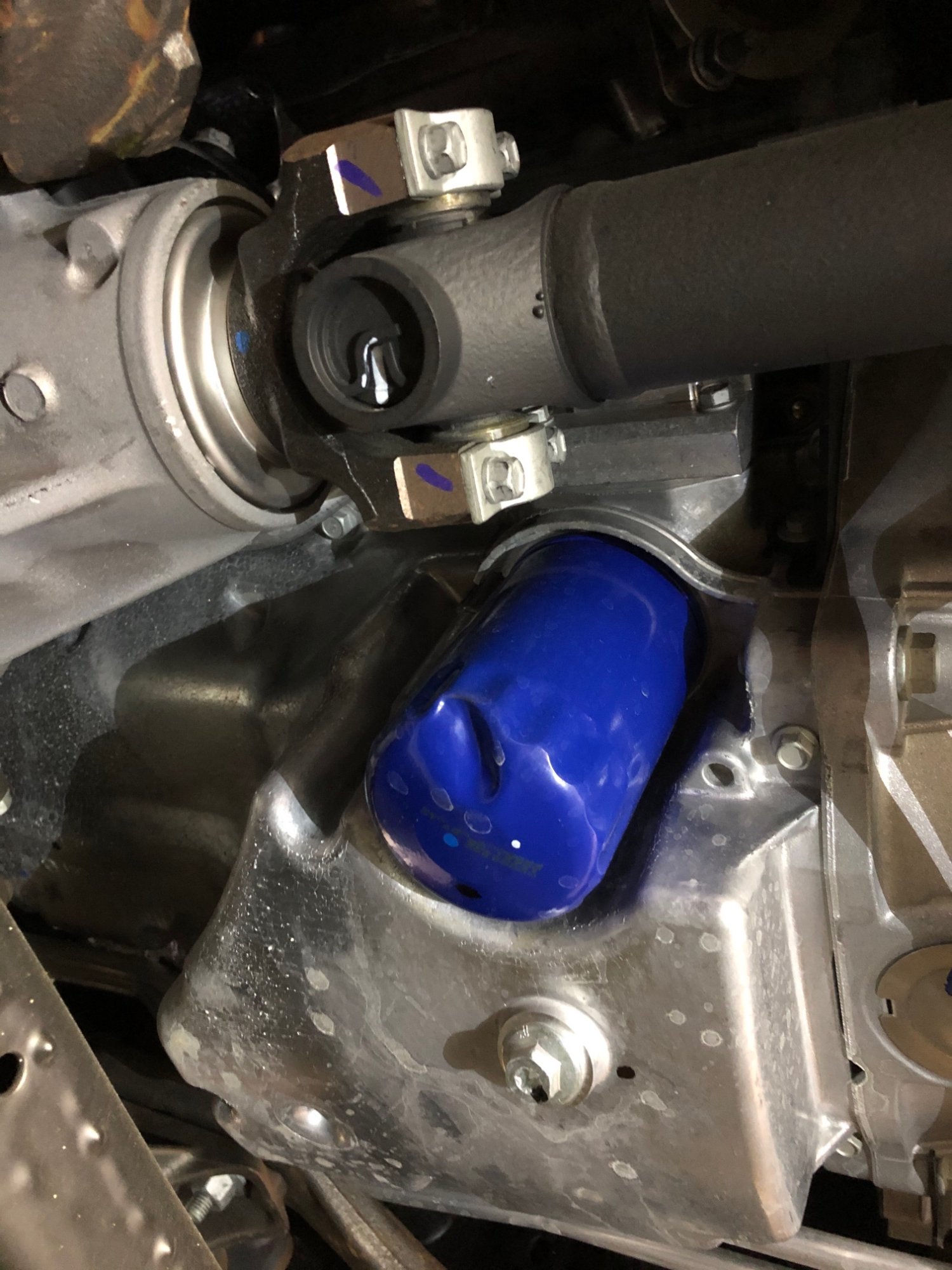
Yes, thanks for the reminder about needing to get a long flexible or bent funnel of some type. I made do with a plain funnel and vinyl tubing I had around last time, but it was awkward and slow, and I need to get something better. I added a picture of the dented oil filter that was on the truck at delivery.

-
I was planning to do a first oil change at around 1000 miles. However, a couple of days after i took delivery I crawled under the truck to plan installation of my camper power cables, and I noticed the oil filter had a dent in it, I’m guessing from the truck portion of the shipping. It was probably nowhere near enough of a dent to internally leak, but why wonder? I asked the dealer to change it and they did it readily under warranty. I suspect they would have also done the next change for free but I didn’t ask them because I was past 12 months, wanted to use my preferred oil type, and it’s easy for me to do. I’m doing my first tire rotation soon at about 7500 miles. I have the equipment to do it myself.
-
Another data point for comparison: 2021 GMC 3500hd gas cclb srw 7200 total miles on the truck, changed oil at 300 miles and 3750 miles so far, next change planned at 7500 miles. I have a 2000 lbs popup camper mounted in the bed that I only remove for maintenance. No towing of significance, so fairly light duty. At 3450 miles since the last oil change, no oil added since, I just checked the level with a completely cold engine and it is still at the very top of the range on the dipstick. So apparently no measurable oil burned or otherwise lost in 3450 miles.
-
I asked the dealer service advisor to find out if a software update can add this feature. I’ll post what I hear back.
-
I can ask about a software update. However, everything is working well on the truck and I am reluctant to let the dealer mess with it. When I have expressed that general reluctance to the service advisor, he actually agreed.
-
That makes sense. Sheath’s and NWStever’s trucks are 22s. It’s not in my owner’s manual. Is it in the manual for your 22 hd truck? (Edit - I now see gemarsh said it is in the 22 manual. Thanks.)
-
I have a 2021 GMC 3500hd SLT. I read on line about the lockout procedure for the upper tailgate, and asked the dealer and they printed out the same procedure: With key fob within 3 feet of the tailgate buttons, press and hold the upper button for three seconds until the tail lights flash. The upper tailgate is locked out and won’t open if the button is pressed. Repeat procedure to restore normal operation. Has anyone had success with this? When I try to do it the upper tailgate just immediately releases even though I’m holding the button. Am I missing something? Thanks
-
Drain hole in top of tailgate?
Another JR replied to Hoginedgewood's topic in Modifications & Accessories
Agreed. I was going to say the same thing. -
Drain hole in top of tailgate?
Another JR replied to Hoginedgewood's topic in Modifications & Accessories
Without those holes, when you open a wet tailgate that little handhold full of water dumps right on your shoes. Can’t have that. Get the drill out. And then the thinking stopped. That’s my guess anyway. -
Probably a few reasons, and I’ll guess at them. We had a two horse side by side trailer and its axles were pretty far back. So it’s not just large trailers. 1) it’s a live load that can move on its own potentially initiating sway. You want a lot of margin from a geometry and mass distribution where sway can occur. 2) in the case of three horse diagonal trailers, the designer probably wants to ensure no sway occurs even when improperly loaded with two horses at the rear. 3) when the trailer is empty and you go to load the first horse and all their weight is on the ramp, you don’t want a negative tongue load and a potential hitch release. These are just somewhat educated guesses. Fifth wheels and goosenecks tend to have their axles further back because the trucks can take higher pin loads, and because its a better geometry for stability and maneuverabiity.
-
Rear view camera pixel issue
Another JR replied to GMC-Trucks-are-best's topic in Troubleshooting, Warranty & Recalls
My truck is about 18 months old. I’ve had that happen two or three times, although my blanked areas were rectangular. Each time it was gone after the next start. I don’t know if it’s related, but i have disconnected my rear camera a few times taking the tailgate off when my camper is installed. -
Rear end clunk on AT4 HD
Another JR replied to souper's topic in Troubleshooting, Warranty & Recalls
Why is this spam bot willing to help Jamesh89 but not willing to help the OP with the same problem? -
I have an SLT, but I actually kind of like the look of the steel 18 inch wheels. Painted flat black or plastidipped they might look even better.
-
I agree for normal road driving. My experience is similar. The last blowout I had (and the last time I had to use a spare) was literally about 1986. The OP’s tire size is close enough I wouldn’t worry about it for a short diversion to get service.
-
I think previous discussions concluded that the speedometer calculations were compensated for the 18s versus 20 inch optional wheels/tires difference depending in which option you have. My speedometer (really odometer) seemed dead on based on one of those surveyed 5 mile check stretches we have in WA. I have the standards 18s on the SLT. As you say, the differential is the same for both options, so the wheel/tire option does make a slight difference in miles per engine rotation.
-
Thanks. That’s good to know. Looks like the part and seals are around $80. I decided to call GM and open a warranty case to get their position on the intent of 21-NA-199 as it applies to my case (complained of occasional rough 2-1 shift, no fault found). I figure it’s worth a shot trying to get them to cover it. The person said they’d call me with an answer tomorrow.
-
Yeah, that’s probably what I’ll do. I’m a bit concerned I’d have to add fluid, and the procedure for that may involve running the truck while adding fluid. (my BMW requires that). I’ll have to research it. His description of the work didn’t seem right, but I didn’t have the TSB printed and with me when I was there. I may print it and go back and ask WTF, and how am I supposed to trust them about anything now.
-
I took my truck to the dealer and asked them to do this TSB. The service advisor said they can only cover it if there’s a related problem with the transmission. He read the stored codes - nothing transmission related. I told him the only thing i can complain about other than the high thermostat set point is the occasional rough 2-1 downshift approaching a stop uphill if I give it a little gas. He offered to keep it overnight and do a road test over the temperature range starting cold, so I had them do that. He said they could not identify anything wrong to justify replacing the thermostat. (I agree - the transmission works great. ). He said the change involves dropping the transmission pan and replacing a harness inside that has a temperature sensor. That sounds different from what others have described here. For example, a person above mentions being able to see the part code externally. I had the impression it was a device in the external cooling circuit. Can anyone clarify what the work is to change out the thermostat? Thanks
-
Yes, it seemed clear that the person in that thread felt they could not give specifics. As you say, the truck does not have excessive coolant or transmission temperatures under those conditions. However, the actual combustion conditions at high altitude on warm days (lowest air density conditions) when attempting to get maximum available horsepower out of the engine lead to high combustion and exhaust gas temperatures. This increases the formation of NO and NO2. It’s not a matter of dissipating or rejecting heat - it’s simply a combustion temperature issue. The same problem exists with jet engine combustion. I’m guessing they run into a temperature limit they’ve set to limit the emissions, the computer reduces the actual throttle plate position to limit power and rpm (despite the pedal position being floored), and truck won’t downshift because you can’t give it enough actual throttle to trip the downshift. Or they just directly prevent the downshift to limit rpm and thereby limit mass air flow, power and temperature. Again, my speculation on what they are actually doing to prevent the downshift. Why didn’t the Ford 7.3 do the same thing? Same load, but almost 10% more rated horsepower, yes. But more importantly, look at the two videos. When the Chevy was tested they were in shirtsleeves and no snow in sight, not even on the nearby 12k mountaintops. Hot day for 11k feet. When the Ford was tested, they were all bundled up and there was snow all along the highway. Huge difference in temperature and air density, which causes a big difference in horsepower. The difference in air density altitude for that maybe 40F temperature difference was about 4000 feet if I’m reading my charts correctly, so the Chevy was working with a very large additional maybe 12% horsepower reduction (using the rough power loss formula used in aviation) simply due the higher density altitude (lower air density) from the temperature difference. So there was a roughly 20% horsepower difference between the Ford and Chevy on their test days, more than half of which was caused by the temperature difference.



-
Forum Statistics
250.5k
Total Topics2.7m
Total Posts -
Member Statistics
342,915
Total Members8,960
Most Online
-
Who's Online 4 Members, 0 Anonymous, 1,246 Guests (See full list)