

Dr1ft3r
-
Posts
155 -
Joined
-
Last visited
-
Days Won
1
Content Type
Profiles
Forums
Gallery
Events
Articles
RPO
Store
Blogs
Everything posted by Dr1ft3r
-
Multipro Tailgate Working Backwards.
Dr1ft3r replied to Wellarmedlamb's topic in Troubleshooting, Warranty & Recalls
Odd. My upper button unlocks the small upper gate and the bottom button unlocks the main bottom gate. My fob and the button in my truck both unlock the main gate only. (it does not open on it's own because the weight of my cover keeps it from opening without some manual intervention) -
Behind the back of the steps on the corners of your rear bumper. You can't see them from the outside. The step material must allow them to detect objects through them. If you get under the truck and look up behind the bumper you should be able to see them, or the wire harness that connects to them.
-
I just had my front and rear bumpers swapped out for Ranch Hand bumpers. I also had that message about the side detection system when I started my truck when I was about to leave. I told the installers and they had forgot to plug the wire harness back onto the blind spot monitor sensors. So my guess is either the sensors are not connected to the wire harness, the wire harness is not connected to the cpu, or the wire harness is damaged in some way. Edit: Maybe a sensor is not working either? But for both systems to not be working then I'd guess it would have to be at least 1 sensor from each system, which seems less likely. With my issue I did not get a message about the park assist system. Check the connections and if that doesn't fix the issue I would go to the dealer.
-
I must be weird; Long Bed SRW
Dr1ft3r replied to IDBrett's topic in 2020-2026 Silverado HD & Sierra HD
Is that because you worry about the weight of the wood causing damage to the tailgate? I was thinking that you were worried that it might open. I am fairly certain that it will not open do to a mechanical issue. But an electrical issue that causes it to open is always a possibility. -
I must be weird; Long Bed SRW
Dr1ft3r replied to IDBrett's topic in 2020-2026 Silverado HD & Sierra HD
Using supports like these I have personally had about 1000# on my tailgate. So, the latch mechanism in the tailgate and the latch bolt on the bed is plenty strong for anything you choose to lean against it. Now, whether or not it will malfunction and open on it's own is another matter entirely. -
l8t whipple for 2020- 2022 2500hd
Dr1ft3r replied to Kjduvall's topic in Modifications & Accessories
I will add it to my list of mods. It will go to the top of the list when it becomes available. If that's true then I'm really glad that I didn't wait for a 2024. Large multimedia screen < Supercharger -
Tailgate spontaneously opening
Dr1ft3r replied to jsward12's topic in Troubleshooting, Warranty & Recalls
That's good enough for me. I know what I'm doing tomorrow. At the very least, it's not going to hurt anything even if it doesn't prevent the problem. -
It's no problem. I'm happy to help. There's not much info on this stuff to be found here on these forums. I don't know everything, but I'm happy to share what I know. If that method works for you then there's nothing wrong with that route either. Some people do that for winches they keep on their trailers. Some also run a dc-dc charger for the winch batteries on their trailers or even for their campers (which is where I go the idea). At some point I may mount a winch in the front of the bed of my truck as well and run it off of the aux battery bank I already have for the front winch. I had also considered a battery isolator, but there are other issues that arise in that situation. Such as issues with properly charging both battery banks (starter and aux). Plus, with a dc-dc charger the amperage from the alternator is controlled and kept low. I believe this is better for the alternator in the long run. Not to mention that with a charger the proper charge profile can be selected for the aux battery being used to ensure that it is charged properly, which will give the battery it's best chance for a long life. Running 2 batteries in parallel, such as how they come from factory, would be a better route than an isolator. But that doesn't solve the problem of high amp loads on the system and both batteries would have to be identical in every way, including level of charge when installed (preferably both be charged to 100%). I much prefer to keep my power sources separated. Edit: I was just reading up on battery separators. Those are another option that may work for some people. They have certain advantages and disadvantages over isolators and parallel options. I still prefer the dc-dc charger method for this situation though.
-
Now that I've started planning my winch installation I have given this a lot of thought. I have decided to install another battery in the auxiliary battery location and run the winch off of that. However, it will be completely isolated from the primary system. I will keep it charged with a 40A dc-dc charger, most likely from Redarc, along with a nice Odyssey AGM battery. A good AGM battery will provide enough power to winch at max load for 15+ minutes, which is also most likely more than the duty cycle of the winch. (The charger is still supplying 40A of power at this time as well). This way the primary system will never be subjected to 400+ amp loads from the winch (500+ amp loads max with my 16.5k Warn winch under full load, which will never happen to me... snatch blocks are your friend...). The primary system may or may not be able to handle it, but why take the chance? I know it can handle 50 amp loads with no problem. I have the snow plow prep package and a snow plow can draw up to around 200 amps on it's own. The downside is if the winch needs to be used a lot in a short period of time then the battery may run out of juice. But with a 40A charger the battery should be able to be charged from empty to full in about 2.5 hours. So the drain would have to be significant to run out of juice. But if it becomes a potential issue, the battery bank can be doubled by using 2 batteries in parallel. I may upgrade to the Redarc 50A charger instead. I'm still on the fence. Be sure to research your batteries if you go this route. Some AGM batteries around this size (100 AH) may not be able to handle charging at this rate. Odyssey batteries require a 40A charger at the minimum for cyclic operations. Using a battery to power a winch this way is certainly considered a cyclic operation. Some AGM batteries cannot be deeply discharged either (i.e. below 50% capacity). Be sure to use batteries that can be discharged to 80%+. I would not use LiFep04 (Lithium Iron Phosphate) batteries under the hood, they can't handle the heat nor the cold (but otherwise would be ideal). The Odyssey batteries I'm looking at are rated for temps between -40 and 176F. The Redarc chargers are rated for 14 to 175F. So if it's too cold the charger will stop, but the battery will still work. I'm more concerned with heat as the engine bay should be warmer than outside temps when the engine is hot. The Redarc chargers are also waterproof, dustproof, etc... as they are completely sealed and are used on vehicles that go under water while overlanding. Clearly this route is more expensive than running the winch off of the primary system. But I believe that you will get what you pay for.
-
I usually do half of what the manufacturer recommends. Some of my vehicles in the past have had a manufacturer recommended synthetic oil with a change interval of 10,000 miles. I still changed it every 5,000. 4,000 miles is what I planned for my truck. I did the first change at 2,500 and my next change will be at 6,500 (next week). I do short and long trips in warm and cold climates. But I spend most of my time in the northern US, lately. Direct injection engines just require a little more maintenance if a person wants longevity out of their engine. But if properly maintained there is no reason to not expect it to last for a long time. If you want to get the valves cleaned every 100,000 miles, then do it. The cost to clean the valves is about the same as replacing 1 tire. If that's only done every 100,000 miles then I don't consider that to be a great expense or inconvenience. I don't expect to need to have that done sooner than that, if it even needs it then. There are Lexus IS-F vehicles out there with over 300,000 miles on them. Granted, they are both port and direct injection engines, but they are direct injection engines. Those are cars that are usually ran hard too, since they are sport oriented V8 cars that put out over 400 hp stock. Keep your valves clean, if needed, and who knows how many miles you can get? Here's a IS-F with over 400k: New high mile record. 423k mile ISF - ClubLexus - Lexus Forum Discussion
-
Multipro Tailgate Use With Forklift?
Dr1ft3r replied to Haoleguy's topic in 2020-2026 Silverado HD & Sierra HD
There are certainly pros and cons to either choice. If I were in your situation I would probably choose the normal tailgate as well. The multi-pro tailgate has certainly come in handy for me, but there have been times I would have preferred the regular tailgate. If I were ever really worried about the load on the inner tailgate I would put something over it, like a piece of plate steel or maybe even a 2x6. -
If adding anything to the fuel has zero effect on carbon deposits, or any other type of deposit, then why would using top tier fuels as instructed by GM matter either? The only difference between top tier fuel and fuel not rated as top tier are the detergents used in the fuel. Think on that. Also, it is my understanding that changing the oil sooner has a positive effect on deposits accumulating in your engine.

-
Multipro Tailgate Use With Forklift?
Dr1ft3r replied to Haoleguy's topic in 2020-2026 Silverado HD & Sierra HD
If loading a pallet into your truck then it's likely not going to be an issue if the weight on the pallet is evenly distributed or the total weight on the pallet is in excess of 3,000#. That is, if the pallet is placed entirely inside your truck and only the last board on the bottom of the pallet is on the edge of your tailgate. Also, pallets are generally 48" wide and the small portion of the tailgate is barely wider than that. So, unless the pallet is perfectly centered then most likely one corner of the pallet will be on the main portion of the tailgate. Also, nobody knows exactly how much weight the small tailgate supports. The owners manual says 300#, but only when using the step on the tailgate while it is open. It does not specify what weight the gate will support when closed. However, unless you are using aftermarket supports to support your tailgate I would not put a lot of weight on any portion of any tailgate, multi-pro or not. I have seen stock tailgate cables fail while someone was loading something as light as a 700# ATV, which means some of that 700# weight was also on the ground at the time. I personally use some steel brackets that latch between my tailgate latch and on the rod that the tailgate latch locks onto when the tailgate is closed to support my tailgate when I was loading my ATV into my truck. I also lowered the small tailgate and (barely) drove between the main tailgate as my ATV is 48"-49" wide at the tires. I actually rub the main tailgate a little. But now I have a Diamondback cover over my bed and I load directly onto that and don't have to worry about my tailgate when loading my ATV anymore. -
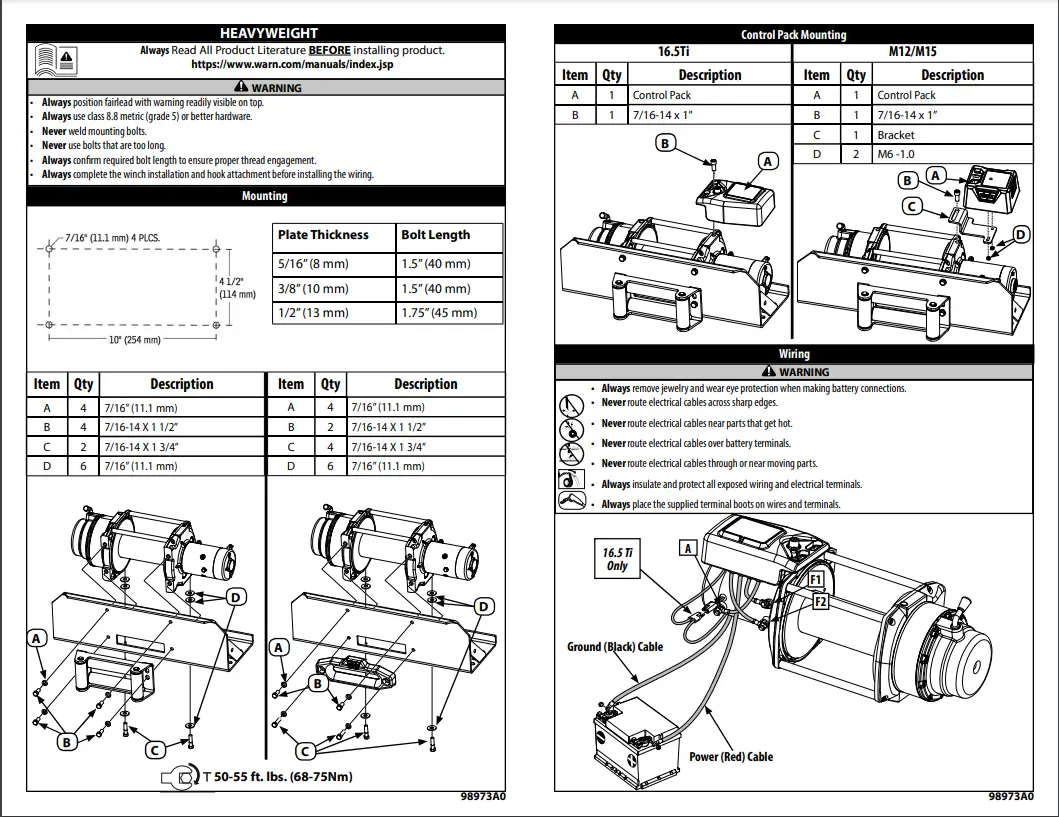
Yeah, there's the fact that they are in Israel combined with the price for their mount that is leading me to fabricate my own mount for a lot cheaper. Besides, their mount is only good for up to a 12k winch and I want a Warn 16.5k winch. I'm pretty sure that I'm going to do my own mount using steel plate and angle iron. I was taking measurements today to formulate a plan. I don't intend to weld anything as I don't trust my amateur welding skills for the forces involved here. I will over-engineer it using 3/8" to 1/2" thick steel plates and bolt it all together. I'll only have to cut the steel to length, drill holes and sand and paint the metal so that it doesn't corrode. I can tie into the frame using the existing mounting locations for the bumper and the recovery hooks. It may be a while before I get to this project. I like to plan things out way in advance to give me time to consider all options. Edit: I forgot to mention that I need to mount my winch feet forward as well, which limits my options. I'll most likely use this and custom build what I need to attach it securely to my frame: https://www.warn.com/flatbed-winch-mount-m12-m827450-11078
-
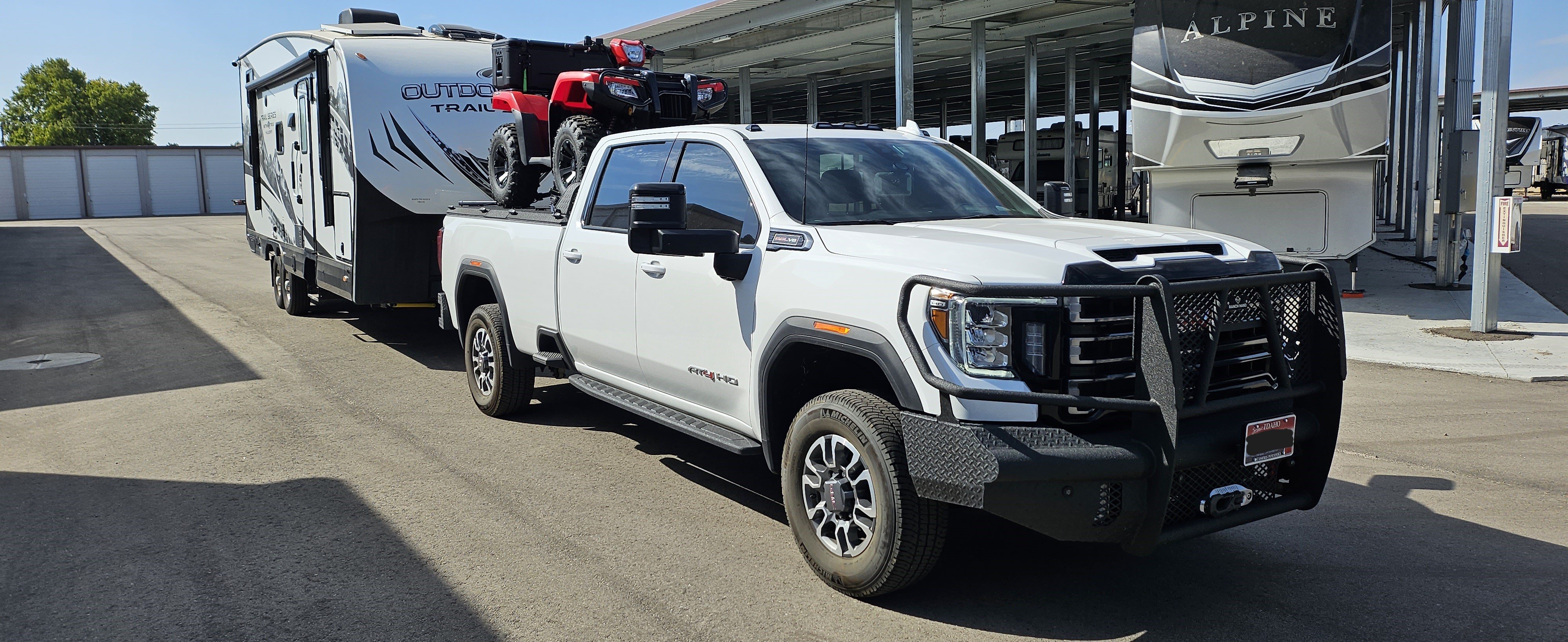
Thanks for the PDF. Some good info in there. I wouldn't ever attempt to tow more weight than the sticker states (14,500# conventional). Especially since I live in the Rocky Mountains and I have a lot of steep grades to contend with. The truck did feel a little light in the front end when ascending the mountains with 1,700# tongue weight, but it didn't feel light to the point of being unsafe to me. This was also before I installed my steel bumper and grille guard this week. Soon I'll have a winch up front too. So the light feeling on the front end will surely be gone with an extra 400#+ on the nose of the front end to counteract the tongue weight. A WDH would also have transferred enough weight to counteract the lighter front end as well.
-
The upper half of the sticker is what law enforcement is going to look at. The lower half of the sticker is certainly not 100% correct for my truck. My sticker states 1,450# max conventional tongue weight, which is most certainly wrong. That tongue weight was set where it is because the max conventional trailer weight is 14,500# for my truck and they just took 10% of that and called it the max tongue weight. The hitch on our trucks is rated for up to 2,000# tongue weight. Even at 2,000# tongue weight I would not be over RGAWR (7,250#), or any other weight rating on the upper sticker without another 2,050# of payload for my truck (4,050# payload on my sticker). I've already towed a few hundred miles with 1,700# on my tongue. The day any 1-ton truck cannot tow any conventional hitch trailer is the day they need to redesign that truck.
-
I've started looking for a hidden winch mount because I have my Ranch Hand bumper installed now and I noticed there is plenty of room to mount a winch between the bumper and the radiator. I'd much rather have a permanently attached winch on the front and the back of my truck over of using a receiver cradle. So, I've been looking for a mount that will attach directly to the frame at the tow hook locations. I found this for the Silverado: https://www.asfir.com/hidden-winch-mount-544022.html I'm assuming that the Sierra and the Silverado share the same frame. If so, then I believe that I can make this work for me. Worst case, I can fabricate my own mount. But I'd much rather buy one.
-
OEM 17” vs 20” HD wheels and tires
Dr1ft3r replied to Jagerschnapps1's topic in 2020-2026 Silverado HD & Sierra HD
Oh, my mistake. I thought he had the 17s. 18s still have more sidewall than the 20s (.6" more sidewall). Lots of people run much larger tires as well as lifting their trucks to accommodate those larger tires. There are aftermarket shops which can recalibrate the speedometer. It's not very expensive at all, usually around $100. -
OEM 17” vs 20” HD wheels and tires
Dr1ft3r replied to Jagerschnapps1's topic in 2020-2026 Silverado HD & Sierra HD
The stock 18" tires which came on my AT4 will have the most sidewall of these 3 tire sizes as it is 275/70 R18. I had to select many of my options separately to avoid the 20" tires which came with the preferred package as I did not want the 20" tires. The stock 18" tire has a sidewall height of 7.6" instead of 7.3" and 7" for the other 2 tire sizes mentioned. So, for me it was a big difference between the 18" and the 20" tires (about 10% difference). For you it would be a .3" difference on the sidewall. But the 18" does have a diameter of 33.2", which is 1.6" larger than your current tire. However, your speedometer can be recalibrated by the dealer for different size tires. They do the same thing at the factory when the vehicle is assembled. Another option is to keep your current wheels and get tires with a larger aspect ratio. Then have the speedometer recalibrated for the new tire diameter. This method would allow you to get the most sidewall before having rubbing issues on the fenders/linings. Some dealers will do it. There are other ways as well. But the speedometer error is only 3 mph at 60 mph for changing the tire diameter by about 1.5". So there's no reason why you couldn't drive like that if you wanted to. Just be aware that more sidewall means less handling in corners. -
Use top tier fuels and run cleaner through it every now and then. I am using this every 6,000 miles: https://www.amazon.com/Chevron-Techron-Concentrate-System-Cleaner/dp/B00092893E/ If doing that doesn't work for you, then just get the valves cleaned for ~$500 if you start noticing a loss of performance. If you don't notice any performance loss then there's nothing wrong with your valves. It's not as big of a deal as some people make this out to be.
-
Vehicle Information Reset?
Dr1ft3r replied to Dr1ft3r's topic in Troubleshooting, Warranty & Recalls
Yep, I haven't ruled this out either. As things get more advanced they become more susceptible to errors. Just look at Windows OS. When it was a basic OS with no frills it ran much better than it does now with all of the bells and whistles. -
Vehicle Information Reset?
Dr1ft3r replied to Dr1ft3r's topic in Troubleshooting, Warranty & Recalls
Yeah, I understand that. Most of the time the voltage hovers around 14v. But sometimes it's around 15v. I was under the impression that when the voltage was around 14v the battery was not being charged, but around 15v it meant that the battery was being charged. Regardless, if the battery voltage was low enough to cause the CPU to reset, shouldn't it have also affected the starter? In my experience with vehicles in the past, the battery had to get low enough to cause starting issues before it would cause the CPU to lose it's memory. I also have the 220 amp alternator and the vehicle runs at least 90 minutes per day or more and rarely for less than 15 minutes after being started. I put 6,400 miles on it and I've only owned it for 9 weeks! I'm not ruling out a low or bad battery, but it seems less likely to me with no other signs or issues that I believe should be present if that were the case. -
Vehicle Information Reset?
Dr1ft3r replied to Dr1ft3r's topic in Troubleshooting, Warranty & Recalls
I suppose that's possible. I haven't noticed any voltage below 14v on the gauge though. I have the dashcam offered on the GMC accessories website and it runs in parking mode. But I have the cutoff voltage for it set as high as possible, which is over 13v I believe. I also drive my truck every day. so the battery should remain topped off. -
Today when I started my truck I immediately noticed that the fuel gauge looked different. When I looked through the settings I found that the display settings were set to metric instead of standard. I did not change it, it changed on it's own. When I started looking through the information screen I noticed that my mpg stats had reset and so did the total hours that the engine has been running. My odometer, trip a and b information and all other information appears to be unchanged. Has anyone else experienced this? I thought maybe the truck had been updated OTA and it caused these things to reset. At least I hope that's all it was.
-
This thread is a great example of why there aren't as many winch mount choices for GM vehicles. There's not enough demand for them. Ford and Ram have a lot more sales potential. Even Ranch Hand doesn't offer a winch ready bumper for our trucks, but they do for new 3500 Ram trucks. Back in the days when I owned and raced Camaros it was Ford that had most of the aftermarket share for performance parts. Which also meant that Ford owners were able to get parts cheaper than I could for my Camaros. I don't know if that has changed, but I doubt it. The Mustang is everywhere. It's all about supply and demand.



-
Forum Statistics
250.3k
Total Topics2.7m
Total Posts -
Member Statistics
342,719
Total Members8,960
Most Online
-
Who's Online 5 Members, 0 Anonymous, 801 Guests (See full list)