
Leaderboard



Popular Content
Showing content with the highest reputation on 06/02/2026 in all areas
-
Yeah, amusing and perplexing. For sure.
 2 points
 -
I find all this amusing and perplexing. In measuring oil I use the supplied tool. It’s called a dip stick. Using the supplied tool I have been fortunate enough according to this thread not to have oil usage problems in all but two vehicles. They use one qt every 2500 miles. Different manufacturers both said within normal perimeters. I have access to quite a few vehicles. They have countdown meters for oil changes. I figured using that and pulling the oil checking device I could actually show no oil usage problems. I’ll show them I thought. Then I realized I can’t prove I didn’t add oil. So I decided, screw it. I know what I know. If people want to believe that all vehicles use oil. That’s fine with me. I’m not going to get in the weeds. It’s comes down to what your definition of what is, is. Seems I heard the analogy before.
2 points
-
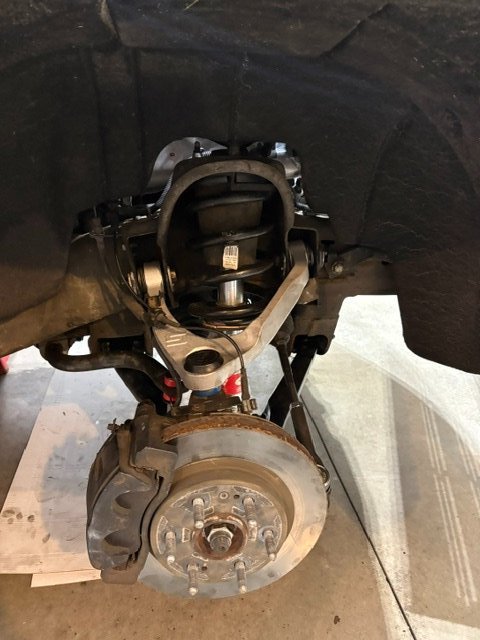
Appreciate everyone's help and suggestions. I am going to man up on this one and admit my stupidity. I had the lower control arms on the wrong side and obviously upside down. I should have disassembled and then assembled 1 side at a time. Instead I disassembled both side ones night, cleaned up, and then reassembled the next night. It's amazing how closely everything still lines up with the arms on the wrong side. Close enough that I was able to get one side loosely bolted up. As soon as I went to put the knuckle on and saw that the hole for the lower ball joint to fit into was tapered the wrong direction it hit me what I had done. Once I swapped the LCA's the passenger side bolted right up imagine that. On the driver side I did have to compress the spring again and rotate it 180deg. Once I did that the angle of the shock and mounting ears all lined up as well. Have not got the new tires mounted and alignment yet (later this week), but the improvement was definitely noticeable over the worn OE shocks. I did end up getting rid of the 1/2" Rough Country strut spacer and then adjusted the Eibach's up all the way to the 2.5" setting. No rubbing on the Superlift UCA like I had with the OE one with the same tires. Did not need the wheel spacers.
2 points
-
I fill between half and a quarter tank, always have, now more so because we live rural.2 points
-
Why run the tank this low?2 points
-
Did the passenger side today. Seemed worse than the drivers side. I’ll check back in 5000 miles or when the low oil light comes on - whichever comes first. on another note - went to do sway bar bushings and 3 of 4 bolts broke. Gotta love New England.
1 point
-
I have 3 vehicles, one of which is a 2016 jeep grand cherokee. My wife and I bought off the show room floor 124,500 miles and doesnt lose a drop. The other is a 2023 toyota 4runner 24k miles same thing no oil loss between oil changes 4k-5k. Ive owned many cars/trucks since 1981. None used oil except as mentioned before 1968 buick lasbre and my 2024 siverado 6.6. Dipstick's tend not to lie...1 point
-
Early on we all had our own crews and worked different jobs. I was the one who hauled the equipment and campers the most. One brother ran the shop. So each was responsible for our own equipment, maintenance and repairs. Chainsaws, weed eaters etc. We each built, race cars too. I was a bit extreme. I had a lot. I would build, restore get bored sell it get another. To be clear no one touched my stuff but me. Vehicles using oil would go through spark plugs and ruin cats. My one car that did use oil clog the cat. Some people are splitting hairs and it’s rather amusing. I used my equipment hard as well as my vehicles. During my extreme times we used Amsoil maybe that was the difference. We didn’t use measurable oil.1 point
-
Hurts nothing, IMO. It's another example of how an engine burns oil. Where do you think the oil vapor comes from?1 point
-
Ever wonder why so many people run catch cans? Me neither. I wonder if it's because they don't want ...oil and oil vapor... ...from the crankcase... to be routed back into the intake by the PCV system, where it's then burned in the combustion chamber. Weird, right?! I understand we may be getting too "technical" here, but it's worth pointing out those cans aren't just for catching unicorn farts.1 point
-
We run VP-X85 in our race car. But I was running Rec gas because I fill up the boat at the same time and was getting 50 cents a gallon off.1 point
-
I agree, it must be a better compound. The difference is not subtle, either at low speeds on boat ramps or on my steep driveway. The Goodyear would spin and then gain some traction, and the Bridgestone do not. Before this truck, I had AT3W, and they would also spin. I am sure many are better in the dirt, but that is not my use case.1 point
-
Thank you.1 point
-
An update to this problem. It turned out that my front door Bose speakers were blown. Today I popped off the door panel and pressed in the speaker cone and it was crunchy. It seems that if I push in one side it is crunchy and on the other side it is smooth. Just a poorly made speaker I guess but with the Bose name on it??? Put some JL Audio 6x9’s in place of these Bose crappers and the sound is clean now. Sort of weird that the problem would go away and come back mainly on longer trips which sucked. So one more thing cleaned up on this truck. Eventually, I will change out the rest of the speakers.1 point
-
There are often two assumptions made in these kinds of threads: 1. That the meter on the gas pump is actually calibrated and the outdoor temperature was exactly 60 degrees at the time of fueling. 2. That the vehicle-in-question's fuel tank holds only exactly its described capacity, i.e. if it's a 24 gallon tank and you put an exactly measured 24 gallons in, the next drop will spill out, and that's generally not true. Tanks don't have a reserve, the gauge has a reserve. It will indicate empty usually a gallon or two before the tank runs out. But what's in there is part of the tank's total capacity. Gasoline tanks typically are larger than their stated capacity because they have to have room for volatility and vapor expansion. You can "stuff" the tank by continuing to run the fuel dispensing pump past several clicks, filling very slowly, or pulling the nozzle slightly out, and other tricks. IMO, don't do it, you can also stuff your EVAP lines, charcoal canister, and stuff that shouldn't be saturated with liquid fuel. I like the solutions proposed above. Just don't run the tank down that far. If you think you'll need to, carry extra fuel.1 point
-
Always refuel when it gets down to 1/4 tank, especially in hot weather. Anything lower than that just wears out the fuel pump faster. And that way, you won't have to worry if you can make it to the next gas station or not.1 point
-
When the light turns on, there is approximately 2 gallons left. Light on = reserve point. When LOW hits, you've got closer to 1 gallon left. There IS some buffer to that. The gauge and warnings will be slightly conservative at times. Its all based on your current live MPG and rolling MPG average as to when that turns on, plus going from driving to a complete stop, the gauge will move as the float is moving and the tank settles down. So I'd say you'd have to be looking at your MPG average when you get down that low and see where its at. If you are getting 12-14mpg, its gonna hit the LOW mark faster than if you were getting 18-20mpg.1 point






This leaderboard is set to New York/GMT-04:00