


B&J Aviation
-
Posts
39 -
Joined
-
Last visited
Content Type
Profiles
Forums
Gallery
Events
Articles
RPO
Store
Blogs
Everything posted by B&J Aviation
-

Dash rattle coming from passenger side
B&J Aviation replied to Washburnvincent's topic in Troubleshooting & Recalls
This video on the FB Duramax forum is exactly the same buzzing as mine: https://www.facebook.com/groups/1222898191107557/permalink/3287187891345233/ One other post talking about the turbo shield: https://www.facebook.com/groups/1222898191107557/permalink/3078728808857810/ -
Dash rattle coming from passenger side
B&J Aviation replied to Washburnvincent's topic in Troubleshooting & Recalls
One more forum discussion with the L5P engine. So, good chance it might be the aluminum heater hoses right behind the glove box. That makes sense. https://www.duramaxforum.com/threads/2020-gmc-2500hd-dash-vibration.1006650/ -
Dash rattle coming from passenger side
B&J Aviation replied to Washburnvincent's topic in Troubleshooting & Recalls
Sorry not sure if the crack could be seen when installed. However, when I was heavy on the accelerator (especially under a load pulling a trailer) I could hear a loud air sound, like an air leak, but I thought it was normal for the L5P. My LML does not do that. I picked up the truck last night. No air noise at all. Sounded like my LML and no buzzing noise, but the engine was hot (the buzzing always went away when the engine was hot). This morning, I departed to Charlotte and I heard the dang buzzing noise again until the water temp gets above 170 degrees and seems to go away. So the EGR pipe replacement did not fix the buzzing in the dash. $3800 parts and labor and still have the buzzing. I have researched this a lot and there is a Chevy bulletin on the LML engines where the heater hoses route through the firewall and the metal tubes rub on the firewall. I am convinced that is what is causing the buzzing, but the bulletin does not reference the L5P engine. I am going to take the truck back to the dealer again and ask them to read the bulletin again. I had given this PIP4826 to them, but he felt the EGR pipe was the buzzing noise. This is a link to the LML site. https://www.duramaxforum.com/threads/have-a-buzzing-sound-in-dash-after-egr-delete-solved.935730/ I found Technical Service Bulletin for the LML Duramax. ~~~~~~~~~~~~~~~~~~~~~~~~ Bulletin number PIP4826. PIP4826: Vibration Moan Or Buzz Type Noise Heard Or Felt Inside Passenger Compartment - (Aug 31, 2010) Subject: Vibration, Moan, or Buzz Type Noise Heard or Felt Inside Passenger Compartment Models: 2011 Chevrolet Silverado 2011 GMC Sierra Equipped with the 6.6 Duramax Diesel Engine ( RPO codes LML and LGH ) The following diagnosis might be helpful if the vehicle exhibits the symptom(s) described in this PI. Condition/Concern: A dealer may encounter a customer concern of a vibration, moan, or buzz type noise heard from either inside the passenger compartment, or from under the hood. Noise may be described as coming from passenger side front of engine compartment, or from cowl area. The noise is heard better when the engine RPM is raised to between 2300 to 2600 RPM. Recommendation/Instructions: If the customer concern fits the noise described in this PI, verify if the noise will change if slight pressure is put on the heater hoses. If the noise dissipates with light pressure applied on heater hose, rotating the heater hose may alleviate the noise. To rotate the inlet heater hose follow the steps below. Make sure engine has cooled down, and cooling system pressure has been released. Squeeze the clamp tangs to loosen the clamp on the EGR cooler heater hose (removal of the hose is not necessary so there should be no coolant loss). Rotate the hose (approximately 60 degrees counter clockwise) on the steel pipe fitting at the EGR cooler. The heater hose has a molded bend and a quick disconnect fitting at the heater core. After the hose is rotated be sure the molded bend is at the highest vertical point or approximately the 12 o'clock position. Rotate or wiggle the hose connection at the vehicle's body side to remove any pre-load in quick-connect fitting. Release clamp tangs to engage or tighten the clamp at the EGR cooler. Please see completed hose relocation below. Re-evaluate the noise after the hose has been rotated on the EGR cooler fitting. Please follow this diagnostic or repair process thoroughly and complete each step. If the condition exhibited is resolved without completing every step, the remaining steps do not need to be performed. -
Dash rattle coming from passenger side
B&J Aviation replied to Washburnvincent's topic in Troubleshooting & Recalls
Gerald, my 2017 3500HD truck is currently at the Chevy dealer now and should be finished today. They found the EGR pipe was cracked at the flex area of the pipe. Tech said it is common. He said this was the cause of the vibration noise and the diesel smell I was noticing when coming to a stop in the winter. They removed the EGR pipe and two out of four stainless bolts broke off in the right exhaust manifold. Dealer said GM had the manifold on back order w no ETA. I waited a week and finally asked the dealer for the manifold p/n and made two calls found one in Maryland. Had it drop shipped to me last Thursday. I’ll know by tomorrow if the vibration buzzing noise is gone or not. It sounded like it was right behind the glove box. Just the exact same noise as the original post video. I even had pulled the a pillars and plastic dash trim looking for it. Hope this EGR pipe has fixed it. -
Dash rattle coming from passenger side
B&J Aviation replied to Washburnvincent's topic in Troubleshooting & Recalls
Wow, I have the same dash noise at 1600 rpm. Did you ever find what it was? I planned to take the truck to a car audio place and they are going to remove the dash and find what it is. I bought the truck from a NASCAR team that had 9 of these trucks and they said two or three had the same buzzing. So, this is an issue that GM should know about. Local deal did not know anything. -
HID Headlight Bulbs / HID Projector Retrofit
B&J Aviation replied to MotoMedic's topic in Modifications & Accessories
Stopped by GMC dealer and looked at the 2015 yukon's. They have same yellow headlight with LEDs for daytime running lights. Sales guy thinks the 2015 Yukon Denali will have HID projectors. Anyone know for sure. If so, I would have to think we could order those from GM and retrofit our Sierra's ?? -
What have you done to your K2 today?
B&J Aviation replied to block8head's topic in Modifications & Accessories
Yes. Had it covered three days owning the truck. You really cannot tell the entire windshield is tinted from sitting inside looking out. No difference at night either. As a matter of fact, my 4 yr old son has to have the right rear overhead light on at night and since that light does such a good job as a spot light, no noticeable glare or issues seeing out the tinted front windshield. I think it is more of a UV protector than tinted. I recall Russo's Tinting stating it was 55%, but I could have misunderstood. I will ask him again. I do need all the overhead lights off to back into the garage. A little difficult seeing out the 20% on the side windows when the overhead is on. Greg. -
2014+ Engine & Transmission Tuning
B&J Aviation replied to pendragon's topic in Engines & Drivetrain
Thanks OJ. I live 5 miles from them and did not know about them. I have an appt and looking forward to results. -
2014+ Truck Bed / Tonneau Covers
B&J Aviation replied to Green 1364's topic in Modifications & Accessories
As mentioned in a post earlier today, I absolutely love the BakFlip VP for the functionality and smooth appearance. I have been in some very heavy water and no water on the BedRug. Installation was great and the complaints about the cover rubbing on the cab is not applicable on the 2014 since I installed the nice rubber bumpers to rest on the window when the cover is fully open, as noted in the pics. -
What have you done to your K2 today?
B&J Aviation replied to block8head's topic in Modifications & Accessories
Matt, yes, I had my entire windshield tinted with 55%. It is a special material with UV protectant for the windshield. Then had 5% put across the top of the windshield in the eyebrow area. I think it was around $135 for the windshield. Standing at the front of the truck, you have no idea the windshield is tinted since the upper part is so dark, however it really made a huge difference in darkening the inside. For the bed cover, I spent a ton of time researching what bed protector and cover. Ended up with the BedRug and BakFlip VP. Could not be happier. I absolutely love the smooth look of the VP. I installed both myself and took about 2.5 hrs. Some people have complained about the cover touching the back of the truck (when you need to have it fully open), however the rubber bumpers rest on the window of the 2014. No paint rubbing to worry about. I have a yearly pass to my local carwash that puts a tremendous amount of water down on the truck and the bed is completely dry. The BedRug doesn't let anything slide around. -
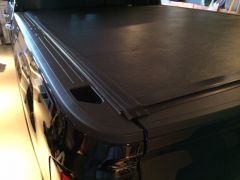
From the album: BakFlip VP and BedRug
-
-
-
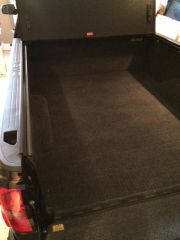
From the album: BakFlip VP and BedRug
-
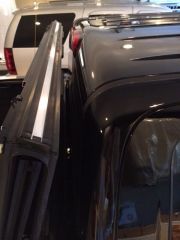
From the album: BakFlip VP and BedRug
-
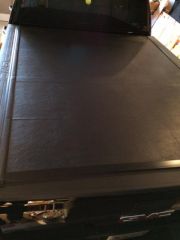
From the album: BakFlip VP and BedRug
-
Well this 2014 has more rear seat room than our 2007 Tahoe, but I hate the child seating situation. First, there is no rear center car seat lower attach points, so that moves my 4 yr old son to the right rear. Then my 8 yr old daughter wants to sit in the rear center. Well, with the ridiculous upper attach points or "loops", my sons latch has to run through his loop then over to the center loop. This is per factory design. Problem is, that leaves a buckle and hook right behind my daughters head and if we get rearended, her head is going right into it. GM, Why is there no center headrest? Has anyone seen a aftermarket center headrest? I have to do something to protect her head from a rear impact. Even if the car seat was not installed, her head would still hit the rear glass. Would be the same for an adult in the back seat.
-
A few pics of the truck after delivery and post tinting and 3M clear shield
-
-

From the album: 2014 GMC
-

From the album: 2014 GMC


-
Forum Statistics
250.5k
Total Topics2.7m
Total Posts -
Member Statistics
342,972
Total Members8,960
Most Online
-
Who's Online 6 Members, 0 Anonymous, 567 Guests (See full list)