
Hozer
-
Posts
90 -
Joined
-
Last visited
Content Type
Profiles
Forums
Gallery
Events
Articles
RPO
Store
Blogs
Everything posted by Hozer
-
Had my full seat bottom frame replaced pretty early in the life of my '14 and then started experiencing the movement and click/clunk noise again right before warranty ran out. The dealer did the rebuild of the seat bottom this time. The truck only has ~22,000 mile still (most of my driving is in a work vehicle) so I'm really hoping this is a permanent fix and not something I'll be dealing with every two years.
-
This has started happening to me occasionally over the last few months. Turn the key, everything lights up on the dash but the "service theft deterrent system" message also comes up and then no attempt at starting when I turn the key all the way to the start position. Try a few times, no luck. Pull the key and put it back in, try again, usually starts. So far, nothing that's looked like a battery issue but I'm glad to hear there's at least some possible explanation. Truck has about 12,500 miles now (yeah, I never drive it!) and was in for the factory oil change in late October. I told the dealer about the issue but they said there's no error code showing so nothing is wrong. I've since filmed the issue twice on my phone so I'll be heading back in with video for them to review.
-
What have you done to your K2 today?
Hozer replied to block8head's topic in Modifications & Accessories
Installed a set of Timbren bump stops this weekend but so far I've only been able to confirm that they don't impact unloaded handling. Now I need to find a decent priced camp trailer to buy and tow. -
What have you done to your K2 today?
Hozer replied to block8head's topic in Modifications & Accessories
Well, it looks great but, what are you gauging? -
What have you done to your K2 today?
Hozer replied to block8head's topic in Modifications & Accessories
A 55 sidewall to a 60 sidewall on a 275 tire should amount to a 3.5% difference in speed. At 60 mph indicated, you'd be going 62.1 mph. http://www.rimsntires.com/specspro.jsp -
What have you done to your K2 today?
Hozer replied to block8head's topic in Modifications & Accessories
Installed my new Roll-X tonneau cover tonight. It took about 45 minutes to do alone and not counting the fifteen minutes I spent looking for two washers I dropped. Still need to get some heat on the weatherstripping in order to get it smoothed out.
-
Thank you. That's a huge relief! I hadn't even thought about the possibility of needing to route drain tubes when I ordered mine yesterday and really didn't want to deal with that.
-
Does the Roll-X have drain tubes you have to route through the bed?
-
I wasn't really planning to buy a tonneau cover just yet but started checking out some of the items mentioned in this thread last night and found that Bak is having a sale right now and so I ordered the Roll-X today for $600 shipped. http://www.bakflip.com/p-349-roll-x-tonneau-cover.aspx I should probably buy something for my wife now.
-
What have you done to your K2 today?
Hozer replied to block8head's topic in Modifications & Accessories
Reinstalled the passenger side rear seat after finishing the mount for my JL Audio Cleansweep and then tethered my under seat sub box in so that it doesn't move around and kill someone. Then I took my 7 1/2 year old son for a ride and taught him what an automotive stereo should sound like. His ears are still ringing. -
What have you done to your K2 today?
Hozer replied to block8head's topic in Modifications & Accessories
The FAQ for the CL441DSP (http://mediacdn.jlaudio.com/media/mfg/9013/media_document/live_1/CleanSweep_FAQ.pdf?1316060569) states that it isn't compatible with factory amplifiers and so, if you have the Bose system with a factory amplifier, you'd need to remove or bypass it. If you've got Bose speakers but no amplifier, this thing would work. The main purpose of the unit is to cleanup the factory head unit signal before sending it to an amplifier and so you won't get any use from this unless you are going to amplify the signal. -
What have you done to your K2 today?
Hozer replied to block8head's topic in Modifications & Accessories
Installed a JL Audio CS112TG-TW3 subwoofer and box combo. I was using an Orion XTR-Pro 10d2 for a while but that won't fit under the rear seat. Also installed a JL Audio CL441DSP to rectify the horrible factory equalization. Gonna finish mounting that tomorrow after I get another section of cutting board. -
Post your 2014+ wheel/tire set-up
Hozer replied to BlueWrapper's topic in Modifications & Accessories
Your wife is wrong. Those look great, especially with the Iridium color of the truck. -
What have you done to your K2 today?
Hozer replied to block8head's topic in Modifications & Accessories
Finally received the wiring harness I've been waiting for and so I finished the install of a JL XD700/5v2 amplifier to feed the Infinity speakers I installed in the doors a few weeks ago. Dropped in the subwoofer and box from my previous vehicle until I can buy a new JL TW3 to fit under the seat. -
They didn't give me too many details about the diagnosis but I'd heard of the clips as an unsuccessful fix so I was just glad when they acknowledged something was faulty and actually needed to be replaced.
-
The "seat slop" issue got me about eight weeks ago. I waited a couple weeks of never remembering to call my local dealer during working hours but, once I called, they set up an appointment for the following week. When I dropped it off mid day, mine was the second vehicle of the day to have the issue. They did dig into it and found the lower seat frame needed to be replaced. Took about 2 weeks to get the parts in and then they replaced it. The seat is great now. Sure, I need to remove a plastic trim piece and install it properly but, at least my seat is fixed. The dealer didn't mess around with clips, shims, or any other sort of work around, they went right to the actual issue and replaced the faulty part instead of trying to band aid it.
-
What have you done to your K2 today?
Hozer replied to block8head's topic in Modifications & Accessories
Keep us posted on that. I'm curious as well. -
What have you done to your K2 today?
Hozer replied to block8head's topic in Modifications & Accessories
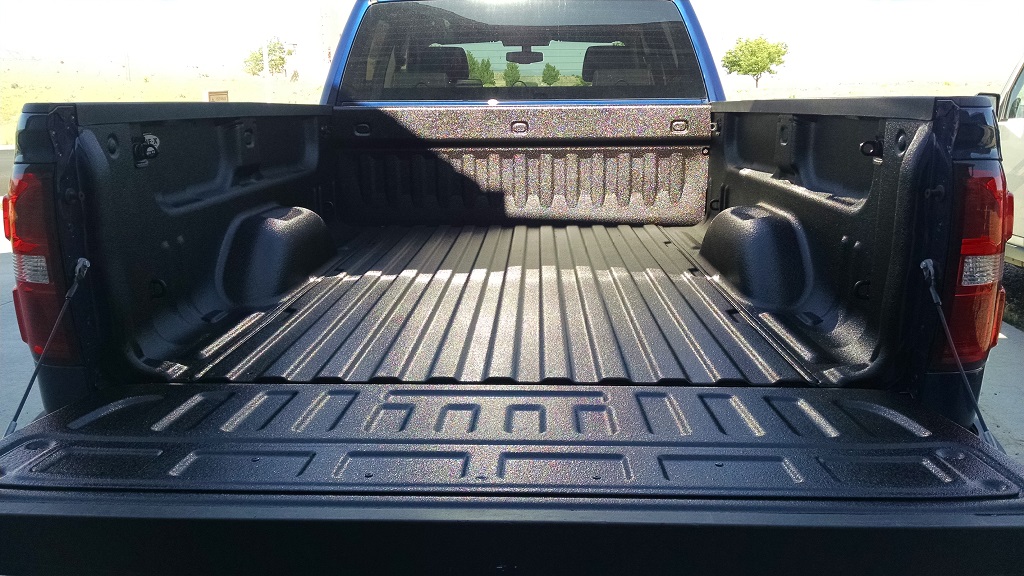
Line-X Premium done today. Oddly enough, immediately after I pulled up at the dealer, someone in a 2015 Sierra 1500 w/ crew cab and standard box pulled up next to me. If not for the blue color change between '14 and '15, it would have been nearly identical. He was lucky enough to have the 6.2 w/ 8 speed tranny though. Turns out, he bought it from the dealer in the town I live in too. He had a Rhino already and was there to have a hard tonneau installed.
-
What have you done to your K2 today?
Hozer replied to block8head's topic in Modifications & Accessories
That does look nice. I didn't do anything special with mine. When I got home, I realized that I should have asked them to continue from the bed out toward the tail lights since there's plenty of clearance and a body line that would have made for an easy stopping place anyway. It's nice to have it done now so that I can stop staring at scratched up paint whenever I use the truck as a truck. -
What have you done to your K2 today?
Hozer replied to block8head's topic in Modifications & Accessories
I opted for the Premium and it apparently takes longer than the standard. -
What have you done to your K2 today?
Hozer replied to block8head's topic in Modifications & Accessories
So far today, I've driven it 110 miles and dropped it off for a Line-X bed liner. Now, I wait 4 or 5 hours at a nearby mall and try to kill time on the Internet. -
Post your 2014+ wheel/tire set-up
Hozer replied to BlueWrapper's topic in Modifications & Accessories
Yes, you can update the computer settings to account for different size tires and thus a different count of rotations per mile. There are many programmers available to consumers that allow us to update the computer settings ourselves but the dealer can also update the settings for you. Buying a programmer will cost you $300 to $500 depending on which you get. On the '14 and up, if you take the vehicle to a dealer for service, GM can see that you've updated the programming and could void all or part of your warranty depending on what settings you changed if they contributed to a failure of some kind. On the older vehicles, if you reset to factory settings before taking it to a dealer for service, they couldn't tell you'd done anything to it. The local dealer to me it would be a bout $50 to $60 for the shop time to have them re-program my truck for a different tire size and any dealer would be far less likely to squawk about the warranty because it was just tire size and a dealer did the work. I'd fight tooth and nail if they tried to void my warranty because I adjusted tire size settings myself but, at the same time, paying them $60 vs. spending $400 for a programming is fine by me. Once my warranty is up, I'll get a programmer and tune the motor, remove speed limiter, etc. but on a new model year vehicle and with some of the issues others have seen, I'll avoid risking warranty coverage! As for mileage, a larger tire, and particularly a heavier 10 ply LT tire vs. the 4 ply P rated stock tires, means more rotating mass and therefor more power/fuel required to get move the vehicle. This is generally why there's a fuel economy loss when going with larger tires. That being said, my '03 had 4.10 gearing and going with a 285/75R16 actually yielded better mileage than the stock 265/75R16 because my motor was at a lower RPM for the same speed and therefor using less fuel per mile. -
Post your 2014+ wheel/tire set-up
Hozer replied to BlueWrapper's topic in Modifications & Accessories
I'm not sure about those specific sizes but there's a comparison tool on rimsntires.com that makes it pretty easy to see the difference between wheel and tire sizes. http://www.rimsntires.com/specspro.jsp -
Post your 2014+ wheel/tire set-up
Hozer replied to BlueWrapper's topic in Modifications & Accessories
Thanks. I still debate whether I should have gone with white so it's nice to hear from someone with a sweet looking white one. -
Post Pics of Your 2014+
Hozer replied to jomuehlbauer's topic in 2014-2018 Silverado 1500 & Sierra 1500
Wheels: Ultra Baron 18x9 +12 offset. Tires: Big O Big Foot A/T 275/65R18E