

.jpg.8f82a73a99688ea2018813b7ec02af08.jpg)
truckmann
-
Posts
116 -
Joined
-
Last visited
Recent Profile Visitors



truckmann's Achievements

Enthusiast (4/11)
36
Reputation
-
Th3magpi3's website is called Coastal Flash. He's in Canada. The other option is GTPprix who is White Automotive & Media Services. He's in the US. I've dealt with both of them.
-
.thumb.jpg.aba4c0324957aa8d0cd28ea272e1b80b.jpg)
Adding GM factory trailer brake controller
truckmann replied to McClain210's topic in Modifications & Accessories
I'm assuming you can't see my picture so I just edited my original post to change how the image is attached. Let me know if that works for you. -
Adding GM factory trailer brake controller
truckmann replied to McClain210's topic in Modifications & Accessories
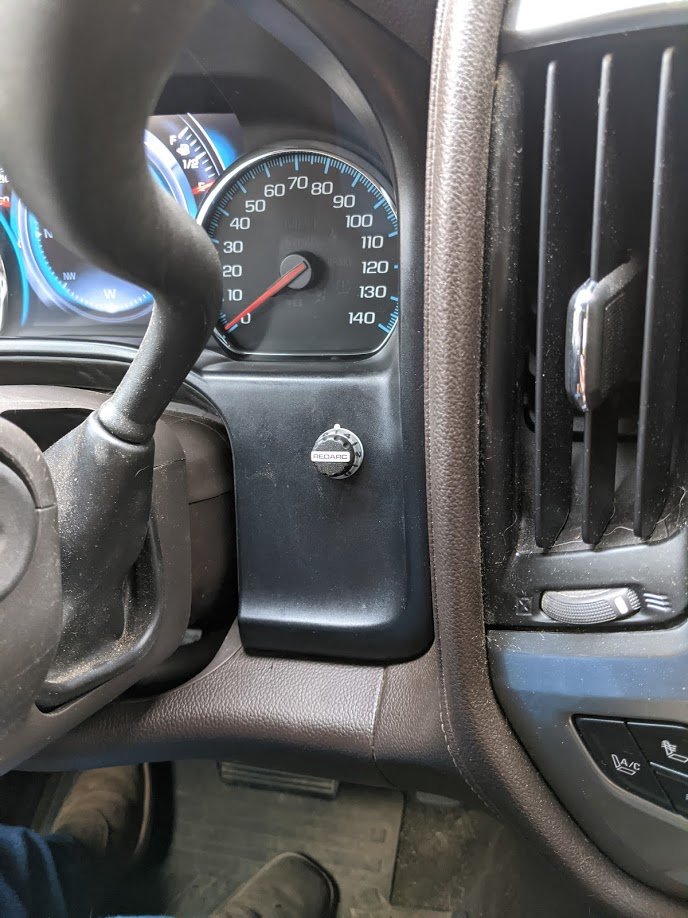
I know this is kind of old, but I just added a Redarc to my 2014 and figured I'd share my control mounting location since I've not seen anyone else put it where I did and yes I know my truck is filthy right now.
-
Cracked instrument cluster cover
truckmann replied to clarkecoln's topic in Troubleshooting & Recalls
Just wanted to say I'm glad I found this post. $36 shipped for a replacement lens is a great deal. Just ordered one for the Denali cluster I put in my 14 Silverado. My used cluster had some scuffs in it that really aren't too bad but for this price I'll go ahead and replace it. Just wanted to say I'm glad I found this post. $36 shipped for a replacement lens is a great deal. Just ordered one for the Denali cluster I put in my 14 Silverado. My used cluster had some scuffs in it that really aren't too bad but for this price I'll go ahead and replace it. -
Pretty sure you will be fine either way. When I got my truck it already had a 2.5" RC lift in the front and stock block still in the rear. I replace the junk Ranchos with 5100s all the way around and added a MotoFab CH-2R 2" rear lift block because I didn't like that the rear was a little lower than the front. I've had no issues with how it drives with either rear block and it's been up to 130 mph with the rear lift blocks in.
-
I ditched the built in navigation and don't miss it at all. Google maps is much better so I didn't see any point in having both.
-
19 SILVERADO FRONT BRAKE UPGRADE
truckmann replied to ModJunky's topic in Modifications & Accessories
I'll try to get to it when I have time. -
19 SILVERADO FRONT BRAKE UPGRADE
truckmann replied to ModJunky's topic in Modifications & Accessories
I don't know. Rock Auto looks to have them both available right now but there is a 2 day delay on the driver's side one. The stock has been in and out on them for a while. -
19 SILVERADO FRONT BRAKE UPGRADE
truckmann replied to ModJunky's topic in Modifications & Accessories
I've seen that one. The issue for me is still being able to use the catch can since it uses those ports. -
19 SILVERADO FRONT BRAKE UPGRADE
truckmann replied to ModJunky's topic in Modifications & Accessories
I'll have to look into it closer. I have a Mighty Mouse catch can on it now. -
19 SILVERADO FRONT BRAKE UPGRADE
truckmann replied to ModJunky's topic in Modifications & Accessories
18" will fit as far as being big enough diameter to clear the caliper. The 19/20's still have an 18" wheel option. Hydroboost is awesome. I did that conversion on my 2003 along with the bigger brakes from the 14-18 trucks. Honestly though I don't think I would bother with it on my 14 with how it feels now after upgrading to the 19+ front brakes. I have considered ditching the vacuum pump if there was a good place to tap into the engine vacuum. I have V4 mode tuned out so I think the engine vacuum would be sufficient from what I've read. -
19 SILVERADO FRONT BRAKE UPGRADE
truckmann replied to ModJunky's topic in Modifications & Accessories
It would be a guess but I would assume some grinding on the outer hump of the caliper or a spacer will be needed with most OEM wheels before 2019. The new calipers bolt right to the existing spindles. The existing hoses can be used, but I chose to upgrade to SS braided. -
truckmann changed their profile photo
-
19 SILVERADO FRONT BRAKE UPGRADE
truckmann replied to ModJunky's topic in Modifications & Accessories
I believe that. There's more going on there than just rotor size though. They are 2 systems purposely built for different situations. Everyday street car brakes built to stop as short as possible but not very many times while a track focused car built to handle multiple heat cycles and continue to work. Initial grab and continued usage is more important than getting to 0 on a track car. Without trying to look it up I'd bet they have different pad material and possibly different rotor material. So not really an apples to apples comparison. -
19 SILVERADO FRONT BRAKE UPGRADE
truckmann replied to ModJunky's topic in Modifications & Accessories
The thing is I understand physics very well and yes it is about the heat conversion, but I think what you are missing is that keeping the same amount of clamping force and pad surface area (basically saying that all things are equal) a larger rotor will create a larger torque force to stop the rotation. Even the equation to calculate brake torque requires the radius of caliper. On top of that a larger rotor is also moving faster through the pads thus creating more heat friction. I could link to many articles that explain it and I don't think I can find a single one that would argue that larger rotors don't allow for a larger brake torque. Also even though the rotor is the main heat dissipating feature in the system that is not it's main mechanical function. The reason good heat dissipation is needed is to keep from overheating all the components of the system like not warping the rotors and boiling the brake fluid. Here's an article from an engineering company that says it very simplistically. http://www.wcengineering.com/articles/brakes.html and here's a white paper from a well know brake manufacturer with formulas. https://www.apcautotech.com/getmedia/89aa6773-73d7-4f7f-b935-5e6bf2d28111/Centric_and_APC_Technical_Whitepaper_A1-The-Physics-of-Braking-Systems-8-2018_1.pdf As for this having any bearing on the upgrade to the 19/20 brakes it's probably not a big factor since the new rotors are not much bigger than the stock 14-18 rotors. The big improvement is with a more even clamping force from the 4 piston calipers and an increased pad contact area. Possibly a better pad friction material and difference in over all piston area too, but I can only speculate about that. I actually look forward to see what you have to say that could explain how rotor diameter has no effect on brake torque stopping power. -
19 SILVERADO FRONT BRAKE UPGRADE
truckmann replied to ModJunky's topic in Modifications & Accessories
Well I am 100% positive you are wrong but I guess no amount of logic or source material will prove that to you so I won't bother to try.

-
Forum Statistics
250.5k
Total Topics2.7m
Total Posts -
Member Statistics
342,949
Total Members8,960
Most Online
-
Who's Online 5 Members, 0 Anonymous, 787 Guests (See full list)