
Leaderboard



.thumb.jpg.971646e537e0c31d40f82bb49837bed1.jpg)
Popular Content
Showing content with the highest reputation on 03/25/2026 in all areas
-
It depends on what is important to you. GM does not manufacture their own glass. It is made by companies like Pilkington or PGW. Often a professional glass company can get aftermarket glass for a fraction of the price and the only difference is that it does not have a GM logo in the glass.1 point
-
All my previous trucks didn't start to see cooler hose seepage until 10 years/ 150k miles on average. My current truck was dripping at half that. Thats what I'm underwhelmed by. They're actually quite easy to disconnect. Routing them out and back in a bit more work.1 point
-
What I love about the 6L90 is, it's a beast. Way over built. Used in racing applications and HD trucks. It's way simpler than the 10L1000. It just works. And keeps on working.1 point
-
They have been using these swaged part-hose-part-metal-tube assemblies for at least 40 years, and they have been failing at the swage after several years for just as long. My 93 K2500 has 160k miles and is on its fourth set of oil cooler hoses. They are designed for ease of factory assembly - not longevity. I do them myself, but it’s a messy, frustrating job because the quick connect fittings are difficult to disconnect in the tight access space.1 point
-
Its not too bad if you're mechanically inclined, but you may as well utilize your warranty if you can. You deserve that privilege when they can't make stupid simple things last anymore.1 point
-
After reading your post several times, (I'm getting older now LOL so try and cut me some slack) Anyhow my guess is you have have an exhaust leak. They tend to "heal" themselves with heat due to heat expansion. And you perfectly described an exhaust leak, probably just a small one. Perhaps the header gasket. They sound hollow and will go away with heat. I hope this helps sir. And if I'm not mistaken here, there was a problem with the early 2020's plus here with header gaskets. Please someone else chime in here if I'm wrong, but I do believe there was a problem with some owners.1 point
-
I’ve mentioned several times over the years how Amsoil hydraulic oil has save my company thousands over the years. And how in the 80s through the early 2000s we went extended up to 25K miles with their oil. Extending hours in our ROW equipment. Did oil analysis and became a dealer. Other oils eventually caught up or at least got close. I don’t drive as much retired and don’t go extended. And I drive in town more vs highway. With the changes internally with most engines extending oil drains is not advisable for most people. I’m convinced 5K oil changes should be the maximum. I don’t use one brand anymore. Honda oil, Valvoline, GM, Mobile one and Amsoil. Who’s the best? I don’t know. If I did my own changes I would use Amsoil. All my daily drivers are plus 150K and use no oil. I know Grumpy test all the time with real world results. Can’t go wrong there. That’s my 2 cents.1 point
-
Same difference. I’ve never had a transmission leak and burn up. But after a hard pull I liked pulling the stick and take a whiff and look at the color. I’d pull the fluid out of the stick tube measure out put that amount in. Then I check the stick cold or hot on level ground. Easy peasy. I could do it wearing a suit. Now craw under the vehicle. No!1 point
-
I had an 100 gal fuel tank in the bed with my diesel trucks. I could go forever except when I was pulling my tractor. Going long distances is great except when you have to pee. So you have to stop anyway. I usually toped off with fuel while I was there. Stretch my legs.1 point
-
I say forget the cute and fun stuff like longer ranges and try and build engines that stay together.1 point
-
I think you are right with the 36-gallon tank. I see it as an option and not the standard. Just bragging rights for advertising to put out there.1 point
-
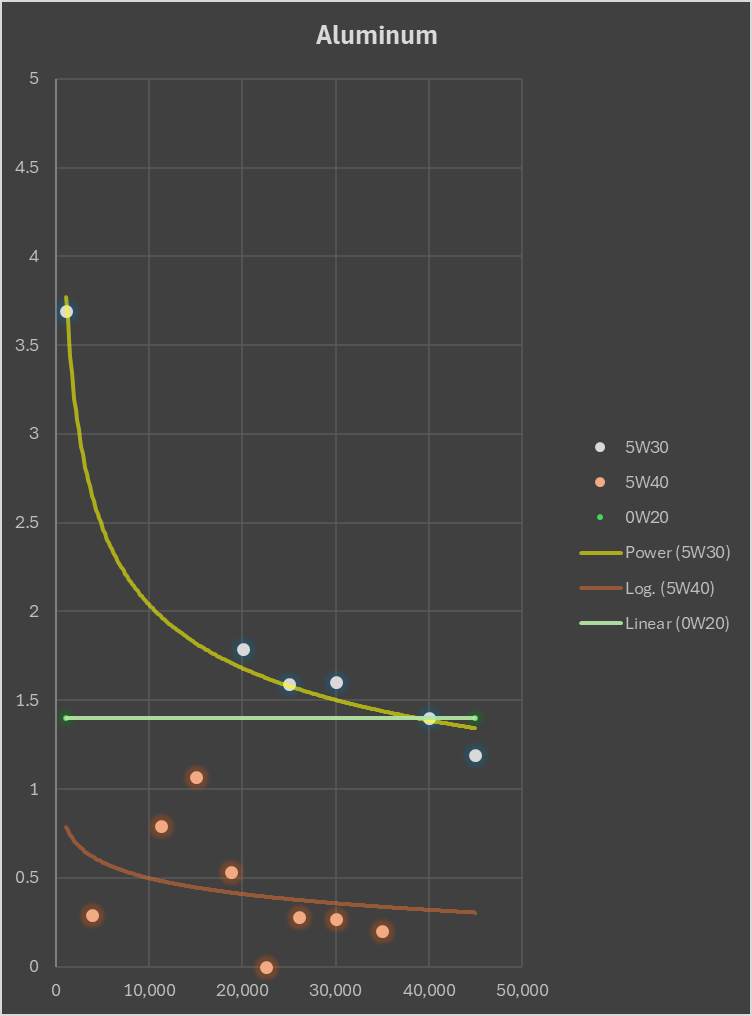
The real reason millions of engines are being recalled (link) None of these articles are fully on point. The writers still don't know the difference between 'tolerance' and "clearance". The MAIN CLEARANCE to be tightened was piston clearance. Use of hypereutectic pistons fit under .015" on a 4" bore and newer ultrahigh silicon content forging alloys. Bearing clearances are still about a thou per inch of journal diameter. This motor, the 3A92, mine, calls for a 0W20 oil. The chart here shows three different viscosities used in this motor. 0W20 line if from Blackstone's library. The 5W30 from an acquaintances motor who is as annal as I, and the last, 5W40 my personal motor. The "Total Wear Metals" chart I posted earlier in this thread. Chart I haven't posted is the Iron level chart. What it showed was that bore wear was reduced by using 5W30 over 0W20 but little more was gained in the use of 5W40. Almost all of the Total Wear Metals reduction comes from the huge reduction in piston skirt wear....aluminum. Bearing wear is reduced with each increase in HTHS viscosity so a smaller portion of the total wear improvement comes from that. Piston cleanliness has next to nothing to do with an oils viscosity. Cleanliness or lack thereof is a ring killer, a VVT-AFM-DOD solenoid killer and a cam chain eater. The posted link hints at manufacturing putting the viscosity cart before the ability to keep it clean enough to support that weight horse. That has absolutely zero to do with piston wear. But skirt and land wear have EVERYTHING to do with ring stability and longevity and control therefore of blowby. Dirty assembly will kill any engine on any weight oil. If the culprit is surface finish then viscosity is a card to be played. Use the information as you see fit.
 1 point
 -
Installed the new battery yesterday afternoon. Went out today and it behaved pretty much as it did several months ago (auto stop/start engaging and such). Feels like it also started faster/easier than before the replacement. I didn't time the start before the battery change, so no real data to tell for certain. I might use my BlueDriver module in the coming weeks to see if the 'low voltage' message comes up again or if it's gone. Glad I had another person to hold the assembly that goes over the positive post aside so that I could do the swap. Plus there was one connection I needed to remove in order to get that to happen. Need to go through the additional settings that I had changed from default that reverted with the battery swap. I've done a couple, but the rear seat reminder has yet to be disabled again.1 point
-
You are likely confusing the parking lights with the turn signal lights. They do both use the same bulb, but, they use their own filament inside each bulb. First thing to try is to remove all the signal bulbs, at both ends of the truck, and then look inside the socket for damage or green crap. If all is good, put 4 ways on and put bulbs back in, one at a time, until the fuse blows. If the fuse blows right away, you are in for a lot of work, unless you get very lucky and find it right away. You already know it is on the left side, so that removes half of the wiring. A "short" is a lot easier to locate compared to an "open". A short means the wire is touching ground at some point. Look for spots where the wiring harness is rubbing against metal, or where it is next to the sharp end of a screw. Do not pull at the wiring until you find the area the short is in. If you twist and pull at the harness you may "fix" it, but only temporarily. You want to find the short to fix, not have it go away for an hour or so. Pay attention to spots in the harness where it attaches to the body with straps or zip ties.1 point



.thumb.JPG.2c573de60d3a3a4407c7d92298db46dd.JPG)

This leaderboard is set to New York/GMT-04:00