

Jon A
-
Posts
1,349 -
Joined
-
Last visited
-
Days Won
5
Content Type
Profiles
Forums
Gallery
Events
Articles
RPO
Store
Blogs
Everything posted by Jon A
-
Cooling System Towing Test Results, Before/After Mods
Jon A replied to Jon A's topic in Engines & Drivetrain
Operating temp is reached just as quickly. It'll typically run in the low 180's in easy highway driving, but will heat up close to 200 in slow traffic on hot days as the fans don't really start moving much air before then. Due to the limitations of the programming (making 212 degrees the lowest temp you can have the fans on at full speed without also having them blasting when they aren't needed) the fans can't be set low enough to take full advantage of the 180 thermostat in such situations. No worry about codes. IIRC in order to set a code the engine needs to stay below 168 degrees which won't happen with the 180 thermostat unless it's leaking. Of course, as I mentioned in the other thread, that is a possibility. So far all the 180 thermostats I've found on the market that work with the stock outlet have a crappy rubber gasket instead of the stock O-Ring design and they are prone to fail. When they fail it's only a small leak, much like the thermostat has a hole drilled into it as people used to commonly do "in the old days" for various reasons. It's not a worry in the summer but if you live where there are cold winters I'd definitely recommend swapping it out for the winter as I have been (it's very fast and easy to do). Another option I've recently become aware of (and big thanks to Crobinson16 for pointing this part number out to me) is GM's part number 12674634. It is the one used for the LT4 (ZL1, ZR1, etc) and has a rated opening temp of 194 degrees. It has 90C stamped right on it and will be 100% reliable for year-round use for the life of the vehicle. It's about 1/2 way between our stock 207 and a 180 so it would make a good choice for those not wanting to go quite as low as 180 but want some improvement. Unlike our stock 207, the 194 is low enough to use the same fan settings I show above. They'll come on more quickly/aggressively so you'll stay closer to the rated temp at low speeds than you will with the 180. Since the same fan settings can be used, it may have done nearly as well as the 180 did on this test. It would have started at a higher temp at the bottom, but may not have topped out much higher. Maybe if I have the chance to collect data on another run like this I'll give it a try and see what it does. Thanks, man. I did the tests and collected the data nearly two years ago, but hadn't gotten all that written up until now. I've been using these: https://www.summitracing.com/parts/SUM-366-180 Those, Jet, Jegs, Lingenfelter, etc, all seem to be the same and have the poor gasket design. Mishimoto seems to have the correct O-Ring (if the pics are accurate): https://www.summitracing.com/parts/mio-mmts-vet-14 But it's only available in 160 which is really lower than necessary in my opinion for a truck that will be used in the winter: But it will probably work just fine for summer use. Yes, the fan settings were changed with HPTuners. Takes about 5 seconds. Good tool to have. -
I had a bit of spare time a couple years ago during the hottest week of the year and figured it would be a great time to do some hot weather tuning and while I was at it, a further eval of the cooling system. I collected a bunch of temp data some may find useful. I posted some similar data a couple of years ago but it was limited to a single “after” run with a couple of mods allowing people to pontificate upon what they thought the “before” results would have been with the stock cooling system. Unfortunately side-arguments were started by people who don’t understand how the cooling system works and it overwhelmed the information provided in the thread. So here’s a second try. This time I collected enough data from enough configurations there’s really no room for any argument, just the results, just what the data show. For the sake of simplicity we’ll compare two runs, one run with the completely stock cooling system and the other configuration the one I recommend for those towing heavy loads in the mountains in the summer with 2014+ V8 trucks—with two simple mods, a 180 thermostat and more aggressive fan settings in the tune. Two of the most common tropes on the internet regarding cooling systems are “the thermostat doesn’t do anything as soon as the engine is ‘warmed up’ so it won’t make a difference,” and “the fans don’t do anything at highway speed.” Both are simply very wrong, for a multitude of reasons. While it’s possible to conceive of specific situations in which one or the other modification won’t be of benefit, the vast majority of drivers (probably on the order of 99.999% if both mods are done together) will never run into one of these situations while running hotter than they’d like. The data below speak for themselves. As I’m sure some are wondering, runs were also made with the 180 thermostat and stock fan settings along with the stock thermostat and modded fan settings. The results were unsurprising, showing one mod helpful in some situations, the other mod helpful in others, but neither mod alone fully effective in all situations. Putting the two together makes each more effective and gives significantly improved cooling performance in all situations which is why I recommend both. This post is long enough and will be confusing enough to many readers already so sticking to comparing the two configs for now is probably a good idea. But keep in mind when I explain and attribute parts of the results to one thing or the other, I’m not making it up, I have the data to support the conclusions. Here are the stock fan settings: And with the 180 Thermostat these setting were used: A snapshot close to the top with the stock system: A snapshot close to the top in the modded config: Cliff’s notes results: Those were the peak temps reached by each fluid. As you can see, the modified configuration dropped peak temps across the board by about 20 degrees. Peak temps of course, don’t tell the whole story. Looking at the data in more detail is instructive. Each run was 20 miles up a mountain pass. The first 15 miles has a decent slope with the last 5 miles or so getting pretty steep—more than a 5% grade. The long runs ensure all fluids had plenty of time to be fully warmed up and find their steady-state on the moderate slope before the steepest final five miles. Ambient temps were right around 92 degrees most of the way up the hill on all runs. Also of note, the runs were made with the cruise on 65 MPH in Tow/Haul Mode for most of the way, but on each run the last ½ mile or so required reduced vehicle speed due to traffic at the top of the hill. Here is an elevation profile of roughly the last 10 miles of the run. Each chart only shows the last 10 miles of each run to better show the differences as the first 10 of each is pretty boring and just takes up space. Note this was not intended to be any sort of “ultimate torture” test or “proof test,” indicating success on this test would insure the cooling system can handle anything. I’ve towed heavier loads up longer, steeper passes and many south of here have done that in much hotter weather (but not while collecting data with a laptop). This was a comparison test to show the differences in performance of the cooling system configurations. Temps headed in the wrong direction on this test, even if they didn’t quite get out of control, should be a red flag for more severe use. Coolant Temp: Here you can see that after the first 10 miles of steady state climb (beginning of the chart), the cooling system is doing pretty well in both configurations and the thermostats are not even fully open (thus the ~25 degree advantage for the 180 thermo). That’s pretty good news, especially for those with the stock system who live where it’s flatter and any hills encountered when towing will be of moderate slope and/or length. When the hill gets steep for the last five miles, the cooling system needs to start working much harder. As both thermostats open more fully, the advantage of the 180 thermo of the modified configuration is slowly negated so the temps converge a bit, but the higher fan speeds of that config still give the system more cooling capacity—along with the stock thermostat not being open 100% until the very end of the test. As you can see, even running full blast up the steepest part of the hill, the modified config tops out in temp, reaching a new steady state. The hill could have gone on forever and it would not have gotten any hotter. Then when vehicle speed is reduced, temp comes down immediately. It is clear the fans played a key role with the modded config as the temp rise stops as the fans approach full speed. Programmed to reach full speed at 212 degrees, the temp stops rising 5 degrees short of that, so the fans get cranked up pretty high, but never quite actually get to full speed, indicating there’s still a little cooling capacity left in the system that would require a tougher test to utilize. If it was possible to program the fans to reach full speed at a lower temp (without them running full speed all the time, which I deem unacceptable for general use) it’s very possible lower peak temps would have been maintained with this thermostat. It’s also possible a slightly higher temp thermostat would have resulted in similar peak temps with these same fan settings. But you can’t use these fan settings with the stock thermostat (it's just too high) unless you want them blasting all the time. The temp for the stock config is still climbing when running at full speed and when vehicle speed is reduced to 50 MPH or so, the temp spikes quickly. Had the steep part of the hill been any longer there’s no telling how high the temp would have climbed. It didn’t quite make it to the danger zone in this test but it’s easy to see how it could in a tougher test. I personally have no interest in ever letting my coolant get into the 230-240 degree range and it’s clear with the stock config that would have happened with a heavier trailer, steeper hill or hotter ambient temps. Other vehicles begin going into various protected modes at such temps. For example, the EcoDiesel will begin “defueling” when the temp hits 244 and you’ll begin slowing down to 18-wheeler speed. The modded config on this truck provides a huge margin of safety before reaching such temps. When vehicle speed is reduced, the stock fan settings really hurt the stock setup. It is very common for speeds to be limited by traffic or road safety when towing and this shows that while increased fan speed helps significantly even at 65 MPH, it’s really, really needed at ~50 MPH. In some states there’s a 55 MPH speed limit when towing a trailer and sometimes there’s just too much traffic to go any faster. Many also tow on gravel/dirt roads, mountain trails, etc, where vehicle speed is kept low even when the engine is working hard. For those conditions the fan settings are even more crucial than they were in this test. Given these results, the engine cooling system seems to be more than adequate on these trucks, even without the NHT radiator. All one needs to do is “turn it on” a bit more aggressively with the lower temp thermostat and fans that don’t wait until you’re close to a meltdown before they crank on with some authority. I see no other mods needed for engine temp control in any situation. Oil Temp: Since the oil cooler is an oil/water cooler located in the cool tank of the radiator—so water temps have a direct effect on its effectiveness--it’s not surprising the oil temps stayed proportional to the water temps, beginning about 20 degrees cooler for the modified setup and converging a bit as water temps converged on the steep part. Again, the modified config found a new steady state in the middle of the most difficult part, indicating the hill could have gone on forever and temps would have risen no further. The stock setup, however, allows the oil temp to keep rising until the end of the hill—had the hill gone on another few miles, how much higher would the temp have climbed? 250 degrees on this test indicates it could get really toasty under harder use with the stock setup. For good fully synthetic oil (I run Redline) 250 is no big deal for short periods if infrequent. I don’t worry about the oil temp at all on my Camaro until it exceeds 300…but then again I change the oil on my Camaro after a single day at the track and don’t rack up that many miles on the engine so engine wear is less of a concern. I don’t think many people change the oil in their truck every time they tow something up a hill, so if you’re cooking the oil on a regular basis and still trying to run it 10,000 miles between changes, keeping the temps down a bit might be a good idea. 0W-20 is thin as water at regular temps, at 250+ it simply won’t protect as well as thicker oils of the same type. Yes, it reduces wear at startup, especially in cold weather, but it can’t do that and also be optimum for really high temps—so trying to prevent it from reaching such high temps is a good idea. For those who drive a truck for a couple years before trading it in it might not be so concerning, but for those who want to keep a truck long past the warranty period and put on a lot of miles, reducing engine wear is a smart thing to do. Using the EcoDiesel as an example again, it begins defueling when the oil hits 266 degrees indicating they feel that is very bad for the engine. Given these results, the stock oil cooler shows it is pretty effective. When the water in the radiator is kept to a reasonable temp in the modded config, the oil cooler is plenty adequate for keeping the oil temps in check. I don’t see a need for adding an aftermarket cooler or modding the stock system in any way, just keep the engine from running too hot when it’s working hard. Trans Temp: Here you can see on the moderate portion of the hill, the mods only made a small difference. Since most (or even all in some conditions) of the cooling comes from the air/oil cooler in the system, and the trans fluid cooling system has its own thermostat, lower water temps only have a small secondary effect on trans temps so the engine thermostat change alone won’t do much. And before the trans fluid thermostat is wide open, the increased fan speed only has a small effect. As the trans warms up, the increased fan speeds do help obviously as you can see the results begin to diverge as the hill gets really steep. In the stock config, the temp was climbing quickly all the way to the top. If the hill was longer, there’s no telling when it would stop. While for a shorter period of time than the other fluids, the temp does reach somewhat of a steady state temp in the modded config before vehicle speed is reduced indicating if the hill went on forever the temp should stay close constant. And the temp is low enough even if it gains another couple degrees, it’s a non-issue. The most worrisome part of the results for the stock system is the huge temperature spike at the top of the hill where vehicle speed is reduced. With the fans humming along in the modded config, there is no large temperature spike. This is an especially important thing for people to note who tow at lower speeds as described above. Towing in traffic is especially hard on the transmission as the on gas/off gas nature keeps the converter unlocking and slipping all the time, creating a lot of heat. The same can be said for winding roads/mountain trails. Unfortunately there are not separate fan settings in the computer based upon tranny temp, you need to get them on indirectly by assuming any time the transmission wants to get hot the engine will be warm enough that the modded fan settings I show above will have kicked in. This should work for most situations but it is possible (towing at low speeds, especially in very cold weather) that won’t always be the case. For pure highway towing the mods I listed above should be adequate. Keeping the transmission temps below 210 degrees in a test like this keeps you way out of the danger zone and nothing else is really needed. However, if you do tow at lower speeds a lot it may be worth it to you to add another layer of protection. The easiest way to do that is to bypass the stock tranny fluid thermostat and splice in an aftermarket one. This should have a similar effect as the lower thermostat does for the engine temp—giving it a lower baseline temp 95% of the time and keeping max temps lower by simply “turning on” the trans cooler a larger percentage of the time in mixed use and earlier during sustained hard pulls. I would not recommend simply bypassing the stock thermostat without replacing it with something. There’s really no advantage to running these modern transmissions colder than 180 or so and some disadvantages, especially in winter use. According to the data so far, the stock air/oil cooler seems adequate so I see no reason to advocate adding a larger aftermarket cooler at this point. But I don’t yet have any data for the system with a lower temp trans thermostat or lower speed testing. I’ll probably do that at some point and try to collect data in situations where the above mods might not be enough. Given the testing so far, I do think it would be very difficult to come up with a scenario where the above mods and the addition of a new tranny fluid thermostat are not enough to keep temps under control and wouldn’t advocate going to the hassle and potential downsides of installing a new cooler until some sort of data indicated it was needed. But more testing in this area is needed. Conclusions: For a 2014+ truck with a V8, even with the non-NHT radiator, I conclude the following for towing in hot weather where steep hills/mountain passes will push the cooling system to the max of its capabilities, in stock configuration and with two mods—a 180 degree engine thermostat and reprogrammed fans. Engine temp: In stock config the system is adequate for all but the harshest of conditions (harder than the above test). However there is indication a harder test could drive engine temps dangerously close to overheating, even if it doesn’t get to the point of spewing steam, it will come too close for comfort for many owners. With the two mods, the stock cooling system should be completely adequate for any situation. Engine oil temp: In stock config, the system is not adequate to keep engine oil temps in the range many users would like for longevity and in a tougher test could reach temps where warning messages appear, oil life is reduced, engine wear is increased, etc. With the two mods, engine oil temps are kept in check and the stock system should be adequate for any situation. Trans Temp: In stock config, the system is not adequate to keep trans temps in the range many users would like for longevity and in a tougher test could reach temps where warning messages appear, fluid life would be reduced and transmission could risk damage. In the modded config, trans temps are kept in check and the system should be adequate for any highway-speed condition where transmission heat is due to longer, sustained hard work as the engine temps will also rise triggering an increase in fan speed. The above test does not guarantee the system will be adequate in all lower speed conditions, especially in cold weather where the engine might stay cold enough the fans will not speed up (unless you have them programmed to stay blasting all the time which is not recommended for various other reasons). More testing and possibly other mods required (lower temp trans thermostat, larger cooler if high temps are still reached after that). One caveat for the entire cooling system overall is that these tests were done with the 6.2. It’s reasonable to suspect they might not have been as good (for each config) if tested on a 5.3 which will need higher RPM and lower gears to maintain speed going up steep hills. For a given load and a given hill, the 5.3 just needs to work harder than the 6.2. This does tend to put more heat in the fluids and I believe everybody thus far who has reported here getting warning messages when towing up passes and had to slow down has had the 5.3—even with the NHT radiator. So for concerned 5.3 owners I’d say look at the above results with the fact all temps may have been higher with a 5.3 in mind, making the mods an even better idea for the smaller engine. Another caveat is that this truck does not have those fantastic grill shutters…. I’ve done zero investigation into how those are operated and how much restriction they add even when open. Any restriction to airflow through the radiator only makes fan power more important, so if anything they would result in an even larger difference between the two configurations. One of the more important things this test reveals, is just how lucky we are. GM did a pretty good job on the cooling system of these trucks and big N/A V8’s are generally easier to keep cool than smaller turbo motors. Most never have any issue in completely stock form, and with a couple of simple mods that “turn on” the cooling system a bit sooner, we can work these trucks hard without worry, no matter the load, no matter the ambient temp. Other brands don’t have it so good. Before buying this truck, I was heavily looking at both the Ford Ecoboost and the Ram Ecodiesel. Both of those trucks have serious issues in tests like this. The Ram has it much worse—they run into the defueling conditions even with lesser loads on lesser hills and even in cool weather. It is very unlikely one of those could have completed this test without having to slow down to the 30-40 MPH range ½ way up the hill. They simply aren’t remotely as capable as these trucks are. Some owners spend money on bigger radiators, intercoolers, aftermarket oil coolers, different grills for more airflow, etc, but most simply seem satisfied to slow down to the 30-40 MPH range on big hills. They sure do get great mileage though. The Ecoboosts don’t have it quite that bad (they’re much more capable trucks), but they do commonly have issues. Heavy loads up long passes in high ambient temps—especially at high altitude—commonly heats them up to the point they enter “Reduced Engine Power” mode where the engine begins cutting boost until the turbos are basically shut off. Owners of these tucks also spend money on bigger radiators, intercoolers, aftermarket oil coolers, etc, but even with all that, nothing seems to “fix” the issue. We don’t need to worry about any of that. Owners commonly force downshifts to increase the engine RPM as a matter of course (sort of negates that whole “low RPM torque tows just like a big diesel” bragging point). Lots of Ecodiesel and Ecoboost owners end up upgrading to heavy duty trucks (usually of the same brand as they are loyal) simply due to frustration of overheating issues when the trucks are worked hard. It’s nice we don’t have to worry about that. Good job, GM.
- 83 replies
-
- 15
-

-

-
Does anybody have any actual pictures of the 34 gal tank from the long beds (GM part # 22772345 )? Standard bed trucks have gobs of space in front of the 26 gal tank if you relocate the EVAP canister. There's certainly room for a much bigger (longer) tank under these trucks. It wouldn't surprise me if the 34 gal tank fit with some modifications. Does anybody have a picture of one so we can compare their shapes?
-
Personally I don't do any real overlanding, but do study builds for ideas that might work for me. While it would be fun, taking "vacations from the world" for weeks or months at a time just isn't possible for me right now and I have other requirements from my truck that a good overland rig wouldn't do well. Here was my Trailblazer when I got done with it: The platform certainly had some limitations but we got by with it pretty well for a while.
-
Yes, big difference. The best offroad trucks would be terrible for overlanding and even the best overlanding rigs aren't going to be nearly as good offroad as a trailered offroad park toy. There is obviously quite a bit of overlap and the terms do get confused/misused often. Part of that is probably because so few people have the time or money to do either all the way in either direction so even while building their trucks geared toward one theme or the other, they aren't really built far enough to be considered "serious" for either. As far as full sized trucks, it really depends upon the terrain the owner is interested in. Heavily forested trails are often simply too tight for a full sized truck to work well (or at all on some trails). But in more open country size is less often an issue and the ability to haul more stuff can be an advantage. The Toyota Tundra has a big following for overland builds and there's nothing it can do the GM's can't, but they do have more aftermarket support for overlanding goodies.
-
Standard bed crew cab leveled or lifted????
Jon A replied to Gabe Bunn's topic in Modifications & Accessories
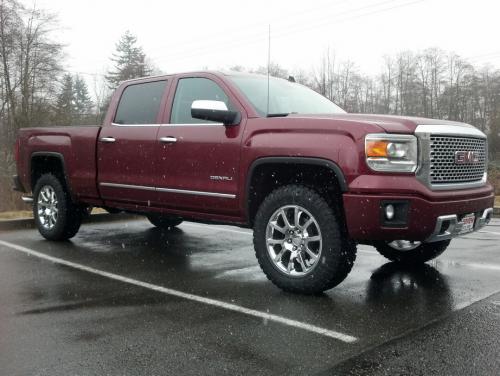
I haven't posted many pics in a while, so since you're asking.... Stock: Leveled 2" Front, 1" Rear with 34" Tires: Leveled ~2.5" Front, 2" Rear with 35" Tires: Lifted 4.5" front, 3.5" rear with 35" Tires: I've since replaced the stock tube steps, gained a bunch of ground clearance and makes it look higher: -
Hopefully the one on the 2019's in the bed will be much more powerful. If so it would be a great retrofit mod when the part is available.
-
Airbags are a great mod and it will ride and handle better with them. You may want to shorten the coupler a bit if you use them so the trailer is still level without the back of the truck sagging so much. Either way I think you can be confident you've got a much safer setup for moving that tractor around now.
-
Look good, let us know how it does!
-
No. Like much on the internet, that page is dumbed down to the point of being wrong. Shocks and struts are both dampers, but with a shock that's all it does. It takes no bending loads (other than those caused by bushing resistance) and has no effect on the suspension geometry. With a strut it serves as the upper pivot point of the kingpin axis (steering) instead of the upper ball joint (because the suspension doesn't have one). Putting a spring on one or the other doesn't transform one into the other. Yes, most strut-type suspensions are based on the MacPherson design, which is where they get their name. You can have the spring mounted on the strut, on the lower control arm (though it's relatively rare as it increases the bending loads on the strut further increasing their structural requirements) or even use torsion springs or leaf springs and it's still a strut suspension. As you can with an SLA. It doesn't matter where you put the spring, that doesn't change the type of suspension you have. Obviously, trying to explain all that to the average behind the counter parts guy is just a waste of time. But you were correct, you needed new shocks. Not struts. These trucks don't have struts.
-
They are shocks, not struts. Truck people are stupid--including and sometimes especially those who sell aftermarket parts for them. Struts rigidly bolt or clamp to the spindle. They react moments about the spindle with the strut shaft in bending, negating the need for an upper control arm. Any suspension with upper and lower A-Arms does not have struts. Such a system would be over-constrained and bind up. Shocks are free to rotate at both ends, thus having no ability to locate/align the spindle. Assembling a spring onto a shock simply makes it a coilover, not a strut.
-
Looks like a nice trailer, one heck of an upgrade! You were asking before about ratings. The newer owners manuals have ratings for 5th wheel/goosenecks for 1500s now which you could use as a rough guide. For example in the 2017 manual, the rating for a 4X4 Crew cab Standard box NHT 6.2 is 10,500 lbs and 8200 for non-NHT maximum trailer weight for goosenecks. These are around 1,000 less than for bumper pull from configuration to configuration for most 1500's as they're payload limited and SAE J2807 uses a minimum of 15% for goosenecks vs. 10% for bumper pulls. You can see how that added 400 lbs of payload really helps the rating for NHT's. Obviously, as with bumper pulls, those are maximums--not a guarantee every trailer of that weight will be towable without exceeding payload. They don't list a maximum pin weight as they do tongue weight for bumper pulls as the payload/rear axle rating will be the limiting factor. But no, the 1200 lbs listed for bumper pulls does not apply. With a gooseneck, you don't need to overload the pin weight in order for them to pull nicely as you do the tongue weight with some bumper pull trailers but it can also be easy to do. It doesn't look like you'll have a ton of room for adjustment (it's much easier when hauling shorter stuff--skid steer, etc) but if you were having trouble with too little tongue weight with that load before, hopefully you'll end up "just right" with the new trailer.
-
Nice! Is that a B&W? Don't be worried about how they're attached, they're very well proven and rated to way, way more than you'll ever tow with that truck. They're very simply the best way to put weight on and tow weight with any truck. Your sway issues are a thing of the past. It looks like it ended up 3-4" in front of the axle? Which trailer did you go with? As you mentioned earlier in the thread, a lot of equipment trailers do have the wheels pretty far back so it's easy to get way more pin weight than you'd want so I'm sure you were careful of that. But if one is to push the limits of the payload rating, a gooseneck is the by far the best and safest way to do it, and it's much easier on your truck than a big bumper pull.
-
Yes, it's just the stiffer rear springs that give the extra payload to the NHT. If you have a fetish for factory stuff, the NHT springs will bolt right on. However simply adding airbags will give you a dramatically better setup than the NHT springs. If you're worried about blowing out a bag, it really just doesn't happen much if they're properly installed. The typical Airlift or Firestone bags people use on these trucks have capacities way, way higher than you will ever use. You're much more likely to blow out a tire. If you do blow a bag your suspension will sag down to the point it's sagging now, that's all. It would suck but it would be no worse than what you have now.
-
The AFE intake will work with the LT1 or MSD manifold since you can swivel the tube on the box. I had to cut the end of mine off and use a new coupler but it worked fine other than that.
-
While you may pick up a couple of HP, it'll be so small it would be difficult to measure on a dyno, much less feel in real life, so don't do it for that reason. The only reason one should consider a lower temp thermostat on a stock or nearly stock engine in one of these trucks is if you do a lot of towing in hot weather up large grades. For that they can help keep temps down. Otherwise there's no real benefit. From my experience, 160 is too low for winter use. The heat will not be as hot and you can run into trouble defrosting at highway speeds. A 180 is generally "hot enough" for winter use but obviously won't give heat quite as hot as stock so if you have no need for it I wouldn't recommend it. Changing the thermostats on these trucks is only about a 10 minute job (especially if you get an extra housing) so if you do want cooler temps for summer towing, there's no reason to not do that because you're worried about the winter time--just swap twice a year.
-
Just so you know for future reference, a technical explanation on the internet consisting of "It's Physics" is akin to waiving a big red banner with the words "I've never actually taken a Physics class!" imprinted on it as most who have don't speak in such a manor (we understand how meaningless the statement is). I'm sure that's not the case here but thought I should let you know. Of course that's just silly. Lots of aftermarket companies publish dyno sheets, including those for 5.3 cat-back systems. Keep in mind, the OP asked about putting a stock 6.2 catback (which while "larger" has a pretty restrictive muffler, a neck-down to 3" for the AFM valve so it's far from "open") on a 5.3 with headers. While I certainly wouldn't try to sell him one saying he'd gain much, if anything over a 5.3 exhaust on that engine, the idea that he'd loose any noticeable amount of low-end torque is something one would say after actually observing it on a dyno to have any credibility.
-
Yes, and we were talking about the 6.2 at the time. If Ryan has a dyno backing up anything you've said on the subject we'd all love to see it. But I won't hold my breath. In fact, if he even has a dyno showing one of these new 5.3's losing torque with a catback sized for the 6.2 I'd love to see that as well; assuming the statement wasn't merely handed-down generic salesman speak.
-
Hyperbole works poorly in technical arguments. I have a 4" system on my truck. According to the chart you posted, that's exactly the size I need (as well as other 6.2 owners with more than a couple bolt-ons). While admittedly at this power level there isn't going to be a huge difference between the two, leading people to believe they're somehow going to make more power with the smaller exhaust is simply wrong.
-
Yes, I'm quite familiar with Larry's work. 1) Do you see the words "Rough Estimate" at the top of the chart? Racecars tend to not have all that many complex bends, flat spots or restrictive mufflers in the system. 2) What makes you think running a system at it's listed "Maximum" somehow equates to "Optimum?" Do you really think at 467 HP 3.5" is "optimum" but if you make 469 you then need 4"? Do you not think when you're at the listed limit the larger one may make a couple HP more than the one that is "maxed out?" 3) I'm well over 468 with my 6.2 with simple bolt-ons. Your own chart shows a 3.5" system provides no room to grow on a 6.2 as mods add up. A full bolt-on 6.2 is well over 500 HP at the flywheel.
-
Gotta love the internet. One can proclaim 2+2=5 and when corrected simply raise the "BS Flag" and think he won the argument.
-
1) "Will support" is a conditional term that means something different than "optimum." General rules of thumb like that do not account for bends, muffler performance, etc. He measured 5 psi with the stock 3.5" system, no engine builder in the world will tell you that's "optimum." 2) I've added more than 30 lb-ft of torque at just a mere 2000 RPM, mostly with the exhaust. I didn't do that by making the pipes smaller. 3) Just so you know, "Torque is what moves you, HP is the side affect of how long the torque is carried." is laughably incorrect. You're confusing torque with HP and HP with work.
-
The logic is they probably found it made more power. The Magniflow for the 6.2 is also 4". Guys, worrying about scavenging of a catback on a big, powerful V8 is really chasing your tail. I have never, ever, ever seen a dyno of a smaller exhaust making more power on such an engine. If you're worried about scavenging, read up and focus on header design when making your selection. Primary diameter (as well as stepped or not), primary length ("Longtubes" "mid length," shorties, etc), primary design (equal length, unequal length, tri-Y, etc) along with the collector design ("merge spike", "scavenging shape" etc) and length can and will have a huge influence on the torque curve. Don't expect any such magic to be happening with the cat-back. After the headers, after the cats, after the Y-pipe....all that's really left is backpressure. A smaller, more restrictive cat-back is generally going to make less power across the board. Changing to a true dual system gives you a little control over the torque curve with differing H-pipe, X-pipe configurations, etc, but with a single cat-back system don't expect anything from a smaller system other than less weight and less noise (and likely less power).
-
Torque App - oil pressure, gear, other good info
Jon A replied to mjj's topic in 2014-2018 Silverado 1500 & Sierra 1500
Heh. Air Conditioning High Side pressure. Good for evaluating how fan settings affect A/C performance at low speeds.... -
No, that's not how it works. The pressure will gradually decrease as you get toward the end (not in a perfectly linear fashion, but as s trend) and what matters is the pressure closest to the engine--that's what it sees. This represents the sum total of the entire exhaust. And guys, 5 psi is a lot. I remember an article by David Vizard in testing mufflers and 2 psi from the muffler alone represented a huge power decrease on the test engine. He advocated rating mufflers in flow (CFM) the way we rate carbs and throttle bodies. He determined you need X number of CFM per HP to not cause a significant power reduction. Which goes back to what I was saying before--the more power you have, the more flow you need. An exhaust may measure virtually no power loss on a low power engine and yet the very same system may cost a high HP engine a bunch of power. These 6.2's need to breath. I just got back from the dyno--I measured a 47 RWHP increase from simple breathing-related bolt-ons. I sure as heck didn't gain all that from the headers alone.
-
Forum Statistics
250.4k
Total Topics2.7m
Total Posts -
Member Statistics
342,762
Total Members8,960
Most Online
-
Who's Online 6 Members, 0 Anonymous, 785 Guests (See full list)