

Jon A
-
Posts
1,349 -
Joined
-
Last visited
-
Days Won
5
Content Type
Profiles
Forums
Gallery
Events
Articles
RPO
Store
Blogs
Everything posted by Jon A
-
The 4.3 V6 "calls for" 5W-30. Both the Camaro and Corvette "call for" 5W-30. All engines use the exact same lifters. If the "orifices were too small" for 5W-30 in an L83 truck, they'd be too small in a LV3 truck, LT1 Camaro or Corvette. Use that certificate to look up ACDELCO 12645725 and re-think your statement please.
-
Cooling System Towing Test Results, Before/After Mods
Jon A replied to Jon A's topic in Engines & Drivetrain
Unfortunately I don't have enough time to work on my own truck as much as I'd like, much less work on others'. But if you pick up HP Tuners (which is good for lots of other things as well) I'd be happy to walk you through it. It's easy enough a caveman can do it. If your trans is running hotter than it used to, that suggests something changed. The thermostat might be going bad, debris may be blocking the cooler, etc. The biggest single thing you can do for trans temps is getting rid of the stock thermostat. Makes a huge difference. I'll be posting some results as soon as I have the chance. -
"Knowing something" has nothing to do with it. It's about having different priorities. Reducing wear on my engine is my priority. Not getting soaked by millions of dollars in CAFE penalties is GM's priority. Do you run the stock tires on your truck? When they wear out you replace them with exactly the same tire? I sure hope so. Those are the best tires for your truck. Unless you know something GM doesn't.... Not a very logical argument, is it?
-
I've had better conversations with brick walls. "Replacement engines" come with some parts I listed as different. So no. If you're building one, same block, heads, crank, rods, pistons, valves, cam, lifters, pushrods, valvesprings, oil pump, AFM garbage, etc, so yes for all internal parts. Same part numbers. How hard is that to understand?
-
The base Corvettes of this generation are wet sump. Just like the trucks. Dry sumps only come on some of the higher option packages.
-
Yes. Exact. Same. Parts. The only difference between the 6.2 in the truck and the Corvette are the intake and exhaust manifolds, oil pan and accessory layout. The 5.3 naturally has different parts related to the displacement but there is no design difference for the parts you mentioned.
-
It's too bad you didn't test it before the lift. On my truck, the lift made no difference--it was so quiet you basically couldn't tell when it was in Auto mode. However after swapping to 4.11 gears, there's a fair amount of noise. I went with Yukon gears instead of GM and GM gears are reputed to be the most quiet and of course the driveshaft turns a lot faster with the new gears. Some amount of noise is normal but I do think it varies from truck to truck within a "normal range."
-
That's just false. Corvettes use exactly the same parts and recommend 5W-30 for street use, 15W-50 for track use.
-
I talked to a tech at Bilstein a few months ago, and he assured me they will make them for our trucks. Of course, after the 6112 delay I won't be holding my breath. Looks like a fantastic shock though, the Toyota guys are raving about them. Hopefully they'll be available before my truck qualifies for antique license plates....
-
It sort of does. That line of cams is actually able to retain all the AFM hardware, so that could save you some money if you wanted to keep AFM. I'd recommend getting rid of it for a more reliable valvetrain and it seems that's what the shop intends to do. But if you do that, you could use a cam with higher lift that will make more power. It's a decent amount of money to spend, so make sure you're picking the right cam before you do it.
-
Cooling System Towing Test Results, Before/After Mods
Jon A replied to Jon A's topic in Engines & Drivetrain
You could make a case that might be true if Cummins engines and the light duty 1/2 ton engines and transmissions had the same expected use and durability requirements. They don't. "In the green" for one application can be in the red for an application you expect to be run at a higher duty cycle for much longer. We have two Cummins as well and neither of them let the fluids get that hot. Ever. Complete apples and oranges. I didn't post this in the HD section for a reason. Most HD owners really don't need to worry about these things. It also ignores the point that many here have found these trucks won't always stay "in the green," even when towing well within their limits. They have gotten warning messages telling them to pull the heck over and idle the truck before they destroy the darn thing. The information above will allow them to avoid having this ever happen again and remove the worry of that happening from the back of their minds every time they have to tow in hot weather. It will allow the people who don't believe running the fluids "just under the warning message temp" is the best idea for long term durability keep the fluids at much more reasonable temps. Talking about how long a Cummins lasts is of little help to the subject at hand. -
Cooling System Towing Test Results, Before/After Mods
Jon A replied to Jon A's topic in Engines & Drivetrain
Sorry for the delay, haven't been online much the past couple of months. Respectfully, you didn't. When you go on to say you need a return on investment for the hassle and cost of adding auxiliary coolers, it's very clear you did not. In this thread I show how they are very unlikely to be needed by anybody with one of these trucks and what improvements can be had from much more simple and cheap improvements. I'm going to have to call BS on that as well. I've been on various automotive boards since they were invented and (no offense intended to everybody here) the level of technical discussion on the "truck boards" isn't something to brag about. In most of "these threads" you'll find nothing but anecdotal data, and people without a clue how things work all wanting to give their "2 cents." Half will be saying things such as the thermostat will make no difference once the engine is at normal operating temp, others will be saying that the fans don't do anything at highway speeds, etc. I didn't conduct back-to-back tests in the most scientific manor possible and collect all that data just so this would be lumped in with "those threads." If you have any other threads in mind that really are similar to this one, please provide links. I always like to see good test data. So you're the type of guy GM had in mind when they decided to make our temp gauges stick at 210 over the span of 35 degrees or so. "What they don't know probably won't hurt them?" "As long as it makes it to the end of the warranty, let's do what we can to keep them from bothering us?" However, even they decided they had better give us accurate trans temp readings (the gauge on the Denali is dead nuts on and it's available in the DIC of other trucks). Thanks. They have the same for transmissions as well: Admittedly many of those are out of date and won't be perfectly accurate for the most modern synthetic fluids so they need to be taken with a grain of salt, but if you think the general trend is somehow not followed by the transmission in your truck, I'd like to see any data that makes you think so. If you think peoples' own fluid temps is too much information for them to handle, you have a low opinion of people. The truth is most people with these trucks have no idea what their oil temp is when towing (have to scan for it) and unless they check for it have no idea what their trans temp is. Hopefully this thread not only opened their eyes to it, but provided some simple solutions for them if they decide they need to do something about it. Because I'm willing to bet "most people" won't agree with your contention that oil temps 260+ or trans temps 240+ are nothing to worry about if they want to keep the truck long term. Thanks, but I really don't think being able to run the wheels off a HD with a Cummins without worry is all that relevant to people with 1/2 tons with aluminum gas engines with much smaller cooling system and lighter duty transmissions. -
Cooling System Towing Test Results, Before/After Mods
Jon A replied to Jon A's topic in Engines & Drivetrain
Yes. There are literally thousands of SAE papers studying the oiling system and various wear rates, the effects of differing viscosities, temperatures, oil types (synthetic vs. non), etc. It's based upon these from which generic charts such as this come: These are concepts well known to the industry, not crazy ideas some millennial made up and put on the internet. OEM's typically put warnings (or in the case of boosted engines, will cut boost) when the oil exceeds 260 degrees or so to save the engine--same goes for the transmission. Quite a few people with these trucks have run into the oil or transmission oil warning lights when towing. My data in this thread shows even towing well below max on a pretty moderate pass is enough to get those fluids well above what is good for the engine or transmission. Just because you don't get a warning light telling you to pull over doesn't mean you're not accelerating wear in a significant way. Especially when using extremely thin oils in light duty (must meet CAFE standards) trucks. Here's a good overview on that subject: https://www.machinerylubrication.com/Read/518/motor-oils Here's a snippet: And how may of those were 1/2 ton trucks? If any, please provide details. If they were all HD's, that's really apples and oranges. They are designed from the ground up for such use and included dramatically larger cooling systems (when fan power is taken into account) with lots of extra coolers. They also don't come with 0W20 oil in the pan. It may have been helpful to read the thread before bashing it. In this thread I only tested a $20 aftermarket engine thermostat and tuning software for the fans (but has many other uses). About the cost of one single aftermarket wheel. Less than 1/2 the cost of many catback exhaust systems people here like (including your Borla catback) even if you throw in a new transmission thermostat on top. But people really NEED those things, right? Again, reading the thread would be helpful. It was specifically aimed at those to do tow a fair amount with their trucks. It's right in the title. -
Cooling System Towing Test Results, Before/After Mods
Jon A replied to Jon A's topic in Engines & Drivetrain
That would be nice, but it's just not practical if you work an engine hard for extended periods of time. To do that on one of these trucks you'd need a massive aftermarket air/oil cooler in front of the radiator, which would destroy your A/C performance and significantly reduce your radiator's efficiency. Just not worth it IMHO for the tradeoffs alone, not to mention the cost and PITA factor. I'm not really interested in trying to run the oil 10K+ when I do a lot of towing, I mainly just want to give the engine better protection when it's working hard than the 0W20 will. I've already dropped the temps a pretty large amount; that combined with an oil that does better at those temps should amount to a big improvement over stock. Thanks. -
Cooling System Towing Test Results, Before/After Mods
Jon A replied to Jon A's topic in Engines & Drivetrain
After more data, I think I've changed my mind on oil selection. I had stubbornly stuck with 0W20 (Redline) for this truck due to the number of cold starts (sometimes way below zero) and short trips this truck takes and figured I'd just try and keep it really cool. But after towing a couple thousand miles this summer and collecting data more than I had in the past, I found oil temps still exceeded 240 on the hardest portions (harder that the test in this thread) even with my current mods. Peak temp recorded on the last trip was 246. I'm fine with that temp using the 5W30 Redline that has been my go-to oil since Terry Dyson steered me toward it for my racecar 15 years ago. But 0W20 at that temp when the engine is working the hardest (and wearing parts at the fastest rate) just doesn't give me the warm fuzzy. I think I'll probably go with 5W30 for the next fill. But that further reinforces what a good idea these cooling mods are...anybody with a stock truck doing what I did would have oil temps approaching 270 degrees. Just not a good idea on 0W20. -
4” Lift on 35’s VS. 33’s Please Post Pics
Jon A replied to Big E in TX's topic in 2014-2018 Silverado 1500 & Sierra 1500
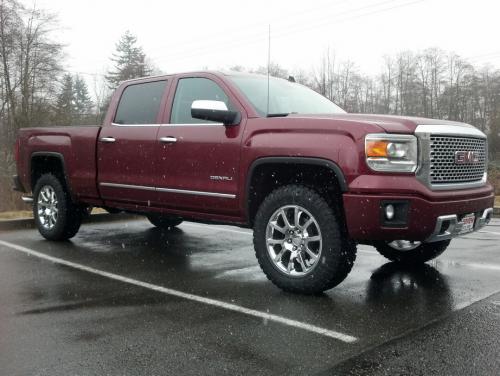
OK, I'll help you out. I have a BDS lift set at about 4.5" front, 3.5" rear with 35X11.5 Ridge Grapplers. Zero rubbing, even offroad: -
Nice! Any chance you could measure the piston diameters before you put them on?
-
Yeah, I'm hoping they kept the same offset and bolt spacing for the new 4-piston calipers. So much better than sliding calipers.... Those calipers and the Eradispeed upgraded rotors might make for a really good setup that could be put together cheaply once 2019 replacement calipers are available.
-
The GM Brembo kit is a massive, quality upgrade. I looked on ebay and can't find them anywhere close to $1600 (partial kits and used parts was all I could find), for that they'd be a steal and I'd definitely go that way. The Eradispeed upgrade is probably the best bang for the buck. It comes out to about $500 more per axle than simply replacing your rotors with new OEM. The added size of the front 15" rotors (and directional cooling vanes) will provide a real improvement in performance (though nothing like the Brembo kit) for relatively little. It's a good option to have.
-
Yes, with the leveled setup I used Cognito UCA's. I now have a BDS 4" lift and went back to stock UCA's for that as the lift corrects the angles and allows all the travel needed.
-
Spending $50K on a truck for daily driving on the highway in the first place is where the "insane waste of money" is. If that's what you did you'd be much better off with a sedan or crossover. How the hell do you think you know what I use my truck for? My current shock setup (ICON front coilovers, Bilstein 5165 Rears--less than $2000 total) rides better, handles better and adds much safety when towing: And is a fantastic improvement Offroad: You specifically asked about highway driving, so that's the question I answered. The shocks I chose are a fantastic improvement there as well (both digressive valved). The biggest improvement is noticed at higher speeds on bad roads (especially when hauling cargo), where large bumps, dips, "whoops" cause a truck with the stock suspension to bounce around, feel unsettled and unsafe; the chassis still bouncing up and down several times as it recovers from a bump or a dip when it encounters the next one. A good setup like mine not only smoothes out the ride over such stuff dramatically but keeps the chassis well planted and in control--a "solid" feeling you just can't get with cheap shocks. Similar improvement in corners and during braking. Again, false. I've actually had the stock Ranchos and then Bilstein 5100's on this truck and done all the same things with it that I have with my "next level" setup so I've felt first hand the improvements at each stage. There was a significant improvement from one stage to the next. One worth every penny. By your statement, it's clear you've never experienced just how good a vehicle can be with a really good set of shocks. Otherwise you'd know the real waste of money is spending $50K on a truck and then driving it around on cheap, crappy shocks its entire life.
-
Until a few days ago I had never heard of them. With shocks I look for quality, and RC isn't typically a name that jumps out and inspires quality to me. However, it's probable they're having the shocks made by a 3rd party for them, so it's certainly possible they're a good shock. The specs look good (though I'd like to know more about their valving), I hope they're good as more choices is always better for all of us. But personally I'd wait for more info on them (comparisons by those who have had other high quality shocks in the past).
-
Money spent on shocks is some of the best money one can spend on a truck. The ride and handling improvements (even on highway) a really good set of shocks can provide is quite transformative. In my opinion, most people short themselves by being way too cheap with shocks. They won't think twice about spending $2000 on a set of wheels and other bling items because they like the looks but don't add any actual performance, and keep their $50 factory shocks or only upgrade to a set of $100 shocks. Completely backward IMHO.
-
Full retail for a full set of Fox 2.5's is $2290: https://www.ridefox.com/filter.php?m=truck&p=&make=Chevrolet&model=Silverado+1500&year=2018-2007&position=ALL $1500 would be one heck of a sale. The Falcons are also available cheaper if you shop around (though not a 45% discount). I was pointing out another choice in a similar price range of those looking for 6112's. If everybody waiting for the 6112's was willing to spend the money on Fox 2.5's, they'd have them already.
-
The Fox 2.5's are nice, but nearly twice as expensive, so not really a good comparison.



-
Forum Statistics
250.5k
Total Topics2.7m
Total Posts -
Member Statistics
342,986
Total Members8,960
Most Online
-
Who's Online 9 Members, 0 Anonymous, 551 Guests (See full list)