


voided3
-
Posts
122 -
Joined
-
Last visited
Content Type
Profiles
Forums
Gallery
Events
Articles
RPO
Store
Blogs
Everything posted by voided3
-
We didn't have any paint issues on our '21 Silverado, but I lot of those items sound similar to my experience with ours. We did have an incorrectly installed trim piece around the passenger side tow hook, though, and the bed was misaligned (both were fixed). Ours had the dreaded DFM lifter failure at 585 miles prior to the updated GM TSB guidance, so it took four dealer visits, four rental cars, two engine tear-downs, and 51 days to get it fixed, so at least you don't have that! We also had to replace the serpentine belt and idler pulley at 6300 miles because it started wearing and squeaking prematurely, most likely due to being removed a few times for the lifter repair(s) and it's a stretch-fit belt (the L84 5.3 doesn't have a belt tensioner... great design). We have a non-Z71 4x4 Silverado with regular shocks and on rough surfaces the rear can get a little squirrely. It seems to have gotten a little better over 11,000 miles, or I've just gotten used to it, or the added weight of my Bakflip tonneau cover, rubber bed mat, and tool kit in the bed helps smooth it out. The brake master cylinders on these trucks are electric-assist ZF units and definitely feel a little different. If I have to do a harder panic stop, sometimes ours makes a funny groaning sound, and the pedal travel to get a firmer brake engagement is a bit far. Apparently the parking brake also uses the service brake calipers instead of a separate drum unit inside the brake disc, so sometimes after disengaging that you'll get an intermittent rubbing sound for the first 80 feet of rolling or so. As far as I can tell from my searches, this is normal, too. The clunk is probably the rear leaf springs or the jack under the back seat. Ours did it a few times earlier on, but I haven't heard it recently. If you search about that rear leaf spring noise, there is a rubber insert you can buy to stick between the leaf packs that is supposed to help. I didn't touch the leafs on ours, but I did remove the jack and noticed it was contacting the floor on one corner so I stuck a few round furniture felts on the floor where the jack contacts it. I think that may have been our clunk as I haven't noticed it since. The ticking is normal, as well, as our trucks use an extremely high pressure GDI (gasoline direct injection) setup that's common on a lot of vehicles now for better fuel efficiency. My understanding is the ticking is just the injectors firing. Our other GDI vehicles do this, too. Honestly, these trucks seem to make a lot of random ticks/clunks/squeaks/rattles and after almost a year of ownership, I've just learned to live with it. It's not great to have a bunch of random NVH on a new vehicle, but I can't keep stressing over every single sound this thing makes. I've been paranoid since my experience with the lifter failure, but I have made peace with the fact that this vehicle is essentially designed to last no longer than the 5 year/60,000 mile powertrain warranty and I plan to trade it in right before that runs out.
-
The rough idle seems to, unfortunately, be an intrinsic characteristic on the 5.3 and 6.2 engines. Our '21 Silverado with the 5.3 with a little over 11,000 miles on it also dances around a bit at 500 RPM, mostly on a cold start after warming up for 20 seconds or so and not so much when up to temperature. I have done cold starts with the hood open so I could watch the engine move and there does seem to be a good amount of engine shaking happening side to side, but I'm guessing they are heavily dampened rubber mounts for noise isolation which allow that much play. Some have reported that running higher octane gas can smooth idle, but I always run our 5.3 on at least 89 octane (extra knock protection for towing) and it still does it. Some also reported that having auto start/stop engaged seems to reduce this (when the engine is actually idling with it engaged, obviously not when it's off at a stop light haha), but I always turn it off reflexively every time I drive the truck. I would honestly do your best to ignore it and just keep up with maintenance. After nearly a year of ownership, I've learned to live with several annoyances that seem to be characteristics of these trucks, the biggest being DFM (which I disable by driving in L7 on the 8-speed), but the various squeaks/rattles/clunks/vibrations I routinely experience all seem to be normal for now. Let's just say if I didn't need a truck, I wouldn't be putting up with it.
-
My parents tend to buy new and keep cars 10-15 years. The longest term vehicle they've ever owned is their '03 Chevy Avalanche as it just keeps going, but they recently had some age-related repairs that were a little bit expensive to resolve (new fuel tank mounting straps as the old ones rusted out, 7-pin trailer wiring stopped working, water pump, yet another set of brakes, etc.). They did confide in me and say they regret keeping some vehicles as long as they did due to repair costs eventually going up while value goes down, however. My take on it is if your vehicle doesn't give you any trouble during the warranty period, keep it for a year or two after it has been paid off, then evaluate your options from there, weighing the vehicle's value and upcoming maintenance costs. If your vehicle has had multiple issues during the warranty period, I would get rid of it right before the warranty runs out. If you negotiated in an extended warranty, that buys you a little more time, but you still need to weigh non-warranty wear items like tires and brakes as well as the vehicle's current value. Our '21 Silverado has had a bunch of issues from day 1 including the dreaded lifter failure and it's definitely getting traded in prior to 5 years/60,000 miles, but at least I didn't have to pay to fix them due to warranty coverage. I feel a lot of newer vehicles are engineered to last the duration of the warranty and no longer so I don't feel that a 10-15 year span of ownership is financially practical anymore, sadly. If the lifters on our truck need replacement again, but out of warranty, it'll most likely be a $5,000+ job. No thanks.
-
We have the GM floor liners in our bench seat crew cab LT and it covers the "dead pedal". I was originally going to get the Weathertechs or Husky liners, but the GM ones cover the transmission hump in the front and split in half down the middle for easier removal for cleaning (they fit together like a puzzle).
-
DFM Vibration after lifter replacement
voided3 replied to 08BlackSierra's topic in Troubleshooting, Warranty & Recalls
We also have a '21 Silverado DFM 5.3 8-speed truck that had lifter replacement. It vibrated the same before and after the replacement, especially cruising at specifically 31 MPH prior to shifting up a gear. I can't stand DFM so I drive the truck in L7 to disable it and it's much smoother at all speeds. -
Bad lifter production dates
voided3 replied to dgstarr63's topic in Troubleshooting, Warranty & Recalls
Our '21 Silverado with the DFM 5.3 and 8-speed was built in November 2020 and we started getting check engine lights due to lifter failure at 585 miles. Ours was finally repaired on the fourth dealer visit for the issue (51 days at the dealer in total) back in April 2021 when they replaced the lifters on cylinders #6 and #8. This was prior to the updated TSB guidance you are referencing, so they only did the two cylinders. I'll let someone else weigh in on the supplier as I don't have info on that. The truck is now at roughly 11,000 miles and the issue has not come back yet (operative word "yet"...), but I also drive it in L7 instead of D on the gear selector as that disables DFM. Even in 7th gear, I still get about 20-21 MPG on the highway with the engine turning about 1900 RPM at 65 MPH, so I'd say DFM will give you an extra 1 MPG, roughly. I also run the truck on 89 octane or higher and run the tires at 38 PSI (instead of 35), FYI, as half the time we are driving it we're towing a small travel trailer. The driving experience is so much better in L7 at all speeds in my opinion, but it's annoying having to toggle up to it every time, plus turning off auto start/stop every time. With that said, I still can't justify the $200 Range DFM disabler as I get the same effect doing the above, but the only compromise is I lose 8th gear. If you live somewhere the highway speed limit is 70/75 MPH, it might be more worth it get get 8th gear back, but around here they are all 55/65 MPH. My advice would be to drive it normally in D for now and keep an eye on your dash for the flashing check engine light, as nerve wracking as that is. It's a well documented issue now if it happens to you, so they shouldn't initially shrug it off like they did to us. The average failure mode on the lifters seems to either be early on (like us), or they fail from normal wear and tear between 60k-80k miles, right when the powertrain warranty runs out. Since the lifter replacement is a $5,000+ job out of warranty, I plan on getting rid of the truck prior to 5 years/60,000 miles and honestly would recommend the same, unless you have a good relationship with a knowledgable independent mechanic who can install a DFM-delete kit for you with a new cam, lifters, ECU tune, etc. once you are out of warranty. Our state does annual vehicle inspections via OBDII scans, though, so my guess is any aftermarket ECU modifications will cause it to fail inspection on the emissions portion, so I'm ruling out this option in our case, unfortunately. -
It sounds like normal AFM/DFM operation to me. I run our DFM-equipped 5.3 in L7 (8-speed transmission) to disable DFM and it's a much smoother, better driving experience. I still get 21 MPG on the highway in 7th gear (3.23 read end) so you do lose about 1-2 MPG, but not bad.
-
Albeit it wouldn't be exactly the same as the factory towing mirrors, you can get custom fit mirror extensions that attach to the standard Silverado/Sierra mirrors. Here's one variety that only costs $60 and looks like a solid fit: https://www.etrailer.com/Towing-Mirrors/Chevrolet/Silverado+1500/2021/KS80930.html?VehicleID=202198911
-
Thank you for pointing this out! Our '21 Silverado LT did not come with that panel so I just ordered one. I hope it comes with the mounting hardware, but it looks like they used three generic plastic "Christmas tree" push fasteners that I can probably get at the hardware store. We get some random squeak noises from the passenger side dash so I hope this helps.
-
Perfect, thank you! I just clipped it back into place.
-
Thank you! That would be great as I want to make sure it's in the correct spot. I mistakenly said earlier it was an A/C line but it's actually a heater hose so I don't want to risk damaging it and having coolant all over the place.
-
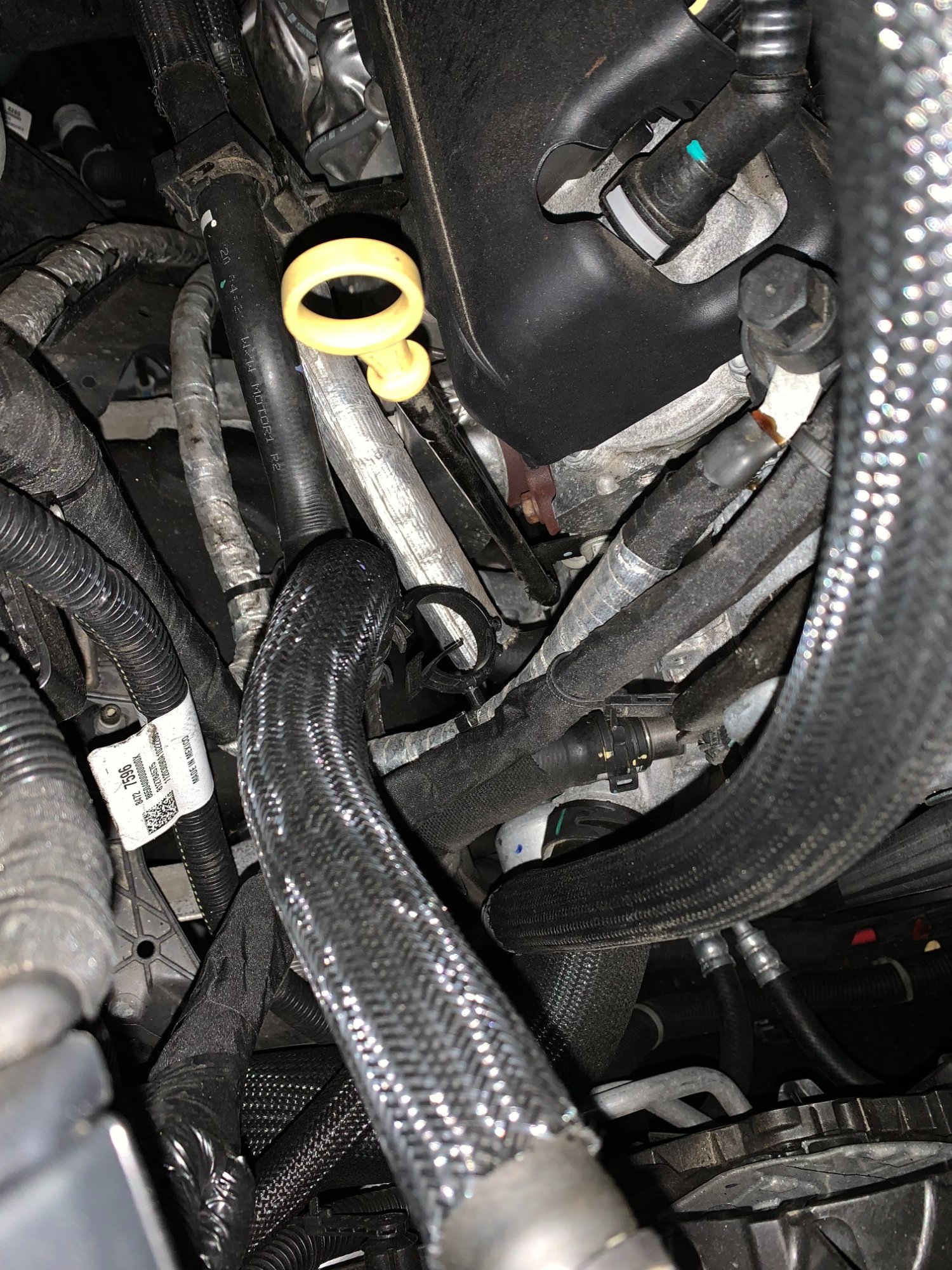
Does the clip attach to the hose above or the hose below the T connector? I'm guessing above based on the alignment but wanted ask. If it's not too much of a bother, a picture would be great, but no pressure.
-
It looks like it is intended to go onto the A/C hose in the black mesh wrap to the left of it, but I wanted to double check before messing with it. The truck had a few lifters replaced on the passenger side a while back and it appears the dealer missed that clip on reassembly...
-
I noticed on our '21 Silverado with the L84 5.3 that there is a hose clip (see photo) that appears to be for one of the A/C hoses, but it's unclipped. Where should this be attached?

-
Check out your door sticker in the driver's door jamb. It will list your payload and towing numbers for your specific truck. With that said, that truck should have at least a 7,000 lbs. towing capacity and 700 lbs. tongue weight allowance, but double check. For travel trailers, go off of the GVWR of the trailer, not the dry weight, and assume it will have a higher tongue weight, up to 15% of the trailer's curb weight loaded, than the usual 10% figure GM uses. The GVWR is the maximum loaded weight of the trailer. The dry weight does not factor in your propane tanks, deep cycle batteries, or any water you may be carrying. An average group 27 lead acid battery is about 50 pounds. Water also is about 8 lbs. per gallon. If you have a 30 gallon fresh water tank you fill prior to your trip, that means you're carrying an extra 240 pounds in water alone. Travel trailers also tend to be pretty heavy on tongue weight, hence why I recommend estimating 15% tongue weight. We have a similar weight trailer (Intech Sol Horizon) that's 3372 lbs. dry and 4000 lbs. GVWR, but the tongue weight is about 575 lbs. so keep in mind that tongue weight plus the weight of your hitch equipment (ball mount or weight distribution system) has to be subtracted from your payload allowance. Also load heavier stuff in the front of the rear axle/as far forward as possible to keep things balanced. We tow with our '21 Silverado with the 5.3 V8 and 8-speed with the 3.23 rear end. I always use tow/haul mode and shift down to L6. I would imagine your 4.3 V6 truck has the 6-speed and the 3.42 read end, so you may way to tow in L5 to lock out overdrive, also with tow/haul engaged. This also makes it faster to downshift when going up or down steep grades if you already are in Low. If you don't have the factory integrated brake controller, you are going to need an aftermarket one as that trailer will definitely have electric drum brakes. Check out etrailer.com for what's compatible. Your truck should be prewired for a brake controller with a 4-pin connector under the dash (check the manual for location). I also will assume your truck has the factory 7-pin harness and a hitch already, but if not, you'll want to buy the factory 7-pin harness from the dealer and get a hitch installed that meets or exceed the tow rating for your truck (once again, etrailer.com will have what you need for that). Final word of advice, drive slow. I find 62 MPH to be the sweet spot and never go faster than 65 MPH, even if the speed limit is higher. You're on a vacation, take it easy! Your transmission also won't get nearly as hot if you go slower, and you're way less likely to get trailer sway if you go slower. Travel trailers and cargo trailers have a large frontal area and have a ton of aerodynamic drag and "act" like a heavier trailer at speed due to wind resistance.
-
2021 Silverado 5.3 Ownership Experience
voided3 replied to voided3's topic in 2019-2026 Silverado 1500 & Sierra 1500
Wow, that's fast; I'm pretty sure the final repair for ours was about two weeks. Our truck got repaired around 1800 miles and is about to roll over 11,000 soon without further lifter-related issues, but I'm definitely keeping a close eye on it still. -
Buy a 2021 sierra or wait for 2022?
voided3 replied to Digger87's topic in 2019-2026 Silverado 1500 & Sierra 1500
I would give it a test drive and see how you like it as it will be very different from your current truck. I honestly wish we had the 3.0 Duramax instead of the 5.3 V8 in our '21 Silverado as we use it to tow a small travel trailer and the better towing range/efficiency and extra torque would have been nice, plus I don't like DFM at all and the Duramax is the only engine option that doesn't have cylinder deactivation. We have the basic cloth bench seat setup in our LT trim Silverado, but it does have the power driver's seat, front heated seats, and the leather heated steering wheel. I think the interior layout and ergonomics are perfectly fine, and I like having dual center consoles effectively with the bench seat. As with all modern vehicles, I think the front seats are too stiff, but I easily remedied that with a pair of memory foam seat bottom cushions for the front seats. It's not a vehicle that's accommodating of shorter drivers, though; my wife is five feet tall and struggles to find a position where she can both see over the ridiculously tall hood and actually reach the pedals without having her right heel floating, so she almost never drives it. The forward visibility on pretty much all modern trucks is pretty bad as they keep making the grilles bigger and the hoods taller. I rode in my parents' 2003 Avalanche recently and it was a real eye opener as the hood on that truck actually slopes down and the visibility is much better. People like to complain about hard plastics, but they also make it easier to clean. Combined with a set of floor liners, it's a pretty easy interior to clean quickly. The new interior on the 2022 models looks like a nice upgrade from a look/materials perspective (at least on the dash, which is the big change), but I'm easy to please; if it has air conditioning and Apple CarPlay, I'm happy. -
8 speed transmission issues still in 2021?
voided3 replied to SilveradoRST's topic in 2019-2026 Silverado 1500 & Sierra 1500
We have a '21 Silverado LT 5.3 + 8-speed 4x4 truck with almost 11,000 miles currently. We had the dreaded lifter issue on our L84 engine early on at 585 miles, but the transmission (knock on wood) has not given us any issues to date. We use it to tow a 3,700 lbs. travel trailer, as well, and roughly half of the miles on the truck were towing that trailer (but we didn't use it to tow at all until about 4,200 miles, so it had a long break-in period as we had to wait several months for the trailer to be delivered to our dealer). I monitor the transmission temperatures and the hottest I've ever seen it get on the road was 195 degrees F towing in slow moving stop and go traffic on a really hot day. The average transmission temps I see towing are between 156 - 180 degrees F depending on conditions, and I use tow haul mode in L6 on the gear selector. -
2021 Silverado 5.3 Ownership Experience
voided3 replied to voided3's topic in 2019-2026 Silverado 1500 & Sierra 1500
Right, to put it in perspective, the lifters were the main pain point. It all added up to a general fog of depression, distrust, and angst, but that was the main/real issue. I also had five different rental cars over the last 10 months due to how many multi-day service appointments this thing has needed, so that wasn't very fun, either. I'd love to try an upgraded serpentine belt, but there's no traditional belt tensioner on the L84 making it less of a DIY job; it's a stretch fit that requires a special tool you slip onto the crank pulley. I could try to pull some strings with the service manager and have them install an aftermarket belt if it gives me issues again, though, as we're definitely on a first name basis at this point and have each others' cell numbers (haha). -
2021 Silverado 5.3 Ownership Experience
voided3 replied to voided3's topic in 2019-2026 Silverado 1500 & Sierra 1500
Yeah, they started doing that after they fixed ours... lucky me! We were the first ones at our dealership to have the issue, prior to the updated TSB guidance. -
2021 Silverado 5.3 Ownership Experience
voided3 replied to voided3's topic in 2019-2026 Silverado 1500 & Sierra 1500
True, though honestly I prefer how it drives in L7, even unloaded. It's significantly smoother between 30-65 MPH and my highway fuel economy average still is around 21 MPG unloaded typically with the engine turning at 1900 RPM at 65 MPH in 7th gear with the 3.23 rear gear. With DFM engaged, it vibrates and shakes very noticeably, and also requires more throttle input to maintain speed. I will admit it's annoying to manually toggle up to L7 every time I put it in gear, though. The higher octane fuel is mostly for knock protection when towing in hot weather with the A/C on as the L84 is a fairly high compression V8 at 11:1. -
Hi everyone! I've been a long time watcher of this forum, but this is my first time posting. We're at the 10 month mark for ownership of our '21 Silverado LT CCSB 5.3 4x4. This is my first Chevy truck, but our family has had Chevy/GMC trucks since 1985 so I have past experience. Unfortunately, the first several months of ownership have been rough. To summarize: Our L84 5.3 fell in the date range for faulty lifters and it started throwing CEL codes at 585 miles. After four service appointments, several hundred miles of them test driving it, and 51 days at the dealer, they replaced lifters on cylinders #6 and #8 and the CEL hasn't come back, but I still have six cylinders worth of original lifters. I now exclusively drive the truck in L7 instead of D to disable DFM and run it on at least 89 octane (93 if I go to Costco for gas) to help nurse it along. They did give us extended component coverage on the engine, at least. The bed was misaligned to the cab, which the dealer body shop fixed, but damaged the plastic deflector in front of the passenger side rear wheel in the process. I had them send me the part and I replaced it myself. One of the rear air vents didn't work due to a chunk of carpet being shoved in it during assembly. After removing the front seats to fix it, the vent now works, but the rear USB ports no longer work after being reassembled. Since the 12v socket next to it still works, I'm not going to have them pull it apart again and just live with it. The serpentine belt became prematurely worn by 6300 miles with rubber dust visible on the front of the engine, accompanied by squeaking on cold starts for the first few minutes. They replaced both belts (A/C and serpentine) and the idler pulley and the squeak is still gone as of today at 10750 miles, but the new belt looks like it's wearing pretty fast, too. Is this normal for GM these days? This is the worst quality vehicle I or anyone I know has owned in the last 30 years. It's a shame because it's a great tow vehicle for our 3,700 lbs. camper trailer and I like the dimensions and layout of the cab and bed (although forward visibility over the ridiculously tall hood is terrible). My parents still have their '03 Chevy Avalanche they bought brand new and that truck never had issues remotely as bad as this Silverado, and it still runs great today despite winter road salt taking its toll on the body. I feel owning this truck outside of the warranty period is financial suicide so I've already been browsing for its replacement, honestly. Am I overreacting?

-
Forum Statistics
250.4k
Total Topics2.7m
Total Posts -
Member Statistics
342,753
Total Members8,960
Most Online