

Donstar
-
Posts
6,222 -
Joined
-
Last visited
-
Days Won
45
Content Type
Profiles
Forums
Gallery
Events
Articles
RPO
Store
Blogs
Everything posted by Donstar
-
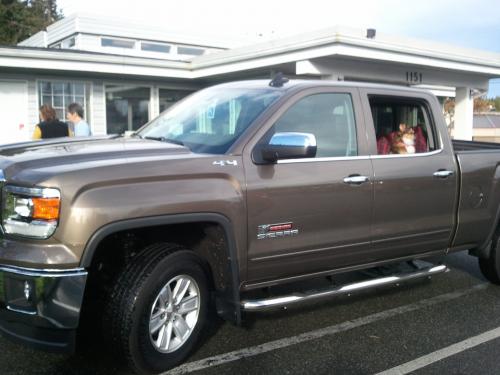
 I have read that one of the benefits of a front level is to compensate for sagging from heavy bumpers etc. This got me to thinking if different springs are used for different engines. There must be considerably more weight to a 6.2 than a 4.3. I can't tell which motor is in the vehicle by the amount of rake. If this is the case, then could lift be generated by heavier springs? I assume that if this was the case, it would probably be an expensive method and hard to predict how high the lift will be until they are actually installed.
 -
Good link, Tyler! Thanks! I was wondering myself if the explanation by Bilstein may be a little skewed as they do have a product to sell! Levelling shocks must impact the up travel the same as a top spacer. Their increased shock length logically should increase down travel which Bilstein says is a negative with spacers. Spurshot, I appreciate you responding. Your experience with these trucks is impressive! I wrote GM for their recommended method of "levelling" and they were firmly opposed to any such modification. (No surprise-but worth a try) My parts guy at the dealership recommends the ready-lift split system. This would be too high for my liking and I don't know if a split system would double the problems or cut them in half !!
-
Great explanation! Thank you. I'm getting a common message from all of these responses that Bilstein 5100 is the preferred way to achieve my goal. You all are obviously very knowledgeable on this topic and have chosen the Bilstein's for your vehicles!
-
Thanks for your response. A spacer will reduce my up travel and increase my down travel? Wouldn't one cancel out the other? The suspension's response to a pot hole should be the same, using my limited understanding!
-
I am looking for an explanation as to how a front 1.5 " level impacts your truck. I love the "lifted" look with a slight rake for carrying the odd load. I currently have 255/70r/17 tires and will not be going any larger than a 265 so I know I don't need a "lift". I have read and participated in the huge thread about leveling on this forum but somehow I haven't enough information to make the move. I understand that installing a spacer at the bottom of the front shocks is the most cost effective way to lift but what are the trade-offs? Do I lose 1.5"s of suspension travel? I have heard it makes no difference. What actually happens to create the lift? This is purely a modification to enhance the looks of my truck but I don't want to do it at the cost of losing function.
-
I believe by your response and by the number of people adding this type of level that there is no noticeable difference. I did an online inquiry with GM on this question and my response was very negative to any such modification. (No surprise) I was hoping they would send me some literature explaining why or why not a small level will enhance my truck.
-
Thanks for the information. I believe as well that the prices I get quoted over the phone are higher than if I paid an hourly rate to have a pre purchased product installed. There just seems to be about $300 difference in the finished install. My truck is basically a grandpa's big car and I won't be putting much stress on the vehicle. Saying this, I don't want to do anything that will compromise the safety or ride. I am hoping to find a better understanding of what changes, other than height, might be caused by such a level.
-
Can someone direct me to a page on this forum (or elsewhere) that will clearly explain what a 1.5 inch level generated by a bottom of the shock spacer will do to my suspension? I want to raise up the front of my truck for appearance while maintaining a small rake. I want to know if I lose any suspension travel or negatively alter anything else. The Bilstein shocks make sense but the installed cost is too much for me to justify at this time. Thanks!
-
I have 2600 kms on my 2015 Sierra CC with the 4.3 V6 engine and am very pleased. I traded in my similarly equipped 2009 Sierra CC with a 5.3 V8 after 153,000 kms. I prefer the versatility and ride of a full sized pickup truck which has been my vehicle of choice for over forty years. The downside of my previous truck was fuel consumption from both a cost and, in some small way, an environmental perspective. I loved my last Sierra but I was one who always wished I had a V6!

-
Forum Statistics
250.4k
Total Topics2.7m
Total Posts -
Member Statistics
342,869
Total Members8,960
Most Online
-
Who's Online 12 Members, 1 Anonymous, 682 Guests (See full list)