

.JPG.6537b7f00fa66f30aa51f5040da0fd95.JPG)
Grumpy Bear
-
Posts
12,857 -
Joined
-
Last visited
-
Days Won
464
Content Type
Profiles
Forums
Gallery
Events
Articles
RPO
Store
Blogs
Everything posted by Grumpy Bear
-
.thumb.JPG.2c573de60d3a3a4407c7d92298db46dd.JPG)
OCI, not when but why?
Grumpy Bear replied to Grumpy Bear's topic in Maintenance, Oils/Fluids, Detailing & Rust Prevention
I like a good echo -
OCI, not when but why?
Grumpy Bear replied to Grumpy Bear's topic in Maintenance, Oils/Fluids, Detailing & Rust Prevention
BTW @customboss, I put you back on ignore. Not because of what you say but because I'm reactive and when I react I am no longer on task. I'm like a dog compelled to chase the squirrel which distracts me from the point I'm trying to express. Ignore allows me to hide the distraction AND see posts in order written preserving my train of thought. -
Some Assembly is Required
Grumpy Bear replied to Grumpy Bear's topic in Maintenance, Oils/Fluids, Detailing & Rust Prevention
Subassemblies When you are looking at a Stribeck curve you are not looking at THE Stribeck curve but rather A Stribeck Curve. Every point plotted to make the curve is unique to that moment in time where load, velocity and viscosity are frozen. Thing is, if it were grafted that way it look like bird shot on a paper target. So...they are draw to display 'cycles' and each moving part has it's own pattern. Makes it easier to understand and yet it eludes minds quite easily. Reciprocating motion, piston/rings/bore move constantly left to right to left with a few hiccups tossed in for nonlinear velocity increased/decreases. Cam/roller start left and move right and stay right but not static as velocity and load change over a single revolution. Main/cam bearing come closes starting left and moving right and staying there within a smaller zone dictated by load/viscosity/temperature. Rod small ends oscillate. Rod big ends rotate concentric with the mains but vacillate in direction relative to each other. Not smooth rotation. Kind of like a differential going around a corner. The also have the most load swing as graphed by GM and shown in Smokey's "Hot to Hotrod the Small Block Chevy" It's cool if you ever get a chance to read a copy. When I use the word 'margin' I mean the far left edge of Stribeck. More HTHS puts the boundary regime in a smaller box as a percentage of the whole. Know what else it does? Allows larger debris to pass the space without damage to the surfaces. Stribeck is a multi level chess game played by multiple players in the same space. It's is dynamic.
-
OCI, not when but why?
Grumpy Bear replied to Grumpy Bear's topic in Maintenance, Oils/Fluids, Detailing & Rust Prevention
I'd say Geeks' video validated every thing I've ever said. Guess it just needed to be said by someone else. I'm good with that. -
OCI, not when but why?
Grumpy Bear replied to Grumpy Bear's topic in Maintenance, Oils/Fluids, Detailing & Rust Prevention
Exactly! I heard a really smart person the other day say, "Some peoples whisper is louder than a shout because of WHO they are not because of WHAT they say. Still doesn't make a lie the truth". This Revelation isn't new to anyone who has invested any time in Stribeck, Hersey, Sommerfeld. -
Some Assembly is Required
Grumpy Bear replied to Grumpy Bear's topic in Maintenance, Oils/Fluids, Detailing & Rust Prevention
Can it be assembled? A Rubik's Cube is challenging to solve because it has over 43 quintillion possible configurations, but only one correct solution. Hold that thought! Google this SAE paper title and read the introduction: In the intro it is acknowledged that there is a relationship between wear and fuel efficiency/Green House Gas generation. It also CLEARLY states that the latter, efficiency, carries more weight than the former, wear. Buy it, read it. If you do you are going to find that 'designing a motor from the ground up for low HTHS' isn't as much about design and it is about goal post moving. Unlike a Rubik Cube and running motor doesn't have one correct solution. It has no correct solution. It only has margins around an acceptable result. It also has not 43 quintillion possible configurations or positions but and infinite number. This is why Rafe Britton says in his viscosity series: [quote] The main significance of HTHS viscosity is its ability to indicate the oil’s performance in maintaining a protective film between moving parts under high stress and temperature. Oils with higher HTHS viscosity values provide better protection against wear and reduce friction, which is essential for engine longevity and efficiency. However, higher HTHS viscosity can also result in increased fuel consumption. [close quote] Two take aways in Rafe's comment. The word BETTER PROTECTION. Odd choice adjectives. He didn't say prevent. If the motor is going to run it's going to wear. Higher HTHS reaches further into the margins. What does that mean? Means it will prevent things from touching other moving things at LOWER SPEEDS, at HIGHER LOADS, at HIGHER TEMPERATURES and this isn't taking about when the motor is being abused. All within a single normal down the road revolution. That piston comes to a dead stop at each end of the stroke. What happens to Hersey at a velocity of zero? HTHS and ring tension hysteresis prevent collapse of the film thickness reducing the wear kiss that no surface finish or hardness will eliminate. And yes adds protection during harsher environments such as fuel dilution and towing. Protection as Rafe uses the word is relative to all conditions during a cycle. More area under the curve. I said there were two. His second went unsaid but implied in that last sentence. However, higher HTHS viscosity can also result in increased fuel consumption. (higher FRICTION) Same word he used in the opposite in the preceding sentence: higher HTHS viscosity values provide better protection against wear and reduce friction, People seem to have a problem separating the wear friction of surface ON surface contact with the internal fluid friction of viscosity. They are OPPOSITE ends of the Stribeck Curve and why Lake Jr makes such a point in saying wear and friction are NOT mutually exclusive. Designing a motor for low viscosity oil would require a smoother or harder surface or both. Even then it doesn't eliminate wear. It utilizes more of the margins. It does not eliminate the margin. It's a frog trying to reach a wall by jumping half way there with each attempt. Motors are not Rubik cubes. Increases in hardness invite fractures as the surface becomes brittle. Reductions in surface finishes inhibit 'wetting'. Both have been known and maximized since WWII. Stellite and Hard Chrome over tool steel cam cores (Now Ceramic DLH coatings) and single quartz light band flat finishes at zero micron have been done. Most of what makes a motor 'designed for it' is altering expectations of the end user. Toyota KNOWS nothing bad happens when you use 0W20 oil in their CROWN 'designed for 0W8. They don't even supply the dealers with 0W8. They offer 0W16 as a suitable substitute and allow 0W20 in the manual. To do that the motor was EPA qualified on 0W20. This designed thing is word salad that can be impossible to assemble until the scales come off the eyes.
-
OCI, not when but why?
Grumpy Bear replied to Grumpy Bear's topic in Maintenance, Oils/Fluids, Detailing & Rust Prevention
So you have ZERO PROOF for your whining ramblings that it is damaging to this motor. OMG what garbage. BTW, there is not such thing as "Designed for this HTHS". But even if it was, SAE 5W30 would not DAMAGE the motor. You are spouting half truths and drivel. And for very reason of physics demands, it will improve wear. You can't CANCEL STRIBECK. do you think you are? God? Anyone else interested it the relationship between wear and viscosity hit this link https://www.machinerylubrication.com/Read/518/motor-oils [quote from link] The best protection against wear is probably a product that is a little thicker (such as SAE 10W-30 or 15W-40) and has more antiwear additives than the oils that support the warranty. The best oil for your vehicle depends on your driving habits, the age of your engine and the climate you drive in, but it is not necessarily the type of oil specified in the owner’s manual or stamped on the dipstick. [close quote} 0W20 isn't even available in the UK accord to FORD and yet the 3.0 is. Yea, ground up design. -
I saw something today that gave me pause. A fellow making a point on another forum, and a darn good point he made, drown out in pages of AI Chatbot drivel. I mean drown like a rat at the bottom of the Mariana Trench. NO attempt was made by the reply or to offer a rebuttal. Just pages and pages of AI generated information blocking. I like machines. I like dogs. I like horses. They don't lie. Fact is they are incapable of telling a lie. Incapable of hate.
-
Sugar Bears 2015 GMC Terrain SLE-2 2.4 AWD
Grumpy Bear replied to Grumpy Bear's topic in Member Build Threads
I've seen a few like that. Either multiple motors OR OTR long haul delivery. Crazy length for the that transmission. Would love to interview the owner(s). Absent context, it means little. Still, not matter how it was done...hat's off. -
ACL/MCL. Hard road back. This turkey is cooked.
-
How about I post less and you just stop posting and be good for you word. (Though you quit this place) Please!
-
Shell V Power Nitro + is now over a dollar cheaper than XOM Supreme which hasn't moved a dime in months. $3.43 Shell $4.58 Mobil
-
Weather whiplash. Sub zero to near 50 F and rain, fog and wind. Melted the nearly 2 feet of snow in hours. Ice breaking up on the river below us and backing up water. Frozen ground not taking any isn't helping. It' will refreeze by to night and back to an ice rink.
-
OCI, not when but why?
Grumpy Bear replied to Grumpy Bear's topic in Maintenance, Oils/Fluids, Detailing & Rust Prevention
And exactly what grave danger will befall the 3.0 with an increase in HTHS viscosity? Give me ya' all's best horror story. I want to hear TRUE SCIETIFICALLY VERIFIEABE experiences of 3.0 motors failing and traceable solely to higher HTHS viscosity. I already gave scholarly articles that PROVE it WILL reduce wear. The trade is fuel economy...sometimes. -
OCI, not when but why?
Grumpy Bear replied to Grumpy Bear's topic in Maintenance, Oils/Fluids, Detailing & Rust Prevention
@Atlas, saw your question on the forums page. I haven't done a lot of looking about for diesel engines but I know that the PF system is VERY finicky which sticks a pin in many commercial diesel oils. I also don't know where you live so not sure if 15W* is appropriate. Both of these place some limits on selection. I also don't know the milage of your engine. But wear reduction MAY be improved with a DEXOS D 5W30. AMSOIL DP530 looks like a winner. HTHS of 3.5 cP, low ash and excellent cold weather and turbo clean properties. AMSOIL tends to use a very shear stable polymer. All that said, testing would be the only way to know. Keep in mind that the improvement in bore wear doesn't come from the 100 C temperature viscosity but rather the HTHS viscosity with limited improvement beyond 3.5 cP. A carefully selected *W30 can meet that and your Diesel Particulate filter requirements as well. -
OCI, not when but why?
Grumpy Bear replied to Grumpy Bear's topic in Maintenance, Oils/Fluids, Detailing & Rust Prevention
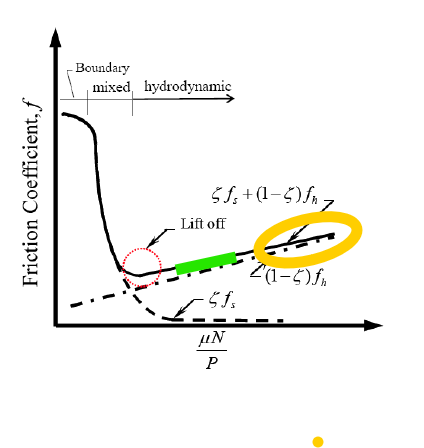
Excellent points both. The oil must be pumpable indeed so yes, 15W/20W/25W is a non starter unless you use coal like my grandfather To clairify. I was speaking about the second number *W20/40/50 The 10W60 example in my area might conceivably place Raven in the yellow circle, agreed and unduly waste fuel. Targeting the green area is well enough. However if I lived in Syria where 20W50 is already the book spec visiting the 10W60 for a look would harm nothing. Standard oil for the BMW M series. The object is lowest wear even at the sacrifice of fuel but wasting it just to waste it is a waste Graph credits to Recent Developments in Wear Prevention, Friction and Lubrication, 2010:263-278 ISBN: 978-81-308-0377-7 Editor George K Nikas Green & Yellow markups my own
-
OCI, not when but why?
Grumpy Bear replied to Grumpy Bear's topic in Maintenance, Oils/Fluids, Detailing & Rust Prevention
Every automotive example I've worked on since 1998 had VVT (save my 3800), which BTW is cam phasing. Honda, Mitsubishi, Ford, GM. The others mentioned, babbitt motors, were "heavy oil causes wear' samples, which it did not and now common place in those arenas. You can remove 'within reason' for the reasons you stated. Viscosity is temperature dependent running in normal course of operations 60,000 cP at -40 C pumping viscosity to now 1.7 cP at 150 C, HTHS. VVT/DFM/AFM works fine. Your argument is sound. Wear is another issue but function unaltered. Even Lee recently suggested I try Red Line 5W50 in the Mitsubishi 3A92 which calls for 0W20 in an attempt to build frictional heat. RIGHT? Could there be some 'jewel-box' bellows type oiling system such as used on steam turbines in an automotive application I'm am unaware of that would be quite viscosity sensitive? I guess. Anyone care to name one? And there are "spray bore" motors, such as the latest Ford Mustang V8's that due to the finish of spray bores are harmed not from the viscosity causing wear BUT from oil migration and calcium carry causing detonation. Or so the claim lies. ************************************** I've run 10W40 in air cooled Harley motors requiring 20W50 (with coolers) with lower wear metals and 5W40 in Mitsubishi motors requiring 0W20 with lower wear metals. Point is? Heavy is always best but it is more often than not better. Testing will sort that out if your patient enough to extract that result. The worst thing that happens is you use a bit more gas if it's to heavy. Early wear out is the worst that happens when to light. For me. it's a good trade and more often than not a motor that actually benefited from additional viscosity ALSO gave better fuel economy!! -
OCI, not when but why?
Grumpy Bear replied to Grumpy Bear's topic in Maintenance, Oils/Fluids, Detailing & Rust Prevention
Somehow I knew this was coming. Dirt in the water. This is an example of a select point of data removed from context can create a situation outside of practical operation. And offered without context, example. A simple statement said as if it's offer in and of itself is proof. As a child grandpas Studebaker was treated to a tin of hot coals placed under the oil pan, transmission and differential for several hours to bring those mineral based straight weights cut by API Gravity alone (ISO scale) to a liquid state thin enough to pump and cling. Any effort short was an open invitation to disaster. Moving on to my fathers time, and offered more than once in these treads, are the examples of dad's business benefiting from such fool hardy operation as to require the replacement of oil pump hex shafts or even main/rod bearings when such fools ratted their motors full of 10W30 on -25 F days during the first few minutes of operation. Today 5W*** is then enough on those same -25 F days to be driven off withing only the time it takes to get oil pressure with a judicious foot and prudent operation for a few miles. Coal no longer required and the use of Group PAO's offering much lower cold temperature viscosities than even the PPD added Group II's. (Not very effective on Group III's and no where near the same low temperature performance by THOUSANDS of Cp). Automatic transmissions, primarily hydraulic devices often act funny until the fluid is up to about 60 F, can kill a CVT, then function the same anywhere between that point and fluid failure temperature. Huge difference between cold weather viscosity appropriately selected and that of a fluid operating at any normal sustained operating temperature. The 4 cSt Idemitsu/Mitsubishi vs Red Line 6 cSt CVT fluid increase is a non issue hot and a very big help cold. Several thousand cP verses 20 cP differential cold. There is more difference than five grades at normal operating temperatures than between an SAE 30 operating between 180 F vs 240 F. Keep the W number the same and any and all augments counter vanish into reality. Interestingly and as a aside. Chevy, Hudson used poured babbitt bearings into the 50's. Prewar the Stovebolt 6 manual said 20W winter for the 216 CID and SAE 30 for the bigger motors summer. Today bearing and bore life has been increased by multiples using 15W40, 20W40 and 20W50. There is not softer bearing and they don't wash out using heavy oils. This sort of counter reality comments are not helpful.
-
OCI, not when but why?
Grumpy Bear replied to Grumpy Bear's topic in Maintenance, Oils/Fluids, Detailing & Rust Prevention
It really is this simple. OntheStribeckcurve.pdf An interesting feature of the Stribeck Curve and one often missed is that wear and friction are not mutually exclusive. The lift point shown in the PDF separating friction caused by asperity contact or dirt and friction caused by increased viscosity beyond that point. PDF also made the point that acidity also wears by erosion; Corrosive erosion. Wear happens when 1.) fluid film thickness is less than asperity height, two body wear, abrasion; 2.) A particle harder than one of the surfaces and as large as the film thickness is passed trough, three body wear, abrasion or 3.) The lubricant becomes acidic or overly caustic. Corrosive erosion. Anti-wear and Extreme Pressure additives are there for conditions that prevent sufficient film thickness. Acid package and corrosion inhibitors self explanatory. This agenda that pushes the idea that the OEM's selection of viscosity will place the lubrication regime squarely at the "Lift Point" of Stribeck for all operating situations belies all common reason. It is a poor attempt to place it there under best operational scenarios and puts an abundance of reliance on the 'sacrificial' AW and EP systems. Which, by the way, API iteration over iteration are reduced. A Plan for Failure? By multiple example it has been shown that wear RATE is high early on even in the most refined machining finishes and that the RATE is a declining slope that last well beyond that required for good ring seal. In multiple cases past 50K miles. That it can be tracked (proved) with wear analysis and with fuel economy by an operator skilled enough to collect, control and process that data. It has been shown that there is noise in that signal that is common and unavoidable thus trending is demanded. Data takes time and you will never know if a 2 ppm change/1K is a problem or within the systems standard deviation until you have enough points to extract that std/dev. You will never know without the 'context' of operations if a trend breaker is the result of aberrant operation of merely the product of another factor (corrosive wear i.e., from long TIME intervals even in weak acids). It's why OCI's have both a milage and TIME specification. It has been shown that increases in viscosity beyond the OEM recommended call out CAN (not will) reduce wear rate AND increase fuel economy and that unless you test and observe you will never know. Give it the right circumstances and occasionally lighter is an improvement. It has been shown that increased viscosity does not physically harm a motor nor interfere with hydraulic function of cam phasers. It has been shown that acceptance of higher wear rates may (not will) take so long as to blind the willfully ignorant into believing one is as effective as the other. Doing what you've always done will get you the result you've always got but it can not get you a better result. It has been shown that once optimal viscosity is well in hand that OCI length extensions will, at some point, increase 'RATE" of wear, induced corrosive wear, much earlier than common belief suggests. Both are found, not specified. And it has been shown that most of what argued about in such threads has nothing really to do with the topic nor any impact in result. Just dirt in the water. -
I made it out today and while regular is stubbornly bottomed, premium has been dropping like a stone in a well Down over a dollar in under a month. Makes me happy. I use a good deal of it. $4.59 down to #3.43.
-
True that. Depth is thin in key places. Left Guard has been an issue since Patrick got there. Salary caps are not helping. But it's hard to fill holes when you're a winner from the draft or lure veterans from other teams. Keep good players lured. Dog eat dog business. Did you see the Bears/Eagles game? Chicago put on a O line run game blocking clinic. It was something to behold. I could have walked for 5 a carry LOL. KC has had that a game or two when people are health and have their heads in the game. Did you see the Chargers game this week? That crap where defensemen are punching the QB in his broken hand crap to weaken his will or remove him from the game ought to be a permanent ban from the game and the coach that is teaching it given a horse whipping. Assault is not sports.
-
Dyno testing Amsoil against other oils.
Grumpy Bear replied to customboss's topic in The Off-Topic Bar
5.2. Wear and wear-in As more-and-more load is carried by metallic surface asperities at slowing speeds in the mixed lubrication zone, a proportionate increase is to be expected in wear rate. If design constraints permit, this deleterious effect can be reduced by applying higher lubricant viscosity, reducing contact unit load, or increasing rotation speed to lower the lift-off point. Use of antiwear and extreme-pressure lubricants may also reduce wear by forming protective surface layers on bearings. Despite the general difficulty and uncertainty in predicting wear rates of asperity contacts, Maru and Tanaka [27] have demonstrated some relation of wear coefficients with friction coefficients, particularly in the beginning stages of the mixed-film regime. Initial wear-in at mild operating conditions can provide a limited smoothing of the finish of both bearing and shaft surfaces. As shown in Fig. 5, this useful action moves the lift-off speed and the mixed lubrication region in the Stribeck curve to the left to reduce, or even possibly eliminate, the support needed from Michael M. Khonsari & E. Richard Booser 276 contact of solid asperities [24]. Grease lubrication and some adhering oil-additive films produce a similar effect in lowering the lift-off speed. *************************************** Lee ya loose me and any thinking man when you try to tell us this isn't true anymore. Power density is up. Speeds are down and both viscosity and AW are being sent lower. Universal law doesn't change. Attitudes about it do. OEM and guys like you are not just willing to increase wear you are demanding we accept it and pay for it while the design world tried to defy LAW.- 137 replies
-
- 2
-

-

-
- Amsoil Signature Series
- Motor oil
- (and 7 more)
-
Did I ever tell you I was born legally blind? 20/320 right 20/280 left, far sighted with a bi-orbital stigmatism. Everyone, including my parents just though I was a klutz. Knocked all my teeth out falling up stairs. Tripped over something in the yard falling into a woodpile and catching a axe in the forehead. All by age four. First week in kindergarten we had eye exams. I couldn't see the nurse much less the chart she had her finger on. My world was shadows and movement. When I got my first set of glasses, coke bottles, I fell in love with science. My world was a constant source of amazement to me. I poked everything with a stick. Optics! What a wonderful science. When in my thirties Lasik Surgery became a thing. As it was new few were doing it and my sight was precious. Although I was being told optics for correction was soon a thing of the past I was hesitant. While I was gathering myself to explore it deeper a neighbor of ours who was born as I was, only worse, decided to have the surgery. Back then they did it one eye at a time. Within a year she was blind in that eyes and has no hope of recovering her sight. It was new. It turned out to be wonderful in time. Just not in that time. I still rely on glasses as you well know. You also know that the science behind optics hasn't changed since it's inception. Oh the materials have improved and the techniques more profitable and more precise and this has allowed large scaling to a practical benefit for everyone. I've certainly benefited from it. My glasses are a fraction of the weight. My wait for a new prescription a fraction of the wait. But my $20 glasses from 1957 now cost nearly $1,000 now and her is the kicker. My eyesight after correction hasn't changed in nearly 70 years. All that progress and the practical result is the same as it was 70 years ago. Why? Because the foundation was laid in the unchangeableness of God given universal law. Optical Physics. On that I don't give up and I will never give in. Someday, perhaps when my cornea clouds I'll have Lasik after cataract surgery. Few go blind doing it anymore. But until that day arrives I will continue to rely on what has been PROVEN TO ME BY USE to provide reliable 20/20 vision. Even though it is a well worn technology. You, Lake, the API and SAE can trot out whatever "New and Improved" versions of current philosophy you like on the oil topic but whatever follows will not and can not improve on an already perfect result. I can't be convinced, humiliate, bullied, ganged up on nor denied by supply to deny the unchangeable. You guys know I've been around since API SB, right? I changed oils and grades as supply changed or as something improved on an imperfect result. I don't run advertising in my motor. I don't run regulations in my motor. I run what has given, continues to give a perfect result. I will quit when the supply dries up or it is degraded to a point it not longer does what it does. So...Lee....what is left to talk about?
-
Stepmother called last night. Uncle Garry passed. Dad is now literally last man standing of his generation in our family. He's 96. Garry was 82 ish. Dad isn't taking this well. I haven't a single Aunt or Uncle left. Dad is the third of six. No one left to tell on him. His sisters liked to do that. Pretty much how I ever knew anything about my parents before I was old enough to form a lasting memory. I miss them all.
-
Haven't been out in days but las time I saw, $2.62. Stubbornly so.





-
Forum Statistics
250.5k
Total Topics2.7m
Total Posts -
Member Statistics
342,988
Total Members8,960
Most Online
-
Who's Online 4 Members, 0 Anonymous, 743 Guests (See full list)