

.JPG.6537b7f00fa66f30aa51f5040da0fd95.JPG)
Grumpy Bear
-
Posts
12,857 -
Joined
-
Last visited
-
Days Won
464
Content Type
Profiles
Forums
Gallery
Events
Articles
RPO
Store
Blogs
Everything posted by Grumpy Bear
-
.thumb.JPG.2c573de60d3a3a4407c7d92298db46dd.JPG)
Another oil thread
Grumpy Bear replied to Bob2C's topic in Maintenance, Oils/Fluids, Detailing & Rust Prevention
ILSAC GF-7 https://www.chevronlubricants.com/en_us/home/learning/from-chevron/personal-rec-vechicles-and-equipment/preparing-for-gf-7-specification.html -
Another oil thread
Grumpy Bear replied to Bob2C's topic in Maintenance, Oils/Fluids, Detailing & Rust Prevention
API SQ https://www.chevronlubricants.com/en_us/home/learning/from-chevron/personal-rec-vechicles-and-equipment/understanding-the-new-api-sq-category.html -
Yes.
-
Nearing holidays season ^
-
1.) 16,450 miles first time (Hengst E1138L) 2.) 22,458 NAPA 200125 3.) 36,796 NAPA 200125 18,281 fresh plugs
-
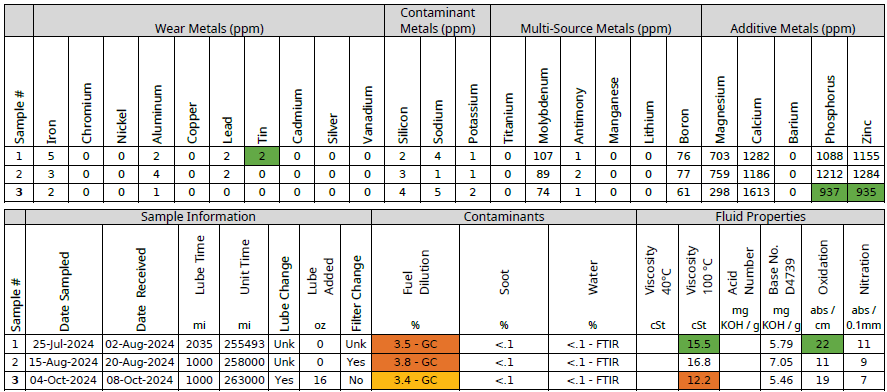
Raven at 35K...Final answer I would not have know this detail if I had not also run a UAO on Pepper from the same batch (case). Note the change in TBN chemistry? Now look at the oxidation? In Pepper, which shows no fuels, that value is 62. At minimum a 30 point spread assuming no elevation from base in Peppers sample which is silly to believe. When this sample was first run the attending paperwork which is attached to the outside of the pouch went MIA during mailing so the sample was run anyway but the Protocol is to run it as a Diesel motor oil sample. This has an impact on how the fuels is reported. A gasoline motor whose 100 C viscosity has dropped less than 1 cSt from the SAE grade mid point is reported as a fuels 'Estimate' of <1% and not actually run. For a diesel motor that threshold for actually running the GC is still 1 cSt but the 'Estimate" report is <2% and thus the original sample was so labeled and why not flagged! Elevated iron and aluminum from the trend along with this 2% estimate had me asking questions and the first run at it got the response of explaining the protocol. The tech then went the next step and actually ran the GC which in deed and fact was higher than 2%....just...but higher. Interestingly enough the viscosity trending in accompaniment with my detailed fuel logs show the point the injectors took a hike. During the miles accumulated to generate test #6 or two samples after the fact. Doing a Red Line SI-1 injector service currently. I will request the GC be run on the next sample regardless of viscosity result. If the service works, fine, I leaned something. Several somethings. If not then the injectors get replaced. This is a MPFI motor, not GDI and this motor from my first tank has seen only Shell V Power Nitro + fuel which has a boatload of detergents in it all ready. 3X the levels of Top Tier Fuel. (So the adverts say). I'm still in conversations with OA and getting positive movement. @Black02Silverado supplied the contacts and took the initial lead. I'm very happy with Nick and the lab at this point and now more educated about the labs protocols. I will set my own internal markers for viscosity reduction and improved fuel system maintenance. And tickled pink I chose to use the Mirage "Home Market' oil "weight' grade and not the North America 0W20 SAE SP, ILSAC GF-6A spec oil. There is nothing in my Mitsubishi Manual that mentions anything about routine injector service, chemical or otherwise.

-
192,342 Miles Moving away from E-85 for the winter. Shell V Power Nitro + 93. 20% ethanol at this point and doing an injector service of Red Line SI-1 cleaner and shock strength. 1-1/2 bottles to the 26 gallon tank. Can't see fuels on high dose alcohol (80%). But vis is down 1 cSt and wear metals are up. So I'm dong a service, a short OCI and test the one after. If clean, back on alcohol and if not replace HPFP and all six injectors. They've done their job. Noted, the change in add package. LSPI friendly now.
-
Sugar Bears 2015 GMC Terrain SLE-2 2.4 AWD
Grumpy Bear replied to Grumpy Bear's topic in Member Build Threads
278,000 Mile Services 447,405 Km 11/18/2025 2015 Terrain 2.4 1K mile OCI 5 Quarts Mobil 1 Euro 0W40 No filter (2) No longer tracking consumption. -
278,000 Mile Services Dizzy 11/18/2025 2015 Terrain 2.4 1K mile OCI 5 Quarts Mobil 1 Euro 0W40 No filter
-
Is this a good team having a bad season or we just loosing it?
-
Search Assist An empirical question seeks to obtain information through observation or experimentation, while a rhetorical question is asked for effect, not to elicit an answer. Rhetorical questions often emphasize a point or provoke thought rather than gather data. Florida International University Wikipedia Are you telling me that a college ed-u-ma-ca-ded fellow like yourself with a degree and decades of human/science grounded work experience can't tell the difference ?
-
It's Rhetorical Not actually a question asking for comment, Is it?
-
改善 Kaizen Dad used to say progress is a great idea America gave up on and sold to Japan that they perfected and sold back to us. I think father might be right. Only in principle. It hasn't a nationality.
-
That didn't take long. Actually I didn't ask anything at all.
-
Is is possible the membership is reading to much into what's been shared? Look past what oil I use. Past how long I run it. Past what parameters I chosen to condemn it. Unless you live in my area the environment I drive in is unknown to you. Traffic in commuting also foreign. My driving style. I especially don't know the mechanical state of you motor and honestly, neither to most of their own. (You don't a leak down lately?) Each has an influence on the totality of the results. I never said use Red Line HP or your motor will die. I never said use 5W40 in all circumstances. I never said your motor will fall apart at any OCI other that what I tell you too. I could but I wont. Why? Because of everything I don't know about each of you that you don't know about me. I've simply been showing the results of a METHODOLYGY I use to get the RESULTS I GET. Explaining the PROCESS is universal and can be used by anyone to use ANY QUALIFIED product to the SAME result. (cap for emphasis, not yelling). You are looking for a result and you have a method. IF that method gives you the result your after, use it! If you are looking for a different result and don't know how to get to it, then I've given you a template to systematically find another so you don't grope around in the dark. I didn't chose the physics and neither I nor you can change those; those surrounding viscosity, solvency, temperature, load and velocity and so on. We all have to work inside those to get any favorable result by any reasonable person or measure. I can say, in example, that oils with greater solvency produce cleaner motors AT THE SAME OCI. But I can't say that absent that constraint. A non-polar detergent oil will produce a clean motor on a short enough OCI. A non-polar, non-detergent oil will produce a clean motor on an even shorter OCI. I can even say a polar detergent oil can extend the OCI but I can't say by how much other that to state some very loose rules of thumb one can use to get started to safely proceed with the METHODOLOGY. Millions have preceded all of us. They used a method and got a result and MOST will never see the need to revisit the method and will by happy to get those results using those means and products others that preceded them got. You don't need my approval nor condemnation, nor do you want it. It would be rude of me to insist. I know a few things, you all know a few things. We share those things so that we all benefit. At least that is my understanding of how a forum works.
-
Some Assembly is Required
Grumpy Bear replied to Grumpy Bear's topic in Maintenance, Oils/Fluids, Detailing & Rust Prevention
Rewind the Assembly A recent post noted upping the viscosity wouldn't hurt anything, it just isn't necessary. Lets remember point of reference. "As things ought be". And in that case and situationally dependent I might be inclined to agree, especially in the case of Dizzy whose OEM call out is 5W30. So why did I up the ante? Because Dizzy isn't operating as she ought. She's operating 'As she is" and that is with a profound amount of fuel dilution that has no remedy other than a rebuild. Early by reason of a faulty high pressure fuel pump and afterwards as a result of the loss of ring seal. Something not abnormal to the Ecotec I-4 engine series. In other words I went to 5W40 to get a 5W30 under current operational conditions for which there is no economic fix. Also because the design has the fuel pump, prone to failure, with access to the crankcase and thus the oil. Upping the viscosity is insurance for the inevitable engine killing pump leak. Why the ultra short OCI's? Again ring seal caused dilution. Fuel doesn't just kill viscosity, it kills lubricity and both increase wear rates. It also accelerates oil degradation. First sample is Mobil 1 HM 15W50. Ending as a SAE 40 with elevated oxidation at 2K miles with pretty good wear. Second sample is that same oil at 1K miles sill in grade with improved oxidation. Cleaner. Last sample is Traveler's SAE 40 Mineral oil with ZDP added, which ended in 1K miles as a heavy SAE 30 and wear is stellar. New fuel pump installed with injector service at 261,753 miles which you see had zero impact on dilution. RINGS. Both too heavy for year around so I settled on Mobil 1 Euro Spec 5W40. So at this point the short OCI is to keep the ring land oil returns open. Cat is shot and I'm setting a P420 code every day now and using a quart over 2000 miles based on usage in 1K miles. Tis her life until I give up.
-
Some Assembly is Required
Grumpy Bear replied to Grumpy Bear's topic in Maintenance, Oils/Fluids, Detailing & Rust Prevention
Explain please the notes on the bottom right column. Yea, I let the dogs out.... -
Some Assembly is Required
Grumpy Bear replied to Grumpy Bear's topic in Maintenance, Oils/Fluids, Detailing & Rust Prevention
We have a defunct Buick Garage in town owned by the same guy for about 40 years and it was his fathers before he. There is a sales guy there whose been not just the sales guy but the buyer for decades. Auction house that is. I stopped in to say Daniel yesterday and he shared a piece of interesting information surrounding the Ecotec I-4 2400. There are still some of these around in Terrains and Equinox's with under 50K miles on them that show themselves at auction occasionally. They discontinued buying them quite a few years ago regardless of the shape they seemed to be in. BUT that same motor in a Malibu or a Verano is still quite sought after. Reason? Motors crap out in the heavier and less aero SUV's but sing like kittens with a bowl of warm mild in the lighter more streamlined sedans. He was puzzled by this. I am not. Wear is not just about design of the unit but about the "Load" placed on it. The reason bridges have load limits. As I have one of each and both have Scan Gauge setups I tested this utilizing the % Load feature and at 60 mph there is a HUGE difference in BMEP. Not quite the difference as there is in a 230 Chevy I-6 in a Biscayne and that motor is 16" Sea Star Tri-haul I/O but quite a difference. One could come to that same conclusion by examining the differences in EPA fuel economy numbers between vehicles with motor of the same type. -
Some Assembly is Required
Grumpy Bear replied to Grumpy Bear's topic in Maintenance, Oils/Fluids, Detailing & Rust Prevention
It seems to me that we all often demand someone accept our point of view when what should be happening is an attempt to understand their frame of reference. We don't even see it ourselves that we are resisting the wrong element of the presentation. We take an outcome based position we defend with a passion and we have that passion because we care about what we are passionate about. Arguments should always include reference and context. It isn't the first time nor will it be the last we ALL forget this salient point. You reminded me of that fact and to that, I thank you. -
Some Assembly is Required
Grumpy Bear replied to Grumpy Bear's topic in Maintenance, Oils/Fluids, Detailing & Rust Prevention
I've read and reread this rebuttal post and the quote imbedded over and over and over. It says volumes more than the words that make it up in what it doesn't say but implies. Both state facts. Both are largely true given each persons starting point. But they both come from vastly different frames of reference and it is that reference that is the hinge of all arguments between @customboss and myself. Terry sees things as they 'ought to be'. His observation that I "shredded one motor" is rooted in that frame of reference and if that reference were true it implies I did something, or perhaps nothing I ought for the 80 thousand miles it ran as it ought. Truth is I changed oil of the OEM recommended grade and of the DEXOS licensing actually 66% more often than the OEM schedule and yet it still failed. I shredded nothing. I did as I was told. Truth is the motors ring and PVC vent flaws are NOT AS THE OUGHT BE. (caps for emphasis not yelling) Truth is, if things were as the ought his advice would have be solid. @garagerog points that out. Roger sees things 'AS THEY ARE' in a rearview mirror historical way. In doing that he not only acknowledges the problem, ring design and vent design, but provides the most common outcomes and two examples of less common outcomes and finally observes Dizzy set a new bar in absolute result. From 'as it ought be' to "what it is", Dizzy and her caregiver goes from zero to hero. Abject failure to unmitigated success. Base on what? Base on a shift in REFERENCE. This constant fight over point of reference was and is a constant distraction preventing others from seeing the method and reasoning that lead to a most unusual outcome of reaching the 300K goal and staying inside the ever shifting oil consumption limits regarded as 'NORMAL" by the OEM. True, I also live in the world Terry does. "As it Ought be"....most of the time....until I am forced out of that reference by 'What it Is'. Now I find this curious given his experience with the CUMMINs ISX15 and a failure in flexibility for myself. It is how I made my living. I do not have a ridged reference point based on historical norms. Seems I'm loosing my edge. I do not need nor do I want an apology. But I will extend one. My comments "I reached success In spite of your counsel" lacks the same grace and latitude in/of reference point I have demanded of you. I rigidly held on to the "as it ought be" far to long and reacted way to slow to what it was. You were simply being you. I apologize. -
One third I'm mowing and on the eight, shoveling. Pavement wasn't cold enough to get it to stick but the grassy areas were. About an inch the weather service says. I'm not seeing but it is cold enough, 29 F
-
I noted on the news last night the death count is now 13 with 9 missing. Found a few?
-
I do the same thing with Shell. Mobil, local, is always 50 cents a gallon higher than the most expensive Shell V Power.
-
I feel for you. For about 5 or 6 years now I have bouts of about six consecutive weeks mid winter of lumbar 'guarding'. A musculature reaction to pinched nerves from thinning disc. Can't sit, can't stand and can't lie peacefully. Chiropractor has held it at surgeons length for this period but eventually..... Alternating a heating pad and ice packs does provide some limited relief. Hope this goes well for you.





-
Forum Statistics
250.5k
Total Topics2.7m
Total Posts -
Member Statistics
342,988
Total Members8,960
Most Online
-
Who's Online 11 Members, 0 Anonymous, 699 Guests (See full list)