

.JPG.6537b7f00fa66f30aa51f5040da0fd95.JPG)
Grumpy Bear
-
Posts
12,852 -
Joined
-
Last visited
-
Days Won
464
Content Type
Profiles
Forums
Gallery
Events
Articles
RPO
Store
Blogs
Everything posted by Grumpy Bear
-
.thumb.JPG.2c573de60d3a3a4407c7d92298db46dd.JPG) I honestly don't know. But I do know a fella that has Lake Speed looking into it for his Hemi. Lake didn't know either but is investigating it.
I honestly don't know. But I do know a fella that has Lake Speed looking into it for his Hemi. Lake didn't know either but is investigating it. -
Pretty rare for any GDI motor to not display some fuel dilution. Has to do with the fact that cold it doesn't vaporize the fuel, it atomizes it and the silly practice of over rich cold starts with really late ignition timing. A practice used to get the cats up to temperature quicker. Burning fuel in them. If you lab used GC instead of a 'crackle test' I'd expect you would see a percent or so. Copper in Ecotec3 motors is not uncommon. Platform specific. Hemi's do this too. Pepper at 165K still showed about the same amount she did at 80K. I don't worry about it. She's nearing 200K and runs like top. Should have latest results some time this week. I don't know what oil you are using but shear down of the VM is absolutely possible in that short of time. What we considered a flaw a few decades ago in VM chemistry is now advertised as a 'Feature". One used to get enough viscosity driven fuel economy improvement into the 20 and 30 grade oils. ILSAC GF-6 and API SP requirements. It's the main reason I don't use them and vis up one grade when I am forced to. IMO using a better lab would be helpful. Ask Nick. @Black02Silverado. I use his lab and get good service.
-
Bought mine at Walmart
-
Black plastic grill treated with Cerakote. She sits outside 24/7/365

-
I did the grill about 10 years ago with this product and it still looks new. It's some good stuff. Your headlight look really nice.
-
Saw $2.72 all over the place today. On a trip to Iowa picked up some E85 at $1.89 Nearly a tank for 30 bucks.
-
Saw $2.72 today!
-
ZDP https://link.springer.com/article/10.1007/s11249-016-0706-7 At least read the discussion and conclusion.
-
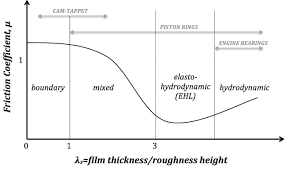
Don't see this every day Typically we see this curve only for neat oils with no VM's. They complicate things. This one is for a single weight with 'friction modifiers'. (ZDP, Boron, Moly etc. e.g.) No VM. Where do you think current design is placing OEM viscosity selection? Read up on GF-6B oils for a clue. Read up on the difference between GF4 to GF6 and ask how they get less friction from the same 100 C viscosity brackets? Explore the history of VM's for your answers. What are you relying on for wear control between the blue and green slopes? How does that work in extended drain intervals? Since your UOA will only tell you the presents of the element and not its chemical availability, how long is to long? What does your current observations of the whole of the industry and ring seal law suits tell you about this strategy? Trust me, I know what I'm doing? Tribologist are not power train engineers and power train engineers are not tribologist. Marketing people are neither and accounts haven't clue about any of it.
-
Saw $2.73 today at a Kwik Star and a Casey's. I've kept a chart of price since I bought the Mitsubishi and the price is for Premium but the trend is flat although the swings are wild. Yellow is 24 point average and the red the linear average. Dead flat.
-
191,230 Mile Oil Service 10/14/2025 191,229 actual 3,750 mile nominal OCI. 120 days. Still honey on the stick at this distance. Improvement. No consumption. No detectable loss of fuel economy. 6 quarts Red Line HP Euro Series 5W40 4 Oz. Red Line Break-in additive 1 Purolator Pure One PL22500 filter Pulled sample for UOA. Adjusted Headlamps down.
-
The Bills are up in 3 weeks and the only one ESPN has nearly even odds on. But we weren't supposed to loose to the Chargers either so....
-
I don't want an oil burner/best oil to use
Grumpy Bear replied to dieselfan1's topic in 6.6L Gas V8 (L8T)
I took note of his comments that you can find a study to support every position or belief. I agree. He also says to do it right you have to TEST and then admits he is to lazy to do that. Well....a least he's honest. I like that. I'm not that lazy. I test. Oil Geek and this guy are in about 99 point agreement. And yet both walk around significant facts that only testing would reveal. Honestly, that is to be expected. Their coverage of generic and the advice would of necessity require it to be specific and that, again, would require testing. For example, his talk about the graphs showing viscosity v temperature walk around the fact that POA's response to cold is quite different from a mineral oil (Group II or III) with even PPD additives and as I've displayed before can be a grade or more different as the specification for qualification is a MAXIUM with no minimum. Here it is again. They both use words like 'Significant" when speaking of the differences in wear. That world implies a standard to judge 'significance' against. Slight of hand but it doesn't mean none, it means compared to THE standard and they leave us in the dark about what the value of THE is. In the Steinbeck Curves displayed the points plotted on that curve for oil grades were plotted to make the point he was making. They were not random. And it is the main reason that you can find a study to support any argument you wish to make. The actual placement of that point on that curve is unique to the example under discussion. Right down the driver as the driver controls the average and median LOAD applied of the test and over the life of the unit used in calculating the Hersey number. To know your particulars you have to instrument and test. Acquire data and LOOK. You can not make blanket statements about lubrication. I have two such studies underway right now for MY equipment.
-
252k - transmission gave its last
Grumpy Bear replied to sdeeter19555's topic in 2000-2014 Silverado HD & Sierra HD
I can think of a few thousand reasons ($$$$) it isn't. -
Looks like the Funk is over! Lions are tough. But can we make up two games in the division?
-
$2.88 is now cheapest and rare for 87 E-10
-
I don't want an oil burner/best oil to use
Grumpy Bear replied to dieselfan1's topic in 6.6L Gas V8 (L8T)
-
252k - transmission gave its last
Grumpy Bear replied to sdeeter19555's topic in 2000-2014 Silverado HD & Sierra HD
If the clutch is slipping then replace the converter before it kills the transmission? -
Super Tech oil filters
Grumpy Bear replied to Jworks's topic in 1999-2013 Silverado 1500 & Sierra 1500
I haven't had a parts store/machine shop relationship like that since about the mid 1980's when I lived next door to a NAPA district manager and we still had interchange and dimensional catalogues. I don't know anyone in my area that doesn't need a VIN to find a lightbulb. I asked a counter guy (back then about 1984) for a water pump for a Gen I SBC and he got all flustered when I couldn't supply make model and year as it was a junkyard salvage. (Oh I knew but....) RJ (guy mentioned above) pushed him aside and asked me, "Short or long shaft". They only made two ever 1955 - 1991. Karl at Clinton Machine (Clinton Iowa 1975 ish) was one of those guys that could tell you which piston from a Dodge fit a Pontiac or what vacuum can from a Edsel Ranger Distributor fit an International Scout when you lost the tags. From memory while grinding a crank with a cigarette hanging out of his mouth and a pint in his pocket. Tell what shelf and bin it was in to and tell you to fetch it yourself if you what your crank back today. I miss that guy. And the kind of service. -
I live in the land of GREED. Most are 20 to 60 cents higher. I have that one station that is at the $2.29 price and rarely varies. BP took over the last Petro Canada station in Rochelle. There is a Casey's about a hundred miles south that is very close to that price but unsteady in content percent. BP is 75% every time. I think most price it as a performance octane and not as a clean air play.
-
Super Tech oil filters
Grumpy Bear replied to Jworks's topic in 1999-2013 Silverado 1500 & Sierra 1500
I opine that the AC-Delco filter sets the benchmark for 'average lifespan'. It is, Afterall, the GM touchstone. Legal "Lifetime" of a power train is 150K. If you believe that is 'average'; that Delco will get you there. Likely take it a bit further if all ducks are in a row. -
Super Tech oil filters
Grumpy Bear replied to Jworks's topic in 1999-2013 Silverado 1500 & Sierra 1500
True! Filter area is also in play on differential pressure. You could filter with a 2 micron full flow absolute system IF there were enough filter media area, but it would be a huge filter or multiple filters. Since that is somewhat impractical those systems are employed in bypass filtering of something like 10% of the pump volume. But on the money. Fine filtration doesn't have to be sacrificed but is often. Especially in cheap filters that count every square inch of media and every gram of metal in ROI calculations. Supertech sacrifices both for margin. They are not alone. People that do this for a living weight both filter efficiency and grams of debris held to a specific pressure drop to give an overall rating for the filter. They don't often share with mortals. -
Super Tech oil filters
Grumpy Bear replied to Jworks's topic in 1999-2013 Silverado 1500 & Sierra 1500
I think penny's make dollars and yes the air filter is very important as is dilution. But it is a concert, not a single note that makes that motor sing. And yes, air filtration has a larger impact than oil filtration. But air isn't the only source of particulate matter in your oil. Amalgamation of oxidation products key. Carbon, soot and yea, GDI creates allot of soot. Diesel levels sometimes. My opinion is that it is a mistake to isolate a single element of wear as unimportant or to prioritize them by cost. Bore/rings are bearings. Linear bearings with tight clearance that run under the worse circumstances than the rods, mains and cam bearings, as you noted. Your oil pump is a vane pump with micron sized face clearance. All that said, it is your money and your equipment. I gave the opinion I was asked for but I'm not the oil police You don't need my permission and I wont' judge your decision. No hook... -
Super Tech oil filters
Grumpy Bear replied to Jworks's topic in 1999-2013 Silverado 1500 & Sierra 1500
A fair point but are you considering all the clearances in the motor or just bearings? Ring face to bore face is 3 to 5 micron and the bore is the first place a well built and maintained motor wears out. Cam lobe to rocker/lifter interface is even tighter. There seems to be an idea that if it goes 100K without issues that whatever took it far will take it ten times that far. Lets go back to the GM wear study. Note that that chart has a formula that I tagged reference to. Let see how that works. A 30 micron filter has a relative engine life value of 4. A 20 micron filter a value of about 5.2. 5.2/4= a factor of 1.3. Let say you get 200K routinely with a 30 micron filter before bore wear gets intolerable. 200K * 1.3 = 260K to the same point of wear. So the question is, how much is 60K extra trouble free miles worth to you? Now lets say you also use a 2 micron bypass filter. You can't stop a mechanical device from wearing out but you can slow it's wear rate to a snails pace. Bearings are fine with 30 micron filters. Rings and cam lobes, not so much. Oh it will go a long distance but it will go further with finer filtration by a significant amount. 30% is not a sneeze. -
$2.29 here.




-
Forum Statistics
250.5k
Total Topics2.7m
Total Posts -
Member Statistics
342,984
Total Members8,960
Most Online
-
Who's Online 4 Members, 0 Anonymous, 549 Guests (See full list)