

.JPG.6537b7f00fa66f30aa51f5040da0fd95.JPG)
Grumpy Bear
-
Posts
12,849 -
Joined
-
Last visited
-
Days Won
464
Content Type
Profiles
Forums
Gallery
Events
Articles
RPO
Store
Blogs
Everything posted by Grumpy Bear
-
.thumb.JPG.2c573de60d3a3a4407c7d92298db46dd.JPG)
NGK Ruthenium vs AC Delco Iridium spark plugs for 5.3?
Grumpy Bear replied to greenoliver1's topic in Engines & Drivetrain
Put NGK Ruthenium plugs in Pepper about 10K ago. Non-event event. Now in 3 of the 5 on the lot. Dizzy is eating oil to the tune of a quart in 1500 miles and has for years. Not a misfire one. -
Woke up to -14 F and windchill at -36. Got a whole 7 degrees warmer and the high not just for today but the next three we are being told. Dog is taking a hot second to do his business and limping back to the house. I don't let him off lead nor outside alone. Short hair and thin ears.
-
Most Reliable GM Truck Engine
Grumpy Bear replied to GN2018's topic in 2019-2026 Silverado 1500 & Sierra 1500
Is the possible with Pepper? -
Lot's of on point in this post. What I put in bold is pure gold. When I was working I ate to survive, not enjoy, and rarely took the time to linger over the one or two meals a day I ate. Lived on bad work coffee club coffee mostly. I also smoked and I hadn't much of a sense of taste anyway. The one or two I ate I did so in minutes. Horrible habits. I'm not that guy that can tell you what 'notes' are in a bourbon or tell you what region a wine if from by smell but since I quit smoking and my sense of taste returned and cooking for the background has become somewhat of an obsession. People intentionally, at times, cover the taste of foods with 'adds' because they either don't like the food they are eating OR and I find this true allot, never learned to prepare it in a fashion that showcases the the food in a way that engages the senses. Your point on how fast we eat is so on point and not just what it does for volume control either; although I understand that is the point you were showcasing and I appreciate that.
-
She's grounded until she can take the altitude change, correct?
-
My mother was one of those who ate to the grave by my age and after multiple bypasses and much doctor coaching and help from my father who watched her diet like a hawk. For her, it was a compulsion. I smoked a good deal of my life. When forced into retirement I went five years without gaining an ounce and was quite thin for a 6 foot plus frame. 145 lbs. Lack of daily work in the industrial setting didn't have much effect. Five years later I quit smoking and over the next 18 months put on 70 pounds while maintaining my life long eating habits. Curious indeed. I've never been a huge sweets guy and eat meat like a condiment for most meals and skip it altogether much of the time. Wife is a vegetarian. Sort of. She was until she got hurt and I took over the kitchen then she ate what I could fix. Poor girl. Eating should be a joy, not a burden. IMO anyway; and even when dieting aka eating sensibly it doesn't have to be like eating a diet of paper plates and old boots. Nor does it have to require cooking school to enjoy but you have to work at it a bit like any skill. We do this with joy when it comes to our hobbies, right? Cooking can be a hobby as well as a necessity.
-
Richard if a guy is to lazy to lift a fork to his own lips then I got nothin for em.
-
Okay, there are 8 USDA beef grades. Prime, Choice, Select, Standard, Commercial, Utility, Cutter & Canner. Know what goes into that $4 can of Dinty Moore Beef Stew? Canner, near floor sweep. Or you could buy Choice Stew meat and make your own in a crock pot for about the same cost. Commercial is most used for packaged ground beef at a cost you can have ground Choice at your ma/pa store. I can use Select from Walmart for braising cheaper than Prime or Choice. I can buy oxtails cheaper than stew meat even two grades better and benefit from the bone and marrow. I buy artisan Carraway Rye bread for the same price as commercial bakery breads and often one to two dollars a loaf cheaper. Loose the conditioners and preservatives and greatly improve taste. And yes, wife hits up the $2 a quart Strawberries that will be a science project in a day or so and I clean and macerate them and they last a week longer and taste better. Things I buy canned are tomatoes out of season, some fish and beans. Unless I'm crocking. Fresh fruit and veg is cheaper than canned most of the time save a few like asparagus and even that can be cheaper in season. Thing is fresh has a short life so buying more than about three days worth is counter productive. I don't mind but some may. I get that. We are in a cold snap currently so I bought a few days of fresh and the remainder of the week in cans, boxes etc. Hybrid. Biggest thing is staying out of the fast food chains. Any idea what sort of meal I can whip up for $25 worth of burger combo meals for two? Iowa Chops, mashed cauliflower, blanched green beans with bacon bits a wedge salad and ice tea. Or a three pound pork shoulder with red potatoes, onion and carrots low and slow for about three suppers. Flounder with asparagus and lemon and boiled new white tatter in butte with tea cake and ice cream for desert. Three days of bacon and eggs with toast and fried red potatoes..... Six or seven Starbuck tall dark roast cost about the same as a pound of premium whole roasted beans and produces 25 cups of French pressed that isn't over brewed and bitter. I can buy a two weeks of tea bag for the cost of two fast food iced teas. I cook for my dog and use USDA Choice 95% and some fresh human grade fruit and veggie for about 25% the cost of the cheapest kibble.
-
Edge Insight CTS3 not showing alcohol percentage
Grumpy Bear replied to Crimson6.2L's topic in Engines & Drivetrain
I would contact the manufacture's support. They may have to find and an create a software patch. Linear Logic did one for my Mitsubishi's CVT fluid temperature. Just a thought. -
Food Cost Food cost money and lots of it and I get that. But the least expensive way there is to eat and eat well is teaching yourself to cook and going fresh, raw and simple. Every time a food is processed it cost more money. Even if that processing is simply putting it in a bag, jar or can and every time it is processed it looses something; Color, texture, taste and nutrition...and often control over seasoning as well as inclusion of preservatives and artificial ingredients. The one upside to processing is having more variety available for off seasonal foods. In which case I prefer frozen to canned. I get to keep everything but texture. People get intimidated in the kitchen and often because they over complicate almost everything about it. To much TV influence. Experts doing crazy things in complicated ways with ingredients you don't or won't have access to. It can be really easy if you stick with the basics. For example Broccoli fresh cut to florets and blanched 3 minutes returns a colorful, flavorful al dente bite as is and becomes something special with a bit of butter and salt. Or you can buy frozen at triple the price and get boiled water logged rubber balls. Fresh Green beans or peas ditto. Perfect the blanch, it is newbie friendly. How hard it boiling water and cutting up produce? Food gets really expensive, or can, when you introduce the proteins. And it raises the difficulty but not horribly. Especially if you learn to braise pork and beef or poach fowl and fish. Crockpots are new person friendly as well. Now I can't prepare and cook green beans as fast as you can open a can and heat them in the microwave but the difference isn't as much as one may think and the outcomes are night and day. Besides, there is a good deal of gratification in the process. And I know how we like our instant gratification.
-
Wife first meet me I owned six pair of blue Levi 517's and two black and six Wrangler chambray shirts. Two pair of black Stewart boots. A vanilla Straw Stetson for summer and black XXXX Beaver felt Resistol for winter. On the weekends I traded for black Harley Tee's and a variety of baseball hats and lace up lineman's boots. At first she wondered if I ever changed clothes. I also owned one blue suit and a pair of black Wingtips. The shoes I still own and the only part of any of all that still in the wardrobe. Some of it changed into something I didn't recognize like the 517's moving from heavy full weight denim to dishrag weight and loosing the full boot cut bottom. Junk. Wrangler discontinued the practice of shirt sizing by half inch neck and sleeve to four sizes for everyone. Stewart quadrupled in price and local outlets quite carrying them. Hat companies merged and acquired Charles One Horse and got silly with the hat bands and stores quit carrying XXXX felt, special order. I got too old to travel for custom fitting for boots and hat shaping. More a lack of will that ability. Like swimming upstream. I let the wife buy and dress me now. Sketchers and canvas painters with flannel shirts and ballcaps most days.
-
Best effort to date this morning. Four eggs whipped (air it up) with a pinch of salt and enough 1/2&1/2 to loosen the albumen in a small skillet gets it deep enough to even out the heat. To thin and you fight both the curd and a skin. Started with a cold skillet and went to low (electric range 2-3) Using a wooden spoon is working best. Using the back of it to crush the curd as it develops. Drag the spoon to see when the curd starts to form then keep it gently moving. Stir, crush, swirl LOL. It will get to the point of holding a form but still liquid looking, glassy almost. If you want cheese now is the time. Grate your own. That non-clump stuff the add to pre-shredded spoils the finish. The finish is between pudding and custard in consistency. Smooth and lump/curd free. Silky pudding smooth or a hair stiffer but not custard stiff. Never dry. Takes a few times to sort it all out but worth the effort. If you freeze two pat of butter quartered and add just before you think it is done and fold it in it adds richness, depth and a nice gloss. Almost desert like. One slice of 'real bread' of a neutral note and fruit. Today it was macerated strawberries and a supremed Cara-Cara oranges. I like English breakfast tea with out mild for this. You will never get eggs like this in a Ma-Pa restaurant. Those a golf ball sized dry overcooked abominations that chew like tires and taste like whatever was cooked on that overheated flat top last. . Before you start experimenting with the cheeses and peppers perfect the finish first. It is worth the effort. Each range is different. Every skillet is different. First time I saw this done was in a sauce pan by a professional using a fork. Crazy stuff.
-
-2 F this morning. -23 F wind chill. An inch of new powder. Dizzy said, "Go back to bed. Leave my old bones alone".
-
I like that one Vrabel has more than clue. McVay is very sharp. Both know how to get the other side to play away from weakness. Front office needs to learn the difference between a bad pick and just a bad day. This McDermott thing is not going to sit well with Josh Allen. Office just burned down the chemistry lab. No...blew it up. I agree, wrong lamb got slaughtered.
-
Progress is good. Pretty soon she will be seeing things you wish she didn't. You go girl!
-
Every once in awhile I watch a team do something incredibly silly. Like Buffalo firing Sean McDermott. Weird final four setup. Lot's of late drama. Kaleb goes full rookie on his final play of the season. Rams win a game then should not have. Bronco's loose there top gun and are starting a guy who hasn't had a start in nearly two years. Seems reasonable to me then the Seahawks and Pat's are the final pair and if they are my bet is the Seahawks take home the cake. IF however, on the odd chance the Ram's win then the Pat's will as well. Yea, I'm not thinking the Bronco's have a chance in this. But if they do the Seahawks will make them wish they hadn't and a Broncos Rams match I might not even watch.
-
Texan's implode. Bears choke. Denver breaks a leg and Rams have a solid chance having spit a pair with the Seahawks this season, both games two points or less. Pat's look like they matter to a three legged horse.
-
After watching the Seahawks dismantle the 49'ers last night I don't think it will matter who wins the Bears/Rams game. Texas and the Pat's ought be worth a watch. Either is a match for the Bronco's IMO. This pot needs to stay on simmer. Just say'n.
-
Sounds like she has a good team and a good partner. Speedy recovery.
-
OCI, not when but why?
Grumpy Bear replied to Grumpy Bear's topic in Maintenance, Oils/Fluids, Detailing & Rust Prevention
A story is told as a joke is a thing told by an individual to a crowd for a laugh. When the crowd is telling the story it's a belief system. I like a good 'two drink minimum' routine as much as anyone. This ain't that. And sir, I didn't come up with the idea: Isaiah 5:20 Woe to those who say that good is bad and bad is good, Those who substitute darkness for light and light for darkness, Those who put bitter for sweet and sweet for bitter! -
Today $2.49
-
OCI, not when but why?
Grumpy Bear replied to Grumpy Bear's topic in Maintenance, Oils/Fluids, Detailing & Rust Prevention
An alligator is wearing a green suit and shades. I laugh and remark on how difficult it must be for the gator to dress himself and comment so. Everyone knows what an alligator is and yet fully half the respondents will declare it to be a kangaroo. Will rasp on for pages in some ridiculous irrational attempt to 'Say a thing in to Truth'. Create 'new' science, redefine natural law.... Attempts to discredit anyone who plainly sees the gator (truth)...Very popular these days in all circles. Figures don't lie but liars figure and if you can't tell the difference it's felt that it's worth promoting for who know what reasons. I am no longer interested in exploring those irrational reasonings. That's some serious cray-cray. -
I never followed up on this. They were able to extract the PID for the CVT temperature and then created a software update to include the change. It works flawlessly and has been quite instrumental in tuning the CVT cooling system.

-
Yesterday I drove through Rochelle in route to Mendota and on the trip down regular 87 was $2.52. When I returned three hours later is was $2.89.
-
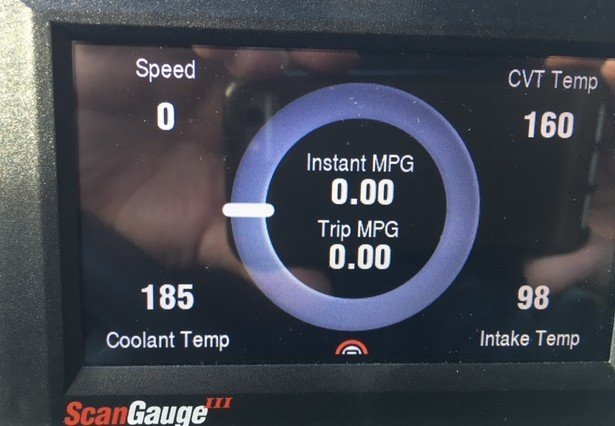
Added some grill covering and added a few gauges to the Scan Gauge III to monitor progress. Chemical Injector Service (RL SI-1) First UOA to follow shows a 33.33% reduction in fuels to a very manageable 1.4%. This did not restore viscosity nor reduce wear metals even on a slightly shorter OCI. That is disappointing. Also confirmed multiple changes in Red Line Euro Spec chemistry. Need to adjust my OCI schedules. I reached out to Red Line....crickets. Since Dave retired this two way street we had for thirty years has turned one way. I will have a VOA run on the two new cases I just bought. Reached out to some fellas with more experience with Mitsubishi for cold weather tips and tricks and learned a few useful facts. Adjust grill block to raise inlet temps to run between 60 and 90 F. The converter doesn't lock up until CVT fluid temperatures reach 50 C and the fuel map doesn't go full lean until 122 F. (2500 stall) Not motor friendly when water temperatures are under 85 F so let it idle until the water is at least 85 F, prefer 100 F and be easy on her until the CVT hits 50 F. Add a block heater (on order) Even without the block heater observing their advice and adding grill block has already greatly improved cold weather fuel efficiency. Guys in Canada run pan heaters.




-
Forum Statistics
250.5k
Total Topics2.7m
Total Posts -
Member Statistics
342,981
Total Members8,960
Most Online
-
Who's Online 3 Members, 0 Anonymous, 300 Guests (See full list)