.JPG.6537b7f00fa66f30aa51f5040da0fd95.JPG)
Grumpy Bear
-
Posts
12,849 -
Joined
-
Last visited
-
Days Won
464
Content Type
Profiles
Forums
Gallery
Events
Articles
RPO
Store
Blogs
Everything posted by Grumpy Bear
-
Sorry, I don't Facebook so I can't see it. PM me a copy if you would like me to take a look. Remember that wear 'rate' is specific to the Engine 'kind'. That is, an Ecotec3 based motor will wear differently than a Mitsubishi 3A9* or a Ford Coyote. It will also wear differently than an LS motor. What you're looking for is what is 'normal' for your motor platform, in your service, with your fluid choice. Universal averages can be useful only as a motor platform guide. Not much to be learned between platforms.
-
.thumb.JPG.2c573de60d3a3a4407c7d92298db46dd.JPG) 2024 Mitsubishi Mirage 39,962 miles 1,518 OCI / 3 months 3 quarts Red Line HP Euro 5W40 and AMSOIL EA15K 13 filter 2 quart drop and fill Red Line Non-Slip CVT Fluid on 4,802 mile OCI.
2024 Mitsubishi Mirage 39,962 miles 1,518 OCI / 3 months 3 quarts Red Line HP Euro 5W40 and AMSOIL EA15K 13 filter 2 quart drop and fill Red Line Non-Slip CVT Fluid on 4,802 mile OCI. -
Getting back on the Tracks https://www.msn.com/en-us/autos/enthusiasts/the-japanese-four-cylinder-engine-that-outlasts-every-german-rival/ar-AA1X5VJO?ocid=winp2fptaskbarhover&cvid=fa422a5470a641a4eb2147fa48664b64&ei=8 Having benchmarks for longevity are handy. The K series I4 Honda sets that mark for daily driver Joe Average maintainer service coming in at 300K. Annal caretakers and adult drivers of a more finnicky nature 500K. At the other end of the spectrum BMW and VW 2.4 I4 Turbos see in the neighborhood of 150 K as a good engine life. 200K for the elite souls. Design philosophy and execution have a good deal to do with this but so does maintenance philosophy and fluids/filter choices. ************************************* So....what can it mean that guys, my father, uncle, cousin and myself, ran FE Fords, 352, 360 & 390 well past 300K, a few double that, on mineral oils and 1-2K oil changes? People tell me that "Todays" motors are far superior and "Todays" oils are so much better and people "Today" are so much smarter and yet motor failures and endless OEM lawsuits indicate otherwise. GM has had good motors. Buick 3800 or GM LS and even Chevy Gen 1 SBC 327's. Chrysler hand the Slant 225 I6, AMC the 232 I-6 and Ford the 300 I6, all million mile motors. When a car or truck rotted out or was wrecked and the powertrain was mint, we found a unit in good shape with a bad powertrain and kept transplanting. I've seen motors of that era outlast a half dozen body/chassis. Yea, we are so much better off now.
-
Updates? How's the Mrs.?
-
Rats! Bomb a major oil producer and gas jumps 20 cents. Pretty much the definition of 'speculation'. We don't live in a "Supply and Demand" world. We live in a "grab it while you can" world.
-
257 miles a day, five days a week for four years. Very few cold starts per 1K miles; much like an OTR Semi. As most wear happens on cold starts.....yea.... No surprise here. If your driving that much, not much time for everyday long and prolonged idle times either. That's better than 5 hours a day highway time at average NET speed. Better estimate could be made if the engine hours was supplied. ALL the information is rarely available. The environment, not the fluids and service schedule is the driver. IMO of course.
-
2027 Which 2027 engine will you choose?
Grumpy Bear replied to Zane's topic in Gen VI Small Block V8 (5.7L & 6.6L)
Anyone know if this platform utilizes "Spray Bore" technology? If it does....I'm out. -
A few more stations slide under $3 but stubborn and fickle pricing around here. Oddly the majority of price relief here as been then Premium grade pricing. Down 40 cents in the last few months but again, many stations clinging to the greed so you have to be careful. Yo-Yo pricing. Bait and dodge. It's pitiful.
-
My 2015 is at 192K and getting her first repair motor work. A set of injectors and HPFP. Other than that I've spent under a $25 in repair parts and less than $200 in labor cost to install them. Still on the OEM brakes and miles to burn on them yet.
-
Some Assembly is Required
Grumpy Bear replied to Grumpy Bear's topic in Maintenance, Oils/Fluids, Detailing & Rust Prevention
So.....I've shown REPEATEDLY that the measurement for nitration is NOT in "Orders of Magnitude." Simpley area under the curve and that area subject to the 'width' of measurement and as oxidation and nitration have different 'widths' common sense AND mathematical definitions preclude the accuracy of that idea. Let me make that simpler I've also show REPEATEDLY that all base oil vary greatly in VOA levels of nitration products and if indeed this were orders of magnitude, and they are not, then not being subtractive would be ludicrous. Let that rest on the gray a hot second. An oil with a VOA background of 4 and one with a background of 9 both are condemned at 10? Again, Get a background value and go with the standards the labs use. 10 unit increase. -
PM me as your research unfolds please. I'd like to see where this tops out. Thanks!
-
Some Assembly is Required
Grumpy Bear replied to Grumpy Bear's topic in Maintenance, Oils/Fluids, Detailing & Rust Prevention
Brake giants go bust: StopTech and Raybestos dead after $6 billion fraud -
Curious. How many miles did the motor have on it when you first started using the R&P and how long you running each batch?
-
https://sandx.us/wp-content/uploads/2025/10/Seafoam-Motor-Treatment.pdf Sections #3 and #9 and #14 are informative. Light distillates and Isopropanol. Likely, given the density and flammability hydrocarbons, in the kerosene/diesel range. The alcohol is the only polar component in it. So it works mainly as a dilutant. It will depress the viscosity of the oil you are using. Significantly? Not at the stated treat rates but given oils that will shear out of grade (many), it will push a few more out. Component viscosities run 1.3 to 6 cP. Is that harmful? Depends who you ask and what mood they are in. Dad used to flush motors with Kerosene and a little Type F ATF and everyone told him all sorts of 'bad' would happen. Now light fractions are packaged; and it just fine? Most cheap motor flushes use some sort of this game plan. Most don't tell you to run it consistently and constantly. Kerosene is cheaper and the alcohol useless in oil. Flashes out on the first heat up. I'm old enough to remember guys washing their hands in gasoline to remove oils/greasy deposits. (Please don't do that) Seafoam works the same way. Like cuts like. It most certainly will NOT remove carbonized ring deposits made mainly of coked VM polymers. Will dilute soft deposits and 'aid' in flushing. If you motor is that bad......
-
Pepper is in process of getting a new HPFP and six new injectors at around 192K miles. Giving the intakes a look and fretting out the brake slides. At 80K she showed 2.4% fuels in the oil running on gasoline. At 160 K zero fuels on alcohol but last wear metals were up a bit and alky is hard to see in a UOA so out of an abundance of caution and given the mileage it seems appropriate. When I get it back she goes to the dealership for the airbag recall then the body shop for a paint correction. Runs like a top yet.
-
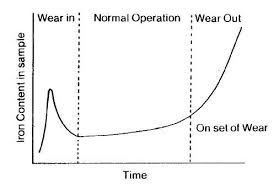
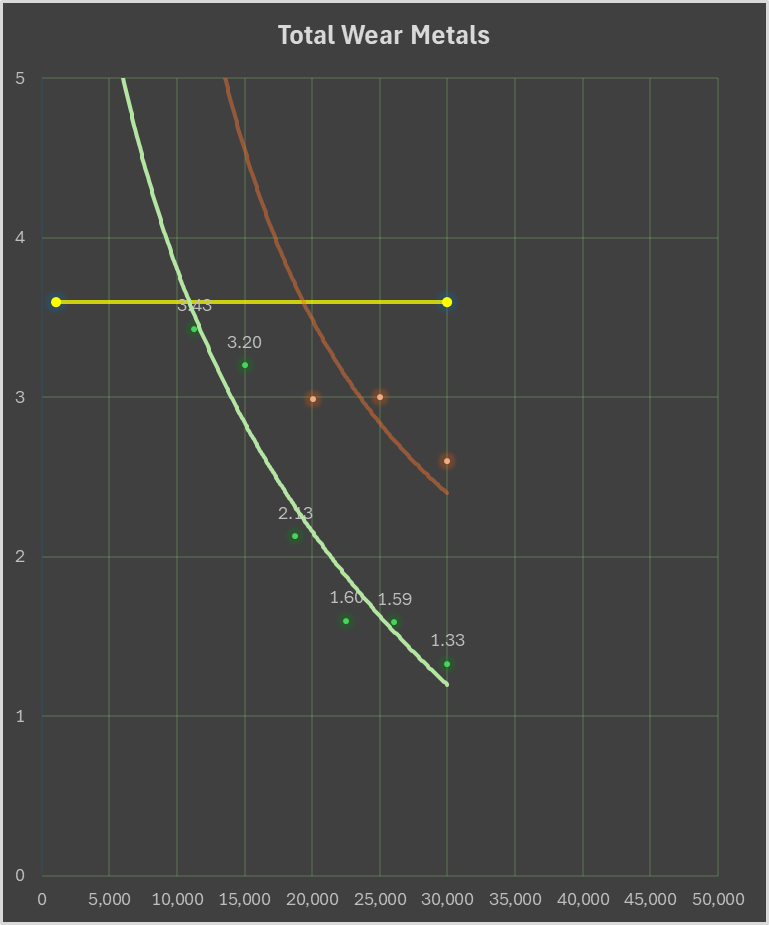
FYI This is Mitsubishi I'm working with. Yellow line is the average recorded by Blackstone for the 3A9* motor they have on file using the factory recommended 0W20 weight oil. The orange is a fellow Mitsubishi owner with this motor on 5W30 and the pale green my motor on a Euro 5W40 after careful run in on 5W30 BREAK IN oil. The chart is capped at 5ppm/K miles per industry standard permissible limits. All three will meet the OEM 'spec' wear rate. Wear in takes longer than most will admit to. When this curve bottoms it will start a very slow rate of increase until the motor reaches a point no longer in line with 'normal wear' rates and enter the 'wear out zone' with a sharper rise in rate show in the second graph below and affirmed in "The Oil Geek"'s latest video on the topic. 200K shown in his work as the point of inflection. That however is the "Universal Averge" because human behavours are indeed predictable and yet not absolute. That last word is quite important. YOU have control over that value and that work is confirmed by age old GM wear studies from decades ago. Wear in is not complete until the slope reverses. Slopes are created by subtracting the background elemental wear metals from the results and normalized to ppm/k miles.

-
I think he wore a blue suit twice and it rained twice then he wore jeans and it didn't rain at all. The Allison pumps bypass setting is somewhere between 50 and 70 psig (application dependent) . Well beyond the 8 psig filter bypass setting. As the pump is a vane pump and indeed a positive displacement pump, the filter being in bypass would have zero impact on flow (starving) and minimal on fluid heating. No more so that the few psi it takes to circulate the oil itself, even through a cooler on a cold day.
-
I'm using Duck Duck Go without issue.
-
Still $3 here.
-
Common, yes. Normal, no. Either a slide is sticking or a piston is.
-
Sugar Bears 2015 GMC Terrain SLE-2 2.4 AWD
Grumpy Bear replied to Grumpy Bear's topic in Member Build Threads
282,000 Mile Service 453,835 Km 2/12/2026 3,000 mile OCI, 80 oz of make up oil. 1 quart/1,200 miles. Rotate and balance tires. Nothing more than half an ounce required. 5 Quarts Mobil 1 Euro 0W40 1 Purolator filter (red box) Topped off Coolant. It's a winter thing. Wiper fluid. Brake fluid check. -
OCI, not when but why?
Grumpy Bear replied to Grumpy Bear's topic in Maintenance, Oils/Fluids, Detailing & Rust Prevention
OIT Oxidation Induction Time by PDSC (ASTM D6186) is a method to determine oxidation resistance of motor oils in the laboratory. You can find and read the method on your own time if it interests you. I did. For PCMO and HDMO this test is carried out at 392 F (200C) and under pressure and in a oxygen rich atmosphere. Every part of that is done to aid in repeatability and reliability of the results. However, it also means it doesn’t have any 1:1 relationship in practice in your vehicle. What we can say is that better is better and worse is worse. How that translates into practice (OCI) in your vehicle is determined by the minutia of the service it is placed into. Influencing this ‘time’ are the usual cast of characters; base oil type and type and amount of antioxidants as well as temperature, moisture and metal catalyst. Much of that is under your control and some of it is induced by your environment. Lake Speed Jr. made a rather big deal out of this in his latest round of videos where he showcased PDSC and TEOST, KRL and so on and using a ‘weighted’ method to come to some conclusions as to the suitability of a particular oil to a particular service. 17 to 80 minutes is the range of normal based on base oil type and antioxidant levels, with 17 to 40 minutes on average for Group I and Group II bases and 40 to 80 minutes on average for Group III and better bases. The only oil on his list that didn’t get past 40 minutes was Driven LS, a mineral based stock with little antioxidant past the ZDDP levels. So limited use of hindered amines, i.e. The effectiveness of ZDDP as an antioxidant is inversely proportional to it’s effectiveness as an antiwear agent and subject to its exact chemistry. Liquid Moly is also aberrant as a Group II/III blend in breaching 40 minutes. Likely majority Group III and a good dose of antioxidants. Then we have AMSOILS SS breaching the expected values of even Group IV/V fluids by a smidgen. Alkylated Napthine? Hinder Amine? Whatever the cause, it worked out to lead the Synthetics. Then we have a true outlier. High Performance Lubricants No-VII decimating the field at 117.61 minutes. Also, a Group IV/V-(AN) with a strong oxidation package. But really letting it blow the lid off is the fact it is devoid of VM’s! The weakest link and easiest to oxidize part of most PCMO’s is the polymeric viscosity improver package. -
I used to bounce out of bed. Now I try not to bounce off the floor.
-
THIS ^^^^^