

.JPG.6537b7f00fa66f30aa51f5040da0fd95.JPG)
Grumpy Bear
-
Posts
12,857 -
Joined
-
Last visited
-
Days Won
465
Content Type
Profiles
Forums
Gallery
Events
Articles
RPO
Store
Blogs
Everything posted by Grumpy Bear
-
Pepper has 192,000 on her and doesn't use between 5K changes. Recently I've shortened that OCI to 3,750 in response to new formulations of lower TBN and ever lower AW packages. I also don't run 0W20 in anything. I didn't put the link up because I agree but rather to give others a 'gauge' of what to expect from their OEM's lack of response to their inquiries.
-
Northern Ill rural 87 $4.00 93 $4.81 E85 ???
-
You be a tough ole bird. Good for you. How's the Mrs.? Any improvement?
-
87 has hit $4 a gallon and Premium $4.85. Wait! Am I getting premium at the same price @Atlas pays for regular?
-
.thumb.JPG.2c573de60d3a3a4407c7d92298db46dd.JPG)
What have you done to your K2 today?
Grumpy Bear replied to block8head's topic in Modifications & Accessories
That was a very good run on a stock converter. -
I used to go up to St. Mary's Glacier when I was younger and it was awesome. Right up to the road. Last time I was there, it wasn't much of anything.
-
Local news tells me today that while this year has been twice as snowy it is still 1-1/2" below seasonal average. It was pretty light last year.
-
If I had a L8T that used nothing for 25K then just starts using a quart in 4,500 I'd be thinking either PCV system has got an issue or the oil control ring drains in the piston are starting to plug. Valvoline Restore and Protect will bring it around if it's rings and it just might be. It could take another 20K to clear them. 4 changes at 5K each. But should see results within the first two.
-
https://engineoiljournal.com/engine-oil-consumption-chart/
-
OCI, not when but why?
Grumpy Bear replied to Grumpy Bear's topic in Maintenance, Oils/Fluids, Detailing & Rust Prevention
VI index as an indicator or base oil type Some values were given in the video above to use as a guide in determining base oil type. That was not well researched. Problem: The numbers he gave are indicative of 'neat base' oils. Here is the SAE values Group I 95 - 105 Group II 95 - 118 Group III 123 - 150 Group IV > 135 Group V has no range Pull the data sheet for Kirkland's Signature 5W30 and you will see the value of 169 and yet that oil is straight up a Group III So what's the what-what with that? The numbers you read on these PDS sheets are after formulation into finished products and not the neat values he gives in the video. His values are: Group III 120 - 135 Group IV 140 - 180 Fully formulated oils have the VI determined on the base AND the Viscosity Modifier together. PPD is not part of this as the VI is a measurement of the viscosity delta between 40C and 100C. His values don't hold. Let's compare Kirkland's Group III value with AMSOIL SS in the same weight, 5W30 and Red Line HP 5W30, both PAO/Ester blends Kirkland 169 AMSOIL 162 Red Line 166 Compare the pour points and CCS values and they still look the same. Then look a volitility and you see something. Red Line 6 NOACK AMSOIL 6.7 Kirkland 12% or about double. Kirkland starts with a very light Group III base to give low pour point and a small CCS value that also gives it a very high NOACK and then stuffs a bunch of very high molecular weight viscosity modifier in it to reach the high VI value they can thus display. Ya can't rely on a single piece of information to find out anything about pretty much anything. Just because someone is making money on clickbait doesn't mean the information is grounded. This one even passed a few rounds of scrutiny. -
Over $3 in Texas is a warning sign.
-
OCI, not when but why?
Grumpy Bear replied to Grumpy Bear's topic in Maintenance, Oils/Fluids, Detailing & Rust Prevention
Take notes on the last four oils in this video and the EXACT wording used. -
OCI, not when but why?
Grumpy Bear replied to Grumpy Bear's topic in Maintenance, Oils/Fluids, Detailing & Rust Prevention
ZDDP isn't going anywhere https://www.stle.org/files/TLTArchives/2022/01_January/Cover_Story.aspx [quote from link above] STLE member Vince Gatto of Vanderbilt Chemicals LLC says, “In engine oils, ZDDP functions by forming various glassy polyphosphate films, which are very effective at reducing wear but not very good at reducing friction. Molybdenum dithiocarbamates function in a way that synergizes with ZDDP by producing more durable friction reducing MoS2 tribofilms.10 Replenishment of the MoS2 tribofims is enhanced by ligand exchange between ZDDP and MoDTC.” [close quote] I found this STLE article while going down the low ash rabbit hole and was but one of many very interesting items I ran across. -
We have one more cold day and a bit more lake effect tonight. It's 18F right now with a windchill of -10F. Wind has died a bit after the sun when down. That was some real wet snow. My back is trashed. LOL Going to get down to 5F tonight with tomorrows high as around what it is right now. May break freezing Wednesday.
-
We got a bit over 7 inches over the last 24 hours. Freezing rain under it and it cold and very windy yet today. But windchill is still above zero for now. Plow just came by and filled me in I'd bet @OnTheReel & @CamGTP got it worse! It's shovel'n time LOL
-
Because it will met the requirements of either; along with a few manufactures requirements. This might sound silly but it works a bit like; "Not all eggs are chicken eggs but all chicken eggs are eggs". In the oil universe this formulation is both chicken egg and egg in a universe where all eggs are chicken. Many SAE and API requirements are 'one directional'. That is they may have a minimum but no maximum or visa-versa allowing a single formulation to meet the requirements of many standards. Sometimes Lake makes a conclusion based on a test where the statistical variability is wider than the point he is concluding. It's like trying to assess two pitchers based on one throw of he ball for each and then saying short pitchers are better that tall ones. Few things are as precise in practice as the median would suggest standing on its own.
-
So today it was near 60F and rained. Quite the winds. 35-45 mph. Then tonight it dropped to a bit below freezing in about 30 minutes and the wind is now driving blizzard rate snow sideways which is predicted to continue for about 12 more hours. Ain't we having fun Ma?
-
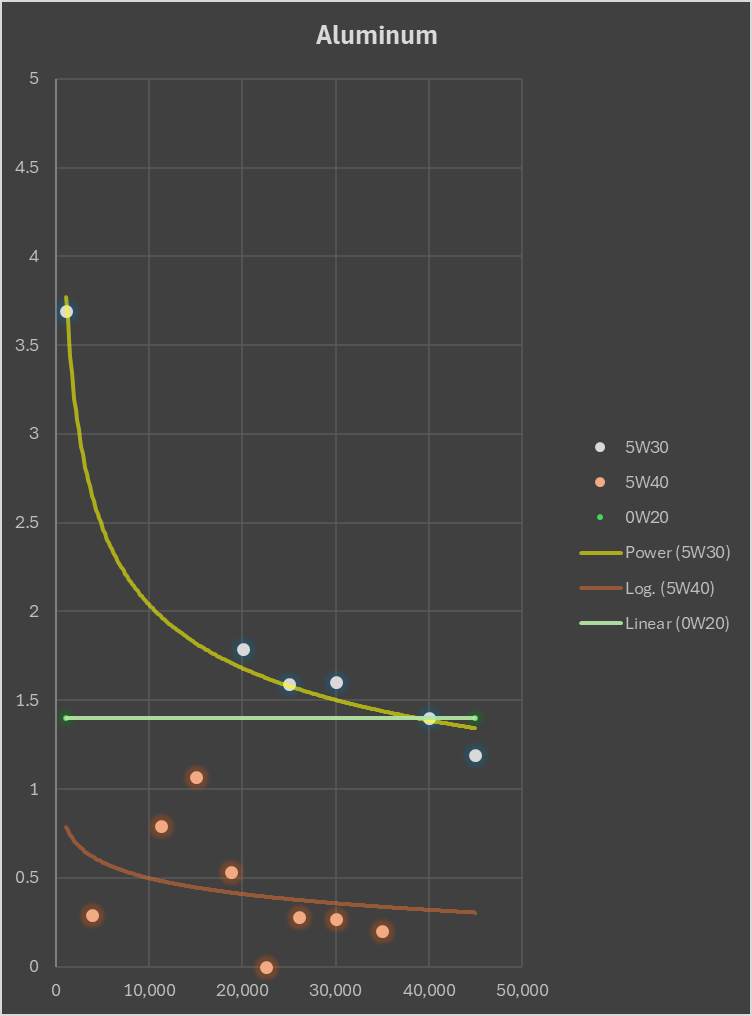
The real reason millions of engines are being recalled (link) None of these articles are fully on point. The writers still don't know the difference between 'tolerance' and "clearance". The MAIN CLEARANCE to be tightened was piston clearance. Use of hypereutectic pistons fit under .015" on a 4" bore and newer ultrahigh silicon content forging alloys. Bearing clearances are still about a thou per inch of journal diameter. This motor, the 3A92, mine, calls for a 0W20 oil. The chart here shows three different viscosities used in this motor. 0W20 line if from Blackstone's library. The 5W30 from an acquaintances motor who is as annal as I, and the last, 5W40 my personal motor. The "Total Wear Metals" chart I posted earlier in this thread. Chart I haven't posted is the Iron level chart. What it showed was that bore wear was reduced by using 5W30 over 0W20 but little more was gained in the use of 5W40. Almost all of the Total Wear Metals reduction comes from the huge reduction in piston skirt wear....aluminum. Bearing wear is reduced with each increase in HTHS viscosity so a smaller portion of the total wear improvement comes from that. Piston cleanliness has next to nothing to do with an oils viscosity. Cleanliness or lack thereof is a ring killer, a VVT-AFM-DOD solenoid killer and a cam chain eater. The posted link hints at manufacturing putting the viscosity cart before the ability to keep it clean enough to support that weight horse. That has absolutely zero to do with piston wear. But skirt and land wear have EVERYTHING to do with ring stability and longevity and control therefore of blowby. Dirty assembly will kill any engine on any weight oil. If the culprit is surface finish then viscosity is a card to be played. Use the information as you see fit.

-
Did you know that both Dexos1Gen2 and Gen3 oils 'may contain' Group II/II+ base oils? Gen2 allows >30% with restrictions on read across. Gen3 limit is 30% without read across. ACDelco and Champion being the two major suppliers of these Semi synthetics.
-
Most Reliable GM Truck Engine
Grumpy Bear replied to GN2018's topic in 2019-2026 Silverado 1500 & Sierra 1500
I don't know how big a trailer she pulls but if it is small and my main concern was longevity I'd put my money on the original IRON 4.3 V6. 85-86 LB1 carbureted or 93-95 LB4 with throttle body injection in a CK. Darn near unkillable if maintained. Dad's had two go over 500K and remain oil tight and oil stingy. He replaced a few water pumps and a front cover seal on the first one. -
Most Reliable GM Truck Engine
Grumpy Bear replied to GN2018's topic in 2019-2026 Silverado 1500 & Sierra 1500
That is data I collected on my personal truck showing how both water temperature and base oil types affected bulk oil temperatures. I did a similar study changing viscosity later. For the study in question all three oils were 5W30. I'm currently doing a study using different weights v wear metals. A guy can learn a bunch no one will tell you if you are willing to PAY and put in the time. You also learn there is allot of lies told by marketing and OEM's and swallowed whole by Social Media drones. -
I wish! LOL
-
OCI, not when but why?
Grumpy Bear replied to Grumpy Bear's topic in Maintenance, Oils/Fluids, Detailing & Rust Prevention
Raven Green Line It would be hard to imagine a lower total wear rate than this and I'm very comfortable with an OCI of 3,750 miles. 6K km. After getting a VOA on the new chemistry of the Red Line HP Euro 5W40 I think somewhere between this value and 5K miles is about far enough. Red Line has reduced the TBN value in compliance with the newest ACEA C4 standard for SAP and TBN which now stands at 6 KOH/gr by ASTM D2896-11 leaving the D4739 method registering 5.05 KOH/gr. Under the old values I ran this oil routinely to 5K in American motors and 7,500 in Asian equipment without crossover. Although tests show me that I can reach 5K in the summer it is a stretch in the winter and me being me I like it simple. To the point. OCI is FOUND and is equipment and fluid choice centric. Blanket statements don't work.
-
Regular is about $3.69.
-
Premium is up over a dollar since the start of bombing. $4.51 Shell $4.80 Mobil/Exxon $4.69 BP $4.79 Marathon


-
Forum Statistics
250.5k
Total Topics2.7m
Total Posts -
Member Statistics
342,990
Total Members8,960
Most Online
-
Who's Online 1 Member, 0 Anonymous, 574 Guests (See full list)