


BlaineBug
-
Posts
903 -
Joined
-
Last visited
-
Days Won
2
Content Type
Profiles
Forums
Gallery
Events
Articles
RPO
Store
Blogs
Everything posted by BlaineBug
-
Transmission Thermostat Delete Pros vs. Cons
BlaineBug replied to Eddie 70's topic in Engines & Drivetrain
Your display looks vastly different than the one I am seeing in Torque Lite. -
Transmission Thermostat Delete Pros vs. Cons
BlaineBug replied to Eddie 70's topic in Engines & Drivetrain
EDIT - Torque Lite has a full list of custom PIDs for General Motors already compiled, although you can still add your own custom PIDs as well. These are buried in the settings and you have to add them in order to be able to insert them as a gauge. I am not seeing an oil temperature PID though already installed, unless you might happen to know of the custom variables to enter for that gauge? -
Transmission Thermostat Delete Pros vs. Cons
BlaineBug replied to Eddie 70's topic in Engines & Drivetrain
I only ever used one custom PID for transmission fluid temperature in my Crown Victoria. I also bought a second cable so I could easily remove the device for performing external diagnostics, yet have the original cord tucked away nicely in my dash for a seamless OCD-esque installation in my vehicle. However when I sold that car I sold the scangauge shortly thereafter and bought the ELM327 Bluetooth dongle for diagnostics. -
Transmission Thermostat Delete Pros vs. Cons
BlaineBug replied to Eddie 70's topic in Engines & Drivetrain
According to Torque Lite, coolant temperature was ranging anywhere from 190-197' F (depending on engine load, idling, cruising, etc.) when the dash gauge was reading ~210. I was hoping for more accuracy given all of the bells and whistles, especially with a digital trans temp readout on the DIC. Torque Lite also doesn't display transmission temperature or oil temperature unless there's a special method to add these gauges I am not aware of, so I can't verify if the DIC display would match a scan tool or not. Intake air temperature was reading around 100' and ambient outdoor temperatures were around 80'. Unfortunately I didn't check the coolant temperature with my tool before installing the alternate thermostat, so I have no data to compare my findings with. -
Transmission Thermostat Delete Pros vs. Cons
BlaineBug replied to Eddie 70's topic in Engines & Drivetrain
I'm not sure what setup it has for cooler routing. At any rate I'll check my scan tool for water temperatures. I noticed your ScanGaugeII displays "water temp" AND "engine operating temp"? Where is the second reading taken? -
Transmission Thermostat Delete Pros vs. Cons
BlaineBug replied to Eddie 70's topic in Engines & Drivetrain
Was mentioning 2 different "thermostats" here, the transmission cooler bypass and the engine coolant thermostat. This discussion now includes 2 different mechanicals. -
Not sure about 10 speed but the 6 and 8 speed now have an OEM GM revised coolant thermostat bypass assemblies that lowers the transmission fluid temperature by 30-40 degrees Farenheit under now-towing conditions, yet still provides thermostatic properties for ensuring that the transmission fluid warms up quicker and maintains a minimum in colder climates.
-
Transmission Thermostat Delete Pros vs. Cons
BlaineBug replied to Eddie 70's topic in Engines & Drivetrain
To report after more than a few days of use, I'll say that visually and using the coolant temp gauge on the dash, there is definitely no "noticeable" difference that is significant in regards to the operating temp of the vehicle which always seems to be just slightly to the left (lower than) 210' Fahrenheit. If you're looking to lower transmission temperatures obviously your best route is either bypassing/[plugging the factory thermostatic properties if you live in a warm climate or installing the newer revised lower opening temperature thermostat for the transmission cooler lines if you live in a cold climate and still require low-end transmission fluid temperature moderation. As has been my belief for decades now, a coolant thermostat will not lower temperatures because the thermal output of the motor and the cooling properties of the radiator will always be consistent, and once the thermostat is fully opened, it's essentially taken out of the equation regardless. The new versus old coolant thermostat opening temperatures of 194' versus 207' aren't significant either, a 13 degree difference, with no noticeable change in operating temperature as per DIC gauge cluster. However, installing the revised transmission cooler thermostat will see noticeable improvement of 30-40 degrees Farenheit on average. Which leads me to believe that typically with no undue stress, hard acceleration, or towing, the transmission was being kept HOTTER on purpose than it's true default operating temperature with the factory transmission fluid cooler thermostat. The engines however are probably designed to be run around 200-210 as they have been for decades. Even in the 1990s engines were designed to run optimally somewhere between 190-210 degrees Fahrenheit. And apparently they still do, if not slightly hotter. Installing a coolant thermostat that opens EARLIER will not result in a cooler operating temperature at all. An engine produces a whole hell of a lot of heat regardless due to the combustion process and friction as well. A transmission only puts out heat due to friction, so when you're sailing along smoothly and not constantly accelerating and shifting through the gears (slipping = friction) you will see lower operating temperatures during this time of reduced operational stress. -
Transmission Thermostat Delete Pros vs. Cons
BlaineBug replied to Eddie 70's topic in Engines & Drivetrain
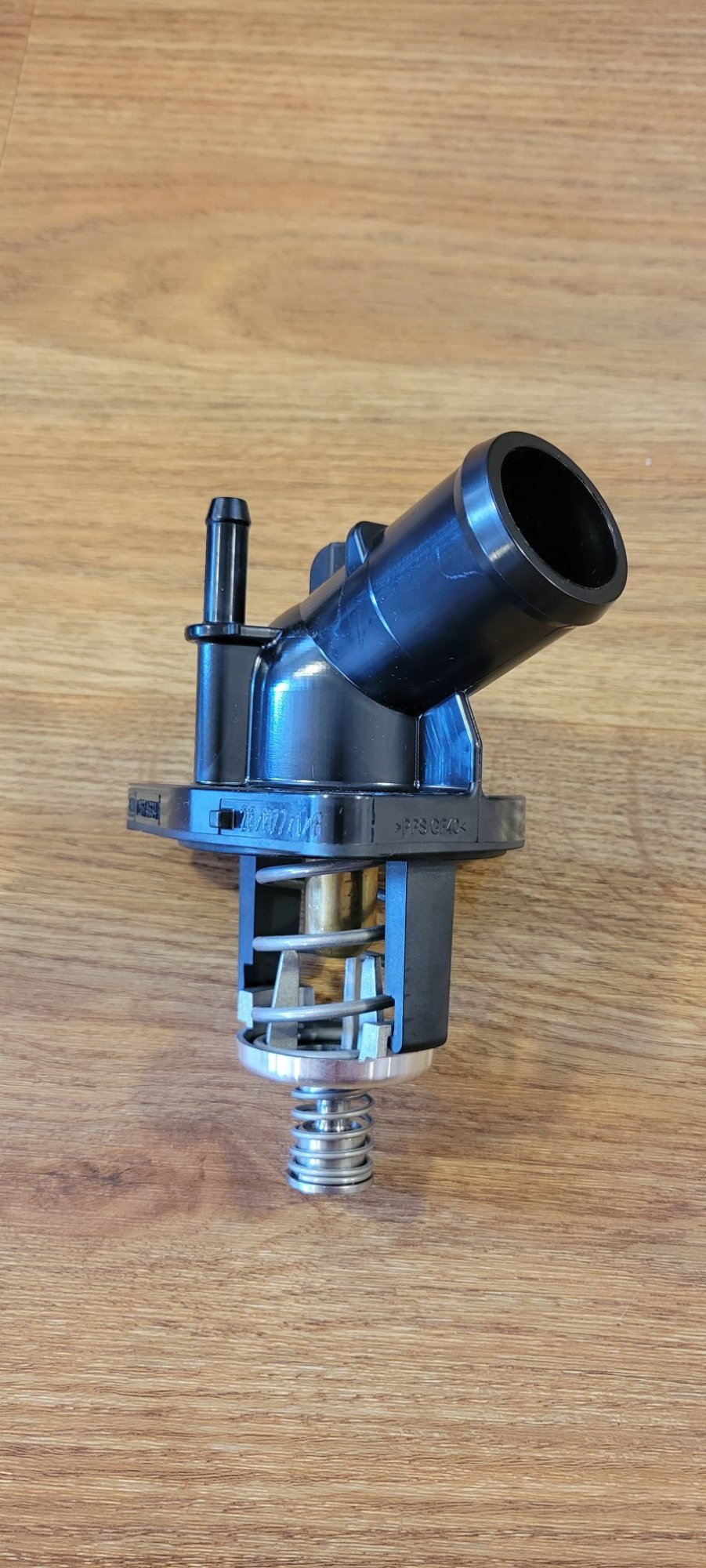
Original thermostat assembly.
-
Transmission Thermostat Delete Pros vs. Cons
BlaineBug replied to Eddie 70's topic in Engines & Drivetrain
The original thermostat pill does not have any Celsius or Fahrenheit markings however is stamped 207 which made indicate 207' Farenheit.
-
Transmission Thermostat Delete Pros vs. Cons
BlaineBug replied to Eddie 70's topic in Engines & Drivetrain
Soon enough. What's the deal with this thermostat with the dual springs and all? Have not seen that before, although the only cars I have replaced thermostats in were old school. Seems to be a thing that never needs replacing anymore. Although maybe some of the things I did as a teen were unnecessary - such as drop-in washable K&N air filters too "for extra horsepowers." -
Transmission Thermostat Delete Pros vs. Cons
BlaineBug replied to Eddie 70's topic in Engines & Drivetrain
-
Transmission Thermostat Delete Pros vs. Cons
BlaineBug replied to Eddie 70's topic in Engines & Drivetrain
-
Transmission Thermostat Delete Pros vs. Cons
BlaineBug replied to Eddie 70's topic in Engines & Drivetrain
New coolant thermostat - the "pill" is stamped 90 C (90 degrees Celsius) which equals 194 degrees Fahrenheit.
-
Transmission Thermostat Delete Pros vs. Cons
BlaineBug replied to Eddie 70's topic in Engines & Drivetrain
Thanks! -
Transmission Thermostat Delete Pros vs. Cons
BlaineBug replied to Eddie 70's topic in Engines & Drivetrain
What is the torque spec for the thermostat housing bolts? -
Transmission Thermostat Delete Pros vs. Cons
BlaineBug replied to Eddie 70's topic in Engines & Drivetrain
Their rebuilds are junk, man. Had issue with their starters and alternators too. JUNK! -
Transmission Thermostat Delete Pros vs. Cons
BlaineBug replied to Eddie 70's topic in Engines & Drivetrain
When it comes to a brake job, I can't wait for them to ship, especially if I do not want to reassemble everything with the old parts. That's the issue, really, the waiting for the items to arrive, especially considering you thought everything was ready to go when the original package arrived. With that said about 8 years ago I was doing a power steering pump (hydroboost with brakes as well) for a friend's Chevrolet Express 3500 van. Advance Auto Parts shipped me a CORE RETURN (as in caked with oil and grease!) as the NEW power steering pump. I'm not sure how in the heck that happens, and although I returned it at the store, I hope they didn't think I was scamming them! -
Transmission Thermostat Delete Pros vs. Cons
BlaineBug replied to Eddie 70's topic in Engines & Drivetrain
I've had a couple of Salty experiences with Rock Auto. You also have to be careful of lining up warehouses otherwise you can potentially get charged for shipping multiple times. I've had the wrong parts delivered and/or incorrectly advertised online, where I had to buy them locally when everything was already torn down. And then when requesting a refund on a "packaged deal" (brake jobs, specifically) they give you peanuts for the parts that didn't work. There are other PAIN IN THE ARSE stories about Rock Auto as well, and plenty of positive ones as well. -
Transmission Thermostat Delete Pros vs. Cons
BlaineBug replied to Eddie 70's topic in Engines & Drivetrain
As an ebay seller myself that's typically my go-to. I don't use Amazon much, considering that I'm not a prime member, it's much more difficult to find "free shipping" as with Amazon you have an order minimum to achieve that. On eBay I can buy items that are just a few dollars and search for free shipping. It's a different approach - most of Amazon is fulfilled by Amazon, whereas ebay is ALL seller fulfilled. -
Transmission Thermostat Delete Pros vs. Cons
BlaineBug replied to Eddie 70's topic in Engines & Drivetrain
The one I ordered appeared to have all of the GM markings on the thermostat housing including the GM box and packaging. I'll inspect and post pictures when it arrives. -
Transmission Thermostat Delete Pros vs. Cons
BlaineBug replied to Eddie 70's topic in Engines & Drivetrain
When I swap I will take note and post in the future. When I swapped the transmission cooler bypass/thermostat assembly I disassembled the new and old and also provided the temperature stampings for both, and also for my own knowledge to rest assured that I was installing the correct part that I wanted to install. -
Transmission Thermostat Delete Pros vs. Cons
BlaineBug replied to Eddie 70's topic in Engines & Drivetrain
Yes, one part number is an AD Delco part number and the other is a General Motors part number, it's the same thermostat, but if you search them individually and uniquely on eBay, you'll see that the prices vary by about double depending on which one you use as your search term! -
Transmission Thermostat Delete Pros vs. Cons
BlaineBug replied to Eddie 70's topic in Engines & Drivetrain
I'm sure it was, some of the ebay ones were "questionable" even if they list the manufacturer as GM, there's no guarantee. I noted that the prices were around $75 when searching for part number 15-11113 and about $30-$35 if searching for part number 12674634. -
Transmission Thermostat Delete Pros vs. Cons
BlaineBug replied to Eddie 70's topic in Engines & Drivetrain
Thanks! This one on eBay was $30! https://www.ebay.com/itm/235113369347?mkcid=16&mkevt=1&mkrid=711-127632-2357-0&ssspo=EtuWMaTQSo6&sssrc=2047675&ssuid=5M210ch5RHm&widget_ver=artemis&media=COPY Appears to come with OEM AC Delco box and packaging too.




-
Forum Statistics
250.4k
Total Topics2.7m
Total Posts -
Member Statistics
342,757
Total Members8,960
Most Online
-
Who's Online 17 Members, 0 Anonymous, 1,946 Guests (See full list)