


Another JR
-
Posts
1,105 -
Joined
-
Last visited
-
Days Won
9
Content Type
Profiles
Forums
Gallery
Events
Articles
RPO
Store
Blogs
Everything posted by Another JR
-
Head bolts are often designed as “torque to yield,” where the bolts are intentionally torqued into the range where permanent deformation (stretching) of the bolt occurs. This is done in an attempt to achieve more uniform clamping force on all the head bolts. Wheel bolts and studs are not torqued into that stress range. If you follow the torque specs for your wheel bolts/nuts you will not cause significant fatigue damage in a hundred or so wheel removals.
-
I looked at mounting a LiFePO battery there in the future but from what i have read the high temperatures that location can get to after you shut down a warmed up truck would significantly shorten the usable life of the battery.
-
I’m thinking I will use it for a portable air compressor for reinflation after airing down tires, and maybe for a small compressor fridge in the back if I go back to truck topper camping at some point. The option cost was less than I could buy the battery for, so I figured I’d get it rather than later wishing I had ordered it.
-
You probably use a similar Blue Sea ACR like originally came in my truck camper before I replaced it with a Victron DC to DC charger to support LiFePO4 batteries. I like how the charger allows me to program in a delay time for start battery recovery before turning on camper battery charging from the truck.
-
That’s what I would have hoped, because if you have killed the aux battery you don’t want it stealing current from the start battery during cranking. No such luck, though. The service manual just says connected when ignition is on, which really simply means when the truck is turned on. More importantly, I put a voltmeter on the aux battery and measured what it does during a start. The voltage was at 13.1 before initiating a start. It dropped as soon as I pushed the start button, and dropped more when the engine began to crank. The aux battery was definitely delivering cranking current, dropping the voltage to 12 or so. It was changing fast and my digital meter has some delay/damping, so I couldn’t really tell how low it dipped during cranking. I have no loads wired to the aux battery, so the behavior was not due to other loads. It’s good to be aware that it works this way, so if I ever really do kill the aux battery I know to disconnect its negative connection before attempting a critical start in a remote location.
-
I’m Jon. Bruce is bruceb58. Happy to try to help, as are the others I’m sure.
-
The radio, the inverter outlets in the dash and the truck bed, and every load in the truck from the factory all draw from the start battery. As said above, only the trailer connector hot 12 volt wire is connected to the aux battery from the factory.
-
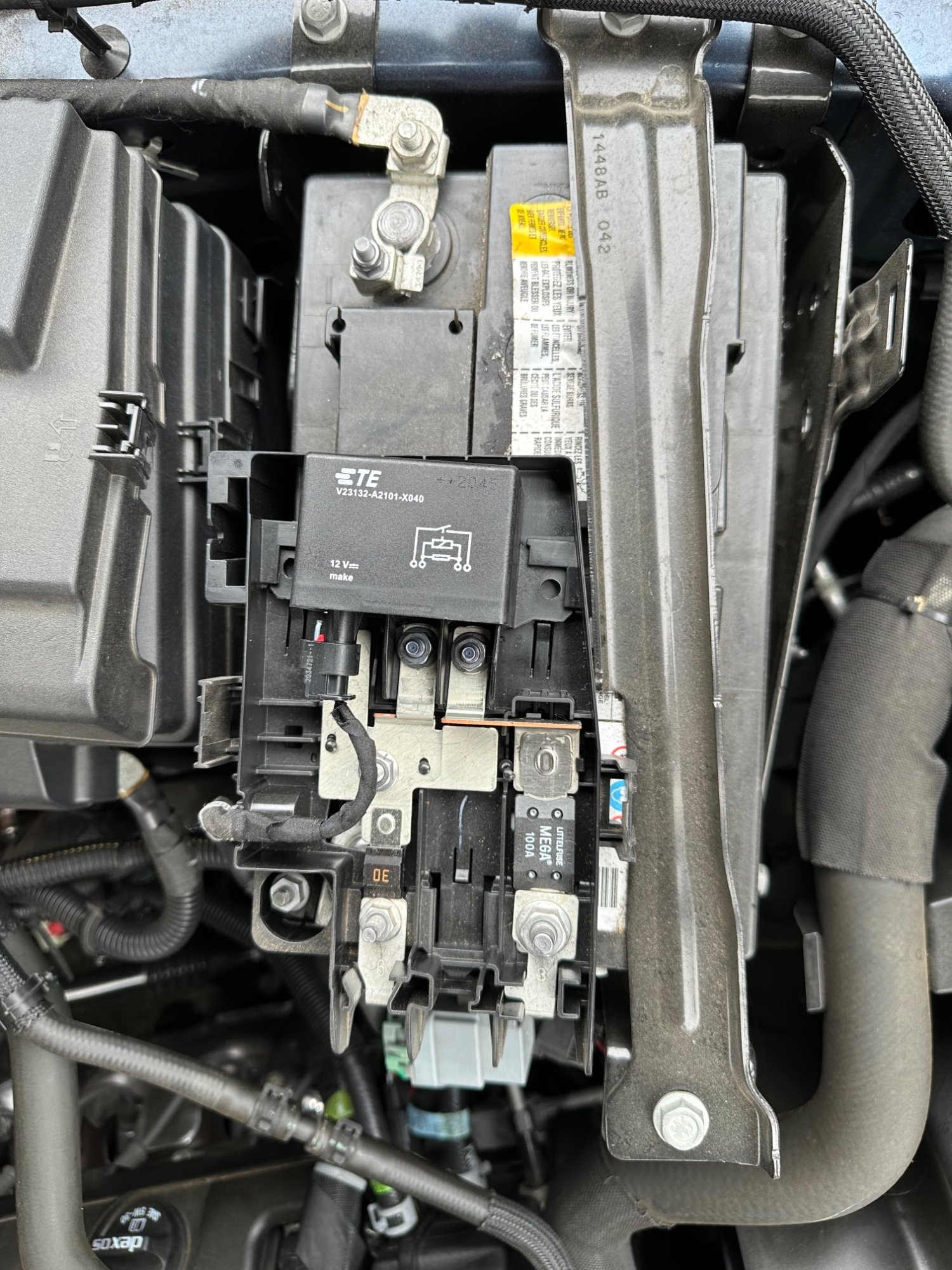
To answer your question for yourself, you need to have a good understanding of the wiring and the way the isolator works. So here’s some additional clarification. I created confusion by using the word “accessories” to mean user-added equipment like a winch, compressor, fridge, ham radio, etc. I didn’t mean accessories as used in the basic truck configuration. Sorry for the poor word selection. I just did some measurements with my voltmeter and verified that the isolator relay is switched just as carkhz316 describes. The relay closes and connects the batteries when the ignition is turned on. The connection is via a 100 amp fuse and a wire that is smaller than a typical start battery cable. Because it is contributing less than 100 amps due the length and gage of the inteconnect cable, I would not have described the aux battery as “used for starting.” Instead it is simply connected during starting because of the “non-smart” way they chose to control the relay. The ideal way to set up an aux battery isolator is to not connect the aux battery to the start battery and alternator until after cranking and after an initial two or three minute recovery period for the start battery. That would require more complexity and cost, though. That less-than-100 amp current isn’t needed for starting (as evidenced by all the gas trucks with a single battery), but does help. You would not be able to start the engine via that wiring if the start battery was dead, though. If you want to have the ability to attempt a start from the aux battery, you would need a jumper cable arrangement or to swap the batteries. You can connect your own user-added accessories to 1) the start battery (hot all the time), 2) to the ignition on bus via the fuse box, or 3) to the accessory bus via the fuse box. With an aux battery, you have the fourth option of connecting your added accessory to the aux battery fuse block (hot all the time). If you have the upfitter switches option, you could connect to those switches, which in turn are powered from whichever battery you choose, but the kit is set up for powering them from the start battery. The advantage of powering your added accessory from the aux battery is that you can use it when the truck is not running, and even use it to the point where you significantly deplete the aux battery if you need to. The start battery will not power the added accessory when the truck is not running, preserving the charge of the start battery for starting. When the truck is running, you can continue to use the accessory and the alternator will recharge the aux battery. Hopefully your options and the reasons to select a particular option are more clear now. Ask more questions if it’s still not clear.
-
My configuration was ordered and received from the factory. On the factory configuration the isolator relay is part of the fuse block assembly mounted directly on top of the aux battery. See the picture I included - the isolator relay is in the center of the picture. Now that I look at it again it appears to be a simple relay controlled by the truck - maybe a simple ignition on command or maybe a command with a short delay to assist start battery recovery. The relay itself is not a voltage sensing isolator. (Note that my fuse block has the fuse kit for the upfitter switch option installed, so it has some additional parts on it.) I don’t know about the retrofit kits. However, for most people that don’t need dual starting batteries as on a diesel, the whole reason to have a second battery is to have an isolated second battery you can use heavily for accessories without depleted your starting battery. I would have thought a GM retrofit kit for a gas truck would have the same isolator and fuse block assembly.

-
See my September 20 post up above in this string. Yes there is an isolator. I have a 2021 3500 gas truck with dual batteries and 220 amp alternator.
-
The OP has a gas truck, which has a battery isolator. The diesel trucks have parallel start batteries with no isolator. Based on your user name I’m thinking your truck may be a diesel. The question for the OP is whether his trickle charger will close the isolator. The answer will depend on how the isolator functions. A voltage sensing isolator likely will close once the main battery charging voltage gets high enough. An ignition signal driven isolator won’t close unless the engine is running or you fool it somehow. I don’t know which type of isolator is installed, but a voltmeter will tell you when the isolator is closed.
-
I believe that, once the main battery is charged enough, the charging voltage will be sufficient to close the isolator and charge the second battery. It should be easy to verify this with a voltmeter.
-
6.6L Gas Transmissions: 6l90 vs. 10L1000
Another JR replied to Coop8202's topic in 6.6L Gas V8 (L8T)
I am totally happy to have the 6L90 on my 2021 3500 hd. It runs great, and has a reputation for being one of the most reliable transmissions available. I could rave more about how it operates, but won’t unless you have questions. -
Autotrac transfer case vs regular
Another JR replied to nick112288's topic in 2020-2026 Silverado HD & Sierra HD
A friend of mine has a 2016 (I think) Tahoe he bought used a few years ago. He was getting ready to put new tires on it and wanted me to look at the tire wear pattern (all tires, but especially the fronts, were worn a lot more on the outside 2 inches of the tread). I told him he needs to slow down around corners and make sure he maintains his tire pressure, but checking the alignment is probably a good idea. Then he told me he was wondering if it might be due to his having driven the thing in 4 auto since he bought it - maybe 15,000 miles. The tire place told him he shouldn’t be doing that. I told him he should change is transfer case and differential oil and see how the fluid looks. I told him i have no idea if driving that much in 4 auto would wear out the clutch. I suggested that next time he’s in the snow he put it in 4 auto, then find a place to put his rear wheels on ice and his front wheels on pavement and try to briskly accelerate. Anybody have knowledge about whether his driving in 4 auto so long would wear out the transfer case clutch or do other damage, like to the front differential? Thanks. -
Trailer Camera/Body Camera connections
Another JR replied to Rick_'s topic in Troubleshooting, Warranty & Recalls
Sorry, I thought you were asking about the trailer connection camera connector on the bumper. -
https://contentdelivery.ext.gm.com/bypass/gma-content-api/resources/sites/GMA/content/staging/MANUALS/8000/MA8664/en_US/10.0/24_GMC_Sierra_Sierra_Denali_HD_OM_en_US_U_84989061C_2023NOV17_3P.pdf See page 352. No TPMS on spare.
-
If you are trying to verify pin assignments, your owners manual has that information.
-
Trailer Camera/Body Camera connections
Another JR replied to Rick_'s topic in Troubleshooting, Warranty & Recalls
All of the truck cameras use FAKRA connectors. The trailer camera connection is different, but I don’t know what that connector type is called. -
I Installed the (6L90E) PML transmission pan - report
Another JR replied to mrjulian416's topic in 6.6L Gas V8 (L8T)
Thanks for the report. I have a 2021 gas 3500 and have been considering this. One question I haven’t been able to get a clear answer about is the impact resistance of the aluminum pan if you hit a rock. Steel would dent, but will the aluminum one fracture and leak the fluid out? Did you look at this question? Thanks. -
Service power steering
Another JR replied to Dave Covelli's topic in 2020-2026 Silverado HD & Sierra HD
You posted this in the HD truck subforum. You might get more answers in the subforum for half tons. -
Everyone is different of course, but I really like the leather bucket upgrade seats in my SLT.
-
My Ranchos damp out large suspension motion just fine. What they don’t do adequately is damp the bouncing of the axle due to the tire bouncing off of bumps. It’s not very noticeable for a single bump, but on certain interstate highway sections where the concrete joints are uneven and are spaced at the right distance, the shaking of the truck body from the repeatedly excited and inadequately damped axle motion from tire bounce is really annoying. A friend of mine assures me the 5100s will improve that a lot. We shall see.
-
Look in your glove box to see if there is a sticker in there with all of the option codes on your truck. If there is, do an internet search for the axle codes for your year and model truck, then search the sticker for the axle code. A quick search found this site, which looks like it should help. https://www.crawlpedia.com/rpo_axle_codes.htm
-
I still have the original Ranchos on my 2021, so I can’t provide any direct experience on improvement from shock changes. This summer i will probably replace them with Bilstein 4600 or 5100. Others have said on this forum that installing Bilsteins gave a noticeable ride improvement for not much money. You could do a search. The truck is going to be stiffer than a 1/2 ton no matter what, but still will give a reasonably comfortable ride with the right tire pressure - especially the 2500. Put 1000 lbs in the bed and it will get even better. My 3500 rides pretty nicely with our 1800 lb camper in the bed. Empty it’s pretty stiff.
-
Plus if the option was not available for your truck’s trim level the dealer may not be willing or allowed to activate it even if you do all that mod work.


-
Forum Statistics
250.5k
Total Topics2.7m
Total Posts -
Member Statistics
342,920
Total Members8,960
Most Online
-
Who's Online 9 Members, 0 Anonymous, 1,144 Guests (See full list)