

Z45
-
Posts
3,568 -
Joined
-
Last visited
-
Days Won
17
Content Type
Profiles
Forums
Gallery
Events
Articles
RPO
Store
Blogs
Everything posted by Z45
-

Price increase on shipping HD trucks
Z45 replied to 64BAwagon's topic in 2020-2026 Silverado HD & Sierra HD
Its across the board for all trucks and SUV's. Looked at a 2025 Yukon Elevation this am and it was $2195. Makes no difference, its the same no matter where its delivered in US, 5 miles or 5,000 miles, same destination charge. Looked at window stickers of 2 GM trucks on lot here in Michigan. One came from Ft Wayne and the other was Mexico, same destination charge. -
New bulletin/Campaign 6.2 L87
Z45 replied to tbarn's topic in 2019-2026 Silverado 1500 & Sierra 1500
Possibly because they are no longer covered by any powertrain warranty. -
GM policy is to NOT provide a calibration (for changing tire size) UNLESS customer buys accessory GM wheel and tires. The dealer can't do it without GM providing the calibration. GM offers tire calibrations for tires that have been sized, tested and designed for the vehicle in question and its applications. Other tires that do not meet these qualifications will not be supported and tire calibrations will not be available.
-
2026 Silverado 1500 color choices
Z45 replied to Amherst RST's topic in 2027+ Silverado 1500 & Sierra 1500
Per AI -
There are many reasons they won't change.
-
How long did it take to your Sierra 1500?
Z45 replied to Rumsfield's topic in 2019-2026 Silverado 1500 & Sierra 1500
GM makes the 1500's in Ft Wayne so tariffs will have little effect if any. The just announced to bumping up production at Ft Wayne. Typically it takes about 4 months from order to delivery IF the dealer has allocation. Not all dealers have but they will not tell you anything. They will take your order and you'll be on a list and may never see it. Other things can affect build time such as constraints. A Constraint is a limit placed on specific build configurations. https://www.reuters.com/business/autos-transportation/gm-increase-us-truck-production-following-trumps-tariffs-2025-04-03/ -
Stallantis has been having sales slump. https://www.reuters.com/business/autos-transportation/gm-increase-us-truck-production-following-trumps-tariffs-2025-04-03/ GM to increase truck production at Fort Wayne plant 225-250 jobs to be added at Fort Wayne plant Temporary workers to be hired for operational adjustments So they can build more here, if the want to or a forced to.
-
His opinion but there is not basis in fact and shows his ignorance of that feature. I use AUTO and have for many years. If the roads are snow covered or wet, its in AUTO. For instance this winter my truck has been in AUTO since November. Even in wet pavement my rear tires will often break loose on the wet pavement. I did not buy a truck with AUTO to save it for the next owner. Acquaintance is a canine police officer and drives a 4wd Tahoe. Runs it in AUTO 24/7 and never had any issues. Currently there's a 2024 Tahoe PPV sitting in the driveway but his last one was also a Tahoe. From GM service info the SA never read. I only copied pertinent info.
- 17 replies
-
- 1
-

-
- 4x4
- Drive selector
- (and 6 more)
-
I use AUTO every winter since they started putting in GM trucks and NEVER have any issues. Anyone telling you to never use it, don't know what they are talking about IMO. Its there for reason, so use it when necessary. Acquaintance is a state police canine officer and he has a Tahoe PPV and he is told to keep it in AUTO 24/7. Has had a couple Tahoe's so far and never lost the transfer case yet. Image them go over 130mph in AUTO? Here is GM info on that; I only copied info pertaining to AUTO
-
3.0L DEF - only 5000km and a warning?
Z45 replied to just fun's topic in 2019-2026 Silverado 1500 & Sierra 1500
5,000 miles in 7-months and I only used 2 gallons of DEF. No towing, just normal everyday driving. Mostly 2-lane blacktop so 60 mph is tops. Fuel quality a factor? So far the only fuel I have used is Murphy (Walmart). I do use a fuel additive with every tank, injector cleaner, cetane boost and cold flow improver all in one. -
ME too. All the naysayers are wrong, never had any issues what so ever and I had trucks with AUTO since it became available way back when. Even the police here have 4wd Tahoe PPV's and they drive in AUTO 24/7 and according to a friends son who master tech at Chevy/GMC for over 25 yrs, they rarely fail and the ones that do are from obvious abuse, oversize tires, lifts, hard core off roading etc.
-
It has more to do with price than reliability. I worked 30 yrs for a state DOT and the Furds and Dudges (RAM) were always the cheapest fleet vehicles because of huge fleet incentives by the oem. We had a few suburbans on our GPS teams but rare due to no fleet incentives (reason they told us, cost too much). Could buy 5 Dudge Vans (with fleet incentive) for the cost of three suburbans so the bean counters would win out on vehicles we got for work. We needed special exemptions to get 4x4 suburbans for the crew leader (me).
-
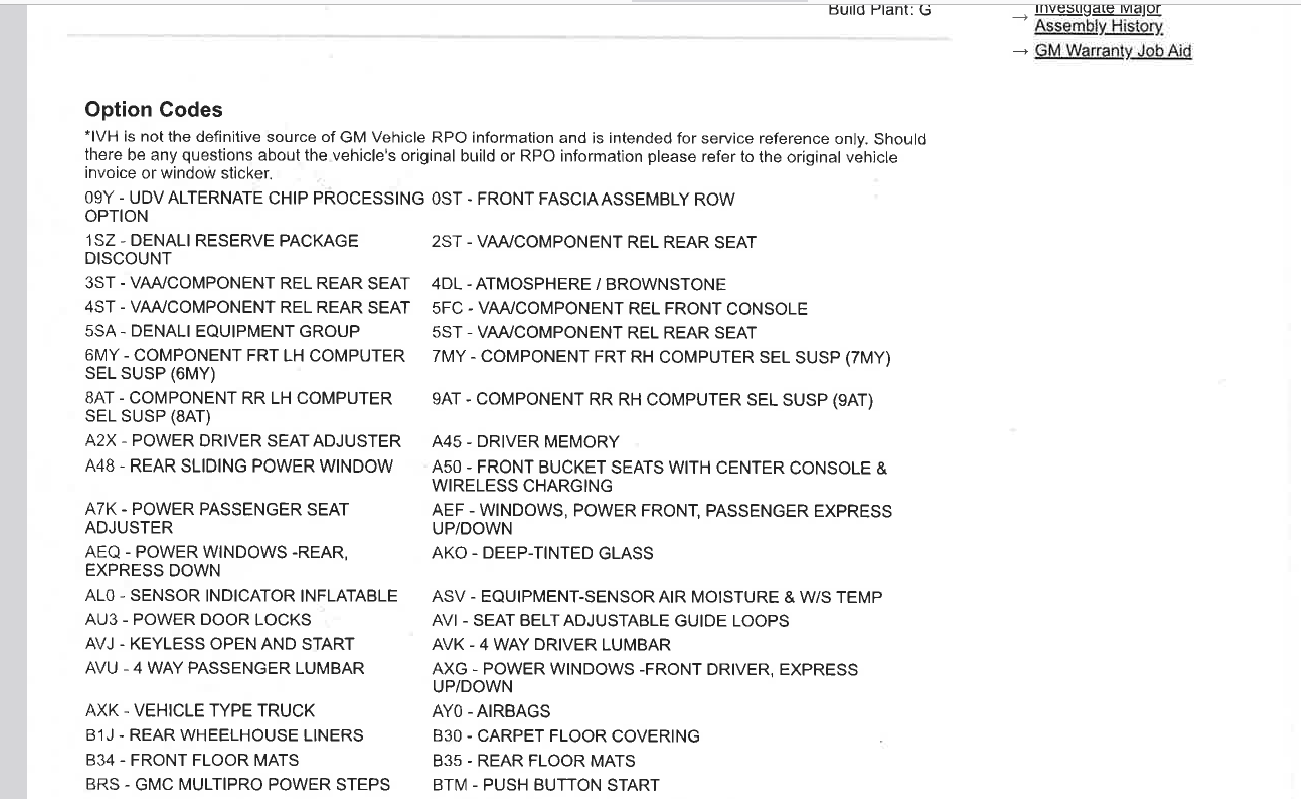
The build sheet is often trashed by the dealer clean up. I have had 5 new trucks in the last 20 yrs and never seen the build sheet. Its gone, can't get another as there only purpose was for plant use and not intended for the customer. The dealer can provide a lit of all options, this is excerpt of what I got

-
2023 Suburban 4HI issues
Z45 replied to davidm767's topic in 2021-2026 Tahoe, Suburban, Yukon & Escalade
The purpose of this bulletin is to help explain the operating characteristics of 4WD/AWD systems. For specific operating instructions for individual transfer cases, please refer to the Owner Manual or Service Information. DEFINITIONS AWD vs. 4WD The very basic difference between AWD and 4WD is the intended usage of the systems. AWD is usually intended for on-road use in inclement weather conditions, while operating smoothly on dry pavement by allowing for a difference in speed between the front and rear axles while turning. These systems are not selectable and do not have low range gearing for the transfer case. These systems can be found in cars or trucks. 4WD is primarily found in trucks and can be broken down into Part-Time, Full-Time, and Automatic Transfer Cases. These selectable systems have modes intended for on-road use and other modes intended for off-road or low traction situation usage. All current GM 4WD systems have a low range available in the transfer case. CHARACTERISTICS Disclaimer: Even though a certain amount of noise or feel can be expected, GM may offer service procedures or components, or change vehicle design, which may reduce perceived noise levels in the interest of customer satisfaction. AWD There are two different categories of AWD systems. The first category is full-time AWD. This type of transfer case delivers torque to the front and rear axles at all times. This ratio can vary depending on the system, but is usually about a 30/70% front to rear split but also can vary depending on traction conditions, up to 100% front or rear. This type of transfer case can have a viscous coupling for low traction conditions along with a planetary gear set to allow for difference in speeds between the front and rear axle, or an open type of planetary gear set differential, which uses brake based traction control for low traction conditions. An example of a vehicle with an open differential/traction control type of transfer case is a 2003 Escalade. RPO codes for these types of transfer cases are NP3 (NVG 149, BW 4473 viscous clutch) and NR3 (BW 4476, 4481, 4485, open differential) or NR4/NR6 (BW 4493, 4494 open differential). The second category is an on-demand AWD. This type of AWD basically delivers torque only to a primary driving axle unless reduced traction is experienced. At that point, the system electronically or mechanically will apply torque to the other axle. Depending on the type of system, this can provide up to 100% of the torque to the axle with traction. These transfer cases use an electronically actuated clutch pack, a hydraulically actuated clutch pack, or a viscous coupling to allow for a difference in speed between the front and rear axles. An example of an electronically controlled version of the On-Demand AWD is in the Smart Trak system in the 2003 Bravada. An example of a hydraulically operated On-Demand AWD is the Versa Trak system in the Aztek, while a viscous coupling is used in the Vibe. The RPO code for the Bravada is NP4 (NVG126). For some vehicle lines, there is not an RPO code. The only way to tell is by the Line Chassis VIN code, B for the Rendezvous/Aztek, V for the Venture/Montana or by SM for the Vibe. PART-TIME 4WD Part time 4WD refers to vehicles equipped with a transfer case to split power between the front and rear axles of the vehicle. This traditionally is a 2-speed selectable transfer case that can be shifted into 2HI, 4HI, 4LO and usually a Neutral position. The 4WD modes of Part time systems do not allow for a difference in speed between the front and rear axles while turning. This system effectively locks the front and rear propeller shafts together. When turning, the tires must allow for the different turning radius of the front and rear axles, which is why this is intended for low traction or off-road use. These systems have low range gearing for the transfer case. An example of a vehicle with this style of transfer case would be a Silverado with a manual shift transfer case (a shift lever on the floor) (RPO NP2) or a Colorado with a push button transfer case with a 2HI, 4HI, 4LO and Neutral position (RPO NP1). The RPO codes for this style of transfer case are NP1 (NVG 233, 243, 263, and T-150 push button) or NP2 (NVG 231, 241,261, BW 4401, 4470 shift lever). FULL-TIME 4WD A second version of a 4WD transfer case is a full-time 4WD transfer case. This style of transfer case has an open center differential to allow for different speeds between the front and rear axles and operates similar to an AWD system. This transfer case can be locked to operate like a Part-Time 4WD transfer case (no difference between front and rear prop-shaft speeds) and/or uses a traction control system to assist in low traction situations. These transfer cases also have a selectable low range. An example of this type of 4WD is the H2. RPO code is NR4. The NR4 transfer case (available in non-luxury utilities) has no switch selection to lock into a part-time 4WD mode as described above. There are only 3 selections on the controls: Disable Stabilitrak, AWD and 4LO. The Owner's Manual describes this system as an AWD system. AUTOMATIC TRANSFER CASES The last category is a combination of 4WD and On Demand AWD. These transfer cases have a 2HI, Auto-4WD, 4HI, 4LO and Neutral position and would fall in the general 4WD category. This transfer case has the operating characteristics of both an On Demand AWD and a Part-Time 4WD system depending on the mode selected. This transfer case uses a clutch pack to allow for a difference in speed between the front and rear axles in the Auto-4WD mode. In the 4HI or 4LO modes, there is no allowance for the difference in speed between the front and rear axles. An example of a vehicle with this would be a Sierra with a push-button transfer case with a 2HI, Auto-4WD, 4HI, 4LO, and Neutral positions. The RPO code for these transfer cases is NP8 (NVG 226, 236, 246, 246 EAU). DIAGNOSTIC AIDS Always follow Strategy Based diagnostics and service information in Service Information (SI). SI is constantly updated with new and more thorough information. One of the first steps that can be used in determining if a noise is a characteristic is to compare it to a similar vehicle. The comparison vehicle should be as close to the original vehicle as possible, including mileage, GVW, RPO, chassis style (extended cab, short-bed...). Attempts to correct characteristic types of noise and/or feel should not be performed. In most situations, these conditions will not be changed. Any attempts to correct these conditions may reduce customer confidence and inconvenience the customer while their vehicle is out of service. 4WD While operating 4WD vehicles in the 2HI mode, they should perform similarly to an equivalent 2WD version of the vehicle. However there are still additional components on the vehicles and there may still be some slight differences in characteristics. Some Part-Time 4WD transfer cases may make a slight gear rattle type of noise when operated in 2HI at low engine speeds, similar to a manual transmission gear rattle type of noise. This can originate in the synchronizer assembly from engine harmonics. This noise will usually be reduced or eliminated while driving in a 4WD mode because the synchronizer assembly clearances will be taken up once engaged in 4WD. Operating the engine at a slightly higher rpm should reduce this noise. While a vehicle is traveling down the road, the tires rotate a certain number of times per mile depending on the true tire radius. If all the tires do not have the exact same true radius (due to load, tire pressure, wear, build variances...), they will turn at slightly different rates. Also, unless the vehicle is traveling in a perfectly straight line, the front and rear axles are traveling in a slightly different arc, which means the front and rear axles are traveling at slightly different average speeds. These systems either do not have a center differential or it has been bypassed (when used in 4HI or 4LO in Part-Time or Automatic systems, or 4HI Lock or 4LO Lock on Full-time 4WD), so the front and the rear propeller shafts will turn at the same speed, which leads to the front, and rear axles rotating at the same average speed. Using the 4WD modes (4HI, 4LO, 4HI Lock, 4LO Lock) will usually increase noise in the axles, transfer case and the rest of the driveline and is usually greater at higher speeds and will usually increase the more the vehicle is turned. As the vehicle turns, the front and rear axles follow a different arc. When this occurs, the only place to compensate for this binding is between the contact patch of the tires and the ground. This can feel like the vehicle is vibrating, crow hopping or grabbing. Even if the vehicle is driven in a straight line, there are slight differences in tire circumference that will cause some driveline binding. If a vehicle had the exact same size tires and was driven in a perfectly straight line, the fact that more parts are moving would mean that there would be more noise and possibly some feel of the system operating. Use of 4HI or 4LO and 4HI Lock or 4LO Lock on Full-time 4WD is intended for use on a low traction surface such as snow, ice, mud or sand. On a low traction surface, the differences in front and rear axle speeds will not have as much effect on binding because of the lower traction levels between the surface and the contact patch of the tires. On a high traction surface, the higher traction levels will create more binding and noise in the driveline. As a result, a small amount of noise or feel of the system operating can be expected when using 4HI or 4LO in Part-Time or Automatic systems, or 4HI Lock or 4LO Lock on Full-time 4WD. The noise and feel can vary depending on the transfer case type, GVW ratings (generally the higher the GVW the more noise it will make), vehicle build variations, gear ratios in the axles, axle type, tires, and importantly driving conditions. While the transfer case is in Neutral, with the engine running, some noise can be expected. When transfer case is shifted to 4LO (or any time through or from neutral, for example from 2HI to 4LO or back) with the engine running, or with the vehicle moving, some grinding noise can be expected. In some vehicles you may experience a slight bump as the shift to 4LO is completed. This occurs because the 4LO range is not synchronized and there may be a difference in transfer case input shaft and output shaft speeds, especially if the vehicle is moving or equipped with an automatic transmission (residual torque from the transmission may be driving the transfer case input shaft). To minimize this noise the shift may be completed at a stop and in an engine off, key on mode. However, there may be an increased chance of having a blocked shift (some models must have the engine restarted to complete the shift). Noise and bump levels will vary between vehicles and even between shifts on the same vehicle. As a reminder, if attempting to determine if noise or bump experienced in one vehicle is a characteristic, be sure to compare to similar make vehicles. For example the shift to 4LO in a Colorado or Canyon will usually have more noise and/or bump feel than in a Silverado or Sierra. When driving in 4LO, the extra gear reduction will make additional noise compared to driving in 4HI. The automatic transmission shift characteristics will also feel different while operating in 4LO. AWD AWD systems are intended for use in high and low traction situations without operator input. These systems will generally be quieter on high traction surfaces than a similar 4WD used in 4HI or 4LO. However, these systems will generally make more noise than a similar 2WD vehicle simply because there are more parts rotating and more gear sets interfacing. Once again, these systems may make more noise in turns, and in some situations you may be able to feel the system operating, even on high traction surfaces. Additionally, you may feel transfer case operation in on-demand AWD systems. These systems generally react to a speed difference between the front and rear axle and it may be possible to detect this by hearing a noise, or actually feeling the engagement of the system. Automatic Transfer Cases Automatic transfer cases will have the characteristics of both the Part-Time 4WD and the AWD systems depending on the mode selected. If the transfer case is operated in 4HI or 4LO, it will behave as a Part-Time 4WD system. If it is operated in the Auto 4WD mode, it will behave like an on-demand AWD system. Driveline noises in 4WD or AWD vehicles caused by loading may be mistaken for transfer case or front axle noise because they can sound very similar. Four-wheel drive noises caused by loading may exhibit the following conditions: • The noise will be greatest on a clear, dry road and decrease on a low traction surface. Front axle or transfer case noise caused by bearings, ring and pinion, or planetary gearing will be similar on all surfaces. • The noises or feel that can be expected will increase while making a tight turn. • The noises may be changed from a deceleration to an acceleration condition (or acceleration to deceleration) by raising or lowering tire pressure at one end of the vehicle. TIRES Tire rolling rates can be a major factor in operational characteristics. Consider the following important items: • All tires are the same size and brand. Tires of different brands may have different circumferences (or radius) even if they are the same size. • Tires are set to factory recommended pressures. A tire with low air pressure will roll at a different rate. • All tires have approximately equal amounts of wear. Tires with different amounts of wear will roll at different rates. • All tires are the same tread type. Don't mix on-off road, all-season or street tires on the same truck as they may have different circumferences and roll at different rates. • One or more of the tires may show small, short scratches around the circumference of the tire tread. The tire "scuffing" on the road surface causes these scratches. -
Where can I find all GM TSB for my truck?
Z45 replied to tcafranz's topic in Troubleshooting, Warranty & Recalls
No site like that exists, that is copyrighted material and not free. -
Rusty front axle on 2025 Silverado 2500 4WD.
Z45 replied to superdave160's topic in 6.6L Gas V8 (L8T)
Pretty normal surface rust, those parts are not painted and mostly likely sit outside at the assembly plant waiting to be used on the line.. That's heavy gauge steel. The body will rust away long before those parts. -
.....
-
You never mentioned what engine you had so when mentioned Duramax I assumed thats what you had? Well you changed the oil now so is your word against theirs and I would bet they won't believe you? Risk you take trusting the dealer. At least they did not forget to put oil in. Happened to a lady I know, she made is 5 miles.
-
How do you come with 2 extra quarts? It takes 10 and you drained 10.. 15W-40 is the correct viscosity, not 5W-30. 5W-30 is for the 6.6L GAS engine.
-
2026 Silverado 1500 color choices
Z45 replied to Amherst RST's topic in 2027+ Silverado 1500 & Sierra 1500
That info has not been released yet for 2026 light and heavy duty truck. -
Which engine - 5.3, 6.2 or 3.0?
Z45 replied to Z71RAD88's topic in Engines & Drivetrain (V8, Duramax, TurboMax)
My last 3 trucks, '12, 17 and 21 were all 6.2l. My 2024 I got the 3.0L diesel for the fuel economy. I have 2 friend who bought earlier versions, 2020 and a 2021, both GMC's and they tell me no complaints. Granted this owners have kept their trucks stock, no suspension lifts or big tires. Like me they have them for basic transportation. 2024 GMC Sierra Denali Window Stikcer.pdf -
Castrol Edge VS Amsoil OE
Z45 replied to diyer2's topic in Maintenance, Oils/Fluids, Detailing & Rust Prevention
There is an interesting article in Jan '25 edition of Lubes'n'Greases mag by Tom Glenn, Petroleum Trends International. He cited an API report that stated nearly 50% of the engine-oils sampled failed to comply with licensing standards. Leads one to wonder if the cheaper brands are playing fast and loose with additives to reduce the selling price? -
Castrol Edge VS Amsoil OE
Z45 replied to diyer2's topic in Maintenance, Oils/Fluids, Detailing & Rust Prevention
I seen it...Means nothing to me. Its new oil with little to no miles. New oil can seem better at start but how long it lasts is what important IMO. Whats it like after 1,000, 2000, 3000, 5000 miles, what the the wear metals? They use a cheaper synthetic base stock, put in less additives or less costly additives because they are selling to a price point, not long lasting quality. There is hardly anything in the world that some man cannot make a little worse, cannot make a little cheaper and the people who consider price only, are this man's lawful prey. John Ruskin 1819-1900 Valvoline is owned by Saudi Aramco Castrol Limited is a British oil company AMSOIL is American Owned Company Royal Purple is owned Calumet, Inc. USA Company Super Tech is blended by Warren Oil Company (and others depending on WM contract bidding). They specialize in making products for private labels. -
Castrol Edge VS Amsoil OE
Z45 replied to diyer2's topic in Maintenance, Oils/Fluids, Detailing & Rust Prevention
CASTROL is a foreign owned, AMSOIL is American owned, that's all I need to know. Support American business! -
2021 GMC SIERRA 1500 AT4, 3.0 L TURBO DURMAX
Z45 replied to Vkk's topic in Troubleshooting, Warranty & Recalls
I had a similar situation involving speed limits with a dealer once. Speed limit here was 55 and my tires would shake over 60 mph. Service manager would not permit his techs break the speed limit to road test nor could they ride with me if I drove over the speed limit (endanger their lives, his words). No amount of conversation would change his mind so I had to seek a tire shop to balance the tires and eat the cost. Even thought I bought new there, never been back since.

-
Forum Statistics
250.4k
Total Topics2.7m
Total Posts -
Member Statistics
342,768
Total Members8,960
Most Online
-
Who's Online 2 Members, 0 Anonymous, 969 Guests (See full list)