
Leaderboard
.thumb.JPG.2c573de60d3a3a4407c7d92298db46dd.JPG)



Popular Content
Showing content with the highest reputation on 06/19/2026 in all areas
-
@Grumpy Bear the conclusion from your post about doubling engine life has me curious. Are we literally talking an expected life of 250,000 miles potentially becomes 500,000 miles with a step up in filtration for fresh oil at "the oil factory" when it's bottled? I know you said that's a single variable among many, but, that's significant if the implication extends that far into a real world use case. I would think the oil marketing folks would really eat that up and make it known. Particles introduced during oil change is a fairly easy one to avoid, but probably not intuitive as one would think. I.e. using a clean funnel. But...what was it wiped with? Paper towel leaves behind little fibers. A solvent if not dried is not something one would want to introduce into their engine with clean oil. And, keeping the oil filler neck clean and free of buildup.. Look at some guys engine bays and they're an absolute mess. Some say that's better than the drawbacks of cleaning it. I'm not a buyer of that idea. I've also wondered if "flooding" the top end of the engine with oil while filling is a bad idea. During normal lubrication the oil flows in a gutter back into the galleys. But if you flood the area you're potentially washing the top of the rockers, springs, and other areas which may not get much oil wash normally, and you're mixing all that into the new oil. I just don't have the patience to pour slowly.2 points
-
Hi Gary, I guess it all boils down to personal preference and what you can afford. I, personally, buy new because I will know from day one how the vehicle is maintained and driven.2 points
-
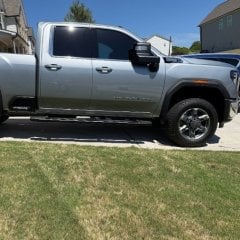
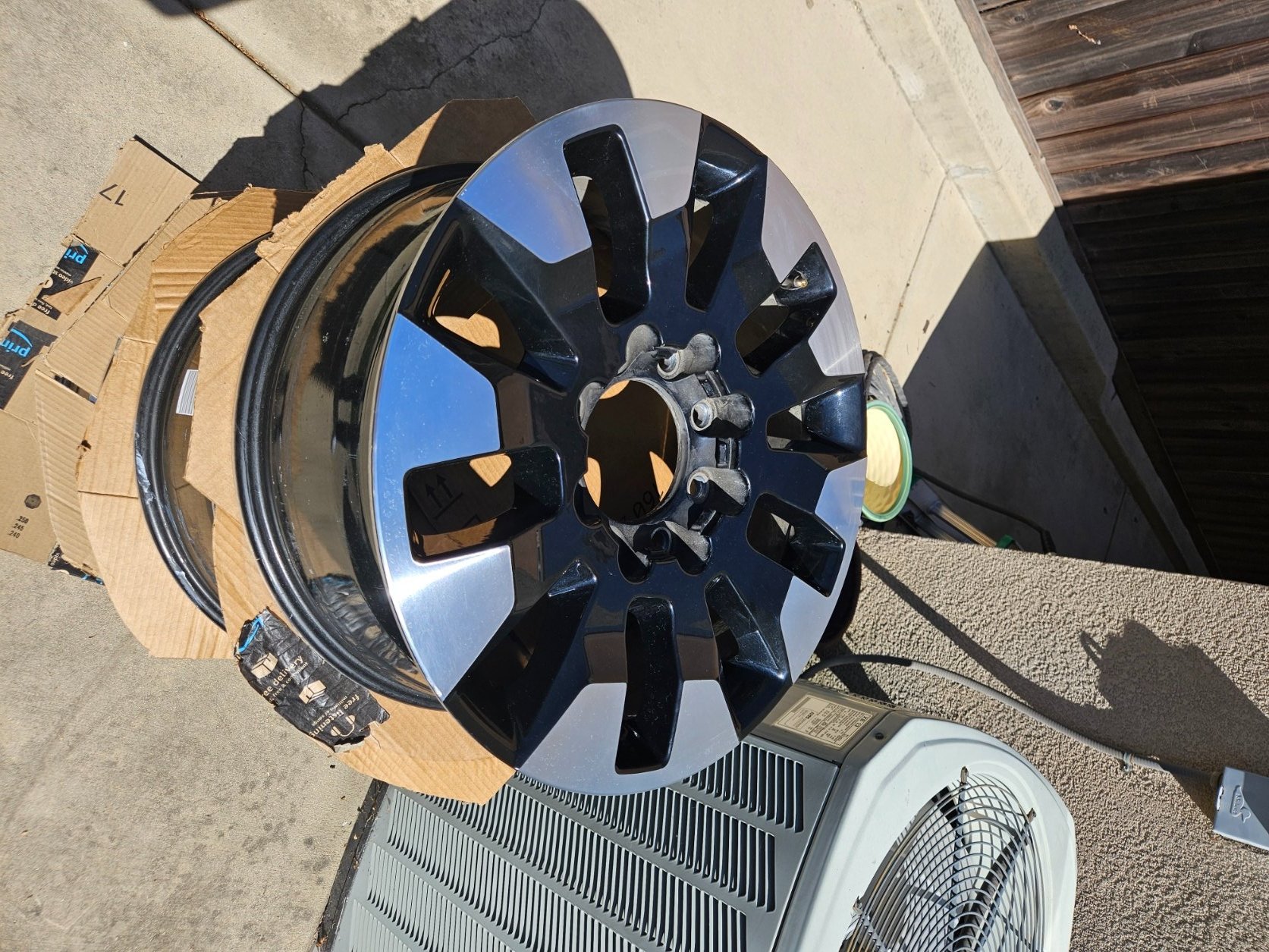
Had some gunmetal grey PlastiDip kicking around and decided to try it on the '26 Denali. Not a big fan of these wheels so I thought it can't be any worse. Would love to hear thoughts on this before I get some black and try that, or replace the wheels? Truck is Downpour color. The orange marker lights are next... TIA
 1 point
 -
Interesting question which you partly answered in the word 'potentially'. I think that is going to be a 'point of reference' inquiry. What are the touchstones? This will sound petty but it is the main source of end fighting in threads on this topic. Define a motors "Life". Think about the various arguments that have been entertained on these pages in that very argument. I can only speak from my viewpoint. Engine "Life" in my world is defined by power cylinder integrity. For the majority of engines it is the bore/ring interface that quits first. Loss of seal. Oil consumption and loss of power. Most Pro motor builders would agree and there is a good deal of information on using "Leak Down" as a primary indicator of bore integrity. At home a compression test is more the thing. If we can agree on that then I think CC Jensen has done its homework and I'd find it valid. Now by my own definition, Dizzy, wife's Ecotec 2.4 I-4 has been dead since about 80K miles. And yet we have logged over 200K miles more on it. "Life" and "Usefulness" are therefore independent. I know a mature fella right now who has just hit 300K on a Mitsubishi 3A92 NA MPFI motor and has done compression test every 100K. It was 205 psi after break in and is now about 195 and still even. He uses shelf oil but good filters and adheres to a 3K mile OCI. He even do UOA's on each of them for the first 50K. I also know a fleet mechanic with that same motor that gets 300 to 500 K out of them but the are oil using, wristpin sloppy, skirt slapping motors. He ran one with a piston pin so loose the piston was bouncing off the cylinder head for about 20K miles before he called TOD. Both of them claim success.1 point
-
Great info to have, I printed out what you had in your document as well as Newdudes post as I could see this mistake with the hardware happening very often if not realizing what type of special bolts are being used and just guess on bolt size for torque or the good enough "easy" method as per whack in the used bolts with an impact and send it !.1 point
-
I prefer new, but not without a deal. Historically I've bought severely aged new inventory, leftover model year, unpopular configuration kind of stuff that sits around on dealer lots until they just want it gone. $10k off MSRP kind of stuff on a mid-priced truck. That really, really helps knock down that first year depreciation. It also requires being somewhat flexible on colors and options. I wouldn't buy a 4 cylinder if I was looking for an 8 cylinder, but if I got blue paint instead of black, or a great deal was lacking a minor option, I'm willing to overlook those things for savings. Used <> used. Condition and history are everything. If I'm buying used I'm looking for cream of the crop. The truck from the guy who religiously pampers it, and then decides a year later he wants newer and nicer. NOT the ex-rental vehicle, or the crew cab traded in by the family with 7 kids who like to throw food, and the oil only got changed when there was time long after the oil life monitor started alerting.1 point
-
Any time I get around 1,100–1,300 lbs of tongue weight, the rear of my truck ends up more than 3+ inches lower than the front. In my opinion, that's not a safe situation. The RAS completely solved that issue for me. Not only did it level the truck under load, but it also improved the unloaded ride quality. As an added benefit, it virtually eliminated axle wrap and noticeably reduced sway, both when towing and when driving unloaded. For my setup, the RAS has been one of the best suspension upgrades I've made.1 point
-
Thank you to all who were quick to respond; providing me with timely and correct info needed to get this correctly addressed today with the body shop. I will be providing this doc I created (with the help of AI) for them to follow. I made it as clear as possible. Maybe they'll consider this disrespectful, but they did not perform the install correctly the first time. If they allow me to (which I do not believe it is allowed for liability and insurance requirements) I will bring the bolts home and replace myself. Hitch install - Steps and torque specs.docxHitch install - Steps and torque specs.docx1 point
-
I would just buy some takeoff, for the most part any plastic will ware off and look like $$%$&. there are usually decent option in the $600 range, I took my time and scored a good set for $400 all in. Good Luck.
1 point
-
no - I did not cut open the filter btw. I did use a PF63 which I will do for at least a few years worth of oil changes just for good measure. I really don't trust dealers for these tasks - I have no issue using them for larger tasks, but I also tend to consider the value of my time in the equation and if I can easily do it myself in significantly less time than the whole process of taking it to a dealer I will choose that every time. I am a very competent mechanic - I have built cars, engines etc. from the ground up and maintained race cars for years and years, built hot rods even from newer platforms with EFI, swapped engines, transmissions, brakes, rear ends - you name it. Oil change is pretty mundane and I can have it done in the time it takes to drive to the dealer let alone drive back and wait for them to do it.1 point
-
The one you posted is correct. Just the 4 bolts are one time use. The other two don't need to be replaced.
1 point
-
Stuff like this is why I have trust issues with anyone else working on my vehicles.1 point
-
Good luck and if appropriate for you1 point
-
I really like the look of the new truck. I have a 2024 Sierra now and will keep it, but I'm jealous that the shifter is back where it should be... on the column! The goofy shifter in the console is one of the few things I hate about my truck.1 point
-
Practical Application ISO 4406 I think this oil cleanliness thing is going to boil down to ones personal resolve. The information is there but applying it I believe will test your commitment to the machine. Implementation would involve building or buying a prefilter or purchase of an "ISOCLEAN" oil. Then installing a single digit micron bypass system. A good deal of testing and about 99.9% of you are saying at that point....yea.....not my cuppa tea. So what can you do? You already did the first step. Get educated and leave the bias at the door. Be aware of the its, cleanliness, importance. Do your own work if you can. Keep the equipment clean. Not just your funnel but the engine bay. Use sealed containers. Think it through. I believe you will find, as I did, that the tightest absolute full flow filters (Beta 200) will be around 20 micron. That will yield on average a Beta 75 of 10-15 micron. They are few in number by brand and price point. Loose filters are a dime a dozen and even the best brands have lines of loose filters. Some cleverly marketed as "Extended Service". Others will market flow over efficiency. But I think the take away once informed is that the extra cost of the best offered is a bargain. There are cheaper filters with good efficiency that are equal in performance to niche brands with big prices. Your Quick Lube is about a 40 micron unit. This is where your dealer is a plus. the AC-Delco filter is a good step up from those places. Even better if you specify the UPF line. Be skeptical of marketing. Buying an oil that is made from GTL advertised as the cleanest base oil is using a truth to support a lie. While GTL's are made from debris free gas the processing equipment and post handling is just like any other oil. It also ignores the fact that PAO's and Esters are also gas in origin. Any private prescreening testing you would do, and some have done, would yield a result only good for the batch you tested. AMSOIL and Schaeffer's have built a reputation for paying attention to this detail. Context. Cold starts account for at least 75%, or more, of an engines wear. But of the remaining 25% ish, over 80% is caused by particle count. Now where do we find high milage motors that use this type of information efficiently? OTR trucking! Now, anyone want to build a prefilter or off line cleaning system anyway?1 point
-
Here's a starter kit: CC Jensen, a Danish oil testing Concern gives us the following guidelines: ISO 14/12/10 Very Clean Oil ISO 16/14/11 Clean Oil ISO 17/15/12 Lightly Contaminated ISO 19/17/14 New Oil ISO 22/20/17 Very Contaminated and not suitable for any service. In addition CC Jensen gives a table showing how engine life is increased by cleaning up the oil. For example cleaning the oil from 19/17/14 to 13/11/8 will extend motor life by a factor of 6X. But even cleaning it two “Life Extension Classes” will double motor life. So perhaps giving those classes would be useful: 21/19/16 20/18/15 19/17/14 18/16/13 17/15/12 16/14/11 15/13/10 14/12/9 13/11/8 ************************************* https://testoil.com/program-management/setting-iso-cleanliness-targets/ Third paragraph from the bottom will give a starting point. Your next question should be, okay 10um at what Beta ratio and the answer is in the graph Beta 75. Then the next question is what is your chosen filters profile? (Purolator PL series below) The red dot is Beta 75. This was the information I obtained from MANN a few years ago. So the best filters, Purolator One, AMSOIL EA, FRAM Ultra, Royal Purple, Bosch Premium should get a doubling engine life over filters like Purolator L, any service filter from any quick lube, WIX, NAPA, STP, Mobil 1, Purolator BOSS. And as noted by CC Jensen a 2-5 micron @ Beta 200 bypass system has the capability of a six fold improvement. AMSOIL has such a system as does Donaldson. Now having said all that testing is the touchstone. Test the oil NEW and test it with your chosen filter. Then test over milage. Do the work, get the result. But understand this in NOT absolute BECAUSE this is one factor in isolation. Example: A valve spring supplier can state that with cam X and a valve train of Y grams the valves will not float to 7K rpm. is that true if the builder choose a system 20 grams over limit? Common sense must be used and limits understood.
1 point
-
I like it. In a world of vehicle front ends that look like they've had a little too much nipping and tucking, I appreciate that GM went with a bold and professional look for the new Silverado and kept the aggression understated. The new 1500 looks a little more like the current 2500. The interior looks well done as usual, although I'm not a fan of billboard screens on the dash. At least recess the gauge cluster screen. I see passenger screens as "keeping up with the Joneses'" in automotive interiors of late, which is fine. I don't think they belong in most pickups, but choice is good. Maybe some day I'll appreciate having one. Probably not, but, maybe. Yet another steering wheel and airbag design. I wonder what it costs to have so many different models of airbags and buttons and steering wheel frames. IMO, pick a good one and stick with it. The new one is very...luxurious...looking. Again, not bad, but also not what I'd expect in a pickup. GM has left us awaiting engine choice announcements and official details. What will I be ordering on day one? Nothing. I like my 2025 and it would be silly to get rid of it just to have a 2027.1 point
-
You may find this of interest. Not addressed in this article is that the UFP produced has some impact on elevated soot in the oil which only means it gets dirtier quicker. Just information and not a deal breaker. I use E-0 when it's cheaper. It does give a bump in fuel efficiency. https://www.enginelabs.com/tech-stories/mixing-e85-with-pump-gas-getting-higher-octane-for-less-money/ (Excerpt from above link below) Concerns About Ethanol These small blending mixtures of E30 to E50 maintain a large percentage of gasoline. The advantage here is that if the electric fuel pump in your street car is not rated for use with E85, a blending ratio of E50 or less can generally be considered compatible. You should consult your particular pump manufacturer to be sure, but a light blend of E30 should not cause any problems. Let’s also address the claimed issues attributed to using ethanol in older cars. Our own experiments and investigations have traced the source of many ailments not to the alcohol in the fuel but rather to the high percentages of aromatic additives used in all pump gasoline. These aromatics are often lumped together under the acronym “BETX.” This is chemical shorthand for benzene, Ethyl-Benzene, Toluene, and Xylene. These aromatics are present at anywhere from 20- to 25-percent (and sometimes more) by volume in gasoline. By themselves, BETX aromatics are not necessarily dangerous. But they are responsible for many of the problems in fuel systems, such as killing rubber fuel lines and affecting small rubber parts in carburetors. Of equal concern is a dangerous by-product created after combusting BTEX, creating what are called ultra-fine particles (UFP). These particles are small enough to enter your lungs and travel past the membranes and directly into your bloodstream. Not good. By mixing ethanol with the fuel, fuel companies are able to reduce the concentration of BETX in the fuel. Conversely, alcohol-free fuels as sold in many Midwestern states contain much higher percentages of BTEX to compensate for the loss of ethanol in the fuel.1 point
-
I bought the 1 quart squeeze packages. They worked well. I drained the empties into the partial one at the end and only got a teaspoon or so out of each. The access is pretty open for the rear differential even without lowering the spare tire.1 point
-
I thought of it after my comment last night, was the Amsoil you used in the 1 quart bottles and if so did you have a bottle pump or one of those bottle hose adapters to then hold the bottle above and upside down to pour in the oil. I had bought some of those squeeze packs ( of course they end up costing more ) of the severe gear 75W-90 for when I do change the diff oil and the only reason I bought them was to see if I liked using them or if it was not worth the premium price. The problem with a squeeze pack is that there is no way of knowing how much is taken out or still in the pack unlike a bottle that is easy to see with the clear strip and markings that most bottles today have. It was the same situation years ago when plastic oil containers had no markings or if they did they didn't have a clear strip to visually see the level. Also another item and as per the video you linked, he went through the process of using new thread locker on the cover bolts and while it does seem odd that a diff cover should require thread locker, what was your thoughts on that and if you used some blue thread locker for example or just cleaned ( solvent ) the bolts if needed and left on the old thread locker residue as they were and reinstalled them. With 29 lb-ft of torque on the bolts, I have a hard time visualizing the bolts backing out, it can't be as critical as you doing jobs like installing a prop on an aircraft and having to wire fasten every bolt head or do GM diffs vibrate that much ? LOL.1 point
-
https://www.helminc.com/helm/product2.asp?Make=GMC&Model=SIER&Year=2025&Category=2&class_2=GMC&mk=GMC&yr=2025&md=Sierra&dt=Owner+Manuals&module=&from=result&Style=helm&Sku=87855255A&itemtype=B $55 to get a paper copy. Gotta keep skimming the costs down for the Generous Mother. In their defense, I suspect you can find a lot of paper owner's manuals in junkyards dutifully stowed in the glove box of said junk vehicle with nary a crease in them. I believe you can also download a pdf copy to your phone in the Chevy/GMC app.1 point


.jpg.b0de86a7a0b8fc858cdbb8a8261cab47.jpg)










This leaderboard is set to New York/GMT-04:00