

.JPG.6537b7f00fa66f30aa51f5040da0fd95.JPG)
Grumpy Bear
-
Posts
12,697 -
Joined
-
Last visited
-
Days Won
450
Content Type
Profiles
Forums
Gallery
Events
Articles
RPO
Store
Blogs
Everything posted by Grumpy Bear
-
.thumb.JPG.2c573de60d3a3a4407c7d92298db46dd.JPG)
Any tips to improve fuel mileage?
Grumpy Bear replied to xSHIFTxNASTYx's topic in 2014-2018 Silverado 1500 & Sierra 1500
While I did mention it in an earlier posting to this thread I have to say I do love your wording. -
Any tips to improve fuel mileage?
Grumpy Bear replied to xSHIFTxNASTYx's topic in 2014-2018 Silverado 1500 & Sierra 1500
You hit the nail on the head Andy. An engine is a 'demand' device. It makes exactly the amount of power required to overcome whatever resistance is against it. If it has the ability to make more power than is nice but if it is against a 25 hp. load it makes ONLY the 25 hp. needed. The power the motor makes is in the fuel, not the air. If it were only about air (O2) then a Nitrous motor should make about a million mpg. Hit the spray bar and voila, mpg. To Doublebase's point a less restricted inlet that allows more air would also mean a lower throttle angle and thus higher pumping losses leading to lower mpg. If there is any change at all it will be due to the air fuel mapping. For the same rpm the MAP will be altered which may alter the fuel delivery RATIO (maybe). IF that leans the mix a bit the blade will open more, the pumping losses decrease the mpg MAY go up. If it's too lean it may go down. The power comes from the exact mix of energy release delivered by a specific ratio of air/fuel. That has to do with turbulence, and....and....and....and You guys get the point, right? It's complicated. Thing to remember is correlation is not causation. Marketing people make a living out of such happen stance without ever knowing why and if they do....they lie from the heart. Keeps the natives ignorant and easy to manipulate. In the days of the carburetor if you wanted great mpg form a certain set up you used a vacuum gauge and drove to the highest vacuum. Today with GDI they attempt to deliver the highest MAP which is opposite high vacuum. Back in the day the higher the vacuum the lower the fuels boiling point the greater amount of liquid was turned to vapor the more BTU was available to be put to work. That job has been turned over to events AFTER the intake manifold. A .04 second blast of high pressure fuel delivered from a very precise spray patterned nozzle in a cylinder rapidly descending does that trick. In effect you two are both right, right? C'mon man...smile! BTW the comment on winter air being denser thus harder to push a truck through? True! But hard to measure on anything other than a slide rule. -
Windless Day. Speed v AFM Nearly 500 miles today and an almost perfect day to do it. 72 F mean. 0 to 4 mph winds. Partly sunny. Light traffic. All directions. Elevation range 500 to 1100 feet. State road, Federal Highways, Interstates. Good day to find some numbers. If I travel 50 mph the AFM is on allot and level ground numbers are just under 40 mpg. At 55 mph the AFM is on more as far as I can tell but the increase in speed drops the level ground number to 34.5 mpg. The AFM will stay on over mild inclines. By 59 mph (95 kph) the AFM toggles with the changes in elevation. Up it's off, down it's on. On the level it depends. If I reach level after a down hill with the AFM active it will remain so. If, on the other hand, I reach the flat after an uphill it will remain off. Level ground AFM on number is 30.5. AFM off level ground just under 28 mpg. The no wind break speed seems to be about 57 mph. That's the highest speed I could get it to toggle with elevation and stay on flat ground regardless of approach. That said two nights ago returning from Peoria I had a 10 mph tail wind and at 60 mph the AFM stayed on like it does at 55 mph and with about the same mpg numbers on level ground. Add a new tool to the box. We don't get many windless days here.
-
Data is your Friend But only if it’s good data. At any given gas station the delivery to the tank will vary even though it has an automatic shut off tripped by fuel reaching the nozzle. The reasons are various and not the point of this post. Point is it varies. At the same pump, at different pumps. At different stations and so on. How much? From best to worst? If I gave you a number you would question it so I won’t. I’ll use a random number than is well within the range of variance I’ve experienced. Let’s call it a quart. Let’s use Pepper as our example. I run about a half tank or 13 gallons between fills. It’s just my practice. On a 325 mile trip that is 25 mpg. Variance of a quart give a range of =/- 2% or 24.53 to 25.48 mpg. Let’s say my odometer is also off by 2%. A likely scenario. Could be high or could be low. If we take the worst case in either extreme that is an 8% shift if mpg. As the tires wear and assuming you run the too minimum that is 1% additional error and the compound error is now 10%. That is fuel variation, odometer error and tire wear compound error total. As this was done on a percentage bases it will hold for any mileage. A 15 mpg example gives the range of error 13.5 to 16.5 A 30 mpg example gives the range of error 33.0 to 27.0 Pretty big holes. Now let’s talk ‘other’. Ripley’s Believe it or Not: Winter/Summer fuel composition variation in BTU content per pound of fuel is @ 2%. Tire pressures alone can create a 10% shift. Weather related variations, which are really viscosity issues, and that number can be huge and can be defined only on a case by case bases. It can only be define statistically. Miami is going to be a different number than Nome. You have to minimize the noise in the statistics to get that value and that isn’t that hard. You have to keep records and then you have to analyze that data and if you like me, graph it. I’m a visual learner. But you have to do it over very long terms and track by season and by year. Now you can spend the next three to five years doing this but you will come to the same conclusions I have. First and foremost is a single number tagged in space on a single tank hand calculated or not is meaningless unless they are giving prizes for best uncorrected single tank values. You don’t buy gas or make choices base on that number if you’re a wise person. Peppers actual log. Worst tank 22.90 mpg. Best tank 33.3 mpg. That is 45% high to low. Life time number is 27.2 mpg. The red line is the 36 tank moving average. Ask yourself what one tank means. What a 25 mile DIC number means. This chart represents @ 82K miles of history. Nearly 3 years. Chart updated 6/7/2019 1600 hrs.
-
Peppers MPG Report Card Limited data for 2016 the year I bought her but the next two years are over a distance of 35,983 miles for 2017 and 31,246 miles for 2018. Only 7,764 miles for 2016. Not charted are then 2019 numbers to date of 7,088 miles for 28.06 mpg. May numbers are in: 2017 - 26.21 mpg 2018 - 28.45 mpg 2019 - 29.64 mpg Quarterly numbers for Spring by year: (March - May) 2017 - 25.28 mpg 2018 - 27.33 mpg 2019 - 28.30 mpg Life Time Average now at 27.2 mpg. Last 26,338 miles 28.6 mpg. That is going back 1 year to date. 5% above the lifetime average and including all four seasons so apples to apples.
-
You're just over 9,000 feet, right? When is your last snow day typically?
-
Any tips to improve fuel mileage?
Grumpy Bear replied to xSHIFTxNASTYx's topic in 2014-2018 Silverado 1500 & Sierra 1500
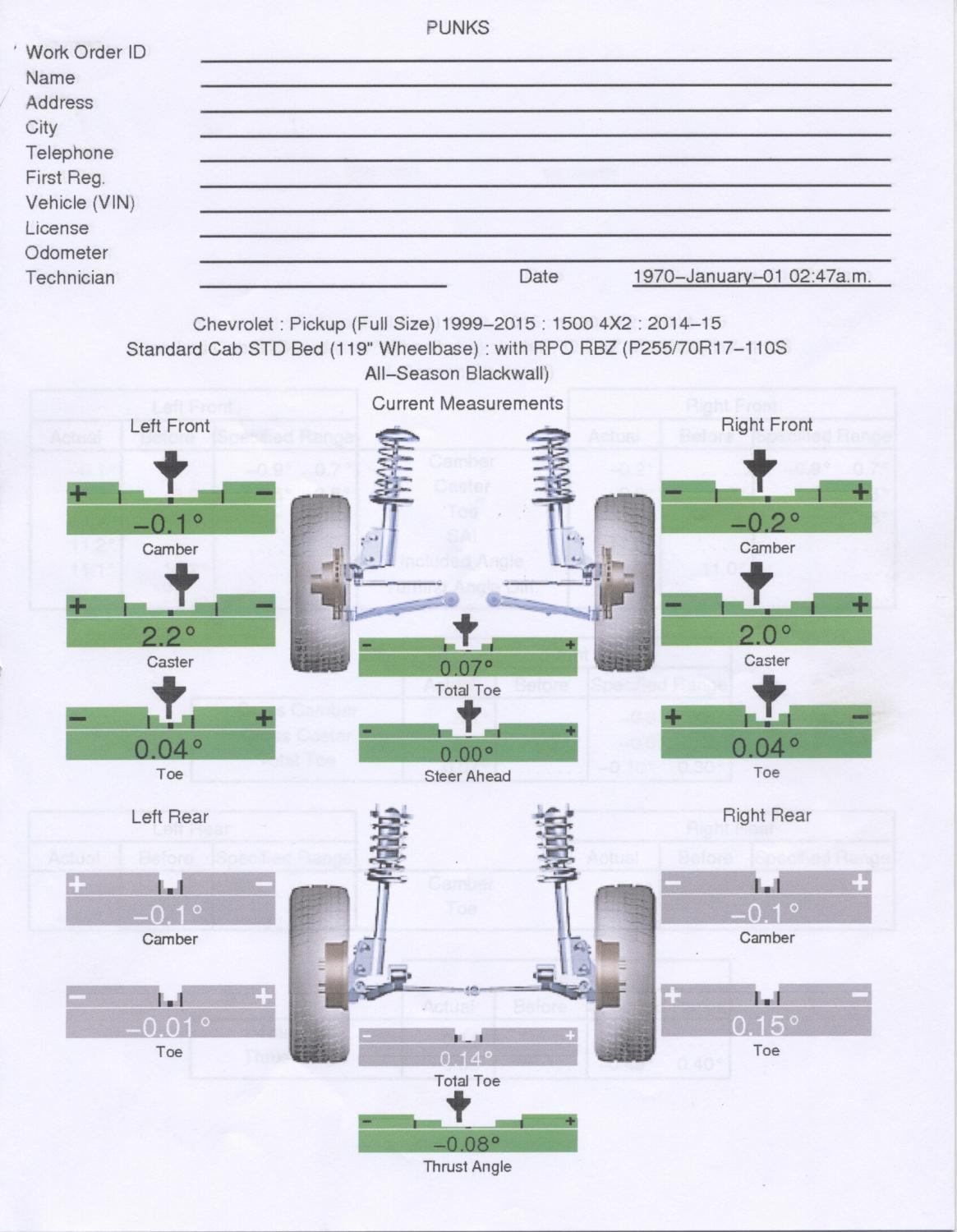
Think 'resistance' and reduce it. A few suggestions in the previous replies go to this end. 1.) Alignment Having an alignment that is in spec and having one optimized can be quite different. This one could still improve on the thrust angle. 2.) Tires. Street tires and weight matters. The factory General and Bridgestone HT work well. Continental Cross Contact LX20. A place to start. Be OCD about maintaining pressures. 35 psi cold. Factory sizes for the WT1 was 255 -70-17. The Generals are the lightest. Bridgestone the longest wearing, Continental the quietest and most comfortable. Nothing wrong with the others suggestions of Michelin but about $25 a tire more money and really don't work any better. 3.) Use 0W30 instead of 5W20 but use a good one. My personal preference is Red Line. The large moly add is a real friction killer. Red Line or AMSOIL in the diff's. Ditto transmission. 4.) Use the 195* thermostat from the Camaro/Corvette and delete the trans thermal bypass valve. Or install IPSCO thermostat housing and run the earlier SBC stats like the 180F. If you get to the 170F to 180F range then the 0W20 oil will reap some incremental gains. Don't get 3 and 4 confused. Oil choice is temperature selected. Operating temperature. 5.) Lower the truck slightly and keep the front air dam and the rear wheel well opening winglets. Best way to achieve the lower is the drop spindle. 2" is plenty. This will retain the factory geometry and alignment ranges. In the back loose the 1.25" spacer, use the 2" drop shackle and the McGaughy's lower shock extenders. That will let you lower the rear that much and keep your factory shocks. You do this drop other ways if you like but the idea is lowering frontal area. 6.) Bed Cover. Soft roll up like a LUND. 7.) Loose the idea you can tell anything about mileage in a tank or two. Averages made from hand calculations over say 5,000 miles and in like season tell the story. Yes that takes patients. Data is your friend. 8.) Get a monitoring device like the Autometer Ecometer or Linear Logic Scan Gauge II. Eyes on what is happening is a great 'feed back' trainer. 9.) Tighten that loose nut behind the wheel. Not one of the above will yield monumental improvements (except driving habits) but combine it can be quite the game changer. Mind set is everything. Your driving habits have more to do with mileage than anything on this list and it has to be your HABIT not what your do once in awhile. A word on fuel. Think in terms of cost per mile instead of MPG when making that choice. 87 is fine. Your truck as a KR sensor. Normally the above list yields a nice return for any vehicle. When motors have AFM it can be substantial and little reductions in resistance have a pronounced effect on how long the AFM is active. Think of it as a MPG multiplier. You may reject it entirely. Some will disagree with some of the suggestions. What they cannot disagree with are the results it has had in use in my truck but, it's your truck, explore it and enjoy it.
-
Cooling System Towing Test Results, Before/After Mods
Grumpy Bear replied to Jon A's topic in Engines & Drivetrain
Your not concerned with your oil temperature? -
Let's just use his.
-
The Peckish Synapse The truth is a hard thing to find and why, I suppose, it intrigues me. Often confused with facts. Considered opinion by some. Rarely defended and often criticized. But truth, it has power. I find truth in three areas fairly easy to find; God, math and physics. That is if you go to the source and not the person manipulating them. As the last two are the result of the first….I find ‘it’ reliable. Who can question God? Isaac Newton is sitting under a tree one day and an apple falls to the ground. He ponders this event and today we see the result of the meditation as the three laws of motion. Does that mean Newton invented Motion Law? No. It had always existed. Isaac was just the first to understand it well enough to explain it. How? Was God ignorant of that law? Hardly. He created it. So the source is faithful. Albert Einstein is contemplating a train and the perspectives of various observers. That meditation produced several Theories of Relativity. Theories solid enough to be used to send men to the moon. How? Galilei Galileo drops two dissimilar balls off a famous leaning tower. Gravity calculations results from his meditation. Did he invent gravity? We still use those equations. Your ECU/PCM can’t operate without them. How? The thing that connects God’s physical laws to the study of Physics is Math. That is how! That is in explaining the workings of the natural world. Data is our friend. But only if you understand its significance and, and it’s a big AND, you don’t bend the math to suit your will. Back to Galileo and scientific method. This the case the first thing people who hate the truth attack is the math. More precisely the measurement. Then the method and then….they just don’t want an answer. Well I do and am quite content not to use the abstract to muddy the definite to irrelevance. That said I’m not oblivious to it either. What does that mean? Means I’m not going to apply a rule of measurement intended for measurements in the field of quantum mechanics to cast a doubt about the accuracy of a GPS measured mile in calibrating my odometer. But I also see the need for a large enough sample size to relegate any unintended error in measurement to a decimal so small that it matters not. All I’m looking for is a ‘process capable’ value that can be used to compare one apple to another. Data will tell the story, not the story teller.
-
"Garbage in, garbage out." And still not as bad as it sounds. Yes I got faked out on the oil pressure into making some moves it will take me awhile to unwind and yet damaged nothing more than my pride. Bought some oil I wont use for this vehicle. Made some commitments to equipment that will lay idle. Delayed some projects I'd rather have done and missed some opportunities I will not get again. What did not take a hit is my confidence in my direction. Besides; a bit of crow now and again is good for digestion and humility. Plus side is the wrong direction still yielded some useful data I would have otherwise missed acquiring. Helps define the picture and remove doubts about the 'what if's' that are a part of experimentation. Affirmed some already knowns so my defense remains solid. I have some things to chase down. I'll share when I can.
-
What a thoughtfully composed reply. I commend you and appreciate you insights. I will attempt the same in reply. I've numbered the paragraphs for ease of reference. 1.) The first two sentence's you surely would agree are a matter for opinion so I confine myself to the last sentence which is a matter of maintenance. Our family on my fathers side take some pride in motors of the era and long before with useful lifespans measured in human life times and a million or more miles. Uncle Roberts 193* Ford Flathead has 1 million on the clock. One rebuild at around 100K. Uncle Garry three over 500K. Leo unnumbered over 300K and Dad has several in the 300 to 750K status. All of these on zero rebuilds. One I saw open at 300 K with an oil pan you could have used for a shaving mirror. Motor date ranges 1928 to present for all. But more than half predating 1970. Internal filth isn't about technology of the build but faithfulness of the maintenance. Oils were not as good as today so we changed it more often and we kept tighter reign on temperatures. Some motors oil was changed as often as every thousand miles. Others two thousand. With todays oils and Dad's routine he is working on the 10K method. 2.) Yes I take the long range view indeed but my particular 4.3 spends the majority of it's running hours in the V-4 mode. At least in the 5K OCI intervals she uses no oil. An exception it may truly be and if so then it works against the idea that AFM is an 'automatic' issue. Back when lead was taken from fuel people worried about valve seats and the 'fear' frenzy of the day was to pull the heads and have them cut for hard seats or the sky will fall. In motors like dump trucks and school busses this proved to be true...however for Joe & Cindy Average...not so much. We still got hundreds of thousands from them when the service was as a commuter. Motor builders made a ton of money fixing things not broken. Chemical companies selling lead substitutes not needed. 3.) No intention to sound condescending but ever think that the perfect ones wouldn't be in your shop? Why would a fella ask you to open up a motor that runs well and isn't using? Even at that, I still can not say with any certainty that you are mistaken and so will defer to your experience. But we both know that oil usage has a great deal with vehicle usage. I'm positive that someone could take Pepper, who has never used a drop and force her to use a quart in 500 miles. No doubt in my mind. My brother-in-law case in point the last time I let him use my Honda. Never again LOL. While this may sound like I'm waffling it is going to a very specific point...soon. 4.) Point. Every year thousands of people get cancer and yet not one person would agree that 100% of the population should receive Chemotherapy and Radiation as a prophylactic. All would agree that there are preventative steps (maintenance) that can greatly reduce the risk. Good diet, exercise, don't smoke and so on. Change your oil, use a good filter, reasonable OCI, don't beat it like a whelped pup. I'm not opposed to a catch can. I'm opposed to the idea that there is an absolute need to cure an issue you can avoid...most of the time. I'm also at issue with those the scoff at prevention and insist on the cure. I have nothing but contempt for FEAR MARKETING. I'm very much opposed to people that get the visual proof then scoff at the result in one line profanities. 5.) Looking forward to the results of your study. Very much interested indeed. I LOVE data...you know that.
-
For those that believe a catch can is an absolute must, those valves could be polished like a mirror and it wouldn't change their minds. For anyone old enough to actually remember when 99.9% of all motors were carbureted and any form of EFI was yet to be invented they look just fine. In fact they look pretty darn good. Yes, we had detergent in fuel then. Me thinks the bar is set a bit high.
-
How many miles? Engine work if any?
Grumpy Bear replied to mookdoc6's topic in 2014-2018 Silverado 1500 & Sierra 1500
I've doubled the miles since this report, so 90K and still nothing...no matter how hard I try to find an issue. Oh wait, I finally replaced the original wiper blades a week ago or so. -
So the landscape has changed, right? What was learned? Seriously? I'm unsure. Traditionally a mechanical gauge is considered third most accurate. Actual water column hook gauges are most accurate. Verified 'test gauge' ranks second. Snap-On OBDII is no joke and backed up by a Snap-On mechanical test gauge within 2-4% seems reasonable. What bothers me is the fact that the Ecotec3 uses a two stage pump and the numbers I'm seeing on the first stage hot are....what? Real? Both Autometer and SPEEDHUT claim 0.5% accuracy. This has to go on hold. My mind is spinning. Good lord I hate liars, thieves and marketing people. What I do know. Red Line products and 5K OCI's have produced a surgically clean motor interior and a motor that uses no measurable oil over that change interval. All this and a full SAE viscosity grade lower than GM's call out for most of her life and apparently more oil pressure than I have a right to expect. Well, and a dash gauge that reads some 10-15 psi low??? There are questions left unanswered that I'm as of yet uncomfortable with what information I currently have. What I also know. Jason knows what he is doing and is unafraid to tell me when he does not know something. So for now I trust I have 50 psi cold idle pressure and about 5 pounds lower hot AT anything under 212F. That I have somewhere between over 60 psi before the second stage engages. Something over 50 psi going down the road. Anyone remember why I scraped the gear project? Low oil pressure! Now I've burned up $300 testing of that money I set aside for that project. Grrrrrrrrr. Okay, lets finish what I have on my plate. They bypass filtration system. Late edit: Tire depth 7/32, pressures adjustment. 170 F radiator thermostat showed up today but rain, rain and more rain. Later.
-
90,462 Mile Services Easy stuff first. Tire rotation and balance. They were all on balance. Today the VLOM screen and oil pressure switch were replaced and then the fun began. Oil Pressure testing. Ran the motor until over 200 F. Plugged in the Snap-On scan tool and got the following numbers: 44-48 psi at idle. 52-78 psi at 1500. (I expect it was going through the test sequence for the high number) 52-59 psi at 2200 rpm. "Something is amiss there." I said so the main oil filter was pulled and a mechanical test rig install. 4-6 psi higher at the filter. You sure the second stage is not active? Nope. No signal. Plug in the Scan Gauge II and compare with the mechanical. Neither the dash gauge nor the Scan Gauge II are even close. I have him roll through other Scan Gauge II parameters and all are on the mark except the oil pressure. By a factor of about 2 or so. I'll have a chat with Linear Logic but bottom line is oil pressure is at the top of the GM range. An aside; I had targeted a 60 psi oil pressure gauge for the future. Scratch that, eh? This also means the dash gauge is reading well below the 'real' numbers. So my worry was ill spent and I have no need for the W30. I'll use what I have and go back. Quoting Jason: "I've never seen a VLOM screen come out looking better than a new one. Not a hint of varnish nor debris". He also mentioned that it is the highest test pressures he has seen on any Ecotec3 motor. He's done a few 5.3 oil pumps already. FYI. These VLOM screens in the 4.3 are installed upside down of the 5.3/6.2 version and a pill to get out. The new pressure switch reads identical to the old one. Good thing they are front mounted, right? A quart of 10W30 Red Line used as makeup for the filter R&R.
-
Engine Coolant Temp High Pulling Trailer
Grumpy Bear replied to Spohner's topic in Troubleshooting & Recalls
If I'm reading this right your talking about coolant temperature NOT transmission temperature? Two items if this is the case. 1.) Lower thermostat from the Camaro 195F instead of 207F 2.) Lower the antifreeze percentage. No less than 20% but lower than the factory fill 50%. Lastly, get something like the Linear Logic Scan Gauge II or equivalent and read the water temperature directly from the ECM instead of that joke of a instrument GM provides. If I missed the mark and you are actually speaking about the transmission ignore me. -
Amsoil for engine and tranny ?
Grumpy Bear replied to CSI-WALLEYE's topic in 2014-2018 Silverado 1500 & Sierra 1500
D6 is a specification. There is as much difference between AMSOIL or Red Line D6 and ACDelco as there is between Makers Mark and ditch water. IMHO of course. -
2014+ Gas Mileage (MPG) Topic
Grumpy Bear replied to BringTheRain403's topic in Engines & Drivetrain
My DIC is roughly 7% 'rosey' as you say over a 36 tank sample so about 2 mpg. Worse than yours. The wife's GMC is about 10% happy in spot checks. I don't keep a book on hers. -
0W20 vs 0W30 Road Test Result 5/17/2019 Test was a 100 mile loop of Interstate I-39. 25 miles of State Road 251 and two hard passes on a county blacktop. Final hot soaked oil temperature is about the same. To close to call different. Plus or minus 1* depending on speed, gear and rpm. Much steadier pressure indication but only about 2 psi higher during first stage operation. That is below the 3600 rpm second stage trigger point. Absolutely no pressure fade and about half the drift. 2-3 psi instead of 5-6 psi. Things get interesting when you pin her ears back. 0W20 would hit about 52 psi and then drift back quickly to roughly 48 psi at the top of each gear with the motor shifting around 5,400 rpm. 0W30 it hit 56 psi and held it. Oddly the dash gauge says no change at all at peak rpm. At hot idle the 0W30 has an indicated 3 psi advantage on both the Scan Gauge and the dash gauge. At 1375 rpm (55 mph) it's about a half a needle different. 30W higher. During the winter months this was not an issue I noticed but once air temperatures got over 80 F it got uncomfortable. That dash gauge isn't much more than a bad idiot light. IMHO. 5/18/2019 Ordered 170 F thermostat from Reisch Performance. A Dayco I believe. Previous JET 170 F unit yielded best efficiency number to date and lowest running oil temperature without using an additional cooler.
-
5/17/2019 Pepper 262 CID V-6 90,000 miles 5,000 OCI 6 Quarts Red Line 0W30 High Performance Cleaned K & P oil filter Seems the 0W20 was frothing (aerating) in the warmer weather (oil temperature over 200F) at higher RPM (above 2500 rpm). Had not been an issue until air temperatures exceeded 80 F. Not foam (water) froth (air). It would reach proper pressure then fade and/or fluctuate. SAE 30 seems to have cured this. 125 mile test run plus a few hard passes with the data system active. Note: Absolute peak pressure difference between 0W20 and 0W30 is less than 2 psig. No surprise there. Actual 212 F vis is less than 2 cSt different.
-
90,198 Mile Service This is a partial service. Just the oil change today. I've traded SAE grade from 0W20 to 0W30. Still Red Line High Performance. New insert in the K&P Filter. I've voiced concerns of late (since the weather got warmer) about oil pressure seeming a bit low. As we learned that the lions share of fuel efficiency comes from the 0W instead of the W30 it seemed right to test both ideas at the same time. The efficiency will be tested over time as usual but pressure was a different matter and the early result is very positive. While the operational pressure was fine the test pressures was of concern. They should be warmed up and fresh oil. (Minimums) 22 psi @ 1,000 rpm 30 psi @ 2,000 rpm 33 psi @ 3,000 rpm These are scan tool readings. We will be hooking up a proper test gauge Wednesday when the service is completed. With the 0W20: 25 psi @ 1,000 rpm 25 psi @ 1,500 rpm 27 psi @ 2,000 rpm but would fade after about a minute to 25 psi. 30 psi @ 3,000 rpm but would fade after about a minute to 25-27 psi. Wide open second stage pressure over 5,000 rpm hit 52 psi then fade to a bit under 50 psi. The fade is my concern With the 0W30: 25 psi @ 1,000 rpm (no change) 25 psi @ 1,500 rpm (no change) This is also the top of my normal cruse speed rpm. 29 psi @ 2,000 rpm ( plus 2 psi and fade free) 33 psi @ 3,000 rpm ( plus 3 psi and fade free) WOT untested as of yet. Will report later. On the dash gauge this change is nearly imperceptible. Less than half a needle width. So what we have/had going on is 'froth'. The lighter oil will froth at higher rpm. As soon as the rpm is below 1500 rpm pressure settle right in. Driving as I do I could have done this forever. *W20 could be trouble for a more aggressive driver. This IS NOT an about face but facts and data driving changes for the better. 0W30 it will be.
-
Let's go ahead and reply to "Balance" as heymrdjCW couldn't have missed the point more if he was throwing darts in another room. Setting the table. US government site says this trucks national average fuel efficiency is 17 mpg Peppers life time average is 27 mpg Google search say average miles/year are 13,500 (rounded) Google search says average wage in the US is $22.63 / hour Current fuel prices $2.75 a gallon. Started driving when I was 16 and lets just say we make the end at retirement age, 66 so 50 years. Total miles driven 675,000 miles. Difference in fuel efficiencies yields a life time price difference of $40,441.18. At the national average wage that is 1787 hours but wait you have to pay taxes to clear that number and that is 30% more for most of us so now 2323 hours. But wait there is more. Wage compression over the last 50 years has taken 40% out of you buying power so now 3250 hours. That is 1 YEAR, 6 MONTHS and THREE WEEKS you were away from you family to pay for your waste. I might be driving yet another 30 years so and 60% to that number. Add to that the numbers for not buying one or two more vehicles and your wasting years of you life to get somewhere faster oh so mush slower. That is allot of 30 minute sessions. Think I'll take the extra time to get there legally and safely and spend a few less years working. FYI heymrdjCW. Your now 'Ignored" I suggest you do the same. I don't do irrational and tired of repeating myself.
-
1.) I have claimed nothing of the sort. Been very forthcoming I'd say. Presently 38 pages of explanation of what my truck is or isn't. No deceit whatsoever. You claim of dishonesty is false...facts are in evidence. And in more than these 38 current pages. I do not hide. 2.) Stated several times I don't Hyper-Mile. Your claim is false. In print multiple times in multiple threads. I drive moderately. I drive legally. I do not Hyper-Mile. 3.) Modified, yes, Heavy modification 'for one expressed purpose"? Not really. This points to the probability you haven't actually read this thread. The fact that a modification for one purpose also suits the goal of another purpose isn't coincidence, it's physics at work. All I know about you presently is that you haven't read this tread. You are therefor speaking without knowledge. As you haven't asked a serious question it would seem you interest isn't to learn anything or share anything to further the threads goals but to promote you own agenda as a guest in someone else's thread. Which makes you a rude guest.
-
2.7 Turbo 4 Fan Club
Grumpy Bear replied to ShamrockShooter's topic in 2019-2026 Silverado 1500 & Sierra 1500
Any rational person would.



-
Forum Statistics
250.4k
Total Topics2.7m
Total Posts -
Member Statistics
342,778
Total Members8,960
Most Online
-
Who's Online 2 Members, 0 Anonymous, 818 Guests (See full list)