

.JPG.6537b7f00fa66f30aa51f5040da0fd95.JPG)
Grumpy Bear
-
Posts
12,858 -
Joined
-
Last visited
-
Days Won
465
Content Type
Profiles
Forums
Gallery
Events
Articles
RPO
Store
Blogs
Everything posted by Grumpy Bear
-
This is a smoke and mirrors statement. Hersey Number indeed considers all three points. Your wording however is absent ALL the facts. Not just the base oil viscosity, (as you state), but ALL VISCOSITY contributions, no matter how that number is obtained. In the case of a multigrade that depends on VM's, ALL of it is considered. Cheap VM's FAILURE to HOLD the viscosity is the issue and as such it fails the physics. Load is controlled by the right foot and total mass. Smaller motors asked to EXCEED the previous generation does NOT provide a lower power cylinder load (BMEP). Most of the time it is the SAME load at a lower velocity (rpm and piston FPM) which increases the value of the viscosity required. Pay. 2.7 liter motors making 454 torque and power in heavier trucks. Give it a rest. Let's circle back to this in bold. It's worth the harping. When an oil is specified the first and primary consideration is VISCOSITY then after that cleanliness and so on and so forth. Each new iteration comes with a "Backward Compatible" statement. Is it really? SAE 30 mineral oil does not have the same nor even close to the same OPERATING VISCOSITY of a GF-6A *W30. Not even in the same galaxy. I just PROVED (Costco report) that todays LICENSED 5W30 has the operating viscosity of a *W16. A proof you cannot deny but only call crappy and yet licensed. In my writing I EXPLAIN that to get the viscosity your motor NEEDS with TODAYS oils you MUST increase either the licensing specification (top of the HTHS for the license) or play the hedge of using a more vicious GRADE to get to the minimum requirement IN OPERATION. ANY oil with the DEXOS1GEN3 license SHOULD MEET THE SAME MINIMUM SPECS. Ego any oil that is in a bottle with that license is enough. And now you are calling it all CRAPPY. That sir is not useful.
-
Funny you should call Kirkland CRAPY oil. GM licensed it as a DEXOS1GEN3 and the API as SM/SN/SN+/SP and ILSAC as a GF-6A certified oil. Kirkland. Amazon Basics, MAG1, SuperTech....all junk? All carry all of these licenses. How did they get these approvals? Who's test did they pass? Let's correct you thinking. I know what viscosity is. I don't ignore it and you know better than to say so. That's getting childish friend. No it is not always better once there is ENOUGH and this is where we really disagree.
-
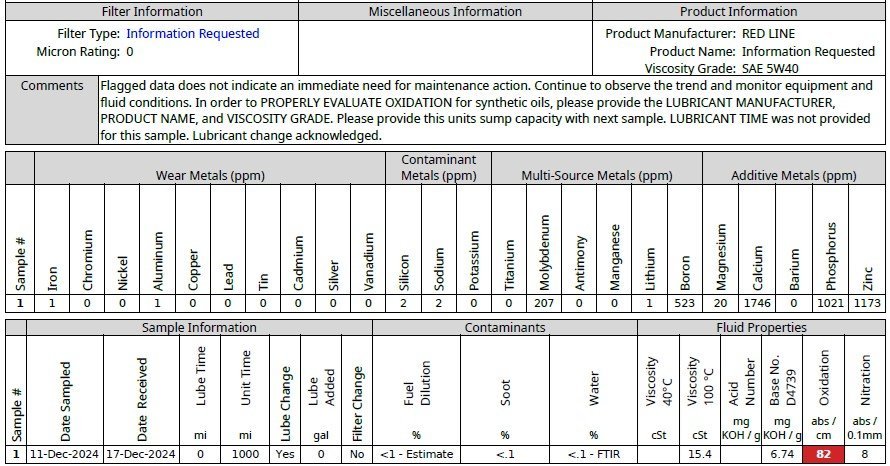
.thumb.JPG.2c573de60d3a3a4407c7d92298db46dd.JPG) VOA Red Line Euro 5W40 from new plant. Tis the stuff Raven is on. I bought two cases from the same lot. About 8 oil changes. This is the touchstone. Major data is very close to the PDS from Phillips. Yea, still a good dose of POE in it. Initial OCI's are targeted for 3,750 miles or Mitsubishi's severe schedule.
VOA Red Line Euro 5W40 from new plant. Tis the stuff Raven is on. I bought two cases from the same lot. About 8 oil changes. This is the touchstone. Major data is very close to the PDS from Phillips. Yea, still a good dose of POE in it. Initial OCI's are targeted for 3,750 miles or Mitsubishi's severe schedule.
-
Hersey Number! Now we are getting somewhere. Didn't take seven paragraphs either. To the portion in bold. Hersey is based on that parameter. YES! However in practice, it is the word in bold red, viscosity, period. Loose the words "the base oil". Tis the point of VM's and in that point; the basis of my arguments. Those, VM's, used in practice, not the lab or what is possible, are by and large unreliable and need hedging when wear is the primary concern. @jwhjr is waiting for a reply (below) To this me thinks: I didn't reply mulling over the 'meaning' of "breakthrough'. The opening quote to this post informs me that you are aware that "breakthrough" (allowing metal on metal contact) isn't solely dependent on viscosity and as I know you know this, it infers you mean something other and as such there is nothing to correct. My assumption may be incorrect as you reference SAE20, a straight weight. You may have meant this generically meaning any *W20 . Point is, I'm unclear of your point. *************************************** I'm going to ignore for the moment the arguments for one SAE Grade over another and focus on stability and what is meant by "Stay in Grade". I'm going to use this multigrade Box Store oil blended by Warren Oil as the example; Start with the specifications for an SAE *W30 oil. 100C viscosity boundaries are 9.3 cSt to <12.5 cSt and a minimum HTHS viscosity of 2.9 cP. Note the three tests I've highlighted in YELLOW for the 100 C viscosity. That top yellow line is the line the oil must meet in the bottle as unused oil. That is the qualifier. But this is not what your motor sees over the course of the oils useful life. The VM's shear, 10.91-9.4 and that value is reflected in the lowest yellow line. In this case the PSSI value is 9.4 cSt and just above the SAE virgin minimum. Thus this oil is considered to be a "Stay In Grade" oil. This oil lost 1.51 cSt of viscosity, 13.84%. But it stayed in grade. Is that the entire story? Not even close... Look at the second yellow line. The 100 C High Shear test has a value of 6.9 cP. Different units. Tricky, right. The Engineering Tool Box list the specific gravity of 5W30 at 100C nominally as .860 which gives us an approximation of the cSt value at 8.02 cSt. That is inside the upper limit of a *W16. A similar loss on a percentage basis is taken in the HTHS value which is not published but we did get a look at it's effects in the HPL video Lake Speed Jr did when they tested HPL No-VII oils. For OCP polymers this loss is ridiculous and those oils are not advertised as "Stay In Grade". Yet still sold as *W30's. This is the 'feature' of VM's used to get that 0.5 to 1.5% fuel efficiency improvement AT THE SACRIFICE OF WEAR. A straight weight mineral SAE30, Valvoline Daily Protection specifically, has a 100 C viscosity of 10.3 cSt and even after shearing the DI package via KRL testing is still above 10 cSt and as a Newtonian fluid which is not shear sensitive is STILL 10.3 cSt under ANY shear. So how do you HEDGE that loss? C'mon man, you know the answer to that. When I've wanted a shear stable 5W30 I use Red Line which has a tested ASTM D6278 TEST LOSS OF ZERO. A 30 weight that stays a 30 weight regardless of the shear rate to the end of a reasonable service life and well above the HTHS limits set for the grade. Meeting those of a 5W40. If I want a W16 in my motor I'll use Costco's 5W30. If I want a W30, it's Red Line. AMSOIL will pass stay in grade shear stability test but as a GF6 Engergy Conserving oil the 100 C HTHS test is going to be out IMHO and until I see labs saying otherwise I'd hedge up 5W40 if a 30 is what I was after. But hey, believe as you wish and do as you like. Ya just ain't putting stuff that won't satisfy Hersey in my motor.
-
That is a lot of fancy words to describe the importance of viscosity. Surrounded by a lot of irrelevance.
-
https://www.amazon.com/Fluid-Analysis-Mobile-Equipment-Maintenance/dp/083113691X In case you are wondering who Blain Ballentine is, the writer for the below link, the above link. https://www.machinerylubrication.com/Read/518/motor-oils Excerpt only. Read the whole thing. It's a short read. Viscosity and Wear Thinner oils have less drag, and therefore less friction and wear. Right? Perhaps in the test engine or engines that experience normal operation. But somewhat thicker oils may offer more protection for more severe operations such as driving through mountains, pulling a boat, dusty conditions, short trips, high rpm, overloading, overheating and overcooling. Figure 2. Ring Wear Any abrasive particles equal to or larger than the oil film thickness will cause wear. Filters are necessary to keep contaminants small. The other side of the equation is oil film thickness. Thicker oil films can accommodate larger contaminants. Temperature has a big effect on viscosity and film thickness. As a point of reference, one SAE grade increase in viscosity is necessary to overcome the influence of a 20°F increase in engine temperature. At a given reference point, there is approximately a 20°F. difference between viscosity grades SAE 30, 40 and 50. SAE 20 is somewhat closer to 30 than the other jumps, because SAE 30 must be 30°F higher than SAE 20 to be roughly the equivalent viscosity. In other words, an SAE 20 at 190°F is about the same kinematic viscosity as an SAE 30 at 220°F, which is about the same viscosity as an SAE 40 at 240°F. This approximation works well in the 190°F to 260°F temperature range. One might be surprised at the slight amount of difference between straight viscosity vs. multiviscosity oils with the same back number (for example, SAE 30, SAE 5W-30, and SAE 10W-30). If an SAE 50 oil at 260°F is as thin as an SAE 20 oil at 190°F, imagine how thin the oil film becomes when you are using an SAE 5W-20 and your engine overheats. When an engine overheats, the oil film becomes dangerously thin and can rupture. Ford is bumping up against its CAFE requirements and recommends SAE 5W-20 oil for most of its engines in the United States. It claims SAE 5W-20 is optimal for fuel efficiency and wear. To determine if SAE 5W-20 oils provide the same level of protection as SAE 5W-30 oils, Dagenham Motors in England, one of the largest Ford dealers in Europe, was consulted. SAE 5W-30 is required for warranty purposes in England, and SAE 5W-20 is not even available. If SAE 5W-20 were better for both fuel economy and wear, why would Ford not recommend it for its same engines in Europe? The best protection against wear is probably a product that is a little thicker (such as SAE 10W-30 or 15W-40) and has more antiwear additives than the oils that support the warranty. The best oil for your vehicle depends on your driving habits, the age of your engine and the climate you drive in, but it is not necessarily the type of oil specified in the owner’s manual or stamped on the dipstick.
-
From link above: Permanent shear happens when the VIIs are subjected to high stress, and the long molecular structure is broken into shorter polymers. The shorter polymers no longer provide the desired viscosity at the operating temperature. The oil no longer “stays-in-grade,” or instead of being an SAE 10W-30, it now has the viscosities of SAE 10W-20 or lower. A common area of high shear would be in the lubricant film between the engine cam lobes and tappets, or between the meshing of heavily loaded gear teeth in the transmission or final drives of mobile equipment. This is one of the reasons the viscosity of used automotive applications oils, or oils with high VIs, should be monitored at 100 C to see if the VIIs have experienced permanent shear and need to be changed out. PSSI is a measure of how much a VII permanently shears under specific conditions. A VII with a PSSI of 10 loses 10% of its viscosity contribution to the finished oil’s viscosity, and a VII with a PSSI of 50 loses 50%. Therefore, the lower the PSSI, the more stable the VII is. There exist several different ASTM methods for measuring PSSI. So, when comparing PSSIs of finished lubricants, it is critical to know the test method used. Some procedures pass the oil through a fuel injector, and different ASTM test methods require different pressures and number of passes through the injector. Another two ASTM test methods utilize a sonic oscillator to cavitate the oil creating the shearing mechanism. Although the shearing mechanism of the sonic and the injector methods are different, the results do correlate fairly well with each other. A more severe shear test is the KRL test, which utilizes tapered roller bearings under load for a specified duration and rpm. The KRL test is typically used for gear applications, whereas the injector and sonic tests are commonly used for engine and hydraulic lubricants. A common area of high shear would be in the lubricant film between the engine cam lobes and tappets, or between the meshing of heavily loaded gear teeth in the transmission or final drives of mobile equipment. Shear stabilities of VIIs are inversely proportional to their molecular size. Generally, larger, or longer, polymers are more susceptible to shearing compared to shorter polymers. Consider how much easier it is to break a new standard-length pencil compared to the short golf course type pencil. The longer polymers are more efficient in providing the required VI, in that it takes a lower dosage of the long polymer VII than the shorter more durable polymers, and, thus, the cost of the finished lubricant can be lower. This is partially why the early versions of multigrade oils were known for not staying “in grade.” The early multigrade finished lubricants utilized the new-at-the-time polymers to enhance the VI of engine oils, but it quickly became evident more durable VIIs were needed. Shorter polymers improve the durability issue but require a higher dosage, and, thus, higher cost, to acquire the same level viscosity modification, but they do stay “in grade.” The appropriate compromise of efficiency versus durability, and cost, must be considered for the finished lubricant life in a given application. Extended life lubricants require more durable polymers to be able to provide protection over the life of the lubricant. Automotive driveline and other gear sets also should lean more toward the more durable VIIs having a lower PSSI. PSSI is not a typical performance data result provided on product technical data sheets. However, if the kinematic viscosity at 100 C in used oil analysis results drops more than 10% before the oil change out, a shorter drain interval may be required. Or a switch to a “long-drain” interval oil that likely is formulated with more shear stable VIIs that also is likely more expensive could be cost effective.
-
https://www.stle.org/files/TLTArchives/2023/04_April/Lubrication_Fundamentals.aspx
-
I remember my Drivers Education instructor, Mr. Williams words, "Bear right and brake, there is no exception in defensive driving". We did endless panic stops to gravel shoulders. Based on physics. Lower speeds lower energy on impact. Everyone goes right is a move to a safe area. If you can't avoid head on, then limit overlap. We were taught that while driving a scan to see an escape route is a life saver. I find that today speed is not the enemy. It's the attitude of drivers that believe THEY are the most important person in the world. Ignore stop signs. Lane markings. Speed Limits, No passing zones. Unyielding. Self important, rude and dangerous. They should bring back the blood and guts horror movies they showed in Drivers Education. Iowa has a good one on being RIGHT.....Dead Right. IMHO people who think a 700 hp Hellcat is the only thing that should be allowed on the road and cannot share that road with a 36 HP Beatle....that is the definition of self important.
-
Not what I got out of it. But...if that is what you see, it's what you see.
-
Ford Model A https://modelafordclub.co.nz/wp-content/uploads/2016/05/Ford-Model-A-Which-Oil-to-Use-Petroleum-vs-Synthetic-March-2012.pdf
-
My two best Shell stations are having cold weather pumping issues on their Premium fuels. One of these stations the state inspector shut down. Next cheapest Shell stations have been about 40 cents a gallon more expensive. Yea, for the same fuel. Fact is there is about a 70 cent a gallon differential for this fuel for stations within 25 miles of home. If I gave up the friction modifiers I can still get 93 at $3.75 a gallon.
-
I'm the short good looking one.
-
I check mine at fuel stops. Unless you've been looking from day one you don't know what is normal or when it starts.
-
@richard wysong suggesting the PCV system is solid. However they do not malfunction for no reason. Blowby (loss of ring seal) overloads them early and when they plug, it is as Richard states. It is a bit of the chicken and the egg however. Several possible scenarios. 1.) Oil control ring and or land return passages plugged/plugging. This won't show on a compression check. 2.) HPFP or injectors leaking into the sump will tank the viscosity and break the seal. It will show up on a UOA as a good dose of GC fuels. Over 2.5% 3.) Combination of the above two wear out the bore. This will also show up as large fuel dilution and knowing which witch is which can be difficult. It will show on a compression check. 4.) DLH coating on the rings failing. Pretty much a teardown to diagnose and repair. Auto RX used as directed will free those rings. That said if the bore is damaged that may not stop the consumption. I tired dong it in steps on a 2.4 to isolate and it took so long that the bores failed even though I fixed the issues of bad pump/injectors and freed the rings and installed a new PCV system. Doing them in concert won't answer any questions but it does give you a better change of success. Replace the PCV system components. Do a UAO, @Black02Silveradocan help with that. And while you wait on the results of the labs Auto Rx it per instructions. No shortcuts. After the rinse oil change use something line HPL Premium or AMSOIL SS and go 5W30. If this works you oil or your oil maintenance program failed you. Fresh air filter helps the PCV system. Fresh plugs is a good idea and have the coil function checked. That is all I have for you sir. Best wishes..... I'm not telling you this will work. I'm telling you if you don't worse is what it gets. I've nursed that 2.4 since 80K and she is limping along at 266K and been a full time job keeping her running.
-
At at what mileage did it start using oil?
-
How many miles are on this truck?
-
Just tossed the one from my childhood away. Lead solder seams. Man, I ate allot of ice cream from that thing.
-
Post Pics of your "Other" Rides
Grumpy Bear replied to RyanbabZ71's topic in Hobbies, Tech & Outdoors
Well...let's see. I made a prepurchase punch list and so far have this much done: 1.) Weather Tech floor matts. Front only. They don't give those away. 2.) Full PPF nose, A pillars and a foot of roof plus door sills, edges and handle pockets and mirror backs, truck ledge. 3.) Level 2 paint correction and G3Ceramic coating including the PPF 4.) Added camber eccentrics and gave it a good alignment. 5.) Sylvania H-11 Silverstar Hi/Lo bulbs 6.) Moved on from Mitsubishi to Red Line Lubricants and Purolator filters 7.) Changed factory preset OLM length from 12,000 miles or 13 months to 3,750 miles or 6 months 8.) Came with LED floods. Yet to do on my original list A.) Fluid Film (hottest item on my left to do list) B.) Ceramic IR/UVA/UVB blocking Window Tint C.) Seat protection covers. Something more Rex friendly. My boy sheds. D.) Block and pan heaters / CVT cooler E.) Canton Pre-lube system The entire original list went/is toward protection/safety. bric-à-brac: 1.) iOttie phone cradle and shielded USB cable 2.) Black bath towel folded up over the E-brake area so Rex has a pillow while he furs up my front seat. -
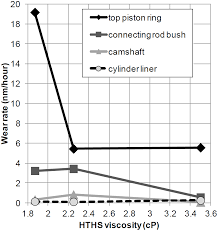
It ain't one thing..... Back up from the forest. Look at ALL the trees. How long that driveline last is the sum of its MEDIAN experience. ALL OF IT. What base oil? What viscosity profile? What add package? How long in service? Under what service? How well maintained? In what environment? Using what fuel? Every time I put the key in the ignition I ask myself how what I'm about to do contributes to the MEDIAN experience of the machine. How does in modify, enable, enforce, detract from its ROUTINE? Actually look at this graph. Note TOP RING is NOT affected by HTHS viscosity once above 2.25 cP? Because? Fuel dilution above the second ring face is horrid. Thus viscosity is, no matter what it is between the second and third ring is, is hardly ever above 2.2 cP. Change it often enough to prevent dilution and three body abrasive wear. Filter it, move it to the right. Keep it tune and lean enough to lower fuel dilution. Move effective HTHS to the right. Use a FUEL that provides friction modification at a 30% rate and you've effectively moved the HTHS a full point to the right. Lower the load, Brake Mean Effective Pressure, more it right. Lower median piston speeds. Every mile you can. Lower the cylinder wall temperature, more to the right. Increase the detergency of the fuel to prevent build up on the top ring land, HUGE to the right. Carbon is very abrasive. You can do one thing right and still get really bad results if everything else on the motors punch list is wrong. You may not believe me. You may not believe in gravity either but ignore it and when you hit the deck your will find out that the ground doesn't have an opinion. Just provides a consequence.
-
I lived there a decade working for Chevron. It never budged me from my lane. Everyone can drive theirs. I drive mine. Get mad, get loud...I should care why? Them guys paying my bills?
-
For whatever reason services here are salting like it Donner Pass and we haven't had enough snow this season to cover the grass. We had a week of temps in the teens and strong winds. Then a three day warm up before plunging us into what is predicted to be our first single digit temperatures of the season (Day time high).
-
I do However I do not consider this car a 'downgrade'. Not even a compromise. I bought it for a specific purpose which it executes better than anything I have access too. I find it a pure joy to drive. Some guys retire and fish, some golf, some bowl. I drive for the joy of the drive. Speed is never a consideration nor is acceleration. At my chosen pace, comfort never enters into it. It doesn't make me do anything. Doesn't prevent me from doing anything I choose. It allows me to do everything I chose to do. Pretty sure it will outlive me. And stupid cheap too! How cool is that?
-
https://fuelsmarketnews.com/the-past-and-future-of-gasoline-additives/ [quote from this link below] Friction modifiers allow for a thin layer of lubrication to coat the walls of the cylinder, reducing friction and wear, as well as decreasing the amount of gasoline burned per cycle. According to Chevron, friction modifiers have a water-soluble end that attaches to the metal surface of the cylinder wall and an oil-soluble end that faces outward to reduce friction. ExxonMobil introduced its Synergy Supreme+ premium gasoline, which includes a new friction modifier that reduces wear and tear on engines by up to 30%, according to the company. Similarly, Shell’s V-Power NiTRO+ premium gasoline yielded significantly smaller wear scars in a wear test (ASTM D6079) against lowest additive concentration (LAC) gasoline, according to the company.





-
Forum Statistics
250.6k
Total Topics2.7m
Total Posts -
Member Statistics
342,992
Total Members8,960
Most Online
-
Who's Online 6 Members, 0 Anonymous, 438 Guests (See full list)