Jump to content

Need tire Advice


Recommended Posts

Posted

I am looking to replace my stock tires on a GMC Sierra Z71 4.8L 4x4 after 58K miles.


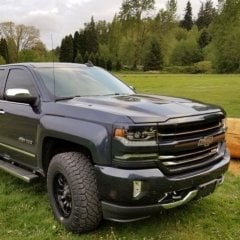
Can I replace the 245/75R16s with 285/75R16s without needing a lift or causing rubbing?


Can I use the same rims?


I can get a good deal on BFGoodrich T/A KOs, but do not know much about them. Does anyone have any experience with these tires? I am looking for highway & off-road tires (60-40 split).


Your input will be greatly appreciated....

Posted

Well asking for tire advice on here, you're going to get a list of about anything and everything. Some will swear by BFG's, others Michelin. I replaced my 265/75/r16 Wilderness AT's with a set of the same sized Bridgestone Dueler AT Revo's. They offer a smooth and quiet ride, exceptional wet and snow traction, and they weren't too pricey either. So far so good, and I've got about 12k on them. I do mostly highway/suburban driving, but we also had probably one of the snowiest winters lately up here in Cleveland, so I got a good chance to check them out in a variety of conditions.

Posted

The BFG All-terrains are an excellent all around tire. Great in the snow, very good in the rain, fair in the mud (if its too thick, you need super swampers, lol). I had a set on my 88 F-150. Now I rotated them every 5k miles and got almost 80k miles out of them.

Posted

The BFG All-terrains are an excellent all around tire. Great in the snow, very good in the rain, fair in the mud (if its too thick, you need super swampers, lol). I had a set on my 88 F-150. Now I rotated them every 5k miles and got almost 80k miles out of them.

Posted

It's my understanding that 285's WILL rub your bumper or fenders at stock height. This can be rectified by adjusting your torsion bars, which will make your truck ride higher. Keep in mind that there will be a loss of acceleration/power and gas mileage with larger tires if your gear ratio is lower(or higher, depending on how you look at it) than around 3.73.

Posted

I ran 285's on my Sierra with stock wheels for awile. They fit on the rim but did rub the fender wall, but barely on sharp turns. I was told differently about the gas mileage though. BIgger tires=more wheel travel=better gas mileage. I got around 20 Highway. My speedo is off a little :) . I need some advice on how to correct it.

Posted

I ran BF Goodrich 285's on stock wheels on my 2000 for 3 years - no rubbing - no problems. So far - sticking with the factory 265's on the 2003. The onlyl problem I had with the BF Goodrich tire was keeping them balanced - I don't know if it was the tire or place doing the work (Discount Tire). They got a new machine a few months before I traded it and it balances the wheel and tire - almost separately. Things seemed to really be much better after that.


With the new machine they actually put the mounted tire on the machine - spin it - and get measurements - they then break the tire down and rotate the tire on the wheel for optimum balance. They air it up and put it back on the machine again - spin it and then add weights as necessary.

Posted

I feel the 265s will look and work better with stock wheels and no lift kit. You are going to take a big perfomance hit with the 4.8 and 285s, the wheels are a bit too narrow and they are going to rub slightly.

Posted

Taller tires "should" yield you more gas mileage, but some folks look at things a different way. Taller and bigger tires have more rolling resistance and weight ,wich gives you crappier mileage. Some also say that the effective gear ratio change , due to the taller tires will consume more gas. I guess it takes more gas to get the big skins rolling compared to a lower gear ratio.


When it comes to tires and gearing there are always pros and cons to each different scenario. I would suggest Michelins LTX's .

Posted

I have 265's on my 02 1500 w/ 4.8. The bigger tire and the small V8 = lower gas mileage, trust me. It's not that bad though, I went from about 17 to around 15 mpg. The bigger tires are a little harder to get rolling so if you do city driving I'm sure your mileage will be less. But if you are on the highway alot you probably won't notice a change. BTW I have BFG's and love them. I plow snow and these tires love to bite into it! :)

Posted

Getting bigger tires will lower the effective gear ratio in the back. Lower ratios are better if they fit with the engine rpms on the highway and usually yield more mpg. But bigger tires have a larger rolling mass which consumes power and wastes gas. If you put your foot into the vehicle and/or do a lot of city driving, you will lose more mpg with the larger tires. Also if you don't reprogram your speedo, larger tires will make your speedo say it's going slower than you really are. If you don't take this into account, you will actually be going faster than you mean too and the faster you go, the more gas you use.

Archived

This topic is now archived and is closed to further replies.

  • Recently Browsing   0 members

    • No registered users viewing this page.
  • Forum Statistics

    250.4k
    Total Topics
    2.7m
    Total Posts
  • Member Statistics

    342,840
    Total Members
    8,960
    Most Online
    appletrav
    Newest Member
    appletrav
    Joined
  • Who's Online   0 Members, 0 Anonymous, 411 Guests (See full list)

    • There are no registered users currently online
  • Latest Articles

  • Posts

    • This is a 1/2 ton thing ONLY.  All HDs 2020-2026 have the two speed transfer case, with Autotrac as an option.     1/2 tons 2019-2026, regular 4x4s come with a single speed case (no 4LO!), and trucks with Z71 ordered, or all Trail Boss trucks come with the 2 speed case.  2 speed case is also an option on WT, and is also standard on High Country.  
    • 2013 5.3 still to this day calls for the PF48 filter.  Which as a 15psi bypass pressure.     There is a TSB, 17-NA-157 that talks about the PF-63 and PF-64 filters which have a higher bypass rating of 22psi.    TSB HERE - temp.xml   "Beginning in 2012, the oil pumps began to regulate main gallery feedback instead of pump out pressure. This means that the oil pump now does not begin to regulate until pressure is built up to the main gallery. This change reduces the amount of time it takes to provide oil to the engine bearing and lifters during extreme cold start conditions.  Main gallery feedback oil pump control systems are present on the following engine families which use Spin-on oil filters: Small Gas Engine (SGE), Large Gas Engine (LGE), High Feature (HFV6) Gen2 and Small Block Gen5 gasoline engines. These engines with the main gallery feedback oil pump control systems are factory built with an ACDelco® oil filters"   It also calls out what engines use those filters.  The gen 4 small blocks were not on that list (LMG, LC9, L9H, L92, L94, L20, L96).  Gen 5 small blocks use the higher pressure filter.          That all said...   Your 7045 Napa filter is the PF63 equivalent, with 22psi bypass.  You are already using the higher bypass pressure filter.  You CAN keep using it, you don't technically have to use it though.  
    • Do you know WHY the filter relief setting was increased to 22 psig?    When the new system goes into the second stage the pump volume ramps up considerably. It was found that the 15 psi filter bypass setting put the filter in bypass on a warm engine when the second stage was activated. Raising the filter bypass setting forced the filter to do what it designed to do. Filter. Preventing debris from circulating during high load, high rpm operation.    So next question is how did GM find this out? VLOM/lifter failures and a deep dive by Melling Corp.    Last question. Is it required? Look at it like this; a motor may be equipped with a rev limiter. But it only works if the set point in reached. That 22 psig setting only matters if the pressure differential across the filter media exceeds 15 psig during normal warm operation. Second stage kicks in around 3000-3500 rpm.    I can't answer your question because I don't know you and how you use the truck. But I think there is enough information here to let you decide for yourself. 😉
    • Probably not their first rodeo, so it should go as planned most likely.  Typically the service manager or tech doing the swap will put some seat time to shake it down after they get it all put back together.  We usually put 50-100mi before we hand them back so if something happens, its not after you get it.  A coolant leaks, oil leaks, a ground left off or loose, vibration, etc.     The new engines so far have been good?  There's been a couple that have popped out there again (the replacement engine) but most have been okay.  
  • GM-Trucks.com Clubs

  • Popular Contributors

×
×
  • Create New...