Jump to content

New Owner - Questions - MPG and Performance


Recommended Posts

Posted

Hey guys,


I'm new here, and I'm also a new owner in the late-model GM truck realm.


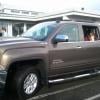
I just bought a '00 Yukon XL SLE, 58k miles. I'm not kidding when I tell you that there is not a spot on the interior or exterior! Beautiful shape. It was a company lease vehicle in Texas.


I have some questions. I could dig through 238 pages here to find them, but I thought you all could point me in the right direction at least. Please?


1. How do I find out what rear gear I have? Is it printed somewhere or do I have to jack it up and count? Will it have a tag on the diff if it's a posi?


2. What all can I do to increse gas mileage? I've heard about K&N filters, 180* t-stats, etc. Do they work? Anything else? I plan to use Mobil 1 oil from now on. Should I change the rearend lube also to Mobil 1?


3. How do I know if this one has the "trailer towing package"? I have a pick-up I use to pull my racecar trailer, but this would be a nice back-up. There's no hitch on it. There is what loks like a small round plug up behind the rear bumper, but it's not a standard 7-pin trailer plug. Will there be a place to plug in a brake controller under the dash?


4. Should I keep the Dex-Cool or change it for green stuff? If I do keep it, how often should I change it?


5. Are there any known problems with the '00 models with the 5.3L that I should look for?


6. The only thing I noticed strange on the motor is a film of oil on the valve covers around the coil packs. Is something leaking?


7. I would like to get a programmer. Any suggestions? Hypertech, Diablo, others?


Sorry for the long post. I really do appreciate any help you all can lend. I hope someday to return the favor.


Have fun.

Posted

Welcome to the forum and the the realm of GM trucks BOP! :thumbs: Let's see if I can answer some of these questions for you.


Just so you know: NBS= New Body Style

OBS=Old Body Style


1. If you look in the glove box you will find a tag with a bunch of numbers and letters on it, those are you're RPO codes, and they're listed on this site. You should be able to find the info on your rear there. I know that G80 is the the code for locking rear diff.


2. I'm not so into gas mileage, more of a performance guy. I love my K&N for this. I'd recommend an air intake, cat-back exhaust, and a good tune (Computer tune that is). PCMforLess is my tuner of choice, Bryan has worked wonders for my truck. The tune can give you both increased performance and mileage There is a link to the PCMforLess website to the left.


3. I think the RPO codes will also answer your trailer towing package question.


4. You're probably gonna get mixed opinions on this, but I wouldn't change the Dex-Cool. First off, it doesn't mix with the green stuff, it actually becomes acidic and turns into something that resembles cottage cheese, but an uglier color. Any horror stories that you may have heard about Dex-Cool seem to have been resolved, I personally haven't heard of any problems with Dex-Cool in the NBS trucks.


5.Known problems: CSK=Cold Start Knock, or Piston Slap, not really a problem, but a "characteristic". The GENIII engines tend to make some noises that may sound bad, but really won't hurt anything. You may notice a knock or tick when cold, and possibly some ticking when warm. The noise you hear for the first few minutes until it warms up is probably piston slap. Due to clearances and the short skirt piston design, the piston actually rocks in the cylinder until the engine warms up and the metals expand. There are some other ticking noises that can be valvetrain, injectors, etc. My 5.3 has been ticking and tapping since day 1 and hasn't lost any performance.


The PCV system on these engines tend to suck oil into the induction system. There is a redesigned, fixed orifice style PCV valve that is supposed to help with this, part# 1257217. Less than $5 from the dealer. If you get really into it you can install an oil catch can, but we'll get to that later. (fingers are starting to get tired)


6. I haven't experienced any oil leaks, might have some oil slipping past the valve cover gasket bolt grommets, you can always unbolt the coil packs and take a look. (5 10mm bolts secure coil packs, 4 8mm bolts secure valve cover)


7. As far as the programmer goes, I feel that you'll get more for your money with a custom tune from PCMforLess. If you really want a handheld, I personally like the Crane/VHP tuner.


Hope I was able to help somewhat, I'll let someone else add their thoughts from here! :thumbs:


-Billy

Posted

Prestone now has a anti-freeze that is compatable with both green and orange stuff, and guess what color it is? Yellow! The orange stuff is formulated for the alumnium parts in the newer trucks, the green stuff will corode the new metals in the cooling systems. I would stick with either the orange stuff or the yellow stuff. As for changing them, every 50k on my truck. If you cannot find the rear codes in the glove box, look on the drivers door, I think there is a sticker there as well, but not sure. Westers Garage has a mixed reputation, those that use it and like it, love it, those that do not like it, hate it. No inbetween. As for the rest, I agree with Bud!


Mike

Posted

Thanks for the info you all. That's enough to get me started. Although, if anybody else wants to add more, I'll be happy to listen. I'll also be reviewing old posts looking for more info, and throwing in questions here and there.


Like I said, thanks! and I hope to be able to help somebody else someday.

Posted

I know GT4 is 3.73 gears and GT5 is 4.10 gears. You mostly likely have one of those two gear sets.


A 180 thermo would probably decrease gas milage since your engine wouldn't be running at optimum temp.

Posted

Well, I wrote down the RPO's from the glove box and decoded most of them. I have the LM7 engine, 4L60E tranny, and 3.73 gears, I couldn't find my GVW code in the 2000 list, but I did find it in the 2001 list. I have C5W, which is 7000#. I don't have a code for a transmission cooler, but I do have a code for "UY7 - Trailer Wiring Harness".


Based on this info, would I be alright to tow a 5500# trailer? I might venture up through Tennessee into Ohio and Kentucky, so there may be some "hills" to climb. I have 2-wheel brakes on my trailer, so I would need to install a brake controller in the Yukon. Is the wiring already under the dash for a brake controller on these trucks?


Also, when I change the oil, do I need to reset a "change oil" light or anything?


Thanks again.

Archived

This topic is now archived and is closed to further replies.

  • Latest Articles

  • Posts

    • I have ordered the car link adapter and registered for the google dev, will need to finish verification process later this evening when I get ahold of our kiddos android tablet. I will be using windows vs mac so hopefully it goes smoothly. I have zero tech background but I feel I can manage this with your write up.    Do you think it will be different for me? My truck is a 2023 GMC 1500, I have looked heavily into the AI boxes but I consistently find common complaints with lag.    Does carplay auto open now that you have it set up when you get in truck and turn it on? Or do you have to do open the app everytime? 
    • I figured you would know about it.
    • It added a cost layer to an already limited production supply. True that. 
    • Swap costs and supply/demand balance. When a barrel comes out of the ground the entire range of products are present but not all at the same percentage.    Breakdown of Refined Products The following table summarizes the approximate output from a standard 42-gallon barrel of crude oil: Product Type Gallons per Barrel Percentage of Total Gasoline 20 gallons 45% Diesel Fuel 9 gallons 21% Other Products 13 gallons 31%   Most of that diesel figure is 'straight run' or cut from the barrel. Gasoline 'cut from the barrel runs 0 to 20% at the crude. So in the crude unit there is more diesel the gasoline, usually.  The full refining experience however gives the tabled values. Ego there is half the diesel than gasoline after the 'first crack' That could be an FCC unit, or Isomax or....   Those units take heavy products and break the big ones into little ones. Those numbers are harder to get hold of but directionally it ends up the same.    Really light products are very profitable. Ethylene and Propylene to name two. Those are cracked from slightly heavier feeds like NG and Propane and Ethane. The cracker harshness determines the feed for distillation. Those feeds come from less profitable products like diesel and gasoline.    So...there is a swap cost. How much market is there TODAY and what crude am I running TODAY..... what is my process capable of always.    There is this as well. The USA uses allot more gasoline than it does diesel so in the cracker the process is tilted to gasoline production which....limits supply of diesel. OTR uses the most and it has different requirements than automotive and agricultural.  Limiting auto products.    You are correct however. It is less refined, just less of it. Allot less. 
    • Most thermostatically controlled ATF systems use a 'wax' pill just like the one in your water thermostat. They work on the expansion volume of the wax and the pill is constructed in such a way as to limit the travel to remain within that range. This means it has an opening temperature often called the 'cracking temperature' and a fully open temperature. For whatever reason oil is designated by it's fully open temperature and water by it's cracking temperature.    Between the two it the "Regulating Temperature" The entire range is about 20 F from closed to open. In your example the lower limit, opening point of 145 F then has a fully open temp of 165 F and a throttling temperature of 155 F.    Thing is, the throttling temperature needs two things to work properly. Enough system load high enough to reach the minimum and a heat sink (cooler/exchanger) large enough to prevent any load applied from exceeding the fully open temperature.    If your system exceeds the fully open temperature it is screaming MORE COOLER.    Here is the silly part of the whole thermostat system where the oil is cooled/heated by the radiator. Nothing is flowing to that system until the oil temperature reaches the cracking temperature unless it is equipped with a minimum flow bypass orifice or a bypass built into the seating surface of the plunger. That system meant to get it up to temp quicker isn't doing a thing until WORK drives if from ambient to cracking temp. One a cold winter day, like zero F, it may never get hotter than about 110 F. Sometimes not even that.    People forget or are young enough to not know that until this millennia transmissions were cooled by the radiator cold tank alone and without a thermostat at all.  In the 50's they weren't even cooled. OEMs learn everything the hard way.    When an OEM tells you the trans "Works best" between 175 F and 220 F it means works best for THEM. The transmission thermostat is fuel play. If you watch you trans temps like I do you will learn that it may take a hundred miles if you are not towing and not driving more than say 55-60 mph on a zero F day to even reach 120 F and it might sit there all day if it's colder. Yet if functions perfectly over about 100 F. It may need to get a bit warmer for the fuel and spark maps to go without an multiplier.    Worry more about too hot. Use a cooler large enough to put that thermostat in range.         
  • GM-Trucks.com Clubs

  • Popular Contributors

×
×
  • Create New...