


redwngr
-
Posts
8,646 -
Joined
-
Last visited
-
Days Won
14
Content Type
Profiles
Forums
Gallery
Events
Articles
RPO
Store
Blogs
Everything posted by redwngr
-
new radio update recall N242435631
redwngr replied to kickass audio's topic in 2019-2026 Silverado 1500 & Sierra 1500
I don't think my app 'notified' me. It did show up in the 'Help centre' location when I looked there before the work was completed. -
new radio update recall N242435631
redwngr replied to kickass audio's topic in 2019-2026 Silverado 1500 & Sierra 1500
More than once I've got the notice after the work had been done. No harm / no foul. GM doesn't seem to send all the notices out at once, (based on reports hear and other forums about notices received) Presumably they don't flood the dealers. I've had dealer advise me of updates when I've arrived for something eles (some are silent -- do them if the vehicle is in) They can easily check vin for outstanding recalls/updates. I've had dealers call me to schedule when a recall before I've received a notice. I've also had them check when I was making and appointment, find a recall/update and as if I wanted it done as well. You can also check the phone app for updates and recalls. It will list the ones that are outstanding and the ones that have been completed. 'Help centre' > scroll to bottom > 'Recall and warranty' > scroll down to 'Safety, Non-compliance & Emissions Recall' > should have choice to pick Incomplete or Complete Mine are all done. Complete section shows a couple recalls and a 'Customer Satisfaction Program' - Serial Data Gateway Module(N242435631) -
Be sure you are checking if cold, before first start of the day to get the most accurate level reading. If it is going down at that rate you'll probably add a quart every 4000 miles and be none the worse for it. Used to be a quart in 4000 miles meant a quart between between oil changes and life was good. (Maybe you'd prefer to add 1/2 quart every 2000 miles) Some engines that 'don't use any' - it's because they aren't run long enough to get the condensation out and it is accumulating. Or they are collecting a little fuel in the oil. Or the mystery coolant loss is ending up in the oil.
-
And it might be that the phone needs a reboot and/or a software update.
-
Maybe educate the dealers about the difference between a 'unit down' parts order and a 'stocking order'...
-
Oil quantity issues
redwngr replied to BrizzoDaIzzo's topic in 2019-2026 Silverado 1500 & Sierra 1500
If it's only when the engine is cold it could also be an exhaust manifold gasket issue -
NHTSA Recall Notice 24V-797
redwngr replied to Transient's topic in Engines & Drivetrain (V8, Duramax, TurboMax)
One of the articles indicated that the newer trucks that are not included in the recall already have the problem detection routines in the software. Recall adds the newer software to the earlier units. The detection routines are supposed to be able to identify the valves that need changing -- before the lockup condition occurs. -
2024 2500 HDs With True North Pkg Question
redwngr replied to revrnd's topic in 2020-2026 Silverado HD & Sierra HD
2024 2500 battery codes and alternators and rpo's starting with T
-
2024 2500 HDs With True North Pkg Question
redwngr replied to revrnd's topic in 2020-2026 Silverado HD & Sierra HD
I think it's just the way the dealer that ordered it decided to spec it out. It's not part of PDU - True North Edition. True North Edition only available on LT Package only available on LT 1 - applies to LT 2 - applies to LTZ, (so doesn't apply to True North
-
2025 2500 battery and alternator offerings. Dual alternators are standard on Denali Ultimate, available on all other trims K4Z is not available on Denali Ultimate, but is available on all other trims (that meet conditions listed)
-
For years I did the oil changes on multiple vehicles. @silveradosid is correct. I don't think I ever replaced a sealing washer / crush washer, and never had a leak. I agree, $75 seems stupid. I'd also say the best way to never need a plug/washer is to have a spare on hand. Stamped oil pans is not a new thing.
-
Very large addition being added to Flint assembly.
redwngr replied to 64BAwagon's topic in 2020-2026 Silverado HD & Sierra HD
Last time I was in Oshawa plant was during the early '90's. I was with a Tier one that produced a bunch of stampings/weldments for the Lumina and it's sisters that were made at the Buick, Pontiac and Olds plants. Some parts we were the sole supplier and the part was used were vehicle from the four plants -- so about a million per year. -
There is a winter front included for 2024 and 2025 6.6 dmax. There is also a standard block heater on that engine.
-
Did they change rpo code from WMI to VMI ?
-
Is Adaptive Ride Control ARC worth it?
redwngr replied to TJL72's topic in 2019-2026 Silverado 1500 & Sierra 1500
Do you know people that have had trouble with them? Denali 1500 has had sensors for ARC or it's predecessor Magnetic Ride Control for many years. Tons of them in my area. I'm not hearing about issues. My understanding was the primary motivation for ARC is smoothing out the ride, rather than making Denali into a sport truck. -
Is Adaptive Ride Control ARC worth it?
redwngr replied to TJL72's topic in 2019-2026 Silverado 1500 & Sierra 1500
Sorry I wasted so much time trying to help you out in the other thread -- but it's now removed it so you will no longer need to be offended. -
Is Adaptive Ride Control ARC worth it?
redwngr replied to TJL72's topic in 2019-2026 Silverado 1500 & Sierra 1500
Could've asked this in the other thread you started about trim differences... -
Lost camera guidelines front and rear
redwngr replied to 2022LiftedRST's topic in Troubleshooting, Warranty & Recalls
Or the setting got changed. The are several selections available. One of the options that can be selected is 'no guidance lines' I don't know which one is the default. -
Very large addition being added to Flint assembly.
redwngr replied to 64BAwagon's topic in 2020-2026 Silverado HD & Sierra HD
This is a recent tour of Oshawa -- but it's not GM produced. They did say no 8 ft boxes, so all HD's are standard box. Unless I missed it, they didn't say if 1500's are built with both short and standard box -
Very large addition being added to Flint assembly.
redwngr replied to 64BAwagon's topic in 2020-2026 Silverado HD & Sierra HD
This video was put out when truck production restarted at Oshawa. (and everyone was wearing masks....) All vehicles seem to be crew and standard box -- but this may have changed since then, -
Very large addition being added to Flint assembly.
redwngr replied to 64BAwagon's topic in 2020-2026 Silverado HD & Sierra HD
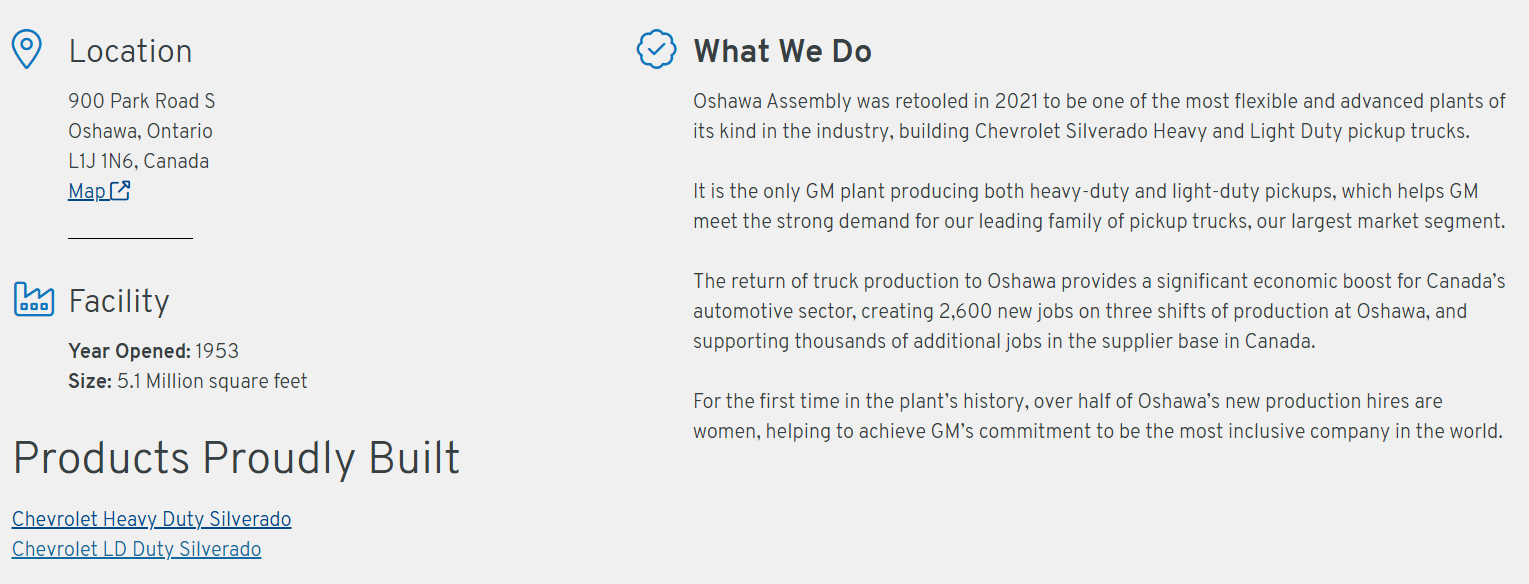
Webpage does say what cab/box versions Oshawa Assembly | General Motors Canada
-
Some more info. https://gm-techlink.com/?p=12232 Inspecting the Diesel Fuel System for Contamination October 31, 2019 Water and other contaminates in diesel fuel will create drivability concerns and a loss of engine power. If water and/or debris is present in the fuel system, the fuel cannot cool and lubricate the components properly, which may lead to overheating, rust, corrosion and, ultimately, component failure. Water and debris can enter the fuel system in several ways, either through a contaminated refueling source, plugged venting or through long-term condensation in the fuel tanks of the vehicle. If fuel system contamination is present on 2017-2020 Silverado 2500/3500, Sierra 2500/3500; 2019-2020 Silverado 4500HD/5500HD/6500HD; and 2020 Silverado 1500 and Sierra 1500 models equipped with the 6.6L V8 Duramax diesel engine (RPO L5P, L5D) or 3.0L I6 Duramax diesel engine (RPO LM2), diagnostics will often lead to removing the fuel/water filter to inspect for contamination. (Fig. In these cases, use care when removing the fuel/water filter and do not reinstall the fuel/water filter into the housing until the fuel/water separator reservoir has been cleaned. Fig. 8 If the fuel/water filter is removed from the fuel/water separator reservoir incorrectly, any debris in the fuel may fall into the reservoir and get pumped back into the fuel system, leading to the same engine performance concerns. TIP: Do not replace any fuel system components if contamination has been found. Flush the fuel system first. Once the system has been flushed, continue with the diagnostics in the appropriate Service Information. Fuel/Water Filter Operation The fuel/water filter assembly consists of a fuel filter/water separator, fuel heater, fuel temperature sensor, and a water in fuel sensor. The filter (Fig 9, #3) is designed to remove water as well as any particles/debris from the fuel system. Fig. 9 When fuel/water enters the filter, it travels through the paper filter element (Fig. 10, A), which traps particles/debris that were in the fuel that may damage the fuel injection system. Any trapped particles should remain on the outside of the filter. The fuel then travels through the water separator (Fig. 10, B), which pulls the water out. The water collects in the bottom of the fuel/water separator reservoir (Fig. 10, C). There is a drain in the reservoir. The filtered fuel is returned to the fuel system. Fig. 10 If a new filter is installed without cleaning the fuel/water separator reservoir, any debris that may be in the reservoir may limit the performance of the filter and water separator as well as lead to contaminated fuel re-entering the fuel injection system. Fuel/Water Filter Removal The fuel/water filter must be removed correctly to prevent debris from entering the fuel/water separator reservoir. When removing the filter from the housing, use care to not separate the filter from the fuel/water separator reservoir. (Fig. 11) Fig. 11 To separate the filter from the fuel/water separator reservoir, place the filter downward in a clean, dry drain pan and pull the filter down. (Fig. 12) Fig. 12 If the filter is facing upward, any debris left on the sides of the filter may escape past the O-ring seal during removal and settle in the fuel/water separator reservoir. (Fig. 13) Once reinstalled to the housing, the water/debris left in the water/fuel separator reservoir will flow past the filter and directly in to the fuel injection system when the engine is started. Fig. 13 Inspect the fuel/water separator reservoir and the filter for heavy debris. If heavy debris is found in the filter, clean the fuel/water separator reservoir and continue with the fuel system flushing procedure. If no signs of debris are found, clean the fuel/water separator reservoir, install a new filter and refer to the appropriate Service Information to continue diagnosis. TIP: Some models may have a fuel filter life monitor. Reset the system after installing a new filter using a scan tool or the Driver Information Center controls in the vehicle. (Fig. 14) Fig. 14 Fuel System Flushing With the fuel filter installed, disconnect the chassis-side fuel feed hose from the engine-side fuel feed pipe and place the end of the chassis-side fuel feed hose into a clean container. Run the fuel pump to clean any debris left in the fuel lines. Also clean the fuel/water separator reservoir and install a new fuel filter. Next, disconnect the chassis-side fuel return hose from the engine-side return pipe. Install a clear line between the fuel supply hose and the fuel return hose and run the fuel pump until the fuel runs clear in the line. (Fig. 15) Fig. 15 Reconnect the chassis-side fuel feed hose to the engine-side fuel feed pipe. Connect a clear line in series at the fuel return hose to the engine return pipe and run the fuel pump until the fuel runs clear in the line. (Fig. 16) Reconnect all fuel lines and test for any DTCs or any fuel symptoms. Fig. 16 For additional information, refer to the latest version of Bulletin #18-NA-361.
-
3.0 and the current 6.6 do not use a spin on fuel filter. 6.6 changed when the L5P was introduced for the 2017 model year. Replaceable cartridge fuel filter, fuel heater and fuel lift pump are under the fuel tank. Same filter part number for both. Like the spin on was, it is also a water separator,
-
Very large addition being added to Flint assembly.
redwngr replied to 64BAwagon's topic in 2020-2026 Silverado HD & Sierra HD
And maybe only crew cab?








-
Forum Statistics
250.6k
Total Topics2.7m
Total Posts -
Member Statistics
342,995
Total Members8,960
Most Online
-
Who's Online 0 Members, 0 Anonymous, 358 Guests (See full list)
- There are no registered users currently online