Jump to content

New Truck


Recommended Posts

Posted

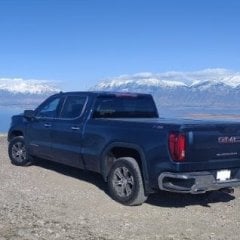
I just picked up a new Silverado 1500 last night. The dealer said that the cruise shouldn't be used for the first 500 miles. I also see that with a locking rear diff that you should drain and fill the fluid after 1500 miles. I was wondering if there is anything else that should be done with a new truck. Any comments would be greatly appreciated.


Thanks,

-Brandon

Posted

Congrats on the new rig. As soon as you drive it off the dealers lot, the pain of that big check you just wrote starts to fade away. Unless you're looking at hefty monthly payments, that is. :confused:


My partial list for things to do soon. These are BASIC things, not "modifications." Those come later.


INTERIOR:


Put down floor trays (not mats) such as Husky, Catch-All, etc., to keep that carpet clean.


Seat covers asap. There are some really nice ones out there; heavy fabric, very well fitted. They improve the comfort of the seats (imho) and take stresses off the seams. When you remove them at 50,000, those seats still look great.


Dash mat? Haven't got one myself, but they may improve the life and look of the dash.


EXTERIOR:


Mud flaps, if yours didn't already come with flaps or wheel well flares.


Protection for the bed, if you're gonna be hauling fire wood and other such stuff. Some people like the molded plastic drop-ins, some like the spray-ons. There is constantly a lot of discussion here about the differences. We also have a really good "Misc. Aftermarket" discussion section hosted by Roofers and RyanbabZ71. Go check it out for lots of good info. Greaat place to ask your questions.


Bug Deflector: some folks swear by them, some folks swear at them.


MOTOR:


I am a partisan for early oil and filter changes. I recommend a concentrated change schedule within the first 1,500 miles. When that engine is new, it is doing most of its breaking in and seating. This is when the majority of its metal shavings and particles will be produced. True, the filter is there to catch them, but lots of micro-tiny shavings remain. So changing out does nothing but help. After that, you can go on one of the standard schedules, such as every 3,000, or whatever catches your fancy.


Some people here will call me crazy (some already have :crazy: ) but I changed first at about 300, then again at 800, then at 1,500. Ever since, I change the oil and filter every 3,000 - 3,200.


DIFFERENTIALS (all of them):


Whenever you have new gears turning against one another, you have metal particles being produced during the wearing-in phase. So changing out the fluid is a good thing to get around to before too long. In addition to the rear diff. which you mentioned, you might get around to changing the gear lube in your front diff. and trans axle before 2,000, assuming that you have a 4x4.


The main transmission is a somewhat more complicated issue. Servicing it yourself is not as straightforward as the diffs., since it's harder to remove the trans. pan and the trans. filter. All I can advise now is that you continue to read the many posts that are always showing up on this forum and decide for yourself if that's a project you can tackle.


SUSPENSION LUBE:


No need to rush on this, but get ready to start popping some grease into the zerks before too long. Maybe start to check the rubber boots around the ball joints at 3,000 or 4,000. They should feel firm and filled up with grease, but not have any oozing out. If you haven't already got a grease gun, get one ready to go.


WHEELS:


The lug nuts on aluminum rims tend to loosen faster than on standaard steel rims. If you have alu. rims, check the tightness of those lug nuts as soon as possible. Hell, check them on steel rims, too!! The recommended torque setting should be mentioned in your owners manual that came with your truck.


TIRE AIR PRESSURE:


onoqweoiiddf'qkwevp9wnrfjbfvunf;jfornf1hvwowuf194tlrhv09rjgp1pi4hg0n


!


What will be interesting now is for me to find out all the really basic things I overlooked !!


Anyhow, congrats again on the new wheels.


gnutruk

Posted

You should vary your driving speeds and RPM's for the first 500 miles. This will aid for engine break-in. You also need to break-in the brakes, so try to avoid any hard or sustained braking.


Congrats on the new ride!!!

Posted
I am a partisan for early oil and filter changes. I recommend a concentrated change schedule within the first 1,500 miles. When that engine is new, it is doing most of its breaking in and seating. This is when the majority of its metal shavings and particles will be produced. True, the filter is there to catch them, but lots of micro-tiny shavings remain. So changing out does nothing but help. After that, you can go on one of the standard schedules, such as every 3,000, or whatever catches your fancy.


Some people here will call me crazy (some already have :( ) but I changed first at about 300, then again at 800, then at 1,500. Ever since, I change the oil and filter every 3,000 - 3,200.


DIFFERENTIALS (all of them):

:confused:


BLEESH!


Another person as Anal-Compulsive as I am about looking after his equipment. Welcome to the club! Agree 100% with all your statements. Initial service intervals are SO important. Heck, you can get lazy afterwards, but nobody makes a motor or transmission spotless at the factory.


I found specks and small particles when I did my transmission at 600 miles. Have never found any specs since!


Right on about especially the first oil change interval. I did my first one at 600 miles, then again at 1,200 miles when I switched to synthetic. I did NOT baby the motor.


An Uncle of mine, a mechanic, always told us to work the motor during break-in. He would wait until the temp gauge was normal then really pound on the gas pedal. After 100 miles, he would change the oil and filter, drive it hard, and change the oil and filter again at 600 miles.


Have you checked out the VERY controversial engine break-in guide at the following URL?


http://www.mototuneusa.com/break_in_secrets.htm


It actually makes a lot of sense. For example, if you have a Cummins in a Dodge Ram, the Cummins web site wants you to WORK IT (Otherwise "break in" could take more than 20,000 miles!). Every heavy truck I've bought also wants it WORKED. Every tractor I've bought wants the thing WORKED.


The key to all of this is the initial service.


Next vehicle I buy I'll try the "Break in secrets." It must work, and I base my statement on car rental fleets. Ever notice that NOBODY rents a car - me included - and babies it? They drive it like they stole it! Yet the motors appear strong, unless they NEVER change the oil.


I bet the only folks who even DARE to call you "crazy" are the new car dealers. They just CRINGE imagining all their customers looking after a car like that - cars would last forever and they'd be out of business. So right on :crazy:

Posted
BLEESH!


Another person as Anal-Compulsive as I am about looking after his equipment. Welcome to the club! Agree 100% with all your statements. Initial service intervals are SO important. Heck, you can get lazy afterwards, but nobody makes a motor or transmission spotless at the factory.


I found specks and small particles when I did my transmission at 600 miles. Have never found any specs since!


Right on about especially the first oil change interval. I did my first one at 600 miles, then again at 1,200 miles when I switched to synthetic. I did NOT baby the motor.


An Uncle of mine, a mechanic, always told us to work the motor during break-in. He would wait until the temp gauge was normal then really pound on the gas pedal. After 100 miles, he would change the oil and filter, drive it hard, and change the oil and filter again at 600 miles.


Have you checked out the VERY controversial engine break-in guide at the following URL?


http://www.mototuneusa.com/break_in_secrets.htm


It actually makes a lot of sense. For example, if you have a Cummins in a Dodge Ram, the Cummins web site wants you to WORK IT (Otherwise "break in" could take more than 20,000 miles!). Every heavy truck I've bought also wants it WORKED. Every tractor I've bought wants the thing WORKED.


The key to all of this is the initial service.


Next vehicle I buy I'll try the "Break in secrets." It must work, and I base my statement on car rental fleets. Ever notice that NOBODY rents a car - me included - and babies it? They drive it like they stole it! Yet the motors appear strong, unless they NEVER change the oil.


I bet the only folks who even DARE to call you "crazy" are the new car dealers. They just CRINGE imagining all their customers looking after a car like that - cars would last forever and they'd be out of business. So right on :confused:

Wowie, JayMan. That site is pretty amazing. And I thought I had strong opinions.


http://www.mototuneusa.com/break_in_secrets.htm]http://www.mototuneusa.com/break_in_secrets.htm


Of course, that guy has done lots of empirical testing. Even going so far as to tear down engines. So he has a sound basis for his recommendations. My program, in contrast, derived from not much more than thinking about these questions over the years (and a large number of vehicles owned), trying to figure out how things like the break-in period worked, what was going on inside the motor, etc.


Agree that there is factory crud in new engines, but maybe not so much in modern engines as there once was. But who needs/wants any at all? So that’s why I suggested frequent initial service.


I’ve heard that modern, state-of-the-art engine assembly facilities are fairly impressive places; never been in one myself. Because, in addition to automating and computer controlling all the obvious aspects of assembly, the maintenance, quality control, and what we might call “janitorial” functions are also highly automated and computer controlled these days. By “janitorial,” I do NOT mean sweeping the floor. I mean having the milling and fitting machines constantly cleaning and calibrating themselves, etc. The net effect is a much cleaner and more “controlled” production environment, as compared to decades ago. So, when we think about the meaning of the phrase “tighter specifications,” that does not only refer to the tolerances between two pieces of metal, or the “roundness” of a cylinder. Instead, our understanding of “tighter specifications” has to extend to the total production environment of modern vehicle fabrication and assembly.


quote << I bet the only folks who even DARE to call you "crazy" are the new car dealers. They just CRINGE imagining all their customers looking after a car like that - cars would last forever and they'd be out of business. So right on . >> quote


Gotta laugh out loud at this one, as I agree with you 100%. At new auto dealerships, you know how all the salesmen stand around on slow days waiting to pounce on the next customer? Well, when you drive by in a relatively newer vehicle, have you ever noticed how them give you dirty looks, like they hate your guts because you’re not likely to trade in that new car/truck anytime soon? Of course, the OFFICIAL position is that the dealerships and the manufacturers all support careful and thorough maintenance. They will even say that their service and parts supply systems are important sources of profit. But it is obvious -- there’s no sense for anyone to deny it -- that vehicle neglect is a crucial component of the profitability of the auto industry. As you say, “They just CRINGE imagining all their customers looking after a car like that - cars would last forever and they'd be out of business.”


Actually, after re-reading this, I can’t entirely agree with you, JayMan. Because, some folks who have never been new car dealers have called me “crazy.” Mostly my friends. For years, in my younger days, I was a big-wall rock climber in Yosemite Valley, and being crazy definitely helps there.

Posted
I’ve heard that modern, state-of-the-art engine assembly facilities are fairly impressive places; never been in one myself. Because, in addition to automating and computer controlling all the obvious aspects of assembly, the maintenance, quality control, and what we might call “janitorial” functions are also highly automated and computer controlled these days. By “janitorial,” I do NOT mean sweeping the floor. I mean having the milling and fitting machines constantly cleaning and calibrating themselves, etc. The net effect is a much cleaner and more “controlled” production environment, as compared to decades ago. So, when we think about the meaning of the phrase “tighter specifications,” that does not only refer to the tolerances between two pieces of metal, or the “roundness” of a cylinder. Instead, our understanding of “tighter specifications” has to extend to the total production environment of modern vehicle fabrication and assembly.


Actually, after re-reading this, I can’t entirely agree with you, JayMan. Because, some folks who have never been new car dealers have called me “crazy.” Mostly my friends. For years, in my younger days, I was a big-wall rock climber in Yosemite Valley, and being crazy definitely helps there.


edited by Jerry

Believe it. I've toured some of those engine assembly plants, both light duty and Heavy Duty. Everything now is CIM / CNC (Computer Integrated Manufacturing / Computerized Numerically Controlled).


Some "traditionalists" would complain about this approach but we all benefit from it. Specs are a lot tighter, in theory things last much longer, and the initial maintenance is much more important.


To perform QC tests, the assembled motors are hooked up to engine dynos, filled with warm coolant, and started up. Under load they're run for at least 15 minutes, sometimes an hour, to see if there are any QC problems. The motors are run up to WOT. This is just like "burning in" a computer component.


Then the oil is changed, the motor is mated to the vehicle, and it enters the real world. Most of my family is from Motor City and the procedure especially +30 years ago was FAR different. In many cases, the motor was started for the first time when it was mated to the finished car. If it calfed, it was rejected.


That's why most "traditional" engine rebuilds are disappointing, in terms of quality and/or performance. A mechanic using techniques 50 years old simply can NOT give you results modern CNC equipment can. That's why you have to find those rare machine shops that own CNC equipment. Or buy a crate motor that was made that way.


So the ancient "break-in" our Grampa's and Dad's used to talk about have NO place now. Like that Motoman guy said, run it hard for 20 miles and change the oil again. Good to go.


Speaking of crazy, when I was in college I joined a mountain biking club. We cycled everywhere, even on mountain paths I wouldn't dream of climbing now. Took a few bad spills and buggered up my knees and back. So much for that! :confused:

Posted

While I am not disagreeing with the maint. suggestions of above, I DO question their worth. I am from farm country. Around here, fertilizer companies buy new trucks, bring them to the shop, hook them up to fertilizer buggies, NH3 tanks, whatever and work the sh*t out of them, from mile number 1 until mile number 250,000. They change the oil every 3000 miles once or twice, but after that, it is at about 5k -6k. They NEVER change the diff. fluids, transfer case fluids and at about 100k, they MAY change the auto trans. fluids.


These trucks NEVER break down. They NEVER have problems and these trucks are used/abused from day 1. Employees, who don't care about equipment use them. They let them idle constantly, pull and haul, WAY more than they are designed for and they are either pulling another rig out of the mud or fighting to get themselves out of the mud.


Do you know what they complain about?? Air conditioning failures, squeeky interiors and crappy radios.


That is it!!


While I am all for good maint., I feel that being a bit anal only costs you time and $$$. I also don't think everyone should treat their trucks like these people do, but if THEY do it and the trucks last that long without major problems, I think the factory is doing something right.


Just my .02.

Posted
While I am not disagreeing with the maint. suggestions of above, I DO question their worth. I am from farm country. Around here, fertilizer companies buy new trucks, bring them to the shop, hook them up to fertilizer buggies, NH3 tanks, whatever and work the sh*t out of them, from mile number 1 until mile number 250,000. They change the oil every 3000 miles once or twice, but after that, it is at about 5k -6k. They NEVER change the diff. fluids, transfer case fluids and at about 100k, they MAY change the auto trans. fluids.


These trucks NEVER break down. They NEVER have problems and these trucks are used/abused from day 1. Employees, who don't care about equipment use them. They let them idle constantly, pull and haul, WAY more than they are designed for and they are either pulling another rig out of the mud or fighting to get themselves out of the mud.


Do you know what they complain about?? Air conditioning failures, squeeky interiors and crappy radios.


That is it!!


While I am all for good maint., I feel that being a bit anal only costs you time and $$$. I also don't think everyone should treat their trucks like these people do, but if THEY do it and the trucks last that long without major problems, I think the factory is doing something right.


Just my .02.

I agree. Some folks get VERY lucky when they ignore their equipment. However, most equipment abused like that is ready for the boneyard within 5 years. Note I didn't say "worked like that."


I still think that a truck is made to WORK. You drive it like a Granny and it will calf on you. Trucks are made very well now. The fluids are WAY better than even 10 years ago.


On my 1984 Ford F-150, I figure the yearly rustproofing and anal initial servicing has cost $2450 to the present day. The servicing by itself has cost about $550. I'm not adjusting for the devaluation of currency, nor am I attempting to calculate opportunity cost (What I could have done with that $2450 if spent for other things).


Since they salt the roads so heavily here in winter, that kills a vehicle. If you do nothing, it's ready for the boneyard after 6-10 years anyway as it's all rusted out. Even the frame. If you know you'll keep a vehicle, the $100 / year for rustproofing is worth it.


The initial service is most critical, as that is when you get all the wear particles out. If you primarily operate at low speeds (Fertilizer appliers spraying nitrates) then the axle will rarely get cooked, even though you may be overloaded.


Tranny is another matter. Remember the Dodge Caravan's from the early to mid 90's? Those transmissions would cook even if you DID look after them.


Once I get the initial service out of the way, I only change filters. So, if I fire up the Excel spreadsheet on my Mac, and graph maintenance cost over time, the graph is a line that goes steeply down after the initial service.


I have had ONE mechanical failure looking after my vehicles this way. A certain 6 cylinder commercial diesel engine has had problems with connecting rod fractures, particularly after about 2,300 hours of operation. After the threat of small claims court, and lots of documents including Used Oil Analysis, the engine maker generously settled out of court.


If you don't care for a vehicle - known as "deferred maintenance" - then the graph starts out very low but with time will climb almost without bound. This reflects the increasing cost of replacing parts that have worn out.


From my own experience, the way I look after a vehicle, the "payback" or ROI (Return On Investment) happens in as little as 18 months on the heavy equipment to as long as 48 months on the light duty equipment. The reason the heavy equipment has a much shorter ROI with my maintenance schedules reflects on their much higher sump capacities.


I don't do "Enron Accounting" nor do I believe in it. Anybody who thinks that it's cheaper to ignore a vehicle and simply buy a new one every 2-4 years is a fool. The amount of money you'll pee away on vehicles will build you a mansion after 20 years.


I run heavy commercial equipment, so I've had almost 18 years to play with numbers and figure how to keep the equipment running as long as possible. I've always found that the following two are very important and provide the best long-term benefit:


1. Early initial service. Sooner the better.


2. Synthetic oils after a "reasonable" break-in.


The "reasonable" break in can happen in as little as 20 hours by the engine meter if you work the equipment hard. About 500-1,000 miles on lightduty trucks.


Then change the hydraulic fluids, powershift fluids, gear oils, engine oils, etc. Install bypass filters on the engines. Then you usually only change the filters from that point on.


I've stated this in earlier posts: if I was leasing or trading every 2-4 years, I'd never open the hood. Ever.

Posted
I've stated this in earlier posts: if I was leasing or trading every 2-4 years, I'd never open the hood. Ever


That is funny, a guy I know leased a truck from Ford a few months ago. When he was signing the papers, the sales manager came over and offered a "special deal" on oil changes for the life of the lease. My friend said: "Oil changes? You want ME to pay for oil changes in YOUR truck?? I am paying to drive this thing, not own it. If you want the oil changed in YOUR truck, YOU can pay for it!"


The sales manager just stared at him a minute and walked away.


I thought it was funny as hell!! :thumbs:

Posted

HAHAHAA you want the oil changed in your turck you do it. HAHAHAHA thats great. I wish I could have been there to see that. Its basicly like saying your never going to change it in the 2 years you drive the truck, and they are f**ked. LOVE to hear it when the customer wins. :thumbs:

Posted
I've stated this in earlier posts: if I was leasing or trading every 2-4 years, I'd never open the hood. Ever


That is funny, a guy I know leased a truck from Ford a few months ago. When he was signing the papers, the sales manager came over and offered a "special deal" on oil changes for the life of the lease. My friend said: "Oil changes? You want ME to pay for oil changes in YOUR truck?? I am paying to drive this thing, not own it. If you want the oil changed in YOUR truck, YOU can pay for it!"


The sales manager just stared at him a minute and walked away.


I thought it was funny as hell!! :thumbs:

EXACTLY!


Thank you!


But since I'm in it for the long haul ...

Posted
These trucks NEVER break down. They NEVER have problems and these trucks are used/abused from day 1. Employees, who don't care about equipment use them. They let them idle constantly, pull and haul, WAY more than they are designed for and they are either pulling another rig out of the mud or fighting to get themselves out of the mud.

Right on,

My little 4.3 94' has been to hell and back. I baby the body and looks of the truck, but as far as fluids, tranny and diff have NEVER been changed. Truck runs like a top dispite my abuse. I do a lot of inner city driving, and lots of stop and gos. I am also a believer in good maintaince of your truck, but there is definatly and overboard. My ol' Silverado has 165k on the odometer and sometimes I have to wait 5 or 6k miles before I can get to oil. :thumbs: Like a Rock.

Posted
You drive it like a Granny and it will calf on you.

Well my 94' has hauled one small Uhaul and the ocasional load of wood or grass in the fall. Its never really been worked hard. I guess thats "driving it like a granny". Fact is I'd put my 94's dependability against any 03 or 04. It makes no difference how a car is driven. Be it Corvettes or Silverados. If you do basic care on today's Chevy's they will last you a lifetime. I do basic service on my 94, and I've had zero problems, and its definatly a high mileage truck.


BTW, it makes no difference when synthetic oil is added. It can be used at initial start up, or at 140k miles. However, if added after high miles you may be wasting you money. But if you believe that synthetics are bad for break in, why does our 00' LS1 come with synthetics from factory?

Archived

This topic is now archived and is closed to further replies.

×
×
  • Create New...