

-
Recently Browsing 0 members
- No registered users viewing this page.
-
Forum Statistics
250.5k
Total Topics2.7m
Total Posts -
Member Statistics
342,965
Total Members8,960
Most Online
-
Who's Online 9 Members, 1 Anonymous, 1,458 Guests (See full list)
-
Latest Articles
-
Posts
-
 That's bad. Like, its probably destroying the stub axle the CV slides into. Do you have a proper lift installed with differential lowering brackets? Did you install AT4/Trail Boss factory CV axles?
 -
 Hot? New Jersey? Today? I was working on my old 2000 Silverado 1500 today. Believe me, it was boiling hot today. As it has been.
 -

By richard wysong · Posted
Gas on the hi-way followed Mobil's lead and went up a dime to $3.79, Sunoco was still $3.69 though. The truck stop went up twice today, first a dime then a nickel. Diesel $5.35 at Sunoco but $5.79 next door at Gulf -
There are no available updates in my settings, but the dealer can still flash the latest. They told me it was risky to force flash updates because if anything went wrong with the update that I'd be on the hook for the repair costs. They recommended just leaving it as is.
-
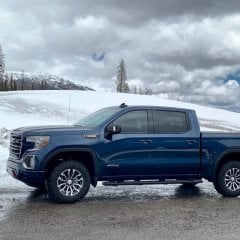 I put a set of the Eibach Pro Truck 2.0's on mine this past weekend. Lower bolts def was the trickiest part. Def leave the top bolts very loose, as in the nuts barely started. Have a jack under the LCA so you can move it up and down. One of mine I had to barely unclip one side of the spring nuts as to create the odd angle. With those spring nuts being fairly loose, and holes slotted, it can be done. Just have to keep at it. One note, I used a LONG extension with deep barrel socket on the inside nut on the passenger side, was able to reach it from the top. Swivel head ratcheting wrench on all the others. Couple of observations: sure seems like the rear lifted some, which I know sounds crazy since I kept the original leafs. I ran the front shock adjustments all the way up to the 137mm measurement. Unfortunately I didn't measure rear wheel arch height before. Front measure about 5/8" higher than before, but I'm sure it had settled some. Had 110,000 miles on the original Ranchos, I can't express how much better the ride is now.
-
-
GM-Trucks.com Clubs
-

Black Truck Club
Open Club · 613 members
-

White Truck Club
Open Club · 381 members
-

Canadian Owners Club
Open Club · 282 members
-

Red Truck Club
Open Club · 158 members
-

diesel 3.0
Open Club · 281 members
-

Texas Owner's Group
Open Club · 371 members
-

NorthSky Blue Club
Open Club · 118 members
-

Midwest Owner's Group
Open Club · 213 members
-

2015 Custom Sport Club
Open Club · 5 members
-

GM Snow Plowing Club HD
Closed Club · 14 members
-
-
Popular Contributors
-

.thumb.JPG.2c573de60d3a3a4407c7d92298db46dd.JPG)


Recommended Posts
Archived
This topic is now archived and is closed to further replies.