

-
Recently Browsing 0 members
- No registered users viewing this page.
-
Forum Statistics
250.3k
Total Topics2.7m
Total Posts -
Member Statistics
342,739
Total Members8,960
Most Online
-
Who's Online 4 Members, 0 Anonymous, 1,508 Guests (See full list)
-
Latest Articles
-
Posts
-
 Fred was in the fertilized egg business. He had several hundred young pullets, and ten roosters to fertilize the eggs He kept records, and any rooster not performing went into the soup pot and was replaced. This took a lot of time, so he bought some tiny bells and attached them to his roosters. Each bell had a different tone, so he could tell from a distance, which rooster was performing. Now, he could sit on the porch and fill out an efficiency report by just listening to the bells. Fred's favourite rooster, old Butch, was a very fine specimen, but this morning he noticed old Butch's bell hadn't rung at all! When he went to investigate, he saw the other roosters were busy chasing pullets, bells-a-ringing, but the pullets, hearing the roosters coming, would run for cover. To Fred's amazement, old Butch had his bell in his beak, so it couldn't ring. He'd sneak up on a pullet, do his job and walk on to the next one. Fred was so proud of old Butch, he entered him in the City Show and he became an overnight sensation among the judges. The result was the judges not only awarded old Butch the "No Bell Piece Prize," but they also awarded him the "Pulletsurprise" as well. Clearly old Butch was a politician in the making. Who else but a politician could figure out how to win two of the most coveted awards on our planet by being the best at sneaking up on the unsuspecting populace and screwing them when they weren't paying attention. Vote carefully in the next election, you can't always hear the bells.
 -
-

By 3CarSeatDad · Posted
Can someone confirm if the GM order workbench terminal is able to validate a custom build sequence: 1) Initialize the Allocation Base: Open a new vehicle build queue, select the 2026 Chevrolet Suburban 4WD, and pick the High Country (3LZ Preferred Equipment Group). 2) Select the Diesel Powertrain: Go directly to the engine configuration screen and choose RPO code LZ0 (3.0L Duramax Turbo-Diesel). Ensure it maps to the MHS 10-speed automatic transmission. 3) Deploy the Seating Swap: Navigate to the Interior Options screen and enter RPO code ATT to replace the standard captain's chairs with the power-release 60/40 bench seat. Because you are not trying to force a separate luxury or air-suspension bundle, the standard, premium D07 Fixed Floor Console remains active. The system will accept this change immediately without triggering a warning message. 3)Apply Heavy-Duty Hauling Capability: Input RPO code NHT (Max Trailering Package). The commercial terminal will automatically bundle the required trailering hardware and software modules to support the diesel engine's maximum towing capacity. 5) Layer the Premium Tech and Glass: Separately add code C3U (Panoramic Power Sunroof) and code UKL (Super Cruise) to the order screen. 6) Run the Final Validation: Click the "Validate Order" button at the bottom of the interface. -
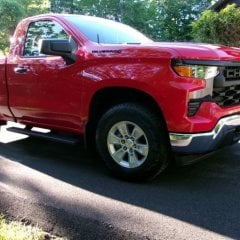 Spent the last hour or 2 googling and reading up on the spacer thing. I don't like the loss of thread contact on the slip on spacers, but it appears you can get "extended" lug nuts that reach into the hole of the wheel to get back the lost threads. Looks like the only true hubcentric slip on spacers are at least .375". I'd want as little as I could get away with and don't want to cause other clearance issues going any thicker. Bora seems to offer what appears to be a well made .375" spacer and extended lug nuts. I searched here and did find a couple threads recommending Bora. But not cheap. By the time I buy spacers and lugs, new TPMS sensors, then pay a tire shop to install the new sensors, I suspect I'm going to be in over $400. Thinking about running out and getting some washers to put behind the wheel to see if .375" is enough to clear calipers, turn lock to lock without rubbing, and to see if the wheels/tires look strange pushed out a little. This would just be to check fitment.
 -
 Roadmaster makes some quality parts; I have their sway bar. I considered the RAS, but I ended up bagging. I didn't know what kind of ride I'd get with RAS, and the bags have interior jounce bumpers, so I can run 0 pounds pressure. I figured I'd have the best of normal suspension ride with assist on-demand. But it seems you got pretty much the same in one item.
-
-
GM-Trucks.com Clubs
-

Black Truck Club
Open Club · 612 members
-

White Truck Club
Open Club · 380 members
-

Canadian Owners Club
Open Club · 282 members
-

Red Truck Club
Open Club · 156 members
-

diesel 3.0
Open Club · 279 members
-

Texas Owner's Group
Open Club · 371 members
-

NorthSky Blue Club
Open Club · 118 members
-

Midwest Owner's Group
Open Club · 212 members
-

2015 Custom Sport Club
Open Club · 5 members
-

GM Snow Plowing Club HD
Closed Club · 14 members
-
-
Popular Contributors
-


.thumb.JPG.2c573de60d3a3a4407c7d92298db46dd.JPG)

Recommended Posts
Archived
This topic is now archived and is closed to further replies.