

-
Recently Browsing 0 members
- No registered users viewing this page.
-
Forum Statistics
250.4k
Total Topics2.7m
Total Posts -
Member Statistics
342,846
Total Members8,960
Most Online
-
Who's Online 7 Members, 0 Anonymous, 675 Guests (See full list)
-
Latest Articles
-
Posts
-
 Engine failure requires radiator replacement per GM if it contains an engine oil cooler. They do NOT want them flushed. Radiator replacement is also required for the 6.2 recall if the engine fails. Here is the TSB the dealer is referring to - 22-NA-074 1..2 Its a slightly older version, but the current version of it covers all model years 2000-2026. So if enough failure debris was present, it gets an oil cooler. If that is part of the radiator, it gets a radiator. Also, same for oil cooler lines. Those get replaced. Now something like a 2.7 Turbo which uses an oil to water heat exchanger for the oil cooler, the radiator would be left alone but the oil cooler would be replaced, as well as any lines.
 -
 Doing the right thing, replacing both valves is the way to go. The valves with the ball leak far more often than the schrader. Never cared for them. The accumulator really should be replaced if the system has had no pressure in it and it was a keeper, but since you're looking to sell it, bet you can get by. Did you pull the orifice screen and see what was there? Shame you can't get 134a. Hopefully the previous repairs included dye. Some of the R4s I messed with developed leaks where the line sets connected or the front seal. Had one where the HPCO was leaking. Front seal would only leak under pressure. See any obvious oily spots? I've got nitrogen I use to test pressure and to help dry the system prior to evacuation. Keep up the good work
 -

By richard wysong · Posted
Next time you're on a road trip to a state where you can still buy it stock up on 12oz cans, you might look into getting certified so you can buy it where you are as well. When they switched from R12 to R134a the test for certification was easy, they basically just wanted the $25 -
 Getting greedy... The AC pump has been replaced at least once per service records, and it's been recharged twice since 2018 or so, in approximately 2 year intervals between those charges. It was done at the same shop...clearly they were enjoying the revenue of recharging the system periodically versus actually tracking down and fixing the leak. I learned that the owner was 88 years old when she passed in 2023, so maybe they assumed only a temporary fix was needed anyway. The system is basically empty now, the compressor spins freely, so I'm guessing it "just needs a recharge". I vacuumed it down, and it has basically held overnight. Doesn't appear to leak under vacuum, check! So it must leak under pressure. I don't have a way to pressurize the system and pressurizing it with shop air wouldn't be great for the air dryer (which is probably toast anyway?) The dryer (accumulator? I'm not an AC expert) has a Schrader valve, but the high side has an old ball-type valve, which are notorious for leaking. It's clearly had schmutz blown out of it at one point because the line/area next to the valve is coated old black crud, which I assume is AC refrigerant residue/oil, or maybe even dirty dye. I think I'll roll the dice and replace the valves. I have a black light around here somewhere so I'll find it and shine it around the engine bay in the dark to see if there's any dye. I can't think of another way to track down the leak other than injecting some dye (if it doesn't have any) and having it charged up. We can't buy R134a off the shelf here anymore, so I'll run it up to Jiffy Lube and have them do it. I think I have a coupon. At the very least, the charge should last long enough for a year or two, according to history. I think this truck will be long gone by then. But cold AC is a selling point.
 -
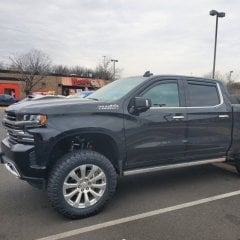 Got the truck back today. Called them yesterday to get an update, and miraculously my truck is finished?!?! The $13k out the door was complete bullshit! Ended up being over $14k. They added some bullshit service bulletin that I cant even find, where they replaced my radiator without telling me or asking me, and charging me for it. Need to do more research into it, cause they leaked the first delivered radiator was ran over by FedEX. Sounds like bullshit to me. 2.5 Months for an engine swap, which ended up being remanufactured, not new; ****ing ridiculous. Brakes are squishy as hell, not sure if its from sitting. Will give a couple days to see it that figures it self out. GAVE IT BACK TO ME WITH 1 GALLON OF GAS! Just filled the tank the day before drop off, more bullshit. My dash cam SD card was formatted, not really much I can do about that. 3 year, 100k GM warranty at least. Time to sell it and say **** off to GM. Bad experience. Cant wait for the survey email to come through. Overpriced Raptor R, here I come!
-
-
GM-Trucks.com Clubs
-

Black Truck Club
Open Club · 612 members
-

White Truck Club
Open Club · 380 members
-

Canadian Owners Club
Open Club · 282 members
-

Red Truck Club
Open Club · 157 members
-

diesel 3.0
Open Club · 281 members
-

Texas Owner's Group
Open Club · 371 members
-

NorthSky Blue Club
Open Club · 118 members
-

Midwest Owner's Group
Open Club · 213 members
-

2015 Custom Sport Club
Open Club · 5 members
-

GM Snow Plowing Club HD
Closed Club · 14 members
-
-
Popular Contributors
-
1
.thumb.JPG.2c573de60d3a3a4407c7d92298db46dd.JPG)
-
2

-
3
-
4
-
5
-
-

Recommended Posts
Archived
This topic is now archived and is closed to further replies.