Jump to content

Alignment help please!


Recommended Posts

Posted
21 hours ago, Grumpy Bear said:

http://www.priertiresupply.com/pdf/hofmannbrochures/fundamentals of alignment.pdf


Give a man a fish vs teach a man to fish, right. 


Now aren't you happy we looked? I am! The factory castor spec is indeed different than how I was taught but not inconsistent with the idea of castors purpose of spindle loading to promote steering stability. Given these numbers the engineers, would be my guess, are compensating for something in their design. I'd go with their recommendation then that right side caster be 0.2 more positive than left. GM Engineers designed it, trust them. Yes that is different that I had said previously and it isn't how mine is set up. That said I'd make my starting  point the mid point of all specs. 


Given your current numbers that should assist you in lessening the 'fight'. Safety first.


I'd like to caution you that as your tires are already worn oddly, that even with a perfect alignment, it will not drive perfectly until they are replaced. They can teach you nothing at this point. 


Also, keep in mind crown in a road is not the same on back roads as it is on a major two lane, the surface the specs were chosen for. Got to watch what I say eh? The idea of the exercise was to detect the trucks tendency to 'drift', when released from a stable condition, and find it's tendency to favor either right or left. 


To this point you have been trying to find an end point without really having a starting point. A least a stable one. One thing at a time. And be patient. Remember, you chose to alter the factory setup. You called the dance and now you get to pay for it. :lol:


:seeya:


So the truck has the tendency to drift to the right st the moment on the Hwy. The steeeeing wheel is also a couple degreee off to the left and should be centred better so I’ll be mentioning that also. 


The rear tires have zero wear on the outside, slight inside, only cause I had em rotated and  re and re to flip em on the rims. They were on the fronts before. So I’ll be moving those to the front tomonitor wear better and as you said, hope the truck is less affected compared to the ones upfront now. 


Im pretty much mid way now. And had been close in the past also. But the alignment keeps letting go so it doesn’t stay that way which is the biggest battle in all this at the moment. I guess Monday we’ll see if it stayed in spec or broke lose again. 


I will ask them to dial in more negative camber than I have now, at -.6 it felt better than it does now at -.1 going down the rd.


sorry just to be certain, I should stick to .2 more positive  caster/camber pass side? 


Thanks 


  • Replies 41
  • Created
  • Last Reply
Posted

I still dont understand the camber. In a perfect work closer to zero is best. Flat tire on the ground. Negative camber helps in turns the truck rolls weight to that's side. But it's a huge truck not a race car and you have larger wider and farther out wheels anyways.
Camber can also compensate as all specs can for the build of the vehicle or the geometry of the suspension, in this case a-arms. I was told not to have over .06 negative camber. Two shops said it was fine. But when I asked "won't it wear the insides of the tire more" they said well yeah. Then then said lowered trucks are just like that. After calling belltech, they said I CAN run that but they highly recommend proper factory spec.
I have zero uneven wear.
Caster with the tires all moved around, I say less. Hard to explain but as the truck turns the tire and truck weight is shifting all over the tire patch. We need a 3d motion model to show this.
Just how I see it in my head. Could be wrong.
So do you think you solved the specs moving around? Is this a 4wd and how old are the shocks?

Sent from my SM-N960U using Tapatalk

Posted
20 hours ago, 1SLOW1500 said:

I still dont understand the camber. In a perfect work closer to zero is best. Flat tire on the ground. Negative camber helps in turns the truck rolls weight to that's side. But it's a huge truck not a race car and you have larger wider and farther out wheels anyways.
Camber can also compensate as all specs can for the build of the vehicle or the geometry of the suspension, in this case a-arms. I was told not to have over .06 negative camber. Two shops said it was fine. But when I asked "won't it wear the insides of the tire more" they said well yeah. Then then said lowered trucks are just like that. After calling belltech, they said I CAN run that but they highly recommend proper factory spec.
I have zero uneven wear.
Caster with the tires all moved around, I say less. Hard to explain but as the truck turns the tire and truck weight is shifting all over the tire patch. We need a 3d motion model to show this.
Just how I see it in my head. Could be wrong.
So do you think you solved the specs moving around? Is this a 4wd and how old are the shocks?

Sent from my SM-N960U using Tapatalk


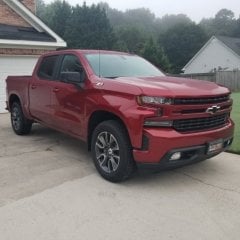
Yeah it’s a crew cab regular box 4x4 all terrain. Shocks are two years old about 23,000 miles on em. They are rancho 9000’s set to 6 firm up front and 4 or 5 out back. 


Do you mean -0.6 camber? Was that on a lowered truck you said? 


I def think -0.1 camber is not enough for an extra 30mm tire width and extra 1.5” of offset. It’s almost 2” out from where the factory offset and tire would be. So stock suspension stock offset stock tire I wouldn’t argue 0 is flat but I’m not convinced 0 is flat anymore when you do what I did. 


And since the truck wanders to the right currently at 0 cross camber and cross caster I’m wondering two things, first is it still in spec or if it is in spec then that’s got to be disked out so it will track straight. Also curios if it drifts cause nobody sits in the drivers seat when they do alignment.

Posted

Yes mine is lower. I was just using as example of changed parts and shops saying its fine. Also to show as it goes down there is more negative camber.
I was talking in a perfect world of traction vs tire wear. The tire traction patch is the most in contact flat on the ground. Tracknattack cars run large negative to keep track tin in. Corners but idea is as the cars suspension compresses on the outside tire it goes from negative to more perfect zero.
All I was saying is higher negative camber isn't needed. You are not a track attack car and with the tire farther out you get a hair more cornering traction.
I believe but listen to grumpy the tires farther out is a issue when you run caster and camber. Right now you are running a little on the inside edge not a lot but let's just say. Then you turn the contact goes from that edge into the center. This is "ok" but with the tire out there more it is more of a scrub.
This is how I see it. Maybe wrong. We run MAX caster, even move it back a few inches and positive or zero and travel.limiter on drag only car. It is the least resistance and as the tire can't see any more camber +/- anyways. On my track attack I had -1 camber but changed it to -.7 as the front tires are 10" wide and suspension travel down was less than 2" so under load there was no more negative camber. Toe out for turning.


Sent from my SM-N960U using Tapatalk

Posted
23 hours ago, 1SLOW1500 said:

Yes mine is lower. I was just using as example of changed parts and shops saying its fine. Also to show as it goes down there is more negative camber.
I was talking in a perfect world of traction vs tire wear. The tire traction patch is the most in contact flat on the ground. Tracknattack cars run large negative to keep track tin in. Corners but idea is as the cars suspension compresses on the outside tire it goes from negative to more perfect zero.
All I was saying is higher negative camber isn't needed. You are not a track attack car and with the tire farther out you get a hair more cornering traction.
I believe but listen to grumpy the tires farther out is a issue when you run caster and camber. Right now you are running a little on the inside edge not a lot but let's just say. Then you turn the contact goes from that edge into the center. This is "ok" but with the tire out there more it is more of a scrub.
This is how I see it. Maybe wrong. We run MAX caster, even move it back a few inches and positive or zero and travel.limiter on drag only car. It is the least resistance and as the tire can't see any more camber +/- anyways. On my track attack I had -1 camber but changed it to -.7 as the front tires are 10" wide and suspension travel down was less than 2" so under load there was no more negative camber. Toe out for turning.


Sent from my SM-N960U using Tapatalk


Well it’s def trial and error at this point.

i could go with a lil less neg camber and a lil more neg toe. I feel like the caster at 1.8 is about correct, unless I’ve lost my mind it’s actually eliminated the rubbing I was getting at full lock on the inner fender liners. I haven’t felt or heard that since it was in last. 


I may have them set the toe to .02 or .03 and maybe stay at -.6 camber swap the rear tires to the front as the tread blocks are square and will be easier to monitor wear and how it leans with no steering input going down the rd. I’m curious as to if the truck is still in spec from the last alignment last week. I’ll find that out soon enough I guess. 

Posted

Wow 140 miles and toe was out 15 degrees! Camber and caster went out .1 on one side each. Dealer wants to blame my lift and charge me another alignment I told them nice try. Going back in a couple days for another look. Frustrating! 

Posted

Not a total loss Cheech. You  now know that it isn't the alignment but rather it's inability to hold one. So....which ones gave up? You had them marked, right? Something is moving. What is it? 

Posted
19 minutes ago, Grumpy Bear said:

Not a total loss Cheech. You  now know that it isn't the alignment but rather it's inability to hold one. So....which ones gave up? You had them marked, right? Something is moving. What is it? 

We’ve got a blizzard going on at the moment so the wheel wells are caked in ice and snow I can’t see anything.  I’ll see if I gotta copy of the new specs. Tech who realigned it and then again today went home by the time i Got to the dealer. Service advisor and i are going to try and get a hold of him in the morn. 


Posted

Left caster went from 1.8 to 1.9


Left camber went from -0.1 to 0.0 


Left toe went from 0.05 to 0.20

right toe went from 0.05 to 0.00


total toe went from 0.10 to 0.20


Another thing the oem thrust angle spec is 0.4 my initial and final are and seem to have been always 0 on initial and final alignments. 

Posted

It’s been a while since I’ve uodated this but I’m no further ahead now than i was then.


Long story short get the truck back to the dealer on a different bay, tech and machine and it showed some difference in the alignment specs upfront from previous week. Previous Tech never marked the bolts. Current tech says it’s not far off could just be differences in the machines. Imo that’s a huge problem if not all machines are calibrated to read the same but I digress. 


New tech says hes not too worried about the front specs but he’s concerned about the rear. First I’ve heard and the truck has been on 5 or 6 alignment racks now. He’s saying the rear is out almost 15 degrees and will cause the truck to get loose over bumps at high speed. I will say I have noticed the shimmy at high speeds over rail crossings etc but I chalked it up to stiffer shocks and e load range tires. They quoted me 4hrs to reshim and align the rear. 


At this point ive thrown my hands up in the air. I don’t know what to believe anymore, machines reading different parameters on the same truck, one machine shows things 5 others didn’t I’m debating making this a GM Canada problem now, all this time and money and you have no consistency between machines in your shop how do I know which is most correct? Or just bite the bullet and try  to find a really good frame/alignment shop in my area. I’m just pissed all this back and fourth to learn all of GM machines don’t read the same and as much as there are issues with my alignment some could be caused by their crappy machines. So frustrated! 

Posted

Peppers rear axle was 1/4" off square to the chassis centerline which was corrected with the Deaver spring packs were installed. No they themselves were not the cure but it was the opportunity to address it. So yes...it happens and Yes, it is correctable. Thing is that isn't corrected with shims but with grinding the hole in the axle plate oblong to reposition it. The trough bolt that holds the pack together acts as a locating dowel.


Shimming corrects either ride height differences or pinion angle. Pepper is still 1/4" high on one side than the other in the rear. Something you have to measure to actually know is there. On that note, never measure from the ground to the fender lip but from the spindle centerline to the fender lip. 


Some 'wording' in your post is telling me that some items you might believe are alignment related could be dampening related. The dance over RR tracks or bridge expansion joints, the hard jar on same, in example are an issue with all K2XX platform trucks with stock damper valving. The exact issue is what precipitated my total suspension rework. I took a sledge hammer to a thumb tac, granted, but it did cure it. :lol:


Movements like 0.1 degrees can certainly be the result of something as simple as removing and reinstalling the measurement device. Seriously. Over the distance the laser travels to the mirror.....


It's the toe change that was of considerable note. That isn't in the operators set up. BTW that isn't 15 degrees different but only fifteen hundredths of a degree. Easy enough mistake to make. 

Archived

This topic is now archived and is closed to further replies.

×
×
  • Create New...