

-
Recently Browsing 0 members
- No registered users viewing this page.
-
Forum Statistics
250.4k
Total Topics2.7m
Total Posts -
Member Statistics
342,759
Total Members8,960
Most Online
-
Who's Online 8 Members, 0 Anonymous, 1,627 Guests (See full list)
-
Latest Articles
-
Posts
-
 As a matter of amusement I’ll leave this conversation with this. Do you beat the government average fuel estimate? Statistics are a guide to me. Not a rule. Someone once said I have to have the last word. If true and possible may be. I’ll blame that on working in a family business.
 -
 That is a fair point, and I agree that trying to log “everything in the truck” would be the wrong direction. There are a lot of modules and a lot of traffic. If the product became a full-truck datalogger, the amount of data would get huge very quickly, and most owners would never use it. I think the first useful version would need to be narrow: - powertrain-side event evidence - selected high-value parameters - communication / voltage / reset events - pre/post event window - short report first, raw log only as backup One distinction I should make is between active OBD/PID polling and passive bus capture. If you are polling PIDs through OBD, then yes: the more parameters you request, the lower the effective sample rate becomes, and you are adding diagnostic traffic to a vehicle that is already busy running itself. With passive CAN capture, the recorder is not asking all the modules for data. It is listening to traffic that is already on the bus. So it does not consume vehicle bus bandwidth in the same way that a scan tool polling hundreds of PIDs would. But your point still applies in a different way. Even if passive capture does not add bus traffic, the recorder still has limits: - processing rate - storage rate - timestamp accuracy - decoder workload - event filtering - report size - user attention span So the answer cannot be “log everything and let the user figure it out.” The product would need to store enough raw evidence to be useful, but only decode, graph, and present the important parts around the event. A practical report should probably show: - what triggered the capture - how much pre/post data was preserved - which selected parameters changed - how those values compared to baseline - whether the same pattern happened before - whether any voltage, reset, bus-off, lost-message, or communication fault occurred - selected graphs around the event - raw data only as supporting evidence So I agree with you. More data is not automatically better. The real product is the reduction from raw data into a useful event report.
 -
That makes sense, and I agree with most of that. I think the product would need both: 1. a default powertrain template, so it is useful out of the box; 2. user-selected priority parameters, so the owner or shop can choose what they want to see first. Different users are going to care about different things. One owner may care about oil pressure and voltage. Another may care about misfire trend, AFM/DFM behavior, or U-codes. A shop may want communication events and repeatability first. Your baseline point is probably the most important one. Raw data is not very useful unless the report can show what normal looked like for that vehicle under similar conditions. The way I would think about it is: - start with a basic known-good baseline - learn normal behavior for that specific vehicle over time - allow the event to be overlaid against baseline - show whether the event was a one-time spike or a repeatable pattern - provide a simple severity level, but with clear limits on what that severity means For example, early severity could be something like: - Info: event captured, no obvious abnormal pattern - Watch: value moved outside baseline, but not repeated - Warning: repeatable abnormal pattern under similar conditions - Critical: communication loss, voltage drop, bus-off, reset, or severe repeated event I would not want the first version to say “replace this part.” That would be overclaiming unless there is repair-confirmed data behind it. It would be more honest to say “this pattern deserves inspection.” On the OBD port question, I think OBD absolutely has a role. OBD is probably the right place for: - DTCs - freeze frame - VIN - calibration information - normal scan-tool parameters - Mode 6 / enhanced diagnostic data if available The reason I am still looking at an ECM-side recorder is that the failure may happen before anyone connects a scan tool. If the owner plugs in a scanner after the event, the pre-event evidence may already be gone unless the ECU happened to save it. So I do not see this as “OBD versus ECM-side.” I see it more like: - ECM-side recorder: always armed, rolling buffer, event evidence - OBD/DLC companion: DTCs, freeze frame, VIN, calibration, normal scan data - phone/cloud: status, notes, upload, report generation, notifications I agree that phone connection and push notifications would be useful. I just would not want the phone or cloud connection to be required for capture. The recorder should save the event locally even if the phone is not connected. The phone should help with event marking, download, notes, upload, alerts, and report viewing. For a default GM V8 event report, would this list make sense? - RPM - calculated load / MAP - throttle position - vehicle speed - gear / torque converter state if available - coolant temperature - oil pressure - oil temperature if available - battery voltage - commanded AFM/DFM state if available - actual AFM/DFM state if available - misfire counters / roughness by cylinder if available - fuel trims - relevant U-codes / communication events - bus-off / lost periodic message / module reset / voltage drop events Which of those would you remove, and what would you add?
-
.thumb.JPG.2c573de60d3a3a4407c7d92298db46dd.JPG)
By Grumpy Bear · Posted
I went to the county a few years back to dispute my property taxes. To do that I hired an appraiser and a lawyer. The County Assessor wished to argue that the homes in my neighborhood the appraiser used were all 'distressed properties" and not representative of the "Market Average". My response was," Of the 50 homes in our subdivision 43 of them were "distressed properties" under bank foreclosure and as such "Distressed IS the market". Lawyer about choked on his coffee and handed the Assessor the 'receipts'. I won that case on the evidence provided by the Lawyer and the Appraiser. We have the same thing going on here. My statements were based on the GOVERNMENTS NATIONAL DATA and yours on local markets in areas of your interest. They are both correct.... Thing is, this divergence was based on NATIONAL and not on LOCAL. I think you even understand that. But like you said, we are both stubborn and hardheaded. I do not see any advantage to disengagement. But that said we can step back to compose ourselves. -
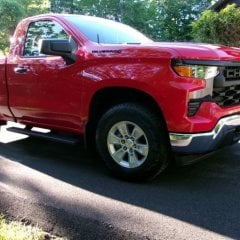 Trust me I appreciate the comments and concerns. It's what I was looking for to help me evaluate the situation and what I want to do. I have decided to move forward with the BORA hubcentric slip on 3/8" (.375") with the extended lugs nuts. Fedex says they should be here Monday :). Meanwhile, the dealer got the remote start and Patriot spray in bed liner done over the last couple of days. Also, I installed an inline stop/start eliminator today. Starts back up in what whatever mode you shut it off in, so you don't have to hit the button every time you fire up.
-
-
GM-Trucks.com Clubs
-

Black Truck Club
Open Club · 612 members
-

White Truck Club
Open Club · 380 members
-

Canadian Owners Club
Open Club · 282 members
-

Red Truck Club
Open Club · 156 members
-

diesel 3.0
Open Club · 279 members
-

Texas Owner's Group
Open Club · 371 members
-

NorthSky Blue Club
Open Club · 118 members
-

Midwest Owner's Group
Open Club · 212 members
-

2015 Custom Sport Club
Open Club · 5 members
-

GM Snow Plowing Club HD
Closed Club · 14 members
-
-
Popular Contributors
-




Recommended Posts
Create an account or sign in to comment
You need to be a member in order to leave a comment
Create an account
Sign up for a new account in our community. It's easy!
Register a new accountSign in
Already have an account? Sign in here.
Sign In Now