Jump to content

Rough Ride - Input on my Torsion Suspension?


Recommended Posts

Posted

Hello.

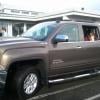
I just purchased a 2005 Sierrra 1500. It's got 4x4 with torsion bars on the front and 1500lb (stock?) springs on the back. I just put new Monroe 911502 on the back, but it didn't improve things so far (unrelated, they had to be replaced).

The ride quality is sub-par. It feels very sturdy but I get this weird feedback you usually associate with a really heavy duty truck. Every bump resonates through the truck and I want to eliminate the ride height as the problem. To me, it looks like the lower control arm is sitting on the rubber bump stop. Do I need to tighten the torsion bar up?

I don't intend to haul or tow, so a more comfortable ride is more important to me.

Pictures attached.

2.jpg

3.jpg

4.jpg


1.jpg

Posted

With it being a 05 those torsion bars are tired as I see its sitting on the bump stop pretty hard, I would jack the front up with the wheels off the ground and crank each bar about 3-4 complete even turns (soak those adjusting bolts down with some WD-40 first) drop it back down and go for a ride, you might need to get new torsion bars as they are pretty weak. You should have about 1/4" gap in-between the bump stop and the A-arm for a stock truck. I would also invest in some front shocks also by the looks at them there gone too.

Posted

The ride height needs to be adjusted to a specific spec. If it is not adjusted properly, it will shorten the life of your front end bushings. The previous owner probably tried to "lower" the vehicle by adjusting them. As for the resonating bumps, check your tire pressure and front hub bearings. As for your front shocks, they can only be evaluated visually if there are signs of oil leaking out of them. There are specific tests you can perform to check the chocks. Do you have 4 ply or 10 ply tires? How much oil are you using? Its looks like some pretty serious leaks. 

Posted
15 hours ago, Silverado4x4 said:

With it being a 05 those torsion bars are tired as I see its sitting on the bump stop pretty hard, I would jack the front up with the wheels off the ground and crank each bar about 3-4 complete even turns (soak those adjusting bolts down with some WD-40 first) drop it back down and go for a ride, you might need to get new torsion bars as they are pretty weak. You should have about 1/4" gap in-between the bump stop and the A-arm for a stock truck. I would also invest in some front shocks also by the looks at them there gone too.

I will do some testing with adjustments.  Thanks for the suggestions.


13 hours ago, starman8tdc said:

The ride height needs to be adjusted to a specific spec. If it is not adjusted properly, it will shorten the life of your front end bushings. The previous owner probably tried to "lower" the vehicle by adjusting them. As for the resonating bumps, check your tire pressure and front hub bearings. As for your front shocks, they can only be evaluated visually if there are signs of oil leaking out of them. There are specific tests you can perform to check the chocks. Do you have 4 ply or 10 ply tires? How much oil are you using? Its looks like some pretty serious leaks. 

Tire pressure is 38 PSI.  I am actually replacing a hub bearing tomorrow for a bad wheel speed ring.


Tires are 3 ply I guess.  They are Yokohama GEOLANDAR H/T G056 P275/65/R18 114T


Oil is good.  No leaks, that oil you see is from an oil change accident.  I missed the old gasket and it blew off when I started the truck :P


I'm actually going to swap my tires with my new Michelin LTX M/S's I have on my van.  They ride REALLY nice.

Posted

I went ahead and increased the adjustment by 4 full turns.  The bottom bump stop is now about 1/3-1/2" away from the lower control arm.  I did a test drive and it might feel a tiny bit better but at least I can rule out this.  Next up are shocks and whatever else might need replacing.  


I couldn't swap tires because as it turns out I have 15's on my van, haha.  I thought I had 18's.


For some reason, a previous owner also swapped out the OEM rims for larger rims.  Stock size are 17's and there are 18's on there.  When I do eventually get tires, I might go back to stock.

Posted
4 hours ago, Smoot178 said:

I will do some testing with adjustments.  Thanks for the suggestions.


Tire pressure is 38 PSI.  I am actually replacing a hub bearing tomorrow for a bad wheel speed ring.


Tires are 3 ply I guess.  They are Yokohama GEOLANDAR H/T G056 P275/65/R18 114T


Oil is good.  No leaks, that oil you see is from an oil change accident.  I missed the old gasket and it blew off when I started the truck :P


I'm actually going to swap my tires with my new Michelin LTX M/S's I have on my van.  They ride REALLY nice.


   Isn't the speed ring on the CV axle, rather than the hub? Try dropping your tire pressure to 30 PSI to see if improves the fell of the suspension. 


Posted
49 minutes ago, starman8tdc said:


   Isn't the speed ring on the CV axle, rather than the hub? Try dropping your tire pressure to 30 PSI to see if improves the fell of the suspension. 


I'm pretty sure it's in this thing:


https://www.amazon.com/gp/product/B001EGT3I4/ref=oh_aui_detailpage_o01_s00?ie=UTF8&psc=1


The CV axle does slip into it... but the ring is in the greased area of the bearing.


Quote

Each front wheel is equipped with a speed sensor, which is mounted on each front hub and wheel bearing assembly. A toothed sensor ring is integral with the bearing; if it becomes damaged, the entire hub/wheel bearing assembly must be replaced.

Posted

PB Blaster on those bolts overnight and again the next day and turn with a long wrench or cheater bar very very carefully, if I remember right 4 turns right is an inch of height, wheels must be off the ground.  Those bolts are prone to breaking if they haven't been moved in a while or old ask me how I know lol.  I would do 2 turns evenly each side drop it down measure floor to middle of inner fender and adjust again as needed.


EDIT- missed the post where you already did it but yea lmao

Posted
4 hours ago, SarahsGMC said:

PB Blaster on those bolts overnight and again the next day and turn with a long wrench or cheater bar very very carefully, if I remember right 4 turns right is an inch of height, wheels must be off the ground.  Those bolts are prone to breaking if they haven't been moved in a while or old ask me how I know lol.  I would do 2 turns evenly each side drop it down measure floor to middle of inner fender and adjust again as needed.


EDIT- missed the post where you already did it but yea lmao

Thanks for the tips.  That's exactly what I did and it went pretty good.  


Bringing the tires down to 30 PSI did nothing or made it worse.  It rides worse than the back seat of an unloaded F350.

Posted
10 hours ago, Smoot178 said:

For some reason, a previous owner also swapped out the OEM rims for larger rims.  Stock size are 17's and there are 18's on there.  When I do eventually get tires, I might go back to stock.


    Increasing the rim size will drastically effect the ride comfort. 


Archived

This topic is now archived and is closed to further replies.

  • Latest Articles

  • Posts

    • Most thermostatically controlled ATF systems use a 'wax' pill just like the one in your water thermostat. They work on the expansion volume of the wax and the pill is constructed in such a way as to limit the travel to remain within that range. This means it has an opening temperature often called the 'cracking temperature' and a fully open temperature. For whatever reason oil is designated by it's fully open temperature and water by it's cracking temperature.    Between the two it the "Regulating Temperature" The entire range is about 20 F from closed to open. In your example the lower limit, opening point of 145 F then has a fully open temp of 165 F and a throttling temperature of 155 F.    Thing is, the throttling temperature needs two things to work properly. Enough system load high enough to reach the minimum and a heat sink (cooler/exchanger) large enough to prevent any load applied from exceeding the fully open temperature.    If your system exceeds the fully open temperature it is screaming MORE COOLER.    Here is the silly part of the whole thermostat system where the oil is cooled/heated by the radiator. Nothing is flowing to that system until the oil temperature reaches the cracking temperature unless it is equipped with a minimum flow bypass orifice or a bypass built into the seating surface of the plunger. That system meant to get it up to temp quicker isn't doing a thing until WORK drives if from ambient to cracking temp. One a cold winter day, like zero F, it may never get hotter than about 110 F. Sometimes not even that.    People forget or are young enough to not know that until this millennia transmissions were cooled by the radiator cold tank alone and without a thermostat at all.  In the 50's they weren't even cooled. OEMs learn everything the hard way.    When an OEM tells you the trans "Works best" between 175 F and 220 F it means works best for THEM. The transmission thermostat is fuel play. If you watch you trans temps like I do you will learn that it may take a hundred miles if you are not towing and not driving more than say 55-60 mph on a zero F day to even reach 120 F and it might sit there all day if it's colder. Yet if functions perfectly over about 100 F. It may need to get a bit warmer for the fuel and spark maps to go without an multiplier.    Worry more about too hot. Use a cooler large enough to put that thermostat in range.         
    • Around 2008 if memory serves they took sulfur out. That was when diesel went up. 
    • Question for you Grumpy, why is diesel so much more than gasoline? Seems to me that it may be slightly a little less refined than gas and it doesn't have 10% alcohol which presumably lowers the price of gas
    • Thanks, so being a different beast altogether, anyone know what the "optimal" temp is for the 10L80/90 for proper shifting?
    • How many years have I pointed out every point in that link to the folks here and been avalanched with criticisms and outright hostilities at times? I ran counter to even the great CUSTOMBOSS and Lake Speed Jr and the half dozen experts on YouTube and in the final.....GM, Physics (Stribeck) backs that Grumpy old Bear.    Honestly, I never said a thing engineering hadn't studied silly and laid in concrete during WWII. But I'm old, the information is old and yet, the Laws of Physics are eternal.    Okay there is one exception. I vehemently disagree with their use of the word 'tolerances' when what it meant is "clearance".   The clearance is the distance between two objects. The tolerance is the degree of acceptable variation permitted in that clearance. I.E., piston to bore clearance is 0.004" with a tolerance of +/- .0002" so the clearance is in specification if it lies between 0.0038" and 0.0042". Cutting that 'tolerance in half has ZERO impact on lubrication requirements. Makes for more difficulty in manufacturing.  But a tighter clearance 'MAY'. Depends on finish. Anyway....   It's one of those statements made by people to make themselves look smarter than they are to convince people who are as un-enlighten as they seem to manipulate their behaviors. But hey, the blind leading the blind puts them both in the pit. 
  • GM-Trucks.com Clubs

  • Popular Contributors

×
×
  • Create New...