
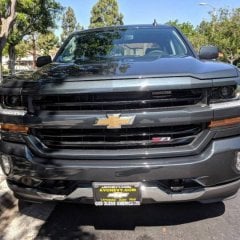
2007 Silverado 6th cylinder crashed, have 2018 Silverado now...
-
Recently Browsing 0 members
- No registered users viewing this page.
-
Forum Statistics
250.4k
Total Topics2.7m
Total Posts -
Member Statistics
342,765
Total Members8,960
Most Online
-
Latest Articles
-
Posts
-
 I would have to read back to get a better picture in my mind of some of the other comments and what they were using for a driving scenario they based the fuel mileage off of. That is why the fuel mileage conversation is extremely difficult to make fair comparisons from. If I was to be living in town and only driving around town, light to light and some longer stretches that doesn't have a light every block, and the usual stop at a grocery store and the bank and so on and so forth, my fuel mileage even during the summer time would be so bad with my truck I don't even want to know how bad it would be !. Then add in winter time and idling to warm it up to clear the windows and driving through snowy streets etc, large heavy trucks with gas engines have NEVER been worth crap for fuel mileage and why some little pot licker of a car with wheelbarrow tires and a 1300 cc four cylinder non turbo engine was the ticket to using a mere fraction of the fuel over a full size pickup. By the way my truck has the 34" tires as its a HC but not the BFG KO3 tires ( that was an option for my truck but the sales guy couldn't figure out what the tires actually were so that never got on the order until it was too late to change the truck order ). So what fuel mileage your getting actually sounds good for "town driving" and with my truck when I go to town the fuel mileage keeps increasing as I get closer to town because it takes quite a while to get the driveline oils warmed up ( and why it always shows better fuel mileage on the return trip from town because its already warmed up ) but once I am in town that fuel mileage average just keeps dropping the more I mess around town and then has to recover back to something reasonable again by the time I get home for an over all average. I'd be curious what your sticker says for the factory weight of your truck, mine is close around that 7700 lb due to the options it has. But anyway the long and short is, vehicle weight, higher rolling resistance heavy tires and a hefty driveline and a relatively large gas engine make for crap fuel mileage in stop and go scenarios, all one can do is drive it easy off the line at each stop and as my dad had said over the years, drive like a raw egg is under your foot and that's the best one can do. Years back with a carbed engine and if the carb was getting a bit out of tune etc as would the ignition system, the fuel mileage on pickups with larger engines was just awful compared to what your getting. We pay the fuel price penalty for driving HD trucks over some little vehicle, that is the reality.
 -

-
 We had two Toyota’s with that engine in the mid 80s. We had 50 gallon fuel tanks, a toolbox full of tools, an air compressor and assorted parts for our equipment. We beat those up and down pipeline ROWs until we started buying diesel trucks. Then they became parts runners and first vehicles for our teenagers first cars. Our shop Forman wrecked them both two years apart when we hired him out of high school as an apprentice. Good thing he’s an excellent mechanic. It took awhile before he could be called a good driver.
 -
-
By William Aldrich · Posted
I have a 2025 GMC Canyon Denali. On a trip recently the engine failed. The dealership diagnosed a bent valve and says there is a service bulletin that indicates to 'relace the engine'. The truck only has about 14K miles and is under warranty. The failure occurred 5/11/2026. So far I have worked with GM Customer Assistance and Roadside Assistance. Evidently no engines are available and nobody will offer a date when a new one will be. Coming up on two months with no repair or timeline and no loaner from the dealership. GMC Customer Assistance is 'ghosting' me and keeps closing the cases I've opened with no resolution. Hoping someone can help me on how to escalate this issue.
-
-
GM-Trucks.com Clubs
-

Black Truck Club
Open Club · 612 members
-

White Truck Club
Open Club · 380 members
-

Canadian Owners Club
Open Club · 282 members
-

Red Truck Club
Open Club · 156 members
-

diesel 3.0
Open Club · 279 members
-

Texas Owner's Group
Open Club · 371 members
-

NorthSky Blue Club
Open Club · 118 members
-

Midwest Owner's Group
Open Club · 212 members
-

2015 Custom Sport Club
Open Club · 5 members
-

GM Snow Plowing Club HD
Closed Club · 14 members
-
-
Popular Contributors
-



.thumb.JPG.2c573de60d3a3a4407c7d92298db46dd.JPG)
Recommended Posts
Create an account or sign in to comment
You need to be a member in order to leave a comment
Create an account
Sign up for a new account in our community. It's easy!
Register a new accountSign in
Already have an account? Sign in here.
Sign In Now