Jump to content

Recommended Posts

Posted (edited)

Please help me not buy a new Raptor. lol I've been searching forums for several weeks trying to read up on what might work best for my case. I live a little over half a mile down a county gravel road off of a rural paved highway. I'm sure it sounds like a trivial complaint, but this small stretch of gravel sits between fields at the base of the hills... Rainwater from the hills is supposed to go down the ditches on each side. Doesn't always work the best with heavy rain and for some odd reason there's a ridiculous amount of traffic that chooses to take the first gravel road outside of the small town on their way to where ever they are going in the hills or bypassing the town for whatever reason.. These people are apparently content to beat the fricking crud out of their vehicles as opposed to going down the highway and taking the gravel road that is shortest to where they are going. Sorry, I'll stop griping. Anyway the road gets to where it is nothing but holes and washboards from start to finish. It's to the point that I take the back way in (which is also gravel, but much better) that is like 3 miles out of my way to avoid it when I have time and it's bad. It sucks 90% of the time. They grade it, and it's good for a couple days. My 2017 Sierra SLT CC Z71 4x4 has around 80k miles now, and I'm sure the crummy stock Ranchos are toast by now. Hard to tell, they're never been great since new. I do have a leveling kit, so I'm sure that's not helping. I have a 2016 F150 Lariat CC 4x4 as a work truck that rides light years better down the same road and even on the highway.


So..... I think I want to go to a coilover setup that will provide at least 3" of lift in the front and Cognito UCA's with a diff drop if necessary, rear shocks, and whatever block needed to set the truck exactly level. I hate rake and never tow anything heavy with this truck or have anything heavy in the bed. I don't do any hardcore offroading so which coilovers would provide the smoothest ride? I'm looking for the smoothest highway manners and something that won't beat the truck to pieces on my stupid road. Would this be the Stage 1 Icons? And do you think this setup would work better or a small bracket/spindle lift setup of some sort? Either way, I want good UCA's. The stamped steel ones seem like a terrible design to me and don't last long from what I have read. I'm also considering rigging up some type of box over my rear axle to add weight to.


Edited by Narfengarbler
Posted

I have the bds fox coilovers and they feel pretty good but not as a good as a raptor.  I'm sure if I added deaver style leafs instead of the heavy duty ones it would run much better but I'd lose most of my towing ability.  

Posted

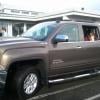
I have this lift kit from Halolifts, they source them from Elka. Went from Magneride to it and it was MUCH better on the gravel road to my in-laws house. The first set lasted me 80k miles. The fronts are adjustable, but max out at 3" so it would be at the low end for what you want. For $1500 it struck a nice balance between affordable, yet high quality. Below are pics of my truck's stance after installing the kit. Keep in mind I set the fronts at 2.5". Another .5" and it would be very close to level. I am not a fan of the factory rake, but want a slight rake because I haul my ATV in the bed (hate a sagging rear end when hauling/towing).


Also, I just installed the Cognito UCAs and they are amazing. You'll have to cut the bump stop out and do a little trimming of one side so the UCAs don't hit the coilover frame.


https://halolifts.com/shop/drivetrain/2wd/halolifts-boss-aluma-ultimate-kit-gm-chevy-2007-2022/


Truck 1.jpg

Truck 2.jpg

Truck 3.jpg

Posted

I'm attempting to educate myself and decided to start this thread to get some real world experiences with the different brands. Thank you so much for the info. So far, I'm attempting to understand the differences between digressive, linear, and progressive valving and how each behaves in certain conditions. I haven't had time to contact the different mfgs to talk with them about what they use and how they are tuned, but do plan on doing so before I buy. I mentioned ICON's earlier, but have been reading that they use digressive valving which might be quite harsh in my situation. I've seen the same for the Bilstein 5100's, so that may account for how many people describe the ride after install. This would be great for handling, but not the most plush on small things. I'm assuming this would lead to more road feedback from the small stuff. Most people are talking about them in comparison to the stock Z71 Ranchos tho, and my stockers all around sucked in my opinion. I have no idea what type of valving they use. At the moment anyway, I think progressive valving may work best for what I'm trying to achieve. I'm not overly concerned with handling, towing, or payload capacity. I am looking for the most "cushy" ride to minimize the beating that my truck takes under normal rough gravel road conditions. A less jarring ride on rough pavement would be a huge bonus as well. I'm leaning towards talking with Accutune with what I'm trying to accomplish to see what they think. Here's some info about the different valving that I hope can help others that may find this thread as well.. I'm sure spring rates greatly affect this as well, but I'm just beginning to do some research on that.


https://accutuneoffroad.com/articles/digressive-vs-linear-vs-progressive-pistons-shock-valving/

Posted

Ok, I thought I would update this. I ended up removing the front anti-sway bar. I had read about this on different vehicles for off road. It made seemed to make sense as the bumps and holes on one side seemed to violently drop or raise the whole side of the truck that it occurred on. I would assume a properly working IFS would allow articulation of each wheel. That didn't seem to be happening very well. From what I read, the coil springs are fairly heavy on these trucks, and that should allow fairly good stability controlling body roll. I'm now over a month into it being removed and can report that it is light-years better. I really wasn't expecting much improvement, and I anticipated at least some less stability on the highway. What I got is a truck that now rides level and smoothly over some pretty awful stuff, and I can honestly say that I have noticed no additional body roll under any of the driving conditions I have experienced. I have tried some mock emergency braking and swerving to ensure that it wouldn't be way out of hand, and so far so good. I can't say that this would be what you want if you tow heavy or have a high centered heavy payload in the bed since I don't do either with this truck, and haven't tested that, but as far as fixing the riding like crap offroad or on really rough gravel or dirt roads, it did that. I am still looking at getting some Fox coilovers and UCA's, but now just as an upgrade to older components. It truly rides amazing now, and I'm actually pleasantly shocked. 1999-2006 rear leaf springs supposedly will bolt up and are 1500lb springs instead of 1900lb, so I might swap them too if they are truly interchangeable. Some soft (actual) ranchos and a softer spring in the rear was recommended to me as a nice improvement as well. I can totally live with it as is right now tho. I am no longer getting myself and the whole truck beat to pieces.

  • Thanks 1

Create an account or sign in to comment

You need to be a member in order to leave a comment

Create an account

Sign up for a new account in our community. It's easy!

Register a new account

Sign in

Already have an account? Sign in here.

Sign In Now
  • Latest Articles

  • Posts

    • Most thermostatically controlled ATF systems use a 'wax' pill just like the one in your water thermostat. They work on the expansion volume of the wax and the pill is constructed in such a way as to limit the travel to remain within that range. This means it has an opening temperature often called the 'cracking temperature' and a fully open temperature. For whatever reason oil is designated by it's fully open temperature and water by it's cracking temperature.    Between the two it the "Regulating Temperature" The entire range is about 20 F from closed to open. In your example the lower limit, opening point of 145 F then has a fully open temp of 165 F and a throttling temperature of 155 F.    Thing is, the throttling temperature needs two things to work properly. Enough system load high enough to reach the minimum and a heat sink (cooler/exchanger) large enough to prevent any load applied from exceeding the fully open temperature.    If your system exceeds the fully open temperature it is screaming MORE COOLER.    Here is the silly part of the whole thermostat system where the oil is cooled/heated by the radiator. Nothing is flowing to that system until the oil temperature reaches the cracking temperature unless it is equipped with a minimum flow bypass orifice or a bypass built into the seating surface of the plunger. That system meant to get it up to temp quicker isn't doing a thing until WORK drives if from ambient to cracking temp. One a cold winter day, like zero F, it may never get hotter than about 110 F. Sometimes not even that.    People forget or are young enough to not know that until this millennia transmissions were cooled by the radiator cold tank alone and without a thermostat at all.  In the 50's they weren't even cooled. OEMs learn everything the hard way.    When an OEM tells you the trans "Works best" between 175 F and 220 F it means works best for THEM. The transmission thermostat is fuel play. If you watch you trans temps like I do you will learn that it may take a hundred miles if you are not towing and not driving more than say 55-60 mph on a zero F day to even reach 120 F and it might sit there all day if it's colder. Yet if functions perfectly over about 100 F. It may need to get a bit warmer for the fuel and spark maps to go without an multiplier.    Worry more about too hot. Use a cooler large enough to put that thermostat in range.         
    • Around 2008 if memory serves they took sulfur out. That was when diesel went up. 
    • Question for you Grumpy, why is diesel so much more than gasoline? Seems to me that it may be slightly a little less refined than gas and it doesn't have 10% alcohol which presumably lowers the price of gas
    • Thanks, so being a different beast altogether, anyone know what the "optimal" temp is for the 10L80/90 for proper shifting?
    • How many years have I pointed out every point in that link to the folks here and been avalanched with criticisms and outright hostilities at times? I ran counter to even the great CUSTOMBOSS and Lake Speed Jr and the half dozen experts on YouTube and in the final.....GM, Physics (Stribeck) backs that Grumpy old Bear.    Honestly, I never said a thing engineering hadn't studied silly and laid in concrete during WWII. But I'm old, the information is old and yet, the Laws of Physics are eternal.    Okay there is one exception. I vehemently disagree with their use of the word 'tolerances' when what it meant is "clearance".   The clearance is the distance between two objects. The tolerance is the degree of acceptable variation permitted in that clearance. I.E., piston to bore clearance is 0.004" with a tolerance of +/- .0002" so the clearance is in specification if it lies between 0.0038" and 0.0042". Cutting that 'tolerance in half has ZERO impact on lubrication requirements. Makes for more difficulty in manufacturing.  But a tighter clearance 'MAY'. Depends on finish. Anyway....   It's one of those statements made by people to make themselves look smarter than they are to convince people who are as un-enlighten as they seem to manipulate their behaviors. But hey, the blind leading the blind puts them both in the pit. 
  • GM-Trucks.com Clubs

  • Popular Contributors

×
×
  • Create New...